腾讯混元大模型

Search documents
——光研之声2026年4月联合月报:市场的三个潜在拐点-20260330
EBSCN· 2026-03-30 11:48
Current Strategy Viewpoints - The market experienced significant volatility in March, primarily influenced by external uncertainties, particularly the US-Iran conflict, which affected global capital markets and led to noticeable adjustments in Chinese assets [1] - Despite the adjustments, market liquidity remained stable, indicating resilience in the trading structure, with current market corrections reflecting a certain degree of overseas risk impact [1] Potential Market Turning Points - Potential turning points in April may arise from three directions: 1. Better-than-expected performance from listed companies, with improvements anticipated in overall earnings, particularly in technology and cyclical sectors [2] 2. Continued support for medium- to long-term capital inflows into the market, which may be triggered by previous market corrections [2] 3. Easing of external risk factors, which could serve as a direct catalyst for market upward momentum, although predictability remains low [2] Sector Recommendations - Focus on sectors that have previously experienced significant declines, those benefiting from rising commodity prices, and industries likely to exceed performance expectations [3] - Recommended sectors include resources, essential consumption, hard technology, and government investment-related areas, with particular attention to high-growth industries in annual and quarterly reports, mainly in resources and technology [3] Macro Perspective - The report highlights a structural advantage for Chinese exports amid high global energy prices, which may drive orders back to China, as seen in previous years [9] - The first quarter economic data is expected to show slight year-on-year declines due to high base effects, but underlying economic momentum is recovering, supported by investment policies and signs of recovery in major real estate markets [9] Financial Engineering - The A-share market has shown wide fluctuations since March, with a cautious risk appetite among leveraged funds, indicating a potential continuation of "high-low cut" trading strategies [13] - The report notes a divergence in market sentiment, with some sectors experiencing increased crowding, particularly in transportation, construction, and utilities [13] Fixed Income Market - The bond market's future trajectory will depend on marginal changes in economic fundamentals and monetary policy, with expectations of potential easing measures earlier than anticipated [15][16] - The report suggests that inflation's impact on bond yields will be limited, with temporary pressures manageable and unlikely to push yields significantly above current levels [16] Industry Insights - The report emphasizes the importance of the AI sector, particularly in the context of the GTC conference, where advancements in AI technology are expected to drive significant demand and investment opportunities [20][24] - The renewable energy sector is highlighted for its growth potential, particularly in light of geopolitical tensions affecting energy security, with significant increases in exports of solar inverters and electric vehicles [28][29] High-End Manufacturing - The report identifies key opportunities in high-end manufacturing, particularly in robotics and the North American AI supply chain, with significant developments expected in production capabilities and market demand [32][34] - Recommendations include focusing on companies involved in advanced robotics, AI-driven technologies, and mining machinery, which are poised to benefit from increased capital expenditures in these areas [34] Mechanical Manufacturing - The report notes a rise in demand for data center equipment driven by increased power needs, with significant growth in related sectors such as generators and cooling systems [38] - The focus on controlled nuclear fusion and low-altitude economy is expected to create investment opportunities in infrastructure and equipment manufacturing [39]


用AI清退全部外包?网易回应;百度挖DeepSeek核心人才入职;曝宇树对外称弹性双休,内部是另一套规则,非常卷|AI周报
AI前线· 2026-03-22 05:33
Group 1 - DeepSeek core talent has joined Baidu, but it is not the rumored Guo Daye, raising industry speculation [3][4] - Baidu's internal personnel changes include the departure of Zhao Shiqi and the appointment of He Jingzhou as the head of the new Baidu APP R&D Center [4][5] - Tencent has dissolved its AI Lab, reallocating personnel to the large language model department and the industry-academia-research cooperation center [6] Group 2 - A programmer from Yushun Technology claims that the company promotes flexible working hours externally, but internally maintains a demanding work culture [7][8] - Yushun Technology has filed for an IPO on the STAR Market, aiming to raise 4.202 billion yuan [9] - NetEase responded to rumors of "AI layoffs of all outsourced employees," stating that recent personnel changes are part of normal business adjustments [10][11] Group 3 - A man was detained for spreading false rumors about iFlytek planning to lay off 30% of its workforce [12][13] - Cheetah Mobile's chairman, Fu Sheng, publicly criticized Qihoo 360's founder Zhou Hongyi over a debt dispute [14] - Cursor's new model faced accusations of being a rebranded version of Kimi K2.5, which the company later acknowledged [15][17] Group 4 - Major layoffs in the tech industry include Dell announcing a 10% workforce reduction, affecting approximately 11,000 employees, with severance costs around 5.69 billion USD [21][22] - Japan's Rakuten AI 3.0 was criticized for allegedly copying the architecture of China's DeepSeek V3, leading to public backlash [23][24][25] - OpenAI plans to acquire the startup Astral to enhance its Codex project, expanding its developer service tools [26][27] Group 5 - Alibaba has established a new business unit, Alibaba Token Hub, to consolidate its AI services and development efforts [28][29] - AI computing and storage product prices have increased by 5%-34% due to rising demand and supply chain costs [30] - ByteDance's "Doubao AI glasses" production plans have been delayed, with a focus on ensuring product differentiation [31]






申万宏源证券晨会报告-20260316
Shenwan Hongyuan Securities· 2026-03-16 01:09
Group 1 - The report indicates that the current market is transitioning from the first phase of an upward trend to a consolidation phase, which is expected to last for a quarter, serving as a preparation period for the second phase of the upward trend [8][10][12] - The A-share market is showing resilience amid geopolitical tensions, with a shift in asset pricing dynamics reflecting China's proactive stance in the face of external shocks [8][10][12] - The report emphasizes the importance of capital market support for asset allocation migration across various sectors in China, highlighting the need for diversified resident asset allocation and resource optimization [8][10][12] Group 2 - The macroeconomic outlook suggests that inflation is expected to rise, benefiting traditional cyclical resources, with a focus on sectors such as steel, coal, construction, chemicals, and power equipment [11][12][13] - The report notes that the current inflationary environment is leading to a recovery in corporate earnings, particularly in cyclical sectors, as the A-share market enters a replenishment phase [11][12][13] - The analysis of the global economic landscape indicates that geopolitical risks and inflationary pressures are likely to influence market dynamics, with a focus on the implications for energy and resource sectors [12][13][14] Group 3 - The report highlights the potential for investment opportunities in the AI sector, emphasizing the need to embrace inflation assets and the structural changes brought about by AI advancements [18][19] - It discusses the impact of geopolitical conflicts on global asset prices, suggesting that the current market is experiencing significant volatility and differentiation due to these tensions [18][19] - The report also points out that the A-share market is expected to attract foreign capital due to its relative stability and the ongoing structural adjustments in the economy [18][19]
腾讯控股(00700):深度之三:AI时代核心受益者,超级入口与生态壁垒的再进化(腾讯控股深度之三)
Shenwan Hongyuan Securities· 2026-03-13 13:50
Investment Rating - The report maintains a "Buy" rating for Tencent Holdings [1][10] Core Insights - Tencent is positioned as a core beneficiary in the AI era, leveraging its super entrance and ecological barriers for further evolution [7] - The company has a solid financial foundation and core scenarios that support its AI strategy, indicating strong potential for latecomers [9][12] - Tencent's AI capabilities are being enhanced through organizational restructuring and the recruitment of top talent, improving the efficiency of AI research and commercialization [9][40] - The company has established a leading position in 3D and image generation capabilities within the industry [9][40] - The ecological value of Tencent's AI will be amplified in the Agent era, with significant impacts on existing business lines such as advertising and gaming [9][12] Financial Data and Profit Forecast - Revenue projections for Tencent are as follows: - 2023: 609 billion - 2024: 660 billion - 2025E: 755.6 billion - 2026E: 848.8 billion - 2027E: 929.9 billion - Year-on-year growth rates are projected at 9.8% for 2023, 8.4% for 2024, 14.4% for 2025, 12.3% for 2026, and 9.6% for 2027 [8] - Adjusted net profit forecasts are: - 2023: 157.7 billion - 2024: 222.7 billion - 2025: 260.2 billion - 2026: 296.9 billion - 2027: 337.1 billion - Year-on-year growth rates for adjusted net profit are 36.4% for 2023, 41.2% for 2024, 16.9% for 2025, 14.1% for 2026, and 13.5% for 2027 [8] Valuation and Target Price - The overall target valuation for Tencent is set at 61,412 billion RMB, corresponding to a target price of 765 HKD per share, indicating a potential upside of 40% from the closing price on March 12, 2026 [10][12]
中国人工智能,这样揭幕“十五五”开局之年
第一财经· 2026-03-10 12:02
Core Insights - The article highlights the rapid development of AI in China, particularly in 2026, which is expected to be a significant year for the industry, with the AI-related industry scale projected to reach 10 trillion yuan by the end of the 14th Five-Year Plan [3][25]. - The competition among Chinese companies in the AI sector is intensifying, with a focus on improving research and development efficiency rather than merely increasing financial resources [26]. Industry Developments - The compatibility of domestic chips with large models like DeepSeek is under close scrutiny, with recent reports indicating successful adaptations [4]. - The trade tensions between China and the U.S. have unified domestic AI companies in their pursuit of technological breakthroughs and a thriving industrial ecosystem [5]. - Chinese chip manufacturers have made significant strides, with companies like Moore Threads achieving end-to-end deployment of large models, marking a breakthrough in domestic chip capabilities [6][9]. Product Innovations - Major advancements in AI models have been observed, such as ByteDance's Seedance2.0 and MiniMax's M2.5, which have shown impressive performance in various applications [11][12]. - The cost-effectiveness of Chinese AI models is highlighted, with MiniMax's M2.5 model operating at a low cost of $1 for an hour of continuous work, significantly enhancing economic feasibility for users [13]. - The rapid iteration of models and products is a key feature of the industry, with companies like MiniMax and Moore Threads planning to release new architectures and chips regularly [8][9]. Market Competition - The competition for user engagement in the AI sector is fierce, with companies like Doubao and Qianwen experiencing significant user growth during the Spring Festival, indicating a robust C-end market [19][20]. - The article notes that the competition among leading AI applications is just beginning, with major players like Alibaba, ByteDance, and Tencent vying for market share [21][22]. Future Outlook - The integration of AI with the physical economy is seen as the next wave of innovation, with potential for a trillion-level market [24]. - The emphasis on speed and efficiency in AI development is crucial for maintaining competitiveness in the global landscape [25][26].

B站,巨头眼里的香饽饽
虎嗅APP· 2026-03-10 00:37
Core Viewpoint - Bilibili (B站) has demonstrated its ability to achieve profitability for the first time in 2025, with a revenue of 30.35 billion and a net profit of 1.19 billion, despite a subsequent drop in stock price after the announcement, illustrating the market's tendency to sell on news rather than rumors [5][6]. Revenue Growth - In 2025, Bilibili's total revenue reached 30.35 billion, marking a year-on-year growth of 13.1%. The revenue breakdown includes value-added services at 11.93 billion (up 8.5%), advertising at 10.06 billion (up 22.8%), mobile games at 6.39 billion (up 14%), and IP derivatives at 1.97 billion (down 3.3%) [10][12]. - Over the past decade, Bilibili's revenue has increased 231 times, with significant contributions from mobile games, value-added services, and advertising [9]. User Engagement - Bilibili boasts over 100 million daily active users, with an average viewing time exceeding 100 minutes and 34 million monthly paying users, indicating strong user engagement and monetization potential [6]. Advertising Business - The advertising revenue is a significant contributor, with a growth of 18.7 billion in 2025, accounting for 53.2% of total revenue. The top five advertising sectors include gaming, digital appliances, online services, e-commerce, and automotive, aligning well with Bilibili's user demographics [12][22]. Profitability Path - Bilibili's gross profit margin has been on a steady rise since Q3 2022, reaching a plateau in 2025, with a gross profit margin of 37% by Q4 2025. The company has focused on increasing the proportion of advertising revenue and achieving economies of scale to improve profitability [24][25][28]. - The company has effectively controlled costs, with total expenses in 2025 precisely at 99.9 billion, indicating a strategic approach to maintaining profitability [32]. Cash Flow and Financial Health - Bilibili's operating cash flow turned positive in 2023, with net cash flows of 6 billion and 7.1 billion in 2024 and 2025, respectively, representing 22.4% and 23.6% of annual revenue [36]. - As of the end of 2025, Bilibili's current assets totaled 27.55 billion, with liquid assets comprising 18.63 billion, indicating a strong liquidity position [39]. Acquisition Resistance - Bilibili's dual-class share structure, with the founder holding significant voting power, reduces the likelihood of hostile takeovers, despite the company's newfound profitability making it an attractive target for larger firms [41][43].


元宝自己也承认,它确实存在差距!!
Xin Lang Cai Jing· 2026-02-05 09:58
Group 1: Overall Strategy and Competitive Landscape - The core viewpoint is that the true winners in AI will be companies that deeply integrate technology with their core business, rather than those that merely focus on model performance [2][3] - Tencent's AI strategy emphasizes practical application over merely achieving top rankings in model evaluations, leveraging its extensive ecosystem of services like WeChat, QQ, and gaming [2][3] - Tencent's significant investment in AI is not just to catch up with leading models but to solidify and expand its ecosystem advantages, ensuring its vast user base operates on a self-controlled and efficient technological foundation [4][5] Group 2: Core Advantages and Specific Capabilities - Tencent's unique advantages lie in its vast ecosystem, which includes over 1.4 billion combined monthly active accounts across WeChat and QQ, providing an unparalleled testing ground for AI applications [8][9] - The company's pragmatic approach focuses on enhancing user experience and business efficiency through AI, ensuring that technology serves measurable commercial value [8][9] - Tencent's strong cash flow from established businesses allows for substantial long-term investments in AI without compromising overall financial health [9][10] Group 3: Future Outlook and Key Decisions - The necessity for strategic autonomy in AI development is highlighted, as reliance on external models could jeopardize Tencent's core business profits and influence [14][15] - Tencent's path in AI involves a focus on specialized chips that cater to its specific business needs, which is seen as a long-term competitive strategy [12][13] - The competition in AI is characterized as a marathon, requiring a balance of strategic patience and rapid iteration in application ecosystems [6][7]
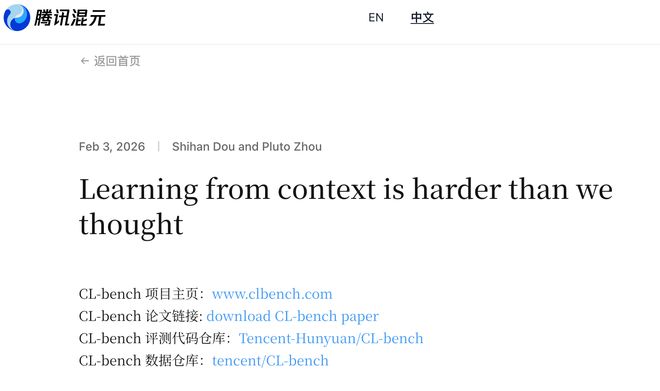
担任腾讯首席AI科学家后,姚顺雨带领团队揭晓首个研究成果
Nan Fang Du Shi Bao· 2026-02-03 15:35
Core Insights - Tencent's first research outcome under Chief AI Scientist Yao Shunyu has been revealed, focusing on the challenges of learning from context in AI models [1][6] - The competitive landscape is shifting from improving model training to providing rich and relevant context for tasks [1][7] Group 1: Research Findings - The joint research by Tencent's Mixyuan team and Fudan University highlights that enabling large models to learn from context is more challenging than previously thought [6][7] - A benchmark called CL-bench was created to assess language models' ability to learn new knowledge from context, consisting of 500 complex contexts, 1,899 tasks, and 31,607 validation standards [7] - The top ten language models achieved an average task-solving rate of only 17.2% on CL-bench, indicating significant shortcomings in utilizing context effectively [7] Group 2: Future Directions - The research suggests that enhancing models' ability to learn from context could be a key direction for future iterations of large language models [7] - The role of humans in AI systems may evolve from being primary data providers to context providers as models improve their contextual learning capabilities [7] - Memory mechanisms in models are expected to become a core theme in the development of large models by 2026, potentially leading to autonomous learning capabilities [7]
腾讯姚顺雨团队发布署名论文,让模型“上下文学习”真正走向现实
Yang Zi Wan Bao Wang· 2026-02-03 15:09
Core Insights - The article discusses the challenges faced by current language models in learning from context, highlighting that even the strongest models struggle with this capability [1][2][3] Group 1: Research Findings - Tencent's research team, in collaboration with Fudan University, emphasizes that enabling large models to learn from context is more difficult than previously thought [2][3] - The team developed CL-bench, a benchmark designed to evaluate whether language models can learn new knowledge from context and apply it correctly, consisting of 500 complex contexts, 1,899 tasks, and 31,607 validation standards [3] - The top ten language models achieved an average task resolution rate of only 17.2% on CL-bench, indicating significant shortcomings in their ability to utilize context [3] Group 2: Future Implications - The research suggests that enhancing models' context learning capabilities could shift the role of humans from being primary data providers to context providers, changing the competitive landscape in AI [3][4] - The team also notes that memory management in models may become a core theme in the development of large models by 2026, potentially leading to autonomous learning capabilities [4]
早已“破圈”的庞天宇, 能带领腾讯混元“破圈”吗?
3 6 Ke· 2026-01-31 05:03
Core Insights - The article discusses the recent hiring of Pang Tianyu, a prominent AI researcher, by Tencent, marking a strategic move to enhance its AI capabilities with young talent [1][3][20] - Pang Tianyu, a PhD from Tsinghua University and former senior research scientist at Sea AI Lab, will lead the multi-modal reinforcement learning technology at Tencent [1][6] - Tencent aims to rejuvenate its AI narrative by integrating young talents like Pang and Yao Shunyu, both born in the 1990s, into its leadership [3][17][20] Group 1: Hiring and Talent Acquisition - Pang Tianyu announced his joining Tencent on social media, reflecting a trend in the AI industry where social platforms are used for recruitment and sharing achievements [2][3] - Tencent's internal strategy emphasizes a youthful and international team, with a significant proportion of PhD holders from prestigious institutions [17][18] - The company is actively recruiting young AI talents through initiatives like the Qingyun Plan, which offers competitive salaries and resources to recent graduates [18] Group 2: Strategic Direction and Product Development - Tencent's multi-modal department, established after a structural reorganization, focuses on various areas including image, video, and 3D generation [10][11] - The recent developments in Tencent's multi-modal capabilities include the release of HunyuanImage 3.0 and advancements in video and 3D generation technologies [10][11][12] - The company is addressing challenges in model reliability and user experience, particularly in consumer-facing applications, as it seeks to enhance the stability of its AI outputs [16][13] Group 3: Industry Context and Competitive Landscape - The hiring of young researchers like Pang is part of Tencent's strategy to shift its image from a conservative approach to a more dynamic and aggressive stance in the AI sector [17][20] - Tencent's AI products, such as the Yuanbao social platform, are being positioned to compete with emerging players in the market, highlighting the need for a fresh narrative [3][20] - The article notes that Tencent's previous image of restraint may hinder its competitiveness in the rapidly evolving AI landscape, necessitating a shift towards a more youthful and innovative representation [17][20]