
Alloy

Search documents
Seaport Research is Bullish on Reliance, Inc. (RS)
Yahoo Finance· 2026-03-01 12:44
Group 1: Company Performance and Analyst Ratings - Seaport Research raised the price target for Reliance, Inc. (NYSE:RS) to $340 from $315, maintaining a Buy rating, citing effective management and consistent bottom-line growth [2] - JPMorgan downgraded Reliance, Inc. (NYSE:RS) to Neutral from Overweight, reducing the price target to $330 from $340 due to an earnings miss attributed to aluminum margin pressure [3] - BMO Capital lowered Reliance, Inc. (NYSE:RS) to Market Perform from Outperform, trimming the price target to $320 from $340, noting slower-than-expected margin improvement while acknowledging the company's resilient performance over time [4] Group 2: Company Overview - Reliance, Inc. (NYSE:RS) operates a metal distribution center, providing a range of products including alloy, aluminum, brass, copper, carbon steel, stainless steel, titanium, and specialty steel goods [4]

Reliance, Inc. Reports Fourth Quarter and Full Year 2025 Financial Results
Globenewswire· 2026-02-18 21:05
Core Insights - Reliance, Inc. reported strong Q4 growth with net sales of $3.5 billion, an increase of 11.9% year-over-year, and record tons sold of 6.4 million, up 6.2% for the full year 2025 [1][4][8] - The company repurchased $594.1 million of common stock in 2025, reducing outstanding shares by 4%, and increased its quarterly dividend by 4.2% to $1.25 per share [1][21][22] - Management expressed confidence in continued demand and pricing strength entering 2026, with expectations for tons sold to increase by 5% to 7% in Q1 2026 compared to Q4 2025 [11][23] Financial Performance - Q4 2025 net sales were $3,498.6 million, a decrease of 4.2% from Q3 2025 but an increase of 11.9% from Q4 2024 [2][37] - Gross profit for 2025 was $4.11 billion, consistent with the prior year, while non-GAAP FIFO gross profit margin expanded to 29.6% [9][10] - Net income attributable to Reliance for Q4 2025 was $116.5 million, down 38.5% year-over-year, with diluted EPS of $2.22, a decrease of 38.2% from Q4 2024 [2][10][37] Market Dynamics - The company achieved a significant increase in domestic market share to approximately 17% from 15% in 2024, driven by strong operational execution and market demand [11] - Demand in non-residential construction, the largest end market, improved, with expectations for continued healthy demand in early 2026 [13] - The broader manufacturing sector showed improved demand, particularly in military, industrial machinery, and construction machinery sectors [14] Cash Flow and Capital Allocation - Reliance generated cash flow from operations of $276.1 million in Q4 2025 and $831.4 million for the full year [19] - For 2025, the company deployed $1.18 billion towards stockholder returns and organic growth activities, including $594.1 million in share repurchases and $254.7 million in dividends [20][22] Business Outlook - The company anticipates a modest improvement in FIFO gross profit margin in Q1 2026 and expects non-GAAP earnings per diluted share to be in the range of $4.50 to $4.70, reflecting year-over-year growth of 19% to 25% [23]


Insights Into Reliance (RS) Q4: Wall Street Projections for Key Metrics
ZACKS· 2026-02-12 15:16
分组1 - Wall Street analysts expect Reliance to report quarterly earnings of $2.80 per share, reflecting a year-over-year increase of 26.1% [1] - Revenues are anticipated to reach $3.38 billion, which is an 8.2% increase from the same quarter last year [1] - The consensus EPS estimate has been revised upward by 0.3% in the past 30 days, indicating a reassessment of initial estimates by analysts [1] 分组2 - Analysts project 'Net Sales- Carbon Steel' to be $1.84 billion, representing a 9.5% increase year-over-year [4] - 'Net Sales- Alloy' is expected to reach $146.15 million, indicating a 2.1% increase from the prior year [4] - 'Net Sales- Stainless Steel' is forecasted at $476.93 million, showing a 0.8% increase compared to the previous year [4] 分组3 - The estimate for 'Net Sales- Aluminium' is $587.58 million, suggesting a 10% year-over-year change [5] - The average selling price per ton sold is projected to be $2275.56, up from $2170.00 in the same quarter last year [5] - The consensus estimate for 'Shipments (Tons sold)' stands at 1.51 million, compared to 1.44 million in the year-ago quarter [5] 分组4 - Analysts expect 'Tons Sold - Aluminium' to reach 77.25 thousand, an increase from 75.80 thousand reported last year [6] - The average prediction for 'Tons Sold - Stainless Steel' is 70.95 thousand, up from 67.70 thousand in the same quarter last year [6] - 'Tons Sold - Alloy' is estimated at 28.06 thousand, compared to 27.80 thousand from the previous year [7] 分组5 - 'Tons Sold - Carbon Steel' is projected to be 1.26 million, an increase from 1.19 million reported last year [7] - Reliance shares have increased by 14.2% in the past month, contrasting with the Zacks S&P 500 composite's decline of 0.3% [7] - Reliance holds a Zacks Rank 3 (Hold), indicating it is expected to closely follow overall market performance in the near term [7]

Can Stablecoins Break Free From the US Dollar?
Yahoo Finance· 2026-01-24 14:01
Core Insights - The stablecoin market is currently dominated by USD-pegged stablecoins, which account for approximately 99% of the total market capitalization of over $306 billion, despite the emergence of alternative models [6][19] - The collapse of algorithmic stablecoins like TerraUSD has led to a cautious approach towards purely algorithmic models, with a shift towards stability through real liquidity and cross-chain reliability [1][7] - There is growing interest in diversified stablecoin designs, such as those pegged to baskets of currencies or commodities, as a means to reduce reliance on the U.S. dollar [8][14] Stablecoin Models - Algorithmic stablecoins have faced significant scrutiny following high-profile failures, leading to a preference for models that utilize collateral and liquidity [1][7] - Non-USD stablecoins have struggled to gain traction, with only three in the top fifty by market cap, highlighting the dominance of USD in the stablecoin ecosystem [3][6] - Tether's Alloy, a token over-collateralized with gold, represents an attempt to diversify away from the dollar, but has not gained significant popularity, with a fully diluted valuation of under $50 million [8][9] Market Dynamics - The dollar remains the primary reserve currency, but its long-term dominance is increasingly questioned, with geopolitical factors pushing discussions around de-dollarization [4][19] - The stablecoin market's reliance on USD is partly due to inertia and convenience, as institutions find it easier to adopt familiar USD-pegged models [5][19] - The potential for basket-pegged stablecoins to provide more stability in volatile markets is recognized, especially in countries with high inflation [14][15] Future Outlook - There is a belief that as political tensions rise, the trust in the dollar may decline, potentially leading to greater de-dollarization and a more diverse stablecoin landscape [18][19] - The success of alternative stablecoin models will depend on market acceptance and the ability to provide long-term stability over short-term convenience [19][20] - The evolution of stablecoins may lead to a coexistence of USD-backed and local stablecoins, balancing global liquidity with local monetary needs [20][21]
黄金真正的“大庄家”:“稳定币老大”Tether
美股IPO· 2025-11-27 03:38
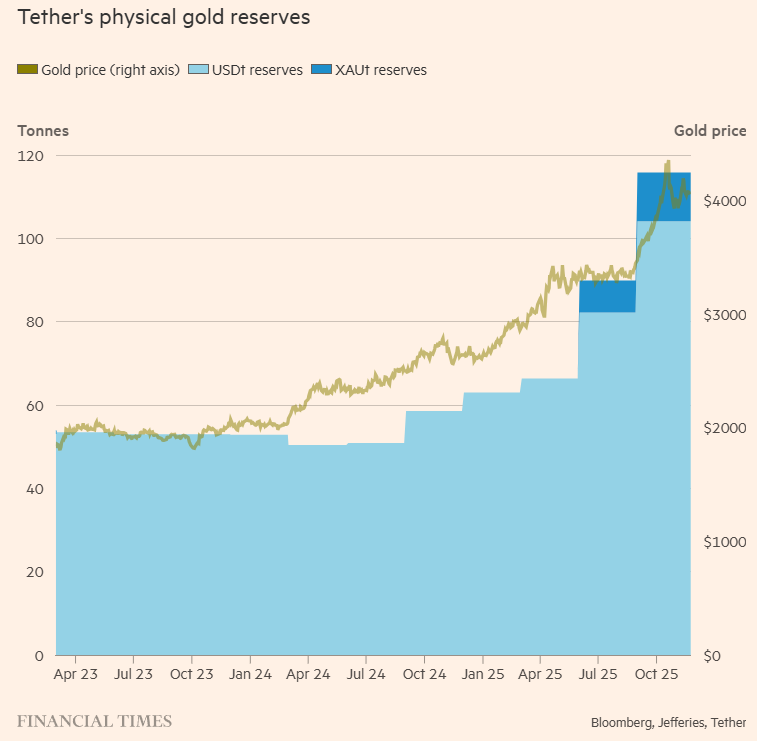
Core Insights - Tether has emerged as a significant player in the gold market, holding 116 tons of gold as of September 30, making it the largest single holder of gold outside of major central banks [2][3][5] - The surge in gold prices this year, which increased by approximately $2000, coincided with Tether's accelerated gold purchases, indicating a potential influence on market dynamics [5][7] - Tether's strategy involves supporting two different tokens with gold reserves, reflecting a complex motivation behind its gold acquisition [10][13] Group 1: Tether's Gold Holdings and Market Impact - Tether's gold holdings are valued at around $14 billion, comparable to the official reserves of countries like South Korea and Hungary [3][5] - In Q3, Tether purchased about 26 tons of gold, accounting for 2% of global gold demand during that period and 12% of known central bank purchases [3][8] - The demand from Tether is believed to have tightened supply in the short term and influenced market sentiment, potentially driving speculative investments into gold [5][11] Group 2: Future Projections and Regulatory Challenges - Tether plans to purchase approximately 100 tons of physical gold by 2025, supported by an expected profit of nearly $15 billion this year [8][9] - The recent passage of the GENIUS Act, which prohibits stablecoin issuers from using gold as reserve assets, raises questions about Tether's increasing gold reserves despite regulatory constraints [10][14] - Tether's ambition to promote tokenized gold as a viable alternative to fiat-backed cryptocurrencies reflects a long-term vision, despite current market challenges [13][14] Group 3: Risks and Speculative Nature of Gold - The intertwining of cryptocurrency and traditional safe-haven assets like gold introduces risks, particularly if stablecoin demand reverses, leading to potential sell-off pressures on gold reserves [11][12] - The volatility of cryptocurrencies contrasts with the perceived stability of gold, raising concerns about the speculative nature of gold as an investment in the current market environment [11][12] - Tether's approach to tokenized gold aims to address the challenges faced by retail investors in holding physical gold, but demand for such products remains limited [13]

黄金真正的“大庄家”:“稳定币老大”Tether
Hua Er Jie Jian Wen· 2025-11-27 01:46
Core Insights - Tether, a major stablecoin issuer, has emerged as a significant buyer of gold, holding 116 tons valued at approximately $14 billion, making it the largest single holder of gold outside of central banks [1][3][5] - Tether's gold purchases have influenced gold prices, contributing to a 56% increase in gold prices in 2025, with its buying activity aligning closely with price surges [3][5] - The intertwining of cryptocurrency and traditional safe-haven assets like gold raises concerns about potential market volatility and the risk of speculative bubbles in gold [3][7] Group 1: Tether's Gold Holdings and Market Impact - As of September 30, Tether's gold holdings are comparable to the official reserves of countries like South Korea and Hungary, with its purchases accounting for 2% of global gold demand in Q3 [1][5] - Tether's gold buying activity has increased significantly, with its purchases representing 14% of central bank gold purchases in Q2 and 12% in Q3 [5][6] - The demand from Tether is expected to continue, with plans to purchase an additional 100 tons of gold by 2025, supported by its projected profits of nearly $15 billion this year [5][6] Group 2: Regulatory and Strategic Considerations - Tether's strategy involves using gold to back two different tokens, USDT and Tether Gold (XAUt), with a total of 116 tons of gold in reserves [6][10] - The recent GENIUS Act prohibits stablecoin issuers from using gold as reserve assets, yet Tether has increased its gold reserves, raising questions about its long-term strategy [6][10] - Tether's ambition to create a gold-backed cryptocurrency aims to provide a more accessible way for retail investors to hold gold, despite current regulatory challenges [10][11] Group 3: Speculative Risks and Market Dynamics - The relationship between gold and cryptocurrencies reflects concerns over currency devaluation, but the volatility of cryptocurrencies poses risks to the stability of gold as a safe-haven asset [7][11] - Jefferies predicts increased demand for gold from the stablecoin sector, but the unpredictable nature of the crypto market could lead to significant pressure on gold prices if demand shifts [7][11] - Tether's efforts to promote a gold-backed value exchange system face skepticism, particularly regarding the transparency and security of its gold reserves [11]
Reliance, Inc. Reports Second Quarter 2025 Financial Results
Globenewswire· 2025-07-23 20:05
Financial Performance - Net sales for Q2 2025 reached $3.66 billion, marking a 5.0% increase from Q1 2025 and a 0.5% increase year-over-year [2][5] - Non-GAAP gross profit margin was reported at 29.9%, slightly up from 29.7% in Q1 2025 [7] - Pretax income increased by 16% from Q1 2025 to $304.3 million, while net income attributable to Reliance was $233.7 million, up 17% year-over-year [2][34] - Earnings per share (EPS) for Q2 2025 was $4.42, an 18% increase from Q1 2025 [2][34] Sales and Market Dynamics - The company sold a record 1,615.0 thousand tons in Q2 2025, a 4.0% increase year-over-year, despite a 0.9% decline from Q1 2025 [5][9] - Average selling price per ton sold increased by 6.1% compared to Q1 2025, exceeding the company's guidance [6][7] - Demand for non-residential construction, the largest end market, improved, and is expected to remain healthy in Q3 2025 [10] Cash Flow and Capital Allocation - Cash flow from operations was $229.0 million in Q2 2025, reflecting a significant increase of 255% from Q1 2025 [16] - The company repurchased $79.9 million of common stock in Q2 2025, with a total of $143.0 million returned to shareholders through dividends and share repurchases [18][17] Business Outlook - Reliance anticipates a seasonal decline in tons sold of 1.0% to 3.0% in Q3 2025 compared to Q2 2025, but an increase of 3.0% to 5.0% compared to Q3 2024 [19] - The company expects average selling prices in Q3 2025 to remain stable, with potential fluctuations in carbon steel and aluminum prices [19]