Ascend 910C芯片

Search documents
AI芯片竞争,再起波澜
半导体芯闻· 2025-12-16 10:57
Core Insights - NVIDIA has dominated the high-performance computing chip market for machine learning and artificial intelligence over the past decade, with a projected market value reaching $5 trillion by 2025 [1] - The revenue for hardware supporting AI development, including semiconductor chips and network connections, is expected to reach $147.8 billion from February to October 2025 [1] - NVIDIA's latest processor, the "Grace Blackwell" series, sold out quickly, but the company's market dominance is gradually declining due to increasing competition from multiple fronts [1] Group 1: Competitive Landscape - Major cloud service providers are moving away from reliance on NVIDIA's CUDA ecosystem and are investing in developing their own chips for high-capacity inference, as operational costs exceed training costs [2] - North America's four largest hyperscale data center operators—Google, Amazon Web Services, Microsoft, and Meta—are collectively shifting towards custom chips to ensure competitive advantages [4] - Google has begun transitioning to custom AI chips, with its latest product, the seventh-generation TPU Ironwood, optimized for inference and capable of connecting up to 9,216 chips in a single SuperPOD [4][5] Group 2: Client Dynamics - Meta Platforms may start leasing or purchasing Google's TPU chips for its data centers by 2027, potentially accounting for 10% of NVIDIA's annual revenue, which could amount to billions [5] - Amazon Web Services (AWS) is enhancing cost-effectiveness to attract businesses seeking alternatives to NVIDIA's expensive chips, claiming its "Trainium" chip can reduce training costs by up to 50% [6] - Microsoft faces challenges with its custom chip project, as the release of its next-generation chip Maia has been delayed until 2026, forcing continued reliance on costly NVIDIA GPUs [7] Group 3: AMD's Position - AMD aims to become an alternative to NVIDIA, with its MI300X chip featuring 192GB of HBM3 memory, making it an ideal choice for reducing large-scale model inference costs [9] - AMD's software limitations have been addressed through OpenAI's Triton compiler, allowing developers to write high-performance code compatible with both NVIDIA and AMD hardware [10] Group 4: China's Semiconductor Strategy - China is striving for semiconductor industry independence amid U.S. export restrictions, with Huawei leading the infrastructure development and producing high-performance chips like the Ascend 910C [11] - The Ascend 910C reportedly achieves 60-80% of the training performance of NVIDIA's H100, with plans for new versions of Ascend chips to be released by 2026 [11] Group 5: NVIDIA's Market Diversification - NVIDIA is investing in new markets, including telecommunications infrastructure, due to limited capacity from TSMC affecting its profit margins [14] - The future of AI computing is expected to be characterized by specialized, highly interconnected systems rather than being dominated by any single company [14]



华为 CloudMatrix 384开始出货,售价5800万
傅里叶的猫· 2025-05-02 11:51
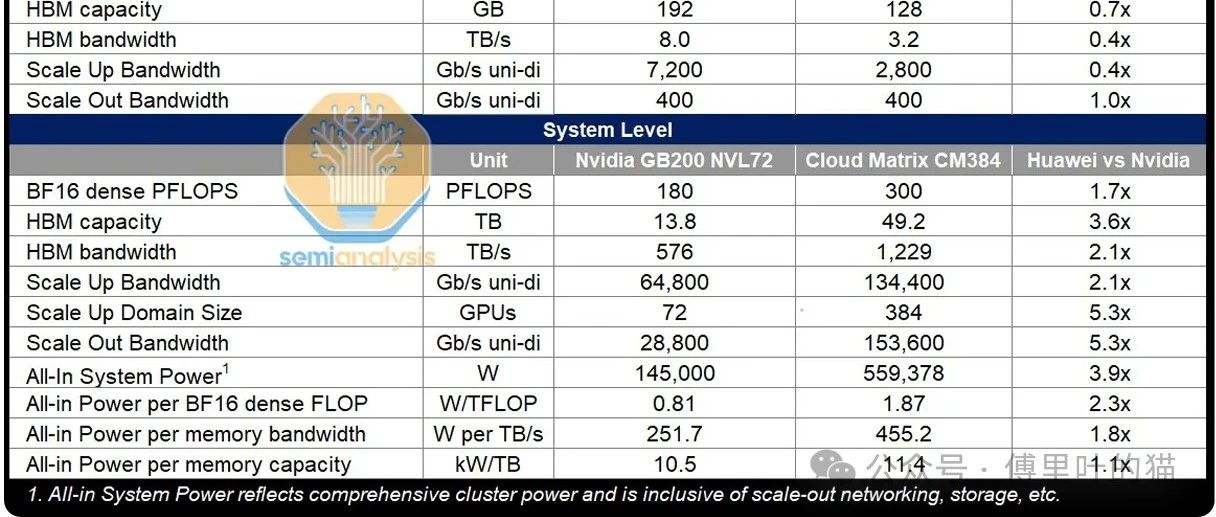
end GPU 我们前几天讲过华为的CloudMatrix 384,在该AI集群的核心,是384块Ascend 910C芯片,它们以"全 互连"(all-to-all)拓扑结构相互连接。这套系统内部简称CM384。 根据SemiAnalysis的分析,CloudMatrix 384的BF16的算力是GB200 NVL72的1.7倍,显存容量是 GB200的3.6倍,由于集成了384个910C,这也导致了功耗是GB200的3.9倍。虽然单个chip的性能不如 GB200,但CloudMatrix 384系统绝对是目前最强的AI服务器。 据Financial Times的报道,一套完整的CloudMatrix 384系统的售价约为800万美元,约合5800万人民 币,大约是英伟达GB200 NVL72价格的三倍。这清楚地表明了华为的战略目标:它并不是要提供一 种低成本的替代方案,而是要为中国市场建立一个独立、无需依赖出口的高性能平台。 已有十家中国大型客户采用了该系统,并将其集成进现有的数据中心基础设施中。尽管这些客户的 名称并未公开,但报道称他们都是华为长期合作伙伴——很可能包括国家资助的云服务商、电信集 团以 ...