CUDA软件系统

Search documents
在上海设立研发中心?英伟达回应:为员工租用新办公空间
Huan Qiu Wang· 2025-05-20 03:31
Core Insights - Nvidia plans to establish a research and development center in Shanghai to enhance its localized R&D capabilities [1][2] - The company is renting new office space for existing employees as part of its ongoing commitment to the Chinese market [2] - Nvidia's revenue from the Chinese market is projected to account for 14% of its global revenue in 2024, approximately $17 billion [2] Group 1: Market Strategy - Nvidia's core products, such as the H100 chip, face export restrictions preventing direct sales to China, leading to the introduction of a "special version" H20 chip with only one-third the performance of the H100 [2] - The H20 chip is experiencing inventory buildup due to insufficient market competitiveness [2] - Nvidia's CEO has emphasized the importance of the Chinese market, with expectations that the AI chip market in China could reach $50 billion in the next two to three years [2] Group 2: R&D Focus Areas - The Shanghai R&D center will focus on three main areas: customized product development, global R&D collaboration, and local ecosystem partnerships [3] - Customized product development will include chip design validation and optimization tailored to Chinese customer needs, such as developing lower-capacity HBM chips compliant with export regulations [3] - The center will also engage in cutting-edge technology research, including autonomous driving systems, and collaborate with Nvidia's global R&D network [3] - Strengthening partnerships with Chinese universities, research institutions, and companies will be a priority, particularly in optimizing the compatibility of Nvidia's CUDA software system for the Chinese market [3]


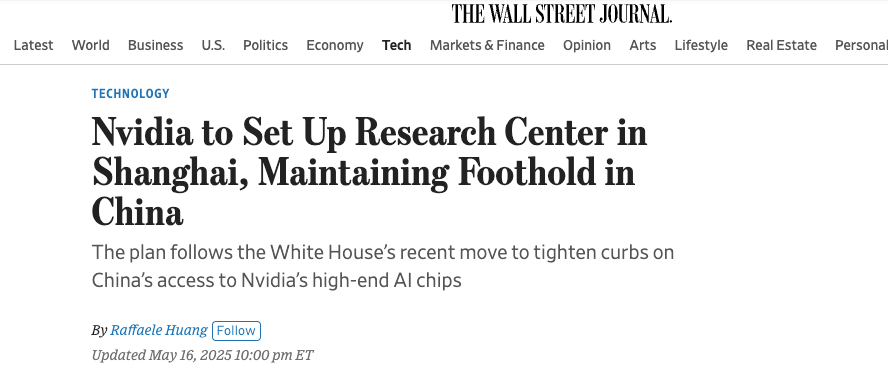
英伟达计划在上海设立研究中心 彰显对中国市场新承诺
是说芯语· 2025-05-16 04:53
Core Viewpoint - Despite the impact of U.S. export controls, American chip manufacturers are considering expanding their business in China, with Nvidia planning to establish a research and development center in Shanghai to maintain competitiveness in the Chinese market, which is projected to reach $50 billion in a few years [2][3][4]. Group 1: Nvidia's Strategy in China - Nvidia's CEO Jensen Huang estimates that China could become a $50 billion market for the company in the coming years, despite a decline in sales due to U.S. export restrictions [3][4]. - The company is renting new office space in Shanghai to accommodate existing employees and potential business expansion, focusing on understanding local customer needs and complying with U.S. regulations [3][4]. - Nvidia aims to recruit top AI talent in China, with plans to hire engineers for next-generation deep learning hardware and software development [3][4]. Group 2: Competitive Landscape - Nvidia is concerned about local competitors like Huawei potentially filling the market gap if it withdraws from China, as Huawei could offer alternative AI ecosystems [4]. - In 2022, China accounted for approximately $17 billion, or 14%, of Nvidia's revenue, highlighting the importance of the Chinese market [4]. - The company is currently offering the L20 processor as an alternative to its best-selling chips, which are restricted in China, although the L20 has lower performance capabilities [4][5]. Group 3: Market Dynamics and Customer Sentiment - Major Chinese tech companies, including ByteDance, Alibaba, and Tencent, are closely monitoring geopolitical developments and assessing Nvidia's ability to provide redesigned high-end chips to meet their needs [5][6]. - There is hesitation among tech giants to place orders due to the performance limitations of Nvidia's processors compared to local competitors, leading to a dilemma between lower-cost options and switching to Chinese chips [5][6].