Claude for Financial Services

Search documents
为什么顶尖投行都选择了 Rogo 这个金融 Agent?
海外独角兽· 2026-03-05 12:07
Core Insights - The article discusses the emergence of Rogo, a company aiming to integrate AI into the financial analysis workflow, addressing the industry's pain points related to repetitive tasks and data accessibility [2][4][5]. Industry Pain Points - The global investment banking sector handles over $3.5 trillion in transactions annually, primarily relying on junior bankers who often work over 100 hours a week on repetitive tasks [4]. - Major banks like JP Morgan and Bank of America have implemented strict work hour limits due to severe burnout among employees, highlighting the low-value nature of many tasks performed [5]. - Financial workflows present three significant challenges for AI integration: low tolerance for errors, strong data barriers due to proprietary databases, and complex internal workflows that are difficult to automate [6][5]. Company Overview - Rogo was founded in January 2022 by Princeton alumni Gabriel Stengel and John Willett, who have firsthand experience in investment banking [7][10]. - The company aims to embed AI capabilities directly into existing analyst workflows, integrating with core data sources like Capital IQ and FactSet [2][12]. Product Development - Initially, Rogo's product was a natural language query interface for financial data, but it pivoted to a generative AI architecture following the success of ChatGPT [9]. - Rogo's platform now serves over 50 top financial institutions, with daily active users exceeding 25,000 and an annual recurring revenue (ARR) growth of 27 times within two years [3][10]. Product Features - Rogo's platform integrates research, modeling, document processing, and data operations into a single interface, enhancing the efficiency of financial analysts [12]. - The product includes a research assistant that provides access to over 50 million financial documents, allowing analysts to query data in natural language and receive structured answers with source citations [12][18]. Business Model - Rogo operates on a seat-based subscription model, charging several thousand dollars per seat annually, which can be offset by the savings from reducing the headcount of junior analysts [30]. - The company has established a prestigious client list, including major investment banks, which enhances its credibility and facilitates customer acquisition [30][31]. Market Potential - The core financial data and research retrieval market, dominated by companies like Bloomberg and S&P Capital IQ, generates annual subscription revenues of $25-30 billion [32]. - Rogo aims to convert high operational costs into low marginal costs through AI, targeting even a 10% reduction in inefficiencies could represent a vast total addressable market (TAM) [32][36]. Competitive Landscape - Rogo competes with AI-native players like Hebbia and Boosted.ai, each focusing on different aspects of financial analysis and document processing [54][66]. - Major AI model providers like Anthropic and OpenAI are also entering the financial services space, creating a competitive environment for Rogo [67].


Invent Hires Former Red Hat, Microsoft Executive As Chief AI Officer
Yahoo Finance· 2025-11-19 21:45
Core Insights - Companies across various industries are increasingly appointing chief artificial intelligence officers as AI becomes more integrated into existing technologies or replaces them [1] - The wealth management sector is also adopting this trend, exemplified by Invent's recent hiring of Jim Zimmerman as its chief AI officer [1] Company Overview - Jim Zimmerman previously worked at Red Hat and Microsoft, focusing on enterprise technology deployment and management, which will be a key aspect of his role at Invent [2] - Invent has over 130 team members and primarily serves large Registered Investment Advisors (RIAs) and Independent Broker-Dealers (IBDs) with assets ranging from $1 billion to $155 billion, as well as software companies in this market [4] Industry Trends - The wealth management sector is seen as conservative and slower to adopt innovations, but there is a growing recognition of the potential for AI to drive significant changes [5] - The recent introduction of AI tools like Claude for Financial Services indicates a shift towards more rapid innovation in the sector [5] Future Outlook - The current environment allows for faster development and proof of concept creation using AI, reducing the need for extensive human resources [6] - There is significant potential for automation in the industry, enabling advisors to focus more on client interactions rather than administrative tasks [7]
Google Finance Rolls Out AI-Driven Deep Search, Prediction-Market Data
PYMNTS.com· 2025-11-06 21:19
Core Insights - Google has introduced new AI features to Google Finance, including Deep Search, enhanced charting, and prediction-market data, integrating its Gemini models into the finance product [1][4] Group 1: Deep Search Feature - The Deep Search feature allows users to input open-ended financial questions and receive AI-generated responses with citations and links to supporting material, providing a "research plan" for transparency [3] - This feature is currently being tested through Google Labs and will soon be available to AI Pro and AI Ultra subscribers, with an initial launch in India supporting English and Hindi [4] Group 2: Enhanced Charting and Data Coverage - The update includes AI-powered charting with technical indicators, historical overlays, and sector-level comparisons, enabling users to analyze market patterns more effectively [4] - Earlier reports indicated that Google was testing a redesigned Finance interface with these AI features, which are now live [4] Group 3: Prediction Markets Integration - Google Finance now incorporates data from Kalshi and Polymarket, providing market-based probabilities for economic outcomes like inflation rates and GDP growth, allowing users to track changes in market sentiment over time [5] - The reliability of prediction markets is debated due to relatively small participation volumes, which can lead to price movements influenced by limited liquidity [6] Group 4: Broader Trends in Financial AI - The updates reflect a broader trend in finance where companies are adopting explainable AI to enhance workflows and decision-making rather than replacing existing systems [6] - Other financial institutions, such as Morgan Stanley and JPMorgan Chase, have developed internal AI tools to improve research and compliance processes [7] Group 5: Competitive Landscape - Google Finance's updates come as other financial data platforms, like Bloomberg LP, are also integrating generative AI tools for enhanced data analysis and natural-language search capabilities [8] - Specialized AI providers are focusing on financial applications, with offerings like Anthropic's Claude for Financial Services aimed at analyzing portfolio data and compliance records [9] Group 6: Limitations of AI in Financial Analysis - Despite the promising updates, studies indicate that reasoning models may struggle with visual and numerical context, which is crucial for financial analysis, highlighting the need for manual verification of AI-generated summaries [10]


Anthropic projects $70B in revenue by 2028: Report
Yahoo Finance· 2025-11-04 16:48
Core Insights - Anthropic is projected to generate up to $70 billion in revenue and $17 billion in cash flow by 2028, driven by the rapid adoption of its business products [1] - The company aims for a $9 billion annual revenue run rate by the end of 2025 and targets $20 billion to $26 billion for 2026 [2] - Anthropic expects to achieve $3.8 billion in revenue this year from API sales, significantly outpacing OpenAI's projected $1.8 billion [3] Business Strategy - Anthropic's B2B strategy is becoming more evident, with partnerships established with Microsoft for integration into Microsoft 365 and expanded collaboration with Salesforce [4] - The company plans to deploy its AI assistant Claude to numerous employees at Deloitte and Cognizant [4] Product Development - Recent launches include smaller, cost-effective models like Claude Sonnet 4.5 and Claude Haiku 4.5, catering to businesses deploying AI at scale [5] - Anthropic has also introduced Claude for Financial Services and Enterprise Search to enhance business connectivity [5] Financial Position - The company raised $13 billion in September, valuing it at $170 billion, with future fundraising efforts potentially targeting a valuation between $300 billion and $400 billion [6] - Anthropic's gross profit margin is expected to reach 50% this year and 77% by 2028, a significant improvement from negative 94% last year [8] Competitive Landscape - OpenAI, Anthropic's main competitor, is valued at $500 billion and expects to generate $13 billion in revenue this year, with a long-term goal of $100 billion by 2027 [9] - While Anthropic anticipates positive cash flow by 2028, OpenAI is projected to face substantial losses, with cash burn reaching $14 billion in 2026 [9]
Anthropic更新Claude金融服务功能:嵌入Excel、扩展数据连接,直面微软竞争
3 6 Ke· 2025-10-28 11:08
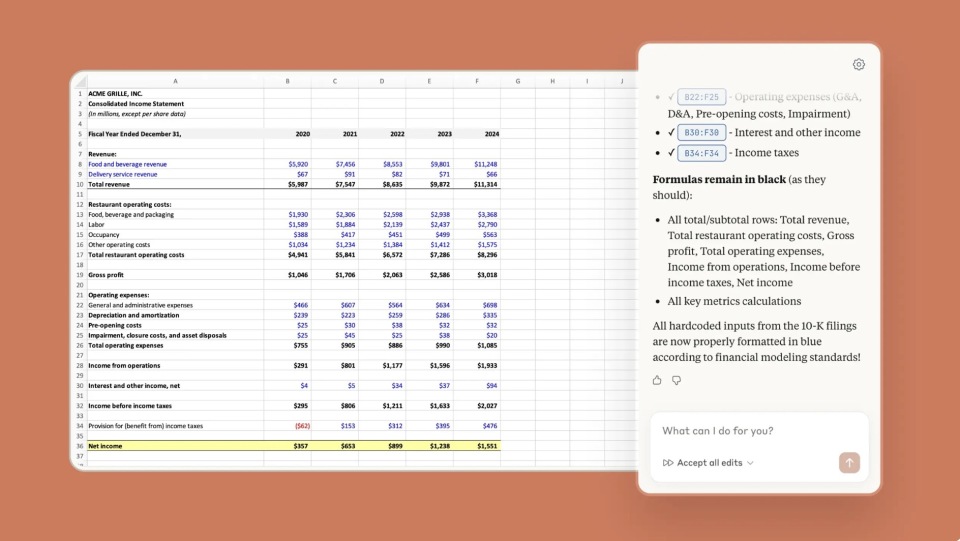
Core Insights - Anthropic has announced significant updates to Claude for Financial Services, including Microsoft Excel integration, real-time market data connectors, and six new financial-specific agent skills, enhancing AI capabilities for financial professionals [1][8] - Claude Sonnet 4.5 achieved a 55.3% accuracy rate in Vals AI's Finance Agent benchmark test, establishing a strong technical foundation for AI applications in finance [1] Group 1: AI Integration and Features - The introduction of Claude for Excel allows financial analysts to collaborate with AI in real-time within the Excel sidebar, enabling the reading, analysis, and modification of existing workbooks or the creation of new spreadsheets [2][3] - A traceability mechanism has been designed to address concerns about AI's "black box" nature, allowing users to track and understand every modification made by the AI, thereby enhancing interpretability and trust [3] Group 2: Data Connectivity Enhancements - Anthropic has expanded its connector ecosystem to enhance Claude's data acquisition capabilities, integrating with external platforms to provide comprehensive financial information, including real-time market data and credit ratings [4][5] - New connectors include Aiera for real-time earnings call transcripts, LSEG for fixed income pricing and macro indicators, and Moody's for credit ratings and financial data [4] Group 3: New Agent Skills - Six new agent skills have been introduced to automate core financial workflows, addressing time-consuming tasks for analysts and reducing operational redundancy [6] - Skills include comparable company analysis, DCF model construction, due diligence data packaging, company profile generation, earnings analysis, and initial coverage report writing [6] Group 4: Client Implementation and Compliance - Claude for Financial Services is already integrated into workflows of major financial institutions like Citigroup and Visa, demonstrating productivity improvements and enhanced data accuracy [7] - The "Human in the Loop" mechanism ensures that all AI outputs are subject to human review, aligning with the compliance requirements of the financial industry [7][8] Group 5: Competitive Strategy - The updates reflect Anthropic's competitive strategy to establish a differentiated advantage in the enterprise AI market by embedding AI into core financial tools, building comprehensive data access capabilities, and standardizing workflows [8]

深度|Anthropic CEO:AI技术潜力巨大,但无序扩张才是风险所在,我将引导其走向正轨
Z Potentials· 2025-08-28 03:51
Core Insights - The article discusses the rapid growth and potential of Anthropic, a leading AI company focused on developing safe and reliable AI systems with human welfare at its core. The company has achieved a recurring annual revenue exceeding $4 billion, making it one of the fastest-growing enterprises in history [12][24]. Group 1: Company Structure and Trust - Anthropic was founded by seven co-founders, which is often viewed skeptically by outsiders. However, the long-standing trust and familiarity among the founders have allowed the company to maintain cohesion and core values during rapid expansion [11][10]. - The unique dynamic of sibling co-founders, Dario and Daniela Amodei, enhances the company's strategic execution and operational management, allowing them to focus on their strengths [9][10]. Group 2: AI Applications and Market Potential - The fastest-growing application of AI is in programming, driven by the close relationship between developers and AI model creators, leading to rapid adoption [10][12]. - AI's potential extends beyond programming, with applications in customer service, biology, and pharmaceuticals, showcasing its versatility across various sectors [13][14]. Group 3: Business Model and Growth Expectations - Anthropic positions itself as a platform company, focusing on broad enterprise services rather than solely vertical-specific products. This approach allows for better understanding of user needs and market demands [15][16]. - The company has experienced exponential growth, with revenue projections that have consistently exceeded initial expectations, indicating a strong market demand for AI solutions [24][25]. Group 4: Investment and Financial Dynamics - The financial model of AI companies involves significant upfront investment in model training, with expectations of high returns over time. This cyclical investment pattern is common in venture capital, where initial losses are expected before profitability is achieved [34][35]. - The current capital expenditures may obscure the underlying profitability of individual models, which can be profitable when analyzed independently [43][44]. Group 5: Talent and Competitive Advantage - The competition for talent in the AI industry is intense, but Anthropic maintains a high employee retention rate due to its strong mission and commitment to its values, which helps in retaining skilled personnel [51][53]. - The company's approach to knowledge protection involves complex engineering capabilities and a culture that balances openness with necessary information security measures [48][49]. Group 6: Future of AI and Market Structure - The future market structure for AI is expected to consist of a few dominant players capable of building cutting-edge models, with the potential for new entrants targeting specific use cases [33]. - The article suggests that AI's growth trajectory may continue to extend, with the possibility of AI companies becoming some of the largest enterprises globally [25][24].

Claude Code出逃的主创又回来了!Anthropic:过去俩月我收入暴涨5.5倍,别走
量子位· 2025-07-17 07:04
Core Viewpoint - The article discusses the rapid return of key personnel Boris Cherny and Cat Wu to Anthropic from Cursor, highlighting the competitive landscape in Silicon Valley and the implications for Anthropic's valuation and growth potential in the AI sector [1][6][7]. Group 1: Personnel Movements - Boris Cherny and Cat Wu, key figures at Claude Code, were initially recruited by Anysphere, the company behind Cursor, where they were set to develop "agent-like" functionalities [2][4][5]. - Just two weeks after their departure, both were lured back to Anthropic, indicating the company's strong position in retaining talent amidst fierce competition [6][7]. Group 2: Valuation and Financial Performance - Anthropic is reportedly in discussions for a new funding round with a target valuation of $100 billion, which would mark a significant increase from its previous valuation of $58 billion just four months prior [8][9][10]. - The company aims to improve its profitability metrics, with current gross margins from direct sales of AI models around 60%, moving towards a target of 70% [12][19]. Group 3: Revenue Growth and Market Strategy - Anthropic's revenue has seen a fourfold increase in the first half of the year, with annualized revenue exceeding $4 billion [20]. - The company is pursuing a "model-as-a-service + vertical solutions" strategy, offering tailored AI solutions across various industries, including finance, law, and healthcare [15][19]. Group 4: Product Development and User Engagement - The launch of Claude Code has significantly boosted user engagement, with a 300% increase in active users and a 5.5-fold revenue growth since the release of the Claude 4 series [21][26]. - Anthropic has introduced a comprehensive analytics dashboard for Claude Code, allowing enterprises to track their AI spending and usage metrics effectively [24][25]. Group 5: Investment and Future Prospects - Amazon is reportedly considering a new multi-billion dollar investment in Anthropic, potentially making it the largest shareholder, following a previous investment of $4 billion [28][31]. - This investment reflects a broader trend where companies are recognizing the long-term profitability potential of AI technologies beyond initial hype [32].