
CoCounsel

Search documents
Thomson Reuters (NYSE:TRI) 2026 Conference Transcript
2026-03-12 17:17
Summary of Thomson Reuters Conference Call Company Overview - **Company**: Thomson Reuters - **Key Executives**: CEO Steve Hasker, CFO Mike Eastwood Core Industry Insights - **Industry Focus**: Legal, Tax, Accounting, and Audit sectors - **AI Integration**: Emphasis on the importance of fiduciary-grade AI models over general-purpose models, particularly in legal and tax markets [3][4][5] Key Points and Arguments 1. **AI as Growth Opportunity**: Thomson Reuters views the rise of AI as a significant opportunity for growth, particularly in expanding Total Addressable Markets (TAMs) in legal and tax sectors [4] 2. **Differentiation Factors**: The company identifies four key assets that differentiate its offerings: - Vast proprietary data repositories [5] - A large pool of 4,500 trained domain experts [6] - Strong data privacy guarantees [7] - Extensive customer support networks [8][10] 3. **CoCounsel Product Suite**: The upcoming version of CoCounsel is expected to enhance the company's position in both litigation and transactional legal markets, with a beta launch scheduled for April 20 [12][14][22] 4. **Organic Growth**: The legal professionals segment is experiencing 9% organic growth, driven by CoCounsel, Westlaw Advantage, and Practical Law [30] 5. **Anthropic Partnership**: Thomson Reuters maintains a vendor relationship with Anthropic, utilizing various AI models while developing its own legal-specific large language model named Thomson [32][33] 6. **Pricing Strategy**: The company is transitioning towards value-based pricing models as AI tools become more integrated into legal workflows [52][62] 7. **Tax and Accounting Growth**: The tax and accounting segment is projected to achieve 11%-13% organic growth, supported by recent acquisitions and a comprehensive end-to-end solution [80][82] 8. **Margin Improvement**: Thomson Reuters aims for a 100 basis points improvement in EBITDA margins over the next three years, driven by operating leverage and productivity initiatives [96][97] Additional Important Insights - **Market Dynamics**: The company is addressing labor shortages in the tax and accounting sectors, which is advantageous for its service offerings [90] - **Capital Allocation**: Thomson Reuters has a strong balance sheet with $10-$11 billion in cash and low leverage, allowing for flexibility in capital returns and potential acquisitions [125][135] - **Innovation Pace**: The company has significantly increased its pace of innovation, launching new products in a fraction of the time compared to previous years [116][118] - **International Expansion**: There are ongoing efforts to expand in international markets, particularly in Brazil and Southeast Asia [137] This summary encapsulates the key points discussed during the Thomson Reuters conference call, highlighting the company's strategic focus, growth opportunities, and market positioning.

Legal AI is splitting in two—and most people miss the difference
Yahoo Finance· 2026-03-04 09:00
Core Insights - Thomson Reuters announced that CoCounsel has reached one million users across 107 countries and territories, highlighting significant growth in legal AI adoption [1] - Anthropic introduced an expanded suite of enterprise plugins for Claude, including tools tailored for legal, finance, and HR applications, indicating a shift towards specialized AI solutions in the legal sector [1][6] - The recent developments underscore the ongoing evolution in legal AI and the importance of understanding the underlying systems that support these technologies [3][4] Industry Analysis - A recent incident involving a general counsel testing Anthropic's Claude for contract review revealed that the AI pulled information from Wikipedia, sparking debate about the readiness of foundation models for legal work [2][4] - The reactions to this incident were polarized, with skeptics claiming that foundation models are inadequate for legal tasks, while proponents argued that improvements are forthcoming; however, both sides overlooked the critical issue of system architecture [4][5] - The distinction between AI capable of automating workflows and AI that can perform authoritative legal work is becoming increasingly recognized in the market, as evidenced by the stock performance of Thomson Reuters following the announcement of CoCounsel's user milestone [7]
Thomson Reuters Announces New US$600 Million Share Repurchase Program and US$605 Million Return of Capital and Share Consolidation Transactions
Prnewswire· 2026-02-25 12:00
Core Viewpoint - Thomson Reuters has announced a new share repurchase program of up to US$600 million and a return of capital transaction totaling US$605 million, which includes a share consolidation expected to be completed in May 2026 [1][2][3] Share Repurchase Program - The amended normal course issuer bid (NCIB) will allow the repurchase of up to 16 million common shares, increasing the maximum by an additional 6 million shares [1][2] - The repurchase period is set from August 19, 2025, to August 18, 2026, with a limit of 91,026 shares per day based on average trading volume [1][2] - Thomson Reuters has already repurchased 6,022,437 shares for approximately US$1.0 billion at an average price of US$166.05 per share under the current NCIB [1][2] Return of Capital - A special cash distribution of US$605 million is planned, equating to approximately US$1.36 per participating share, based on the number of shares outstanding as of February 24, 2026 [1][3] - The return of capital is expected to be tax-free for Canadian tax purposes, with non-Canadian resident shareholders having the option to opt out [1][3] - Shareholders will vote on the proposed return of capital and share consolidation on April 28, 2026, requiring at least two-thirds approval [2][3] Share Consolidation - Following the cash distribution, a share consolidation will occur, reducing the number of common shares proportionally to the cash distribution [1][3] - The consolidation ratio will be based on the volume-weighted average trading price of the shares on Nasdaq for the five trading days prior to the effective date [3]


第一创业晨会纪要-20260225
First Capital Securities· 2026-02-25 06:30
Group 1: AI Industry Insights - Anthropic launched "Cowork & Plugins for the Enterprise," an AI toolkit that integrates with popular office software like Microsoft Excel, PowerPoint, and Slack, allowing users to perform tasks without switching applications [3] - The tool has demonstrated significant efficiency improvements, such as reducing the time to write a 300-page clinical research report from months to just 10 minutes [3] - The report emphasizes that while AI applications are advancing, they are still in the exploratory phase and not yet at the stage of replacing professional software, indicating a positive outlook for rapid growth in the AI industry [3] Group 2: Tongwei Co., Ltd. Developments - Tongwei Co., Ltd. announced plans to acquire 100% of Qinghai Lihua Qingneng Co., Ltd. through a combination of share issuance and cash payment, which will enhance its position in the polysilicon market [4] - Lihua Qingneng has established a production capacity of 150,000 to 200,000 tons of polysilicon, ranking sixth in the industry with low production costs due to new equipment [4] - The report suggests that the current model of industry consolidation is shifting back to individual company integration, which may lower the difficulty of industry consolidation and accelerate the exit of outdated capacities and companies [4] Group 3: Spotify Performance - Spotify reported a significant increase in monthly active users (MAU), surpassing 750 million with a net addition of 38 million in Q4 2025, while paid users reached 290 million, reflecting a year-on-year growth of 10.3% [6] - The company's gross margin improved to 33.1%, and operating profit margin reached 15.5%, indicating a notable enhancement in profitability driven by subscription structure optimization and cost dilution [6] - Looking ahead to Q1 2026, Spotify maintains an optimistic outlook, expecting continued growth in MAU and paid users, with revenue projected at €4.5 billion, a 15% year-on-year increase excluding currency effects [6]


“AI灭霸”Anthropic与“受害股”合作推出智能体,软件板块集体回血
Feng Huang Wang· 2026-02-24 22:57
Core Viewpoint - Anthropic held a briefing to introduce 10 new ways for enterprise clients to integrate artificial intelligence into workflows, covering various sectors including stock research and investment banking, without triggering a new wave of sell-offs in the stock market [1][4]. Group 1: Product Launch and Market Reaction - Anthropic's recent briefing showcased its commitment to AI integration, with notable stock price increases for companies like Thomson Reuters (up over 11%), FactSet (up 12%), and SaaS giant S&P Global (up 4%) [1]. - The company previously launched Claude Cowork in January, aimed at expanding its programming tools to more white-collar jobs, with subsequent updates enhancing capabilities in finance and legal sectors [3]. Group 2: Plugin Development and Collaborations - The latest batch of plugins for Claude Cowork includes five related to capital markets, such as financial analysis, investment banking, stock research, private equity, and wealth management, alongside expansions into design, HR, operations, engineering, and corporate branding [4][7]. - Anthropic collaborated with professional software service providers like FactSet, S&P Global, and the London Stock Exchange Group to develop financial service-related plugins, with Apollo Global Management contributing to the private equity plugin [7]. Group 3: Market Position and Future Outlook - Anthropic's product manager Scott White emphasized that the AI tools are not intended to replace traditional software services but to enhance them by integrating existing business knowledge and client relationships [9]. - The company announced an expansion of Claude's MCP list, allowing access to more external data sources, including Google services and professional data providers like MSCI [9].
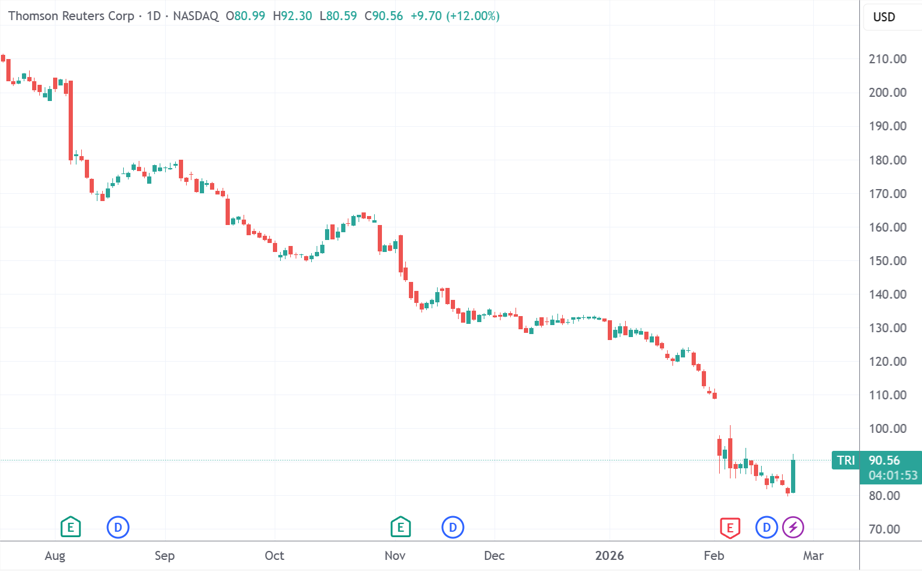
Thomson Reuters shares rally after CoCounsel AI tool draws 1 million users
Reuters· 2026-02-24 21:40
Core Insights - Thomson Reuters shares surged over 11% following the announcement that its AI tool, CoCounsel, has attracted one million users, alleviating concerns about competition from other AI technologies [1] - This stock increase marked the largest percentage gain for Thomson Reuters since 2009, despite the company still being down more than 30% for the year [1] - The legal AI market is evolving, with Thomson Reuters emphasizing the importance of substance over hype in its AI strategy, which is supported by proprietary intellectual property and extensive legal archives [1] Company Developments - CoCounsel was launched after Thomson Reuters acquired AI legal startup Casetext for $650 million in 2023, positioning it as a core AI engine for automating legal tasks [1] - The Legal Professionals division is the largest revenue contributor for Thomson Reuters, accounting for approximately one-third of total sales [1] - The company’s executives highlighted that its legal offerings are differentiated from general-purpose AI startups due to its unique intellectual property, which includes extensive legal documents that are largely undigitized and unpublished [1] Market Context - The announcement of CoCounsel's user base followed a significant selloff in the software and services sector, triggered by concerns over AI technologies potentially reducing revenue streams [1] - The market reaction to the launch of Anthropic's AI tool, which integrates its Claude AI model into legal workflows, had previously caused an $830 billion global selloff over six trading days [1]

Stocks Settle Higher as AI Disruption Fears Ease
Yahoo Finance· 2026-02-24 21:33
Geopolitical Risks - US-Iran nuclear talks are set to resume, with Iranian Foreign Minister Araghchi expressing optimism for a diplomatic solution [1] - President Trump is considering a limited military strike on Iran, indicating a tight timeline for negotiations [1] Tariffs and Trade - President Trump's new 10% global tariffs took effect following the Supreme Court's decision, with a potential increase to 15% being considered [2] - The tariffs are imposed under Section 122 of the 1974 Trade Act, allowing for a 150-day period without congressional approval [2] Stock Market Performance - Stocks gained on Tuesday, with the Conference Board US Feb consumer confidence index rising by 2.2 to 91.2, surpassing expectations [3] - The S&P 500 Index closed up 0.77%, the Dow Jones Industrial Average up 0.76%, and the Nasdaq 100 Index up 1.09% [5] Earnings Reports - Over 88% of S&P 500 companies have reported Q4 earnings, with 74% beating expectations [8] - S&P earnings growth is projected to increase by 8.4% in Q4, marking the tenth consecutive quarter of year-over-year growth [8] Corporate Developments - Software stocks rebounded, led by a significant increase in Thomson Reuters after announcing one million users of its AI tool [13] - Advanced Micro Devices saw an 8% increase after a major deal with Meta Platforms, while other chipmakers also experienced gains [14] - PayPal Holdings rose over 6% following acquisition interest from Stripe Inc. [16] Economic Indicators - The US Feb Richmond Fed manufacturing survey unexpectedly fell to -10, indicating weaker conditions than anticipated [6] - Initial weekly unemployment claims are expected to rise by 10,000 to 216,000 [7]
Anthropic Shout-Out Makes Thomson Reuters Latest AI Winner
Yahoo Finance· 2026-02-24 21:12
Core Viewpoint - Thomson Reuters Corp. experienced a significant surge in its stock price, driven by positive recognition of its AI tool, CoCounsel, during an event hosted by Anthropic PBC, highlighting the growing investor interest in AI-related technologies [2][5]. Group 1: Stock Performance - Shares of Thomson Reuters soared as much as 14%, marking the largest intraday gain in 26 years [2]. - The stock closed 11% higher at C$123.45 on Tuesday [8]. Group 2: AI Tool Recognition - CoCounsel, an AI tool for lawyers developed by Thomson Reuters, reached one million users, indicating a transition from experimentation to production [6]. - The company is collaborating with several AI models, including Anthropic's Claude, OpenAI's GPT, and Alphabet's Google Gemini [6]. Group 3: Market Sentiment - The market is currently fluctuating between optimism about AI's potential to enhance stock market growth and concerns about its impact on existing business models, particularly in software services [5]. - Analyst Adam Shine from National Bank Financial rates the stock as outperform, with a price target of C$175, which is below its previous closing record of C$293.53 [5].
Why Shares of Thomson Reuters Are Surging Today (Hint: It Has to do With Artificial Intelligence)
Yahoo Finance· 2026-02-24 17:03
Core Insights - Thomson Reuters Corp's shares increased nearly 12% following the announcement that 1 million law professionals are using its AI-powered legal solution, CoCounsel [1] - The company has faced significant stock decline, down nearly 49% over the past year, attributed to concerns about AI's impact on software solutions [2] - CoCounsel is designed to enhance legal research, expedite litigation processes, and integrate with commonly used legal programs, emphasizing the importance of trust in AI solutions among legal professionals [3] Financial Performance - Thomson Reuters' stock is currently trading at approximately 27 times trailing earnings, which is below its five-year average [4] - The company reported a 4% growth in adjusted earnings for 2025 and an organic revenue growth of 7%, with expectations for solid growth in 2026 [5] Market Position - The recent rise in Thomson Reuters' stock follows a period of decline after competitors announced new AI tools, indicating the company's adaptability in a changing market [4] - Investors are encouraged to consider the evolving landscape of AI and its potential to disrupt traditional barriers to entry when evaluating Thomson Reuters' stock [5]
Stocks Rally as AI-Fueled Worries Ease
Yahoo Finance· 2026-02-24 16:10
Economic Indicators - The US Dec S&P composite-20 home price index rose by +0.47% month-over-month and +1.38% year-over-year, exceeding expectations of +0.30% month-over-month and +1.30% year-over-year [1] - The Conference Board US Feb consumer confidence index increased by +2.2 to 91.2, surpassing expectations of 87.1 [4] - The US Feb Richmond Fed manufacturing survey current conditions unexpectedly fell by -4 to -10, weaker than expectations of an increase to -5 [6] Stock Market Performance - The S&P 500 Index is up +0.50%, the Dow Jones Industrial Average is up +0.75%, and the Nasdaq 100 Index is up +0.90% [6] - Software stocks are rebounding, led by a +12% increase in Thomson Reuters after announcing one million professional users of its AI tool [11] - Advanced Micro Devices is up more than +7% after a significant deal with Meta Platforms, while other chipmakers also see gains [12] Earnings Reports - Keysight Technologies reported Q1 adjusted EPS of $2.17, exceeding the consensus of $1.99, and forecasts Q2 adjusted EPS of $2.27 to $2.33, well above the consensus of $1.91 [13] - Henry Schein reported Q4 net sales of $3.44 billion, better than the consensus of $3.35 billion [14] - Home Depot's Q4 comparable sales unexpectedly rose by +0.4%, better than the consensus of a decline of -0.36% [14] Company Developments - Qualcomm is up more than +3% after being upgraded to buy from hold with a price target of $185 [14] - Genuine Parts Co is up more than +3% after being upgraded to strong buy from market perform with a price target of $145 [15] - Whirlpool is down more than -8% after announcing public offerings of shares [16]