FIL币

Search documents
突然大跌!超14万人爆仓
Mei Ri Jing Ji Xin Wen· 2026-02-23 13:33
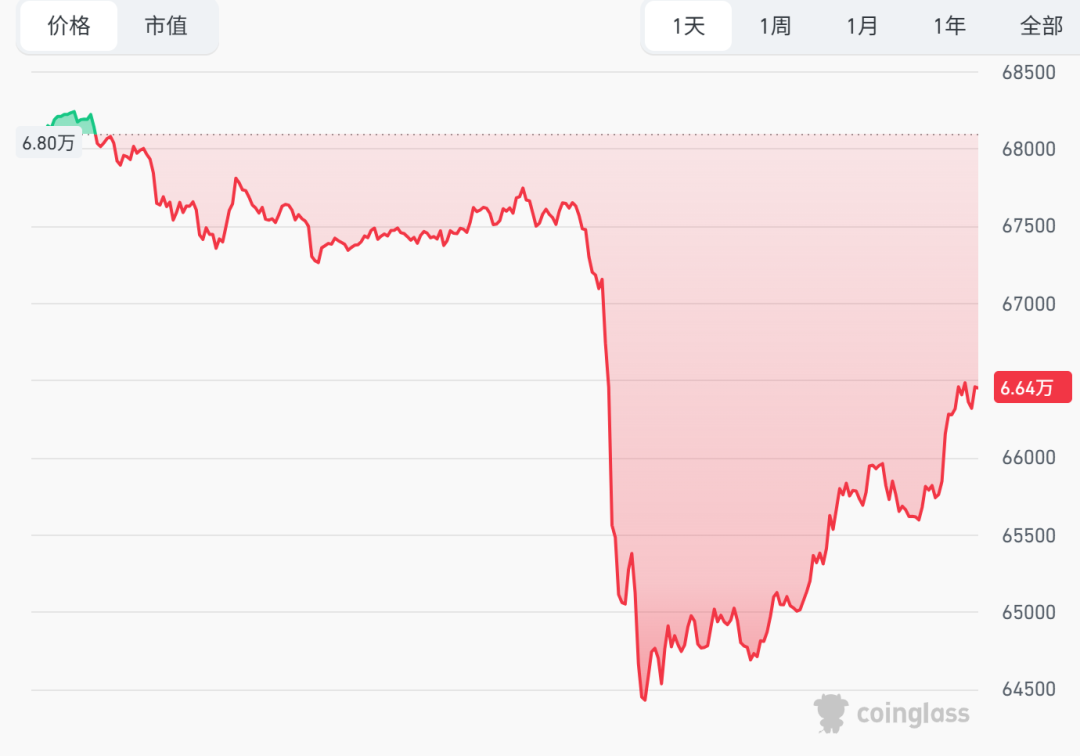
Core Insights - The cryptocurrency market experienced a significant decline on February 23, with Bitcoin dropping over 5% to fall below the $65,000 mark, later stabilizing at $66,418, reflecting a decrease of 2.46% [1] - Major cryptocurrencies, including Ethereum, XRP, and FIL, also saw declines, with Ethereum down over 3% [2] Market Performance - Bitcoin's price was reported at $66,418, with a decline of 2.46% [1] - Ethereum was priced at $1,916.60, down by 3.12% [3] - Other cryptocurrencies such as XRP and FIL also experienced losses, with XRP at $1.3931 (-1.97%) and FIL at $0.91 (-3.17%) [3] Liquidation Data - Over the past 24 hours, more than 140,000 traders were liquidated, with a total liquidation amount of $505 million, primarily from long positions totaling $436 million [4] - The liquidation amounts included $4.52 million in 12-hour liquidations and $5.05 million in 24-hour liquidations [4] Market Sentiment - Analysts from CryptoQuant indicated that Bitcoin has entered a bear market, suggesting that most market participants will incur losses [4] - Ned Davis Research's strategists noted that despite recent sell-offs, Bitcoin still has potential downside risk, with predictions of a possible price drop to $31,000, representing a further decline of approximately 55% from current levels [5] Historical Context - Bitcoin's price trajectory over the past year began at approximately $96,000 in February, peaking at $125,000 in October before entering a downward trend [5] - The price fell to around $86,000 in November and further declined to below $80,000 by the end of January, eventually dropping to a low of approximately $63,000 in early February, nearly halving from its October peak [5]

研究 | 破与立:中国虚拟货币监管的制度重构与法律前瞻
Sou Hu Cai Jing· 2026-02-10 02:22
Core Viewpoint - The issuance of Document No. 42 marks a significant shift in China's regulatory approach to virtual currencies, transitioning from fragmented responses to a systematic reconstruction of regulations, including the inclusion of stablecoins and RWA (Real World Asset tokenization) under regulatory oversight [2][3]. Regulatory Policy Evolution - The evolution of China's virtual currency regulation can be categorized into four distinct phases: 1. **2013**: Initial classification of Bitcoin as a "specific virtual commodity" with a cautious observation approach [4]. 2. **2017**: Introduction of the ICO ban and the requirement for existing ICO projects to arrange for refunds, marking a shift to strict limitations [5]. 3. **2021**: Comprehensive crackdown on all virtual currency-related activities, defining them as "illegal financial activities" [6]. 4. **2026**: Systematic reconstruction with Document No. 42, expanding regulatory scope to include stablecoins and RWA, and enhancing legal frameworks [7]. Innovations in Document No. 42 - Document No. 42 introduces three major innovations: 1. **Stablecoins**: Clearly defined and regulated, with restrictions on issuing stablecoins linked to the Renminbi without approval, emphasizing currency sovereignty [8][9]. 2. **RWA**: Introduced under a "principle of prohibition, with exceptions upon approval" framework, allowing for regulated activities under specific conditions [10]. 3. **Overseas Operations Control**: Extends regulatory oversight to the global activities of domestic entities, marking a shift from domestic to global regulatory logic [11]. Legal Responsibilities - The addition of a dedicated chapter on legal responsibilities in Document No. 42 establishes clear administrative and criminal liabilities for violations, addressing previous gaps in enforcement [12]. Legal Classification Dimensions - The legal classification of virtual currencies in China is complex, involving civil, administrative, criminal, and foreign exchange control dimensions: 1. **Civil Aspect**: The recognition of virtual currencies as property has evolved, but contract validity remains contentious [14][15]. 2. **Administrative Aspect**: Strengthened regulatory defenses against financial institutions and enhanced information control measures [16]. 3. **Criminal Aspect**: Expansion of criminal charges related to virtual currencies, including fraud and money laundering [17][18]. 4. **Foreign Exchange Control**: Concerns over the use of virtual currencies like USDT for circumventing foreign exchange regulations [19]. Judicial Practice Developments - Recent trends in judicial practice indicate a move towards nuanced rulings in virtual currency disputes, reflecting a shift from blanket prohibitions to more refined adjudications [20][21]. - The judicial system is exploring practical solutions for the disposal of seized virtual currencies, indicating a willingness to adapt within the regulatory framework [22]. International Comparison - China's regulatory approach contrasts with global paradigms, highlighting a unique stance characterized by comprehensive prohibitions while observing developments in regions like Hong Kong and Singapore [24][25]. - The regulatory landscape in Hong Kong, with its dual-track system, provides a potential model for balancing innovation and regulation in mainland China [26]. Future Trends - The implementation of supporting regulations for Document No. 42, the specific pathways for RWA registration, and the progression of dedicated virtual currency legislation are anticipated areas of focus [27].
破局虚拟货币追赃难题!上海法院落地 “境内委托香港处置” 模式
Xin Lang Cai Jing· 2025-09-23 07:31
Core Viewpoint - The Shanghai High Court has issued guidelines for the disposal of virtual currencies in criminal cases, aiming to enhance the recovery of assets for victims while navigating the complexities of virtual currency regulations [1][4]. Group 1: Shanghai Court's Approach - The Shanghai Baoshan Court successfully disposed of over 90,000 FIL coins using a "domestic entrustment, overseas disposal, closed-loop return" model [1][2]. - This model involves entrusting the virtual currency to a third-party institution, which then collaborates with qualified overseas agents to complete the transaction on a licensed virtual asset trading platform in Hong Kong [2][7]. - The funds from the disposal are converted and transferred to a dedicated account for the court, ensuring compliance with national foreign exchange regulations [2][7]. Group 2: Comparison with Beijing's Model - Beijing has also developed an innovative approach for handling virtual currencies, involving the Beijing Property Exchange and licensed trading platforms in Hong Kong [3][4]. - Both Shanghai and Beijing's models share a common goal of utilizing compliant platforms for overseas disposal, but differ in operational execution; Shanghai relies on third-party institutions while Beijing uses the Property Exchange [3][4]. Group 3: Legal and Regulatory Context - The legal status of virtual currencies in China is complex, with regulations prohibiting certain activities while recognizing virtual currencies as protected digital assets under the Civil Code [6][7]. - The Shanghai court's actions reflect a balance between regulatory compliance and asset protection, aiming to maximize recovery for victims while adhering to legal frameworks [6][7].
快讯 | 6万枚比特币案主犯钱志敏将被审判;蚂蚁集团CEO:坚决不发虚拟币;香港正落实稳定币发行人制度
Sou Hu Cai Jing· 2025-09-21 11:59
Group 1 - Ant Group's CEO, Han Xinyi, stated that the company will not issue virtual currencies or engage in any form of speculation, emphasizing that compliance is the lifeline of innovation [2] - The Shanghai High People's Court successfully disposed of over 90,000 FIL coins, marking a significant step in the legal handling of virtual currencies in criminal cases [4] - Zhao Changpeng and Binance have donated over $40 million to charity, benefiting approximately 3.8 million people since 2018, showcasing the use of blockchain for transparency in philanthropy [5] Group 2 - Hong Kong's Chief Executive, John Lee, announced the implementation of a stablecoin issuer system, with the Hong Kong Monetary Authority promoting tokenized deposits and asset transactions [7] - Yunfeng Financial announced the issuance of its first Real-World Asset (RWA) project, marking a breakthrough in the integration of traditional finance and blockchain technology [9] - Winner Fashion and Derlin Holdings have reached a strategic cooperation agreement regarding RWA tokenization plans, indicating a growing trend in the fashion industry towards blockchain integration [6]