Gemini3 pro

Search documents
黑色星期五,怎么看?
3 6 Ke· 2025-11-21 10:46
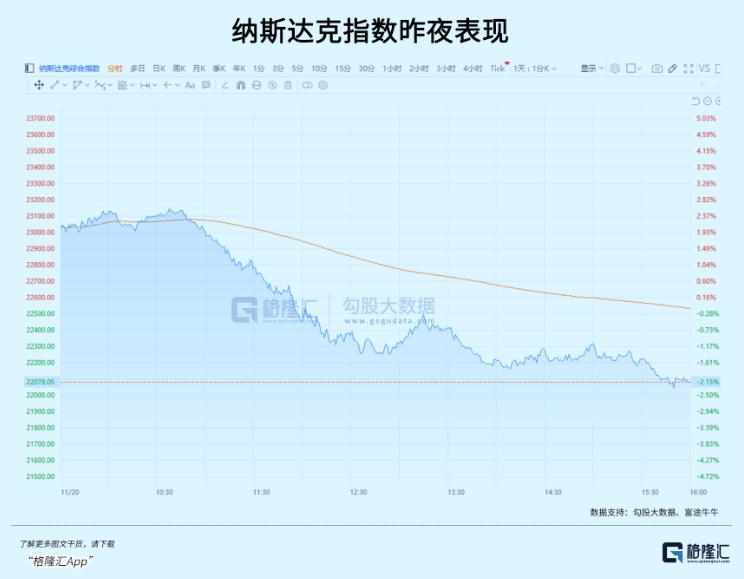
Core Insights - The U.S. stock market experienced a significant drop, influenced by Nvidia's strong earnings report and unexpected non-farm payroll data, raising concerns about an AI bubble and interest rate cuts [1][2][19] - Major indices, including the Nasdaq, saw substantial declines, with the Nasdaq dropping 4.7%, marking its largest single-day decline since April [2][19] - The market's reaction indicates a growing skepticism regarding the sustainability of AI demand and high valuations in the tech sector [6][17] Nvidia's Performance - Nvidia reported third-quarter revenue of $57 billion, a 62% year-over-year increase, and a net profit of $31.9 billion, up 65% year-over-year, exceeding market expectations [4][6] - The company's data center revenue reached $51.2 billion, reflecting a 66% year-over-year growth, and provided a strong fourth-quarter guidance [4][6] - Despite Nvidia's positive outlook, investor concerns about high valuations in the tech sector persist, with warnings from notable investors about the limitations of actual demand [6][17] Employment Data Impact - The U.S. non-farm payroll report showed an increase of 119,000 jobs in September, the strongest monthly gain since April, but the unemployment rate rose to 4.4%, the highest since 2021 [8][9][10] - The employment data has complicated the outlook for Federal Reserve interest rate cuts, with a 60.4% probability of maintaining rates in December and a 39.6% chance of a 25 basis point cut [10][17] - The mixed signals from the labor market have contributed to market volatility and uncertainty regarding future monetary policy [10][17] Market Dynamics - A tightening of liquidity and high valuations have led to increased selling pressure in the market, with significant outflows from long-term funds and a shift in hedge fund positions from net buying to net selling [14][15] - The trading volume of ETFs has surged to 41% of total market volume, indicating a shift towards passive and macro-driven funds, which has exacerbated downward momentum [15] - Goldman Sachs identified nine negative factors contributing to the recent sell-off, including concerns over Nvidia's peak performance and broader market liquidity issues [14][15] AI Market Concerns - The AI sector is facing scrutiny over its long-term profitability, with concerns that rising capital expenditures may not be sustainable [17][18] - The financing model within the AI ecosystem is becoming increasingly fragile, raising fears of a potential "Ponzi scheme" scenario if demand does not materialize [18] - Despite the presence of a bubble, individual companies may still hold investment value, as fundamentals can diverge from overall market sentiment [18][19]


黑色星期五!怎么看?
格隆汇APP· 2025-11-21 09:32
Core Viewpoint - The article discusses the recent volatility in the U.S. stock market, driven by concerns over AI bubbles and changing interest rate expectations, particularly following Nvidia's strong earnings report and the latest employment data [2][4][12]. Market Performance - Major U.S. stock indices, including the Nasdaq, experienced significant declines, with the Nasdaq dropping 4.7%, marking its largest intraday drop since April [4][12]. - In China, the three major stock indices also fell, with the Shanghai Composite Index down 2.45% and the ChiNext Index down 4.02% [3]. Nvidia's Earnings Report - Nvidia reported a third-quarter revenue of $57 billion, a 62% year-over-year increase, and a net profit of $31.9 billion, up 65% year-over-year, exceeding market expectations [6]. - Despite Nvidia's optimistic outlook, investor concerns about high valuations in tech stocks persisted, leading to market skepticism regarding the sustainability of AI demand [6][18]. Employment Data Impact - The U.S. non-farm payrolls increased by 119,000 in September, the strongest monthly gain since April, while the unemployment rate rose to 4.4%, the highest since 2021 [9][10]. - The employment report has complicated the outlook for Federal Reserve interest rate decisions, with a 60.4% probability of maintaining rates in December and a 39.6% chance of a 25 basis point cut [11]. Market Sentiment and Volatility - The article highlights a shift in market sentiment, with a focus on nine negative factors contributing to the recent sell-off, including concerns over Nvidia's "good news already priced in" and tightening liquidity [14][15]. - The average liquidity in the S&P 500 has decreased, indicating that small trades can lead to significant price fluctuations [15]. AI Market Dynamics - The article raises questions about the profitability of AI investments, noting that major tech companies are increasing capital expenditures while facing challenges in cash flow sustainability [19]. - The potential for an AI bubble is discussed, with concerns that the current financing models may lead to vulnerabilities in the market [19][24]. Future Outlook - The article suggests that while the immediate market outlook is uncertain, the long-term trend for A-shares remains positive, with expectations of a gradual upward movement around the 4000-point mark [27].