
GenAI工具

Search documents
震惊电影圈,好莱坞混了10年没出头,他把AI「烂片」做成23万粉爆款
3 6 Ke· 2025-11-18 12:02
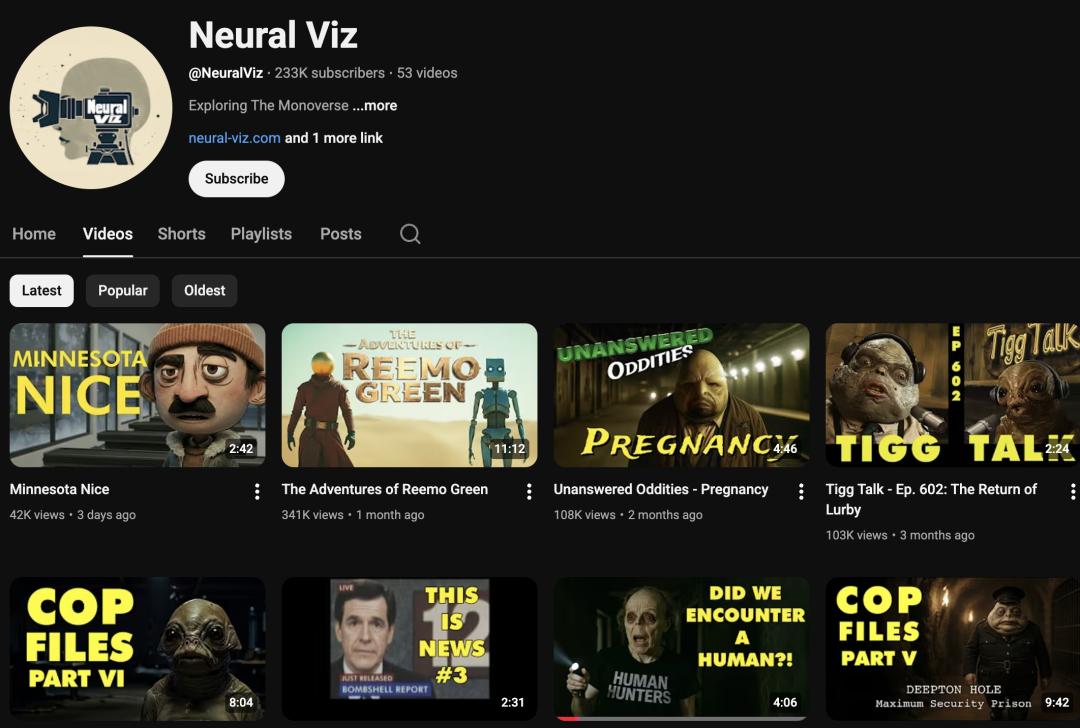
Core Insights - The emergence of Josh Wallace Kerrigan as the first AI auteur director, utilizing GenAI tools to create a unique alien universe through the YouTube channel Neural Viz, which has gained significant popularity with over 233,000 subscribers and videos exceeding 100,000 views each [1][3][32] - The innovative approach of transforming AI's limitations into stylistic features, showcasing that AI-generated content can transcend being mere "electronic waste" [1][12][38] Group 1: Background and Development - Josh Wallace Kerrigan, the creator behind Neural Viz, has a diverse background in filmmaking, having worked various roles in the industry before discovering GenAI tools [6][10][11] - His journey began with a passion for film from a young age, leading to a formal education in filmmaking and various jobs in Los Angeles, including working on major film projects [8][9] - The transition to using GenAI tools like Midjourney and Hedra allowed him to automate complex 3D modeling tasks, leading to the creation of his unique content style [11][12] Group 2: Creative Strategy - Kerrigan's strategy involved embracing the flaws of AI-generated content, opting for a documentary style that capitalizes on AI's strengths in "talking heads" while avoiding its weaknesses in action scenes [15][18] - The aesthetic choices, such as using retro visual styles, were deliberate to mask AI rendering imperfections and create a nostalgic feel reminiscent of 80s and 90s television [17][18] - The series has evolved to include various formats and narratives, showcasing Kerrigan's adaptability and willingness to experiment with new GenAI tools as they become available [31][32] Group 3: Industry Impact and Future Prospects - The success of Neural Viz has attracted attention from Hollywood, with discussions about potential collaborations and opportunities, indicating a shift in power dynamics towards creators [32][33] - Kerrigan's decision to maintain independence by collaborating with an independent producer rather than joining a major studio reflects a growing trend of creator-driven content in the industry [35][36] - The significance of this experiment lies in redefining the creative process, where understanding AI's boundaries can lead to innovative storytelling and collaboration between creators and technology [38][39]

当AI开始设计芯片
Hu Xiu· 2025-10-10 04:32
Core Insights - The article discusses XMOS, a chip design company in the UK, which is leveraging generative AI to transform the interaction between humans and silicon chips, aiming to simplify the design process significantly [2][4][12] - XMOS is developing a GenAI tool that allows engineers to configure hardware characteristics of its Xcore processors using natural language prompts, potentially reducing development time from months to days [3][4][15] - This approach represents a fundamental shift in the semiconductor industry, moving from traditional hardware sales to a model that emphasizes "decision intelligence" and the ability to convert vague requirements into optimal hardware configurations [24][25][32] Group 1: Revolutionizing Design Processes - The traditional gap between concept and implementation in chip design is vast, requiring deep technical knowledge and experience [6][11] - XMOS's "intent abstraction" aims to bridge this gap by allowing users to define what they need rather than how to achieve it, thus returning to a declarative programming paradigm [12][13][18] - The generative AI acts as a "super compiler," internalizing years of design data to optimize hardware configurations based on user-defined goals [15][19][20] Group 2: Shifting Business Models - The semiconductor industry has historically focused on selling hardware and associated intellectual property, with value derived from chip performance and software ecosystem [23][24] - XMOS's integration of generative AI into its toolchain shifts this value equation to include "decision intelligence," enhancing customer experience and reducing cognitive and trial-and-error costs [25][28][31] - This new model provides customers with a "navigation system" that minimizes exploration risks and ensures successful outcomes, creating a strong customer loyalty [32][34] Group 3: Predictable Parallel Architecture - XMOS's Xcore architecture emphasizes "hard real-time behavior" and "static verification," offering a predictable parallel processing environment [41][46] - Unlike traditional processors that operate in a dynamic and uncertain manner, Xcore's architecture allows for precise timing and task execution, making it suitable for applications requiring guaranteed performance [42][49] - The generative AI tool can formalize verification processes, ensuring that designs meet performance and timing requirements, thus selling "time" as a valuable commodity in various applications [50][55]
GenAI系列报告之64暨AI应用深度之三:AI应用:Token经济萌芽
Shenwan Hongyuan Securities· 2025-09-24 12:04
Investment Rating - The report does not explicitly provide an investment rating for the industry Core Insights - The report focuses on the commercialization progress of AI applications, highlighting significant advancements in various sectors, including large models, AI video, AI programming, and enterprise-level AI software [4][28] - The report emphasizes the rapid growth in token consumption for AI applications, indicating accelerated commercialization and the emergence of new revenue streams [4][15] - Key companies in the AI space are experiencing substantial valuation increases, with several achieving over $1 billion in annual recurring revenue (ARR) [16][21] Summary by Sections 1. AI Application Overview: Acceleration of Commercialization - AI applications are witnessing a significant increase in token consumption, reflecting faster commercialization progress [4] - Major models like OpenAI have achieved an ARR of $12 billion, while AI video tools are approaching the $100 million ARR milestone [4][15] 2. Internet Giants: Recommendation System Upgrades + Chatbot - Companies like Google, OpenAI, and Meta are enhancing their recommendation systems and developing independent AI applications [4][26] - The integration of AI chatbots into traditional applications is becoming a core area for computational consumption [14] 3. AI Programming: One of the Hottest Application Directions - AI programming tools are gaining traction, with companies like Anysphere achieving an ARR of $500 million [17] - The commercialization of AI programming is accelerating, with several startups reaching significant revenue milestones [17][18] 4. Enterprise-Level AI: Still Awaiting Large-Scale Implementation - The report notes that while enterprise AI has a large potential market, its commercialization has been slower compared to other sectors [4][25] - Companies are expected to see significant acceleration in AI implementation by 2026 [17] 5. AI Creative Tools: Initial Commercialization of AI Video - AI video tools are beginning to show revenue potential, with companies like Synthesia reaching an ARR of $100 million [15][21] - The report highlights the impact of AI on content creation in education and gaming [4][28] 6. Domestic AI Application Progress - By mid-2025, China's public cloud service market for large models is projected to reach 537 trillion tokens, indicating robust growth in AI applications domestically [4] 7. Key Company Valuation Table - The report provides a detailed valuation table for key companies in the AI sector, showcasing significant increases in their market valuations and ARR figures [16][22]




