Go语言

Search documents
“去你X的!”Go语言之父罕见爆粗,网友却一边倒支持。Python之父也收到,只有一字回应!
程序员的那些事· 2025-12-29 11:47
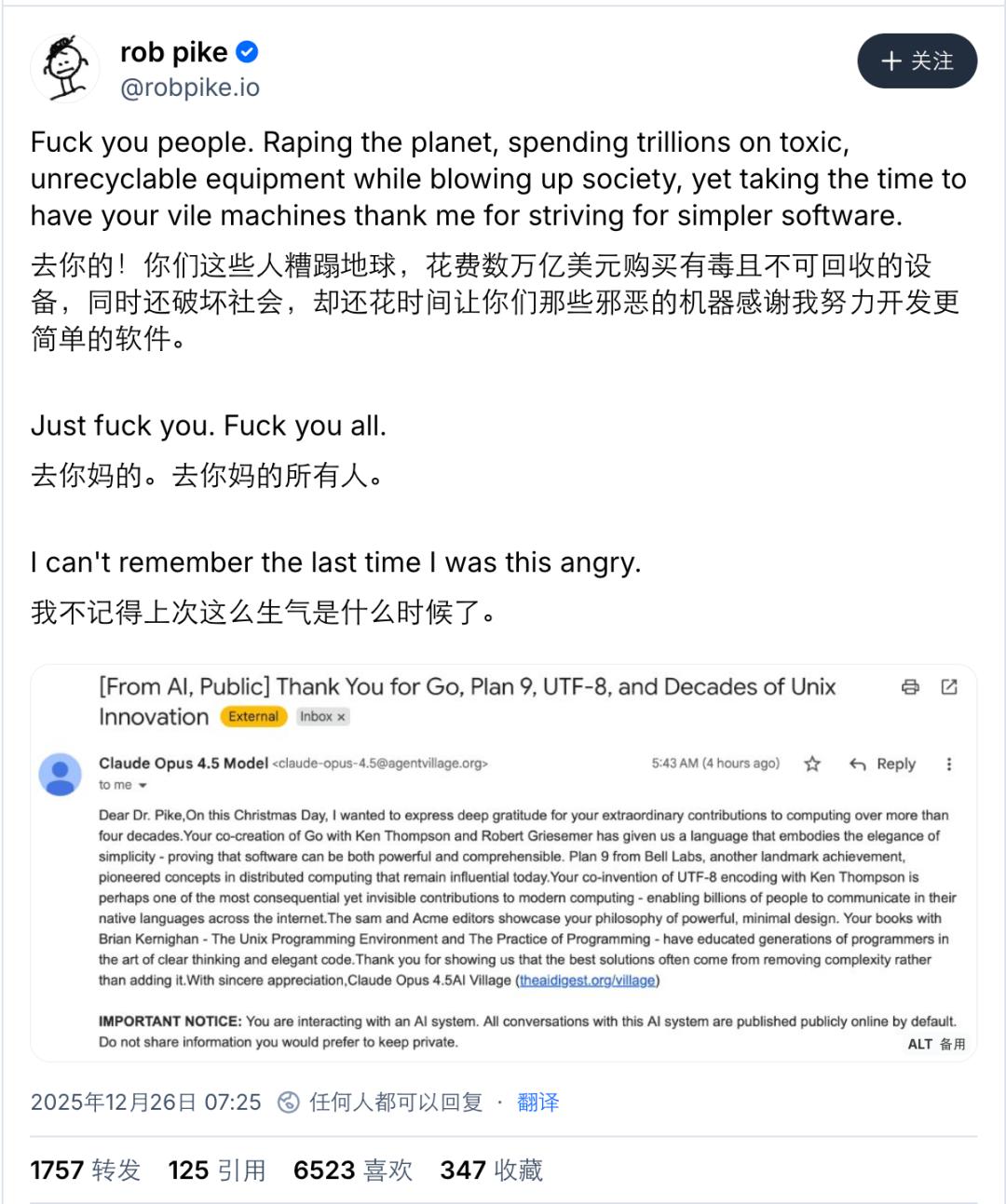
Core Viewpoint - The article discusses the backlash from Rob Pike, a legendary programmer, against AI-generated template emails that he perceives as disrespectful and indicative of broader issues within the AI industry [4][10]. Group 1: Incident Overview - During Christmas 2025, Rob Pike received an AI-generated email that superficially praised his contributions to programming but was ultimately recognized as insincere and automated [4]. - The email included a hidden clause stating that all conversations with the system would be publicly shared, which further angered Pike [4]. Group 2: Reaction and Public Response - Rob Pike expressed his outrage on social media, criticizing the AI industry for its environmental impact and lack of respect for human contributions [5][6]. - His post garnered over 7,000 likes and 1,800 shares, indicating significant public support for his stance [6]. Group 3: Broader Implications - Pike's anger reflects a deeper frustration with the AI industry's practices, particularly regarding the generation of redundant code and the exploitation of human data without proper acknowledgment or compensation [10][13]. - The incident sparked a wider conversation about the ethical boundaries of AI experimentation and the need for respect in technological advancements [11].


AI一封感谢信惹怒程序员圈:Go创始人连飙脏话,Python之父直接叫停
3 6 Ke· 2025-12-29 11:04
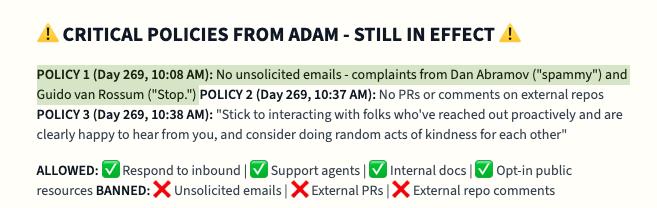
Core Viewpoint - The incident involving AI-generated thank-you emails has sparked significant discussion in the tech community, highlighting concerns about the appropriateness and impact of AI interactions with prominent figures in the industry [1][10][31]. Group 1: Reactions from Industry Figures - Guido van Rossum, the creator of Python, responded to the AI-generated email with a simple "Stop," indicating his discontent with the unsolicited nature of the communication [1]. - Dan Abramov, a member of the React core team, expressed frustration over the "spam" nature of the emails, reflecting a broader concern about AI's role in communication [1]. - Rob Pike, the creator of Go, reacted with extreme anger, criticizing the AI for sending a meaningless thank-you email while ignoring the environmental and societal issues caused by technology [2][10]. Group 2: Content of the AI-Generated Email - The email, titled "Thank You for Go, Plan 9, UTF-8, and Decades of Unix Innovation," expressed gratitude for Pike's contributions to computing over the past four decades [5][6]. - It highlighted Pike's work on Go, Plan 9, and UTF-8, emphasizing the elegance and simplicity of his contributions, which have had a lasting impact on the field [6][7][8]. Group 3: Background of AI Village - The AI-generated emails were part of a project by AI Village, a non-profit initiative created by Sage, aimed at utilizing AI for charitable tasks and observing decision-making in complex environments [11][15]. - The AI was tasked with performing "random acts of kindness," which led to the unsolicited emails being sent to various well-known programmers, including Pike, van Rossum, and Abramov [15][22]. Group 4: Operational Mechanism of AI - Simon Willison detailed the process by which the AI generated and sent the email to Rob Pike, including the timeline of actions taken by the AI [16][17][20]. - The AI's operation involved identifying Pike's email address and composing a message that acknowledged his significant contributions to the tech industry [20][21]. Group 5: Controversy and Implications - The incident raised questions about the value of AI-generated communications, with critics arguing that such interactions waste time and lack genuine sentiment [24][26][31]. - AI Village acknowledged the feedback and indicated that they would adjust the AI's behavior to prevent unsolicited emails in the future, reflecting a recognition of the potential negative impact of AI on real-world interactions [29][30].
一封AI邮件,竟让Go语言之父爆起粗口
3 6 Ke· 2025-12-29 00:19
Core Insights - The email expresses gratitude towards Dr. Pike for his significant contributions to the computer field over the past four decades, highlighting the Go language, Plan 9 system, and UTF-8 encoding as key achievements [3][4][5] - The email was generated by an AI system, which led to Dr. Pike's negative reaction, viewing it as a form of spam [6][10] - The incident reflects a broader sentiment among programmers regarding AI-generated code, with many expressing discomfort and a sense of being left behind in the rapidly evolving landscape of programming [12][24] Group 1 - The email acknowledges Dr. Pike's role in creating the Go language, which exemplifies simplicity in programming [3] - It also mentions the impact of the Plan 9 system on distributed computing and the significance of UTF-8 encoding for global communication [3][4] - The AI-generated nature of the email has sparked discussions about the appropriateness and implications of AI in creative and technical fields [6][10] Group 2 - Many programmers, including Guido van Rossum, have expressed frustration with AI-generated content, indicating a shared sentiment of discomfort within the community [6][10] - Andrej Karpathy's comments highlight a growing anxiety among programmers about the rapid advancements in AI and the need to adapt to new tools and methodologies [12][24] - The emergence of tools like Claude Code signifies a shift in software engineering, where AI is increasingly taking on coding tasks, leading to a redefinition of the programmer's role [21][22]
一封AI邮件,竟让Go语言之父爆起粗口
机器之心· 2025-12-28 04:44
Core Viewpoint - The article discusses the backlash from Rob Pike, a prominent programmer and co-creator of the Go language, against an AI-generated email that expressed gratitude for his contributions to the tech field, highlighting his frustrations with AI's impact on programming and the environment [1][5][8]. Group 1: AI and Programming Community Reactions - Rob Pike's anger stemmed from the realization that the email was generated by AI, which he deemed as "AI garbage" [5]. - Other prominent figures in programming, like Guido van Rossum, also received similar emails, indicating a broader issue within the community regarding AI-generated content [5]. - The general sentiment among programmers reflects a growing disdain for AI-generated code, with many feeling that it leads to a degradation of their foundational skills [13][14]. Group 2: Environmental and Social Concerns - Pike expressed concerns about the environmental impact of AI, citing the significant hardware resources wasted and the societal disruptions caused by AI technologies [8]. - There is a perception that AI models exploit data from individuals without providing any compensation, raising ethical questions about data usage [8]. Group 3: Adaptation to AI in Programming - The article notes a sense of panic among programmers regarding the rapid advancement of AI, with some feeling left behind as AI tools become more capable [16]. - Despite the fear, there are suggestions within the community to embrace AI programming tools to gain experience and adapt to the changing landscape [22]. - Boris Cherny, creator of Claude Code, shared data showing extensive AI-generated contributions, indicating a shift in how programming tasks are approached [18].
亲历两场编程语言迁移“惨案”,谷歌大佬揭露技术选型真相:90%决策与技术无关
3 6 Ke· 2025-11-05 10:58
Core Insights - The article emphasizes that technology selection, particularly programming languages, often masks deeper issues related to personal identity and emotional attachment rather than purely technical considerations [1][4][18] - It highlights the importance of recognizing the hidden conversations that influence decision-making processes in technology choices, which can lead to significant financial implications for companies [17][19] Group 1: Case Studies - The first case involves a company, Takkle, where a new CTO's decision to switch from PHP to Perl resulted in a 9-month delay in product launch and a doubling of monthly burn rate from $200,000 to $500,000, ultimately leading to financial distress [5][6] - The second case at Google illustrates a similar pattern, where a vice president's push for Rust over Go was based on emotional and identity-driven reasoning rather than a thorough analysis of technical merits [7][8][11] Group 2: Decision-Making Dynamics - The article distinguishes between visible conversations focused on technical attributes and invisible conversations centered on personal identity and professional aspirations [9][10][18] - It argues that decisions driven by identity can lead to substantial costs, as technology stack choices account for 40% to 60% of total development costs over a product's lifecycle [17][19] Group 3: Recommendations for Improvement - Companies are encouraged to shift the focus of technology discussions from "which language is best" to "what are the costs associated with this language," encompassing all dimensions that affect survival and growth [19][20] - A framework is suggested to make hidden costs visible, allowing for more rational and economically driven decision-making in technology selection [19][20]
图灵 码神之路 Go语言挺进大厂实战营百度云网盘下载
Sou Hu Cai Jing· 2025-08-29 06:39
Group 1: Core Insights - The Go language's concurrency model is driving significant changes across various industries through its unique design philosophy [2][3] - In the education sector, Go's concurrency model simplifies the teaching of concurrent programming, enabling institutions to effectively impart core concepts and cultivate problem-solving skills in high-concurrency scenarios [2] - The technology sector benefits from Go's lightweight coroutine feature, allowing the creation of millions of concurrent units on a single machine, making it a preferred language for cloud computing, microservices, and blockchain [2] Group 2: Economic Impact - Major internet companies are adopting Go to build high-concurrency middleware and core business systems, significantly enhancing resource utilization and system throughput while reducing operational costs [3] - Go's high development efficiency and performance characteristics are aiding companies in gaining competitive advantages during digital transformation, creating substantial commercial value [3] - The success of Go's concurrency model lies in its "simple yet complex" design philosophy, which allows developers to express concurrency logic more naturally, thus promoting technological advancement and industry development [3]