Google BigQuery

Search documents
Yuki Joins AWS ISV Accelerate (ISVA) Program to Bring Real-Time Data Cost Control to AI Workloads on Snowflake
Globenewswire· 2026-02-09 13:05
Core Insights - Yuki has joined the Amazon Web Services (AWS) ISV Accelerate Program, enhancing its market presence and collaboration with AWS partners [1][5] - The platform is designed to manage variable data workloads for GenAI and LLM applications, improving performance and cost predictability [2][6] - Yuki serves as an orchestration layer for Snowflake and BigQuery, optimizing resource allocation and reducing operational drag [3][7] Company Overview - Yuki is a control platform for cloud data warehouses, focusing on automatic workload routing and resource right-sizing [7] - The platform has demonstrated significant cost savings for customers, averaging 42% last year, with quick onboarding processes [5] - Yuki plans to expand its support to additional environments, including Databricks, later in the year [5] Industry Context - The increasing complexity of AI-era data stacks presents governance challenges, which Yuki aims to address through its automation capabilities [6] - The ISV Accelerate Program provides co-sell support, enabling Yuki to leverage AWS's global sales network for better customer outcomes [5][6]



Snowflake (NYSE: SNOW) Price Prediction and Forecast 2026–2030 (February 2026)
247Wallst· 2026-01-23 12:00
Core Viewpoint - Snowflake Inc. has shown resilience in its stock performance despite recent declines, with significant growth potential driven by the expanding cloud computing market and strong financial fundamentals [1][5]. Company Performance - Snowflake's stock has decreased by 6.93% over the past month, following declines of 6.26% and 5.34% in the previous two months, but has increased nearly 62% since its one-year low on April 4 [1]. - The company reported FY 2025 Q3 earnings on November 20, 2025, with an EPS of 20 cents, surpassing expectations of 15 cents, and revenue of $942.1 million, exceeding the forecast of $898.5 million [1]. - The stock has dropped more than 46% since its all-time high in November 2021, but the market cap currently stands at $71.10 billion [3][5]. Industry Overview - The global cloud computing market is projected to grow at a CAGR of 21.2% from 2024 to 2030, with the U.S. market expected to grow at a CAGR of 20.3% during the same period [2][9]. - Snowflake is positioned to capitalize on the $602.31 billion industry, facing competition from major players like Google and Amazon but leveraging its unique offerings [2][9]. Financial Metrics - Snowflake's revenue has shown significant growth, with projections indicating a rise from $2.81 billion in 2024 to $10.512 billion by 2030 [11]. - The company has a negative P/E ratio of -50.8, but its total assets of $8.22 billion exceed total liabilities of $3.03 billion, indicating strong underlying fundamentals [6]. Key Drivers of Growth - Collaboration with NVIDIA to implement AI Enterprise software enhances Snowflake's capabilities in building customized AI data applications, tapping into dual demand for cloud storage and AI solutions [7]. - The company boasts a revenue retention rate of 127%, indicating strong customer loyalty across a diverse client base, including major corporations and public entities [8]. - The rise of hybrid and multi-cloud solutions, along with increased cloud adoption, positions Snowflake favorably in a growing market [9]. Price Predictions - Analysts have a consensus "Strong Buy" rating for Snowflake, with a median one-year price target of $284.35, representing a 34.68% upside potential from current levels [10]. - By 2030, the stock is projected to reach $472.65, suggesting a potential upside of 108.36% based on anticipated revenue growth and earnings per share [11][12].

摩根大通资管、贝莱德加码 40 亿美元 L轮,Databricks 估值冲到 1340 亿
深思SenseAI· 2025-12-24 01:03
Core Insights - Databricks has completed over $4 billion in financing, with a post-money valuation of $134 billion, indicating strong investor confidence and growth potential [1] - The company reported an annualized revenue of over $4.8 billion for Q3, reflecting a year-on-year growth of over 55% [1][6] - Databricks aims to unify data processing and analysis workflows for enterprises, addressing challenges posed by data volume and complexity [2][4] Group 1: Company Overview - Databricks serves approximately 17,909 customers and holds an estimated market share of 16.49%, ranking first in the enterprise data platform sector [2] - Major competitors include Azure Databricks (15.82% market share), Talend (9.41%), and Apache Hadoop (9.34%) [2][3] Group 2: Market Trends and Challenges - The increasing volume of unstructured data and the need for AI integration in products are driving the demand for unified data platforms [4][5] - Companies face challenges with data governance and quality, leading to inefficiencies and hidden costs due to repeated data handling and misalignment [8] Group 3: Databricks' Strategic Positioning - Databricks focuses on consolidating data storage, reporting, and AI/ML processes within a single platform to reduce complexity and costs [5] - The company employs a pay-as-you-go model, allowing for better cost control and flexibility in scaling operations [5] Group 4: Competitive Landscape - Databricks competes with cloud data warehouses like Snowflake, Amazon Redshift, and Google BigQuery, each with distinct strengths [10][11][12][13] - Snowflake excels in data warehousing with a focus on SQL analysis, while Databricks is more suited for complex data processing and machine learning [11] - Amazon Redshift is integrated within the AWS ecosystem, making it ideal for organizations deeply embedded in AWS, contrasting with Databricks' broader data engineering capabilities [12]

Workday Expands Its Open Ecosystem with New Global Developer Network and Google BigQuery Partnership
Prnewswire· 2025-11-19 07:30
Core Insights - Workday has launched a global developer network aimed at enhancing AI talent through access to tools, training, and certification [1][2] - Google Cloud has joined Workday Data Cloud, providing customers with secure, zero-copy access to HR and finance data for AI-driven insights [1][6] Developer Network and Training - The global developer network will allow a wider community to develop, certify, and apply Workday skills, facilitating hands-on experience in building AI-powered solutions [2][3] - Partnerships with universities and staffing firms will provide dedicated training paths and certifications, preparing learners for roles in the Workday Economy [3][4] Certification and Talent Connection - Developers completing the program will receive a Workday Pro Developer Certification and be listed in the Workday Talent Directory, connecting them with potential employers [4][5] Google BigQuery Partnership - The integration of Google BigQuery with Workday Data Cloud enhances customer flexibility in analyzing and activating Workday data [5][7] - Customers will benefit from direct access to Workday HR and finance data within Google Cloud, enabling predictive modeling without complex integrations [6][8] Planned Acquisition of Pipedream - Workday's planned acquisition of Pipedream aims to expand its open ecosystem, providing an integration platform for AI agents with over 3,000 pre-built connectors [9][10] - This acquisition, along with others, will enhance the ability to connect Workday data with external systems, fostering innovation across the platform [10][11] Availability Timeline - The global developer network is set to launch in early 2026, with the Workday Data Cloud available to early adopters in the first half of 2026 [12]


Snowflake Stock To $120?
Forbes· 2025-11-06 14:50
Core Viewpoint - Snowflake's stock has surged 130% over the past year, significantly outperforming the S&P 500's 20% increase, driven by its positioning at the intersection of cloud data and artificial intelligence [1][2] Company Overview - Snowflake is marketing its AI Data Cloud as a pivotal advancement in enterprise computing and has launched new AI-focused products, such as Cortex for financial services, to attract regulated sectors [2] - The company has formed strategic alliances, including a partnership with Palantir, enhancing its potential as a data backbone for the AI era [2] Financial Performance - Snowflake's revenue is approximately $4 billion, but it faces significant operating losses exceeding $1.5 billion, indicating challenges in achieving profitable growth [5][11] - The company is currently valued at over 20 times sales, with a negative P/E ratio, raising concerns about its high valuation amidst ongoing losses [2][9] Market Context - Historical performance shows that Snowflake's stock is highly volatile; it fell 72% in 2022 during a market downturn, highlighting its behavior as a high-beta momentum asset rather than a stable cloud stock [6][10] - The competitive landscape is intensifying, with major tech companies like Amazon, Google, and Microsoft posing significant challenges to Snowflake's market position [9] Risk Factors - Key risks include competition from big tech, a potential valuation bubble, ongoing profitability challenges, security concerns following a data breach, and market sentiment risks that could lead to significant stock price declines [9][10]

一文读懂如何选择数据架构
3 6 Ke· 2025-09-19 02:51
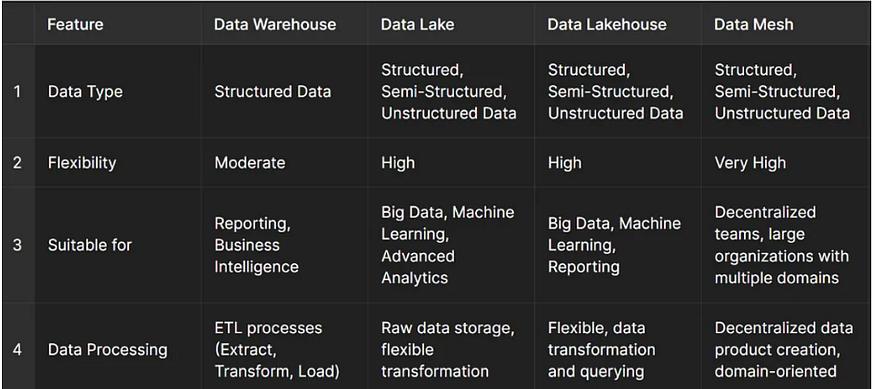
Core Insights - Data has become one of the most valuable assets for organizations, playing a crucial role in strategic decision-making, operational optimization, and gaining competitive advantages [1] - Data engineering is a key discipline that manages the entire process from data collection to transformation, storage, and access [1] - Organizations are shifting towards architectures that can respond to various data needs, with data management strategies like data warehouses, data lakes, data lakehouses, and data meshes playing significant roles [1] Group 1: Data Management Strategies - Data warehouses focus on structured data and are optimized for reporting and analysis, allowing for easy data retrieval and high-performance reporting [12][15] - Data lakes provide a flexible structure for storing structured, semi-structured, and unstructured data, making them suitable for big data projects and advanced analytics [21][24] - Data lakehouses combine the flexibility of data lakes with the structured data management capabilities of data warehouses, allowing for efficient analysis of various data types [27][30] Group 2: Data Architecture Design - A solid data architecture design is critical for the success of data warehouse projects, defining how data is processed, integrated, stored, and accessed [9] - The choice of data architecture design method should align with project goals, data types, and expected use cases, as each method has its advantages and challenges [10][43] - The Medallion architecture is a modern data warehouse design that organizes data processing into three layers: bronze (raw data), silver (cleaned data), and gold (business-ready data) [57][65] Group 3: Implementation Considerations - Effective demand analysis is essential for avoiding resource and time wastage, ensuring that the specific needs of the organization are clearly understood before starting a data architecture project [3][8] - The integration of data from various sources, such as ERP and CRM systems, requires careful planning and robust data control throughout the ETL process [4][6] - Documentation of the data model is crucial for ensuring that both technical teams and business users can easily adapt to the system, impacting the project's sustainability [5][6]
新旧势力再较量,数据库不需要投机 | 企服国际观察
Tai Mei Ti A P P· 2025-05-08 09:50
Core Insights - The generative AI technology transformation is driving intense competition among database vendors [2][3] - Traditional vendors are being challenged by cloud-native distributed databases, prompting adjustments in data strategies to better align with enterprise AI use cases [3][4] - The competition between Databricks and Snowflake highlights the ongoing battle in the cloud lakehouse space, with both companies striving to capture market share [4][15] Industry Dynamics - The emergence of generative AI applications has not yet produced widely adopted enterprise solutions, primarily due to issues like "hallucination" in AI outputs [5] - The evolution of the database market is a natural progression, influenced by technological advancements and changing enterprise needs [5][6] - The concepts of data warehouses and data lakes have evolved, with data lakes emerging to address the limitations of traditional data warehouses in handling unstructured data [9][10] Technological Developments - The introduction of the lakehouse architecture by Databricks in 2020 aims to combine the benefits of data warehouses and data lakes, enhancing data management capabilities [11][12] - Databricks has positioned itself as a leader in the lakehouse space, leveraging open-source technologies like Apache Spark and Delta Lake to build a comprehensive product suite [13][19] - Snowflake has also made significant strides in AI and data analytics, acquiring multiple companies to enhance its platform and compete effectively with Databricks [22] Competitive Landscape - Databricks and Snowflake are engaged in a fierce competition, with both companies focusing on enhancing their AI capabilities and expanding their customer bases [18][21] - Recent trends indicate a shift in market demand from traditional data warehouses to lakehouse technologies, benefiting Databricks [21] - The competition has prompted both companies to explore acquisitions and partnerships to strengthen their positions in the AI-driven database market [15][17] Market Trends - The global big data analytics market is projected to reach $549.73 billion by 2028, indicating a growing demand for advanced data management solutions [13] - The integration of AI capabilities into database solutions is becoming essential, as enterprises seek to leverage data for actionable insights [14][27] - The database market is increasingly competitive, with numerous startups and established companies vying for market share, particularly in the lakehouse segment [15][27]