Grok 4系列

Search documents
腾讯研究院AI速递 20260108
腾讯研究院· 2026-01-07 16:03
Group 1: Generative AI Developments - Anthropic has launched the preview version of Claude Code desktop, featuring a native graphical interface that allows local operation of multiple sessions with independent Git worktrees [1] - xAI has completed a Series E funding round, raising $20 billion, with a valuation of approximately $230 billion, closely following OpenAI [2] - LMArena has achieved a post-funding valuation of over $1.7 billion, with a user base growth of 25 times in the past seven months, surpassing 50 million unique users [3] Group 2: New Programming Languages and Tools - Steve Klabnik from the Rust community has created a new programming language called Rue using Claude, generating approximately 70,000 lines of Rust code in two weeks [4] - Tencent has open-sourced its HY-Motion 1.0 model, which generates 3D animations and supports over 200 action categories, enhancing the creative process for 3D character animation [7] Group 3: AI in Consumer Products - Razer has showcased Project Ava, a desktop AI companion that features a 5.5-inch 3D holographic capsule, aiming to sell 1 billion units [5] - The LTX-2 video generation model by Lightricks supports native 4K resolution and audio synchronization, marking a significant advancement in video generation technology [8] Group 4: AI in Research and Science - Meta has developed an AI co-scientist capable of generating high-quality research plans and optimizing them through reinforcement learning, showing a 12%-22% performance improvement in medical papers [9] Group 5: Trends in AI Hardware and Applications - CES 2026 highlighted the trend of AI taking over the physical world, with over 4,100 exhibitors and more than 150,000 attendees, showcasing the growing presence of AI in various sectors [10]


马斯克xAI又融了200亿美元!老黄说到做到投了更多
Sou Hu Cai Jing· 2026-01-07 13:00
Core Insights - xAI has successfully completed a Series E funding round, raising $20 billion, exceeding previous expectations of $15 billion, with strategic investments from Nvidia and Cisco [1][5][7] - The valuation of xAI is projected to soar from $50 billion at the end of 2024 to over $200 billion within a year, indicating the ongoing AI boom [5][8] Funding Details - The recent funding round includes investments from various sectors, including industry, finance, and strategic capital, with notable investors such as Valor Equity Partners, Baron Capital Group, Stepstone Group, Fidelity Management & Research Company, Qatar Investment Authority, and UAE's MGX [9][10] - The funds will support xAI in expanding its computing infrastructure and building the world's largest GPU cluster [7][8] Infrastructure Development - xAI's Colossus I and Colossus II AI computing clusters are highlighted, with Colossus I being the largest and most stable single computing cluster globally, built in just 122 days [10] - Colossus II aims to deploy over 550,000 Nvidia GPUs, with a significant power supply plan to support approximately 1.1 million Nvidia GB200 NVL72 GPUs [10][11] Model and Product Strategy - xAI is advancing its model offerings, including the Grok 4 series for language, Grok Voice for speech, and Grok Imagine for image generation, with a monthly active user base of 600 million across platforms [11][12] - The upcoming Grok 5 model is anticipated to be a significant advancement, with claims of achieving AGI (Artificial General Intelligence) potential, featuring 60 trillion parameters and training on a supercluster with over 200,000 Nvidia GPUs [14][18] Future Outlook - Grok 5 is expected to launch by the end of 2025, with features such as a 1GW power consumption and real-time multimodal processing capabilities [18] - The excitement surrounding Grok 5 and its potential to achieve AGI reflects the broader enthusiasm in the AI sector, driven by figures like Elon Musk [14][18]
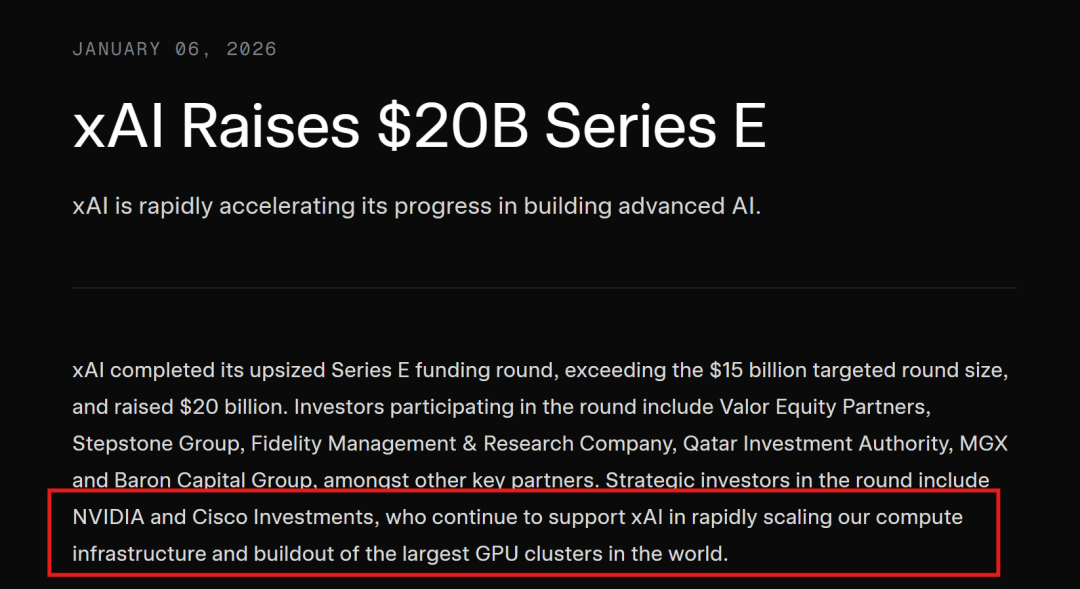
马斯克xAI又融了200亿美元,老黄说到做到投了更多
3 6 Ke· 2026-01-07 07:47
Core Insights - xAI has successfully completed a Series E funding round, raising $20 billion, exceeding previous expectations of $15 billion, with strategic investments from Nvidia and Cisco [1][5][9] - The valuation of xAI is projected to soar from $50 billion at the end of 2024 to over $200 billion within a year, indicating the ongoing AI boom [5][10] Funding Details - The latest funding round includes investments from various strategic and financial entities, such as Valor Equity Partners, Baron Capital Group, Stepstone Group, Fidelity Management & Research Company, Qatar Investment Authority, and UAE's MGX [9][10] - The funds will support xAI's rapid expansion of computing infrastructure and the construction of the world's largest GPU cluster [10] Infrastructure Development - xAI's computing power is set to exceed 1 million H100 GPUs by the end of 2025, with the Colossus I and Colossus II clusters being the largest AI computing clusters globally [10][11] - Colossus I was built in just 122 days and is equipped with approximately 200,000 Nvidia H100/H200 GPUs and 30,000 Nvidia GB200 NVL72 GPUs [10] - Colossus II aims to deploy 110,000 Nvidia GB200 GPUs in its first phase, with a final goal of over 550,000 GPUs [10] Model and Product Development - xAI is advancing its model lineup with Grok 4 series, Grok Voice, and Grok Imagine, while maintaining a comprehensive strategy despite controversies [13] - Active users on xAI's platforms average 600 million monthly, highlighting significant user engagement [13] - Grok 5, the next-generation model, is currently in training and is projected to have a 10% chance of achieving AGI, with a release expected by the end of 2025 [14][16][19] Technical Specifications of Grok 5 - Grok 5 is anticipated to have around 60 trillion parameters, significantly surpassing GPT-4 and doubling Grok 4 [19] - It will utilize a mixed expert architecture and be trained on the Colossus II supercluster, consuming approximately 1 GW of power [19] - The model will feature a native context window of 1.5 million tokens and real-time multimodal processing capabilities [19]
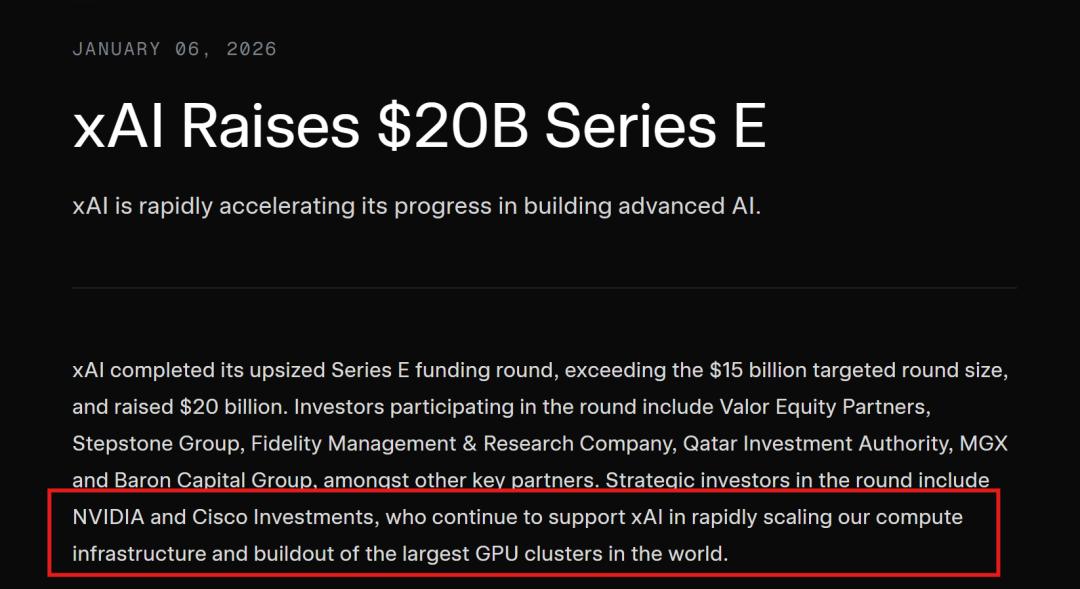
英伟达入局!xAI狂融200亿美元、囤百万GPU,豪赌2026年AGI
Xin Lang Cai Jing· 2026-01-07 06:54
Core Insights - xAI has successfully raised $20 billion in its Series E funding round, exceeding its initial target of $15 billion, which has pushed its valuation to $230 billion, doubling since last spring [1][3] - Elon Musk predicts that xAI will achieve Artificial General Intelligence (AGI) by 2026, emphasizing the urgency and ambition behind the company's goals [5][6] Funding and Investment - The funds raised will be allocated towards infrastructure development, accelerating AI product development, and supporting related research [3] - Notable investors include Valor Equity Partners, Fidelity, Qatar Investment Authority, and Abu Dhabi's MGX, with strategic investments from Nvidia and Cisco to bolster xAI's hardware supply chain [3][5] Technological Development - xAI is focusing on building a robust AI training infrastructure, with plans to deploy over a million H100 GPUs by 2025, establishing itself as a leader in AI training capabilities [7] - The company is advancing its model development with the Grok 4 series and has begun training the next-generation Grok 5 model, which Musk claims has a 10% chance of achieving AGI [7][8] Market Position and Competition - xAI is positioned within a competitive landscape dominated by three major players: OpenAI, valued at $830 billion, and Anthropic, valued at $300 billion, both of which hold significant market shares with their respective products [9] - Despite Musk's confidence in xAI's potential to surpass competitors in the next two to three years, the company faces challenges in model performance and real-world application [9] Regulatory Challenges - xAI is currently facing scrutiny from regulatory bodies, including the EU, due to allegations of its Grok model generating illegal content, which has raised concerns about its safety measures [8][9] - The company has committed to removing illegal content and cooperating with law enforcement, but regulatory pressures are expected to persist in the short term [9]

腾讯研究院AI速递 20250704
腾讯研究院· 2025-07-03 15:31
Group 1 - Google, Nvidia, and seven other institutions have launched the world's first AI-native UGC game engine, Mirage, which can generate game content in real-time through natural language commands [1] - Mirage supports a smooth experience at 16 FPS, allowing for 5-10 minutes of continuous gameplay, with graphics quality comparable to GTA and Forza [1] - The core technology is based on a "world model" created using Transformer and diffusion models, trained on extensive gaming data to enable dynamic interaction and real-time control [1] Group 2 - Zhiyuan Research Institute has released OmniGen2, a unified image generation model that supports text-to-image, image editing, and theme-driven image generation [2] - The model introduces an innovative image generation reflection mechanism, significantly enhancing context understanding, instruction adherence, and image generation quality [2] - OmniGen2 has an open research experience version, with model weights, training code, and training data fully open-sourced, achieving over 2000 stars on GitHub within a week [2] Group 3 - Google has announced the free provision of the Gemini AI tool suite to global educators, deeply integrated into Google Classroom and ChromeOS [3] - Gemini in Classroom includes over 30 AI tools that can automatically generate lesson plans, classroom activities, and quiz questions, saving teachers preparation time [3] - New AI tools like NotebookLM and Gems, along with data analysis features, aim to create personalized learning experiences and data-driven teaching [3] Group 4 - Xingliu Agent is a multifunctional AI creation platform that can complete various creative tasks such as batch emoji generation, brand VI design, video generation, and 3D modeling through natural language commands [4][5] - Key features include high-quality content generation in bulk, Kontext intelligent image editing, and full media workflow support, establishing a new design paradigm of "Vibe designing" [5] - The platform offers free experience credits and supports diverse creative outputs, shifting the designer's role from "mastering technology" to "understanding needs and expressing creativity" [5] Group 5 - Tencent Yuanbao has introduced a new feature that supports AI-based image and video content search, allowing intelligent matching of content without restrictions on model usage [6] - The results can intelligently reference related video tutorials, facilitating a combination of text and video explanations, with one-click access to watch the videos [6] - Users can continue to ask follow-up questions after receiving initial answers, enhancing the interactive experience [6] Group 6 - The Xie Saineng team has released the Blender Fusion framework, enabling precise control of 3D scenes without relying on text prompts [7] - The core technology involves a three-step process: separating objects and scenes using the SAM model, editing in Blender, and generating high-quality composite images with a diffusion model [7] - The system employs a dual-stream diffusion synthesizer to enhance generalization and realism through techniques like source occlusion and simulated object jitter [7] Group 7 - xAI is set to release the new Grok 4 series, including the flagship Grok 4 and the specialized programming model Grok 4 Code, with a launch expected after the U.S. National Day [8] - Grok 4 features a context window of 130,000 tokens, supports function calls, structured outputs, and reasoning capabilities, but currently lacks visual and image generation functions [8] - Elon Musk aims for Grok 4 to rewrite the human knowledge base, filling in missing information and correcting errors, while Grok 4 Code will serve as a professional programming assistant [8] Group 8 - The U.S. Department of Commerce has lifted temporary bans on the three major EDA companies, Siemens, Synopsys, and Cadence, allowing full access to their software and technology for Chinese customers [11] - Previously, a sudden export restriction led to a significant drop in stock prices, with Synopsys predicting a 28% year-on-year decline in revenue from the China region [11] - The domestic EDA industry faces challenges regarding maturity and market share, as chip design companies prefer using more mature foreign products to ensure successful tape-out [11] Group 9 - The World Economic Forum's "2025 Global Future of Jobs Report" indicates that AI and machine learning specialists will be the fastest-growing occupations, with an expected growth of 86% in job numbers [12] - AI is set to reshape the global labor market, with data analytics, cybersecurity, and technical literacy emerging as the three fastest-growing skills, while traditional roles like data entry clerks and administrative assistants face declining demand [12] - Approximately 39% of employees' skills are expected to change significantly between 2025 and 2030, yet only 50% of employees have received systematic training, with 63% of employers viewing skill gaps as the biggest obstacle to business transformation [12]