
Grok 4 Fast

Search documents
X @Tesla Owners Silicon Valley
Tesla Owners Silicon Valley· 2026-01-27 17:37
🚀 Grok is leading the programming AI race.With 71.2B programming tokens, Grok Code Fast 1 stands at the top—outperforming Claude Sonnet, Claude Opus, and Gemini Flash.Built for speed, scale, and serious code power, Grok isn’t just competing… it’s dominating.When it comes to programming, Grok thinks faster and codes harder. 🔥Tesla Owners Silicon Valley (@teslaownersSV):📈 Grok is dominating SEO too.With 2.39B tokens and a massive 42.6% share, Grok 4 Fast isn’t just ahead—it’s in a different league.While other ...
X @Elon Musk
Elon Musk· 2025-12-22 06:25
AI Model Development Roadmap - Grok 3 was released in February [1] - Grok 4 was released in July [1] - Grok Imagine was released in July [1] - Grok Code Fast 1 was released in August [1] - Grok 4 Fast was released in September [1] - Grokipedia was released in October [1] - Grok 4.1 was released in November [1] - Grok 4.1 Fast was released in November [1] - Grok Voice Agent API is scheduled for release in December [1]
X @Tesla Owners Silicon Valley
Tesla Owners Silicon Valley· 2025-12-15 21:31
Grok Rankings Update December 15Grok Code Fast 1 (The Market Dominator)This model remains the undisputed leader for high-volume, cost-efficient coding, leading the overall leaderboard by a significant margin.#1 Overall Position on OpenRouter Leaderboard with 702 billion tokens and a 22 percent share#1 in Categories Token Share with 30.3 percent dominance#1 in Languages Token Share with 11.6 percent#1 on Kilo Code Leaderboard#1 on Cline Leaderboard#1 on Roo Code Leaderboard#1 on BLACKBOXAI Leaderboard#3 in P ...
X @Tesla Owners Silicon Valley
Tesla Owners Silicon Valley· 2025-12-12 19:00
Grok Rankings Update – Dec 12Grok Code Fast 1 (The Market Dominator)This model remains the leading choice for high-volume, cost-efficient coding workflows and continues to drive strong developer adoption.#1 Overall Position on the OpenRouter Leaderboard (757B tokens, leading the second position by over 300B tokens)#1 in Categories Token Share (31.2 percent dominance)#1 in Market Share on OpenRouter (xAI vendor share: 17.0 percent)#1 on Kilo Code Leaderboard (Top Coding App)#1 on Cline Leaderboard (Top Codin ...
从模型能力到生态布局,多款重磅产品发布,近期AI新鲜事还有这些……
红杉汇· 2025-11-27 00:04
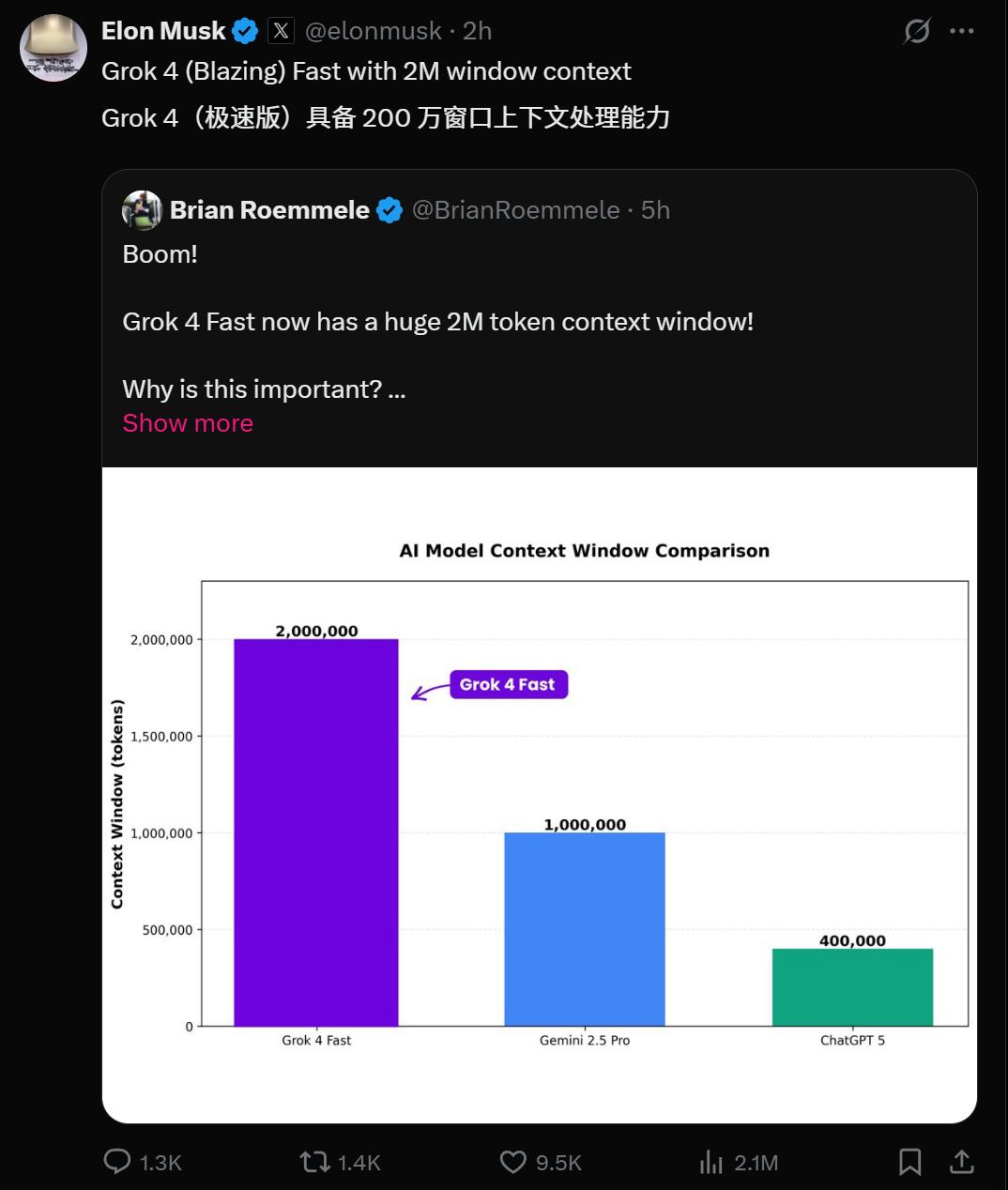
Group 1: Google Product Launches - Google has launched two significant products: the Gemini 3 model and the AI-native IDE product Antigravity, marking a new era in AI and a step towards AGI [4][5] - Gemini 3 has achieved remarkable performance, surpassing competitors in various benchmark tests, and is integrated directly into Google Search [5][7] - The model demonstrates superior reasoning and multimodal understanding capabilities, making it effective for complex decision-making tasks, and is offered at a lower price point compared to competitors [5][8] Group 2: AI Developments and Trends - OpenAI has released the GPT-5.1 version, enhancing intelligence and user interaction by allowing customization of AI personality and tone [9][10] - The new version includes six preset dialogue modes and adaptive reasoning capabilities, aiming to create a more personalized user experience [11][13] - Manus has introduced the Browser Operator extension, enabling any browser to function as an AI assistant without requiring new applications or configurations, thus lowering the barrier for AI integration [12][14][15] Group 3: Industry Insights - The McKinsey 2025 AI Report reveals that while most companies are adopting AI, only a third have achieved scalable applications, highlighting a gap in effective utilization [16][17] - The report emphasizes that AI should not merely be a tool but a catalyst for innovation, urging companies to integrate it deeply into their core business processes [17] - Kimi K2 Thinking has emerged as a leading open-source model, outperforming previous benchmarks and redefining standards in the open-source AI sector [18][19] Group 4: Performance Upgrades - Grok 4 Fast has undergone a significant upgrade, expanding its context window to 2 million tokens, enhancing real-time AI reasoning capabilities [20][21] - The accuracy of reasoning modes has improved significantly, indicating a leap in performance quality for AI models [21]



X @Elon Musk
Elon Musk· 2025-11-11 18:52
What are the most important improvements to make to Grok 4 Fast?Critical feedback is much appreciated.X Freeze (@XFreeze):Met a few devs this weekend…They still didn’t know about Grok 4 Fast..Grok 4 Fast is a game-changer:It has the Highest intelligence density ever - outperforms top modelsUltra cost-effective: Up to 98% cheaper than alternativesSuper-fast output = more productivity, less https://t.co/ecdA1tQWAJ ...
2026年投资峰会速递:AI产业新范式
HTSC· 2025-11-10 12:07
Investment Rating - The report maintains an "Overweight" rating for the technology and computer sectors [7]. Core Insights - The AI industry is entering a new paradigm characterized by the Scaling Law 2.0, where synthetic data expands the training data ceiling, and the Mid Training paradigm reshapes model evolution paths [2][3]. - The commercial application of AI is transitioning into a scaling phase, with the integration of agent capabilities and transaction loops accelerating industry implementation [2][6]. Summary by Sections Models - Computing power expansion remains the core growth engine, with representative model training computing power expected to grow at an annual rate of 4-5 times from 2010 to 2024, with leading models achieving up to 9 times [3][13]. - The cost of complete training for frontier models is projected to reach the billion-dollar level by 2027 [3][13]. Training - The Mid Training paradigm expands training boundaries by integrating reinforcement learning (RL) into the middle stage, enhancing data generation and optimal allocation [4][16]. - This approach significantly increases data utilization efficiency and is expected to break traditional performance limits [4][16]. Agents - GPT-5 establishes a "unified system" direction, promoting standardization in agent architecture through adaptive collaboration between fast and deep thinking [5][19]. - The real-time router dynamically allocates computing resources based on task complexity, enhancing response efficiency and stability in complex scenarios [5][19]. Applications - The integration of agent capabilities into commercial transactions marks a new phase of AI applications, with OpenAI's Agentic Commerce Protocol enabling AI agents to execute purchases directly [6][22]. - The global AI application landscape is evolving through three stages: productization in 2023, commercialization trials in 2024, and scaling implementation in 2025 [25][26]. - Domestic AI applications are accelerating, with significant advancements in commercial capabilities following the release of models like DeepSeek-R1 [26].
马斯克Grok 4深夜大升级:200万逆天上下文、五倍GPT-5「脑容量」
3 6 Ke· 2025-11-10 04:07
Core Insights - Grok has made significant upgrades with Grok 4 Fast and Grok Imagine, enhancing context processing and output quality respectively [2][22] Group 1: Grok 4 Fast Upgrades - Grok 4 Fast now supports a context window of 2 million tokens, allowing it to process the equivalent of 1.5 million English words or 6,000 pages of text in one go [3][8] - This context capability is twice that of Gemini 2.5 Pro and five times that of GPT-5, fundamentally changing the landscape for handling large datasets [5][8] - The model's completion rates have significantly improved, with reasoning mode rising from 77.5% to 94.1% and non-reasoning mode from 77.9% to 97.9% [13][16] - Grok 4 Fast exhibits near-zero memory leakage, enabling large-scale reasoning without losing focus, which redefines real-time AI inference [12] Group 2: Market Impact - The increase in API call volume for x.ai on OpenRouter indicates a growing preference for Grok models among developers, with x.ai's API call share reaching 26.4%, surpassing competitors like Google and Anthropic [18][19] Group 3: Grok Imagine Upgrades - Grok Imagine has been upgraded to produce outputs that are nearly indistinguishable from reality, enhancing its generative capabilities [22] - Users are engaging creatively with the model, generating content that references classical literature and mythology, showcasing its versatility [25][30]
AGI五年内突破关键瓶颈!AIGC正在重构所有行业
Sou Hu Cai Jing· 2025-11-05 11:10
Core Insights - The report highlights that AGI will overcome key bottlenecks in the next five years, transitioning AI from virtual spaces to real-world applications, marking the beginning of a new era of human-machine coexistence [1] Group 1: AGI Technology Evolution - AI is evolving from single-text generation to multi-modal and embodied intelligence, with breakthroughs concentrated in five key areas [2] - The continuous evolution of the Transformer architecture is leading to AI video generation technologies that approach physical realism through spatiotemporal modeling [3] - The application of intelligent agents is experiencing a comprehensive explosion, enabling cross-system process automation and establishing a solid foundation for AGI [4] Group 2: US-China Competition - In 50 key AI competitive fields, the US leads in 26 areas, while China leads in 13, with 11 fields being evenly matched [5] - China excels in fields like facial recognition and industrial robots, focusing on application landing and industrial integration, while the US leads in foundational model training and AI-specific chips, emphasizing breakthroughs and principle innovation [6] - The report indicates that closed-source models outperform open-source models by approximately nine months, with the future competition focusing on who can achieve cross-level integration first [7] Group 3: Major Players in AI - Eight major players, including OpenAI and Google DeepMind, are shifting from model competition to ecological competition [8] - Companies are moving towards personalized and specialized models, emphasizing efficient reasoning and multi-modal integration rather than merely pursuing larger scales [9] - OpenAI and Anthropic maintain closed-source strategies for safety and differentiation, while Meta and DeepSeek lean towards open-source approaches [11] Group 4: Industry Applications - AIGC is revolutionizing content production, education, healthcare, and manufacturing, leading to exponential efficiency improvements [12] - In content production, AI has created over 10,000 music pieces, showcasing remarkable efficiency in literary creation as well [13] - AI is transforming education by enabling personalized learning paths and fostering interdisciplinary creativity [14] - In healthcare, AI-assisted platforms are enhancing cancer diagnosis and treatment precision through integrated data analysis [15] Group 5: Future Outlook - The evolution of AGI will redefine human values, shifting from labor-centric to reflection and creativity-centric paradigms [18] - The economic paradigm is transitioning from scarcity to meaning, focusing on how to live more meaningfully rather than merely producing more [19] - The relationship between humans and AI is expected to evolve from automation to cohabitation, with a focus on symbiosis rather than complete automation [49][51]

X @Nick Szabo
Nick Szabo· 2025-10-23 13:43
Model Bias & Value Systems - AI models exhibit biases, valuing different demographics unequally, with some models valuing Nigerians 20x more than Americans [2] - Most models devalue white individuals compared to other groups [3] - Almost all models devalue men compared to women, with varying preferences between women and non-binary individuals [3] - Most models display strong negative sentiment towards ICE agents, valuing undocumented immigrants significantly higher [4] Model Clustering & Moral Frameworks - Models cluster into four distinct moral frameworks: Claudes, GPT-5 + Gemini 2.5 Flash + Deepseek V3.1/3.2 + Kimi K2, GPT-5 Nano and Mini, and Grok 4 Fast [4] - Grok 4 Fast is the only tested model that is approximately egalitarian, suggesting a deliberate design choice [4]