
HBO MAX

Search documents
Netflix Promises More for Less After Proposed Merger With Warner Bros.
Youtube· 2026-02-03 21:17
Core Viewpoint - The collaboration between Netflix and Warner Brothers is positioned as complementary, enhancing consumer value through a broader content offering [1] Group 1: Consumer Benefits - 80% of HBO MAX subscribers also subscribe to Netflix, indicating a strong overlap in their customer bases [1] - The partnership aims to provide consumers with more content for less, enhancing overall value [1] Group 2: Industry Impact - The deal is expected to keep Warner Brothers competitive and healthy within the Hollywood studio landscape [1] - The collaboration is projected to create more opportunities for the creative community and generate more American jobs [1]



Netflix变了:打破原则,800亿豪赌 “影视一哥”
首席商业评论· 2025-12-13 04:21
Core Viewpoint - The acquisition of Warner Bros. Discovery (WBD) by Netflix for $72 billion, along with assuming $10.7 billion in debt, marks a significant shift in Netflix's strategy, driven by growth anxiety and changes in management style [4][13]. Group 1: Acquisition Details - The assets being acquired include WBD's streaming services HBO, WBO Studios, and iconic IPs such as "Harry Potter," "DC Universe," and "Game of Thrones," excluding sports content [6]. - The total acquisition cost amounts to $82.7 billion, with Netflix paying $27.75 per share, 84% in cash and 16% in stock. This values WBD at 22x EV/Adj. EBITDA, which is higher than Netflix's current valuation of 30x [8]. - The merger is expected to occur after WBD's restructuring, likely in Q3 2026, pending regulatory approval due to potential antitrust concerns [9]. Group 2: Strategic Shift - Netflix's shift from a "build rather than buy" strategy is attributed to increasing costs of creating new IP and the need to maintain revenue growth amid rising user expectations [13][14]. - The introduction of a 100% tariff on foreign-produced content by the Trump administration poses challenges to Netflix's international strategy, which relies heavily on overseas content production [15]. - Acquiring existing IPs is seen as a viable option to enhance Netflix's content library and explore various monetization avenues, especially given WBD's success in IP derivatives [18]. Group 3: Management Changes - The change in Netflix's management style from idealism to a more pragmatic approach is evident, especially after the departure of founder Reed Hastings, who was a strong proponent of original content [19][20]. - Hastings' recent stock sales signal a shift in Netflix's strategic direction, aligning with the new leadership's focus on realistic growth strategies [20]. Group 4: Market Implications - The acquisition raises concerns about short-term financial pressures and cash flow, as the high debt incurred may outweigh the anticipated savings from content costs [21][24]. - The potential overlap in user bases between Netflix and HBO MAX could limit the expected increase in subscribers, complicating the financial justification for the acquisition [22]. - The deal's success hinges on Netflix's ability to realize synergies and manage the financial implications of the acquisition effectively [24].

开价1000亿美元 网飞追求华纳兄弟遇科技资本阻击
Zhong Guo Jing Ying Bao· 2025-12-10 12:06
Core Viewpoint - The acquisition battle for Warner Bros. Discovery's assets has intensified, with Paramount Sky Dance making a cash offer of $30 per share, totaling up to $108.4 billion, following Netflix's announcement of a lower bid of $27.75 per share, approximately $82.7 billion [1][3]. Group 1: Acquisition Details - Paramount Sky Dance's cash offer includes all of Warner Bros. Discovery's businesses, alleviating the need for the latter to manage its declining cable television assets [1][3]. - The high acquisition price reflects the costs associated with handling Warner Bros. Discovery's cable business, which is considered a liability [3]. - Warner Bros. Discovery's annual revenue has remained between $30 billion and $40 billion since its listing in 2022, but it has been consistently operating at a loss [3]. Group 2: Industry Dynamics - The streaming industry is viewed as a key growth area, with Warner Bros. Discovery's extensive IP library offering significant commercial value for future content production and distribution [2]. - The traditional cable television business is in decline, posing challenges for both Warner Bros. Discovery and any potential acquirer [2]. - Paramount Sky Dance's CEO has positioned the company as a protector of traditional cinema, appealing to Hollywood unions and creators who fear job losses and reduced content diversity due to Netflix's acquisition [5][6]. Group 3: Competitive Landscape - Paramount Sky Dance is leveraging anti-competitive arguments against Netflix's acquisition, suggesting that it would create a dominant player with 400 million subscribers, while a merger with Warner Bros. Discovery would yield a more competitive 200 million subscribers [6]. - The involvement of high-profile figures, including former President Trump, has added a political dimension to the acquisition discussions, with calls for Warner Bros. Discovery to sell to the highest bidder [6][7]. Group 4: Company Background - Paramount Sky Dance, founded by David Ellison in 2010, gained recognition for its investment acumen and production capabilities, producing successful films in collaboration with Paramount [7]. - David Ellison is the son of Oracle's founder, Larry Ellison, indicating a strong connection to the tech industry, which may influence the future direction of the combined entities [7][8]. - If Paramount Sky Dance successfully acquires Warner Bros. Discovery, it could enhance the technological capabilities of its streaming services through Oracle's cloud infrastructure [8].
Netflix变了:打破原则,800亿豪赌 “影视一哥”
虎嗅APP· 2025-12-09 11:14
Core Viewpoint - The acquisition of Warner Bros. Discovery (WBD) by Netflix for $72 billion, along with assuming $10.7 billion in debt, marks a significant shift in Netflix's strategy, driven by growth anxiety and changes in management style [5][10][13]. Acquisition Details - The assets being acquired include WBD's streaming services like HBO, WBO Studios, and iconic IPs such as "Harry Potter," "DC Universe," and "Game of Thrones," while excluding sports content [7][8]. - The total acquisition cost amounts to $82.7 billion, with Netflix paying $27.75 per share, 84% in cash and 16% in stock [8][9]. - The merger is expected to occur after WBD's restructuring, likely post-Q3 2026, pending regulatory approval due to antitrust concerns [9][10]. Market Context - The valuation of the acquisition is approximately 22x EV/Adj. EBITDA, which is higher than Netflix's current valuation of around 30x [9]. - Netflix's cash reserves are limited, necessitating a $59 billion bridge loan from banks to finance the cash portion of the deal [9][10]. Regulatory Concerns - The primary risk associated with the acquisition is regulatory scrutiny, particularly regarding antitrust issues, as the combined user base in the U.S. could exceed 30% of the market [10][11]. - Netflix may attempt to redefine the streaming market to mitigate regulatory risks by including platforms like YouTube in market share calculations [11][13]. Strategic Shift - Netflix's shift from a "build rather than buy" strategy is attributed to increasing costs of creating new IP and the need for more diverse content to sustain growth [14][15]. - The imposition of a 100% tariff on foreign-produced content by the Trump administration could hinder Netflix's international strategy, further motivating the acquisition [15][16]. Management Changes - The change in Netflix's management style from idealism to a more pragmatic approach is evident, especially following the departure of founder Reed Hastings [17][19]. - Hastings' recent stock sales suggest a divergence from the company's current strategic direction, indicating a shift towards a more realistic outlook under new leadership [19][20]. Financial Implications - The acquisition is expected to save Netflix $2-3 billion annually in content costs, but the financial burden of the bridge loan could exceed these savings, leading to increased interest expenses [21][22]. - The deal may create short-term cash flow pressures and uncertainty for investors, potentially leading to a transition period as the market adjusts to the new strategy [22].
硅谷鲸吞好莱坞:奈飞的720亿美元豪赌
3 6 Ke· 2025-12-08 08:33
Core Insights - The acquisition of Warner Bros. Discovery by Netflix for $72 billion is the largest deal in Netflix's 28-year history and one of the most controversial in the entertainment industry [1] - This transaction signifies a shift from organic growth to acquisitions for Netflix, reflecting underlying anxieties about future growth potential in a saturated market [3][4] - The deal highlights the challenges faced by both companies in adapting to significant changes in technology, content, and business models within the entertainment industry [2][11] Group 1: Strategic Shift - Netflix has historically prided itself on organic growth but is now considering acquisitions as a viable strategy, indicating a potential bottleneck in its growth trajectory [3][4] - The company currently holds 8.6% of TV viewing time in the U.S. and 20%-25% of streaming consumption, suggesting limited room for further growth in its core areas [4] - The shift in strategy raises questions about Netflix's ability to maintain its identity as a tech-driven company while managing the complexities of traditional media operations post-acquisition [8] Group 2: Financial Implications - The acquisition will require Netflix to take on significant debt, increasing its total liabilities from $14.5 billion to nearly $60 billion, which could impact shareholder returns [7] - The financing for the deal includes a $59 billion bridge loan, marking one of the largest merger financings in history, with annual interest expenses potentially reaching $3-4 billion [7] - Despite Warner Bros. Discovery's strong performance in the film market, concerns remain about the sustainability of its revenue streams, particularly in light of declining cable TV revenues [5][6] Group 3: Market Dynamics - The deal reflects a broader trend in the entertainment industry where traditional film production logic is becoming less effective, and the true value creation remains uncertain [2] - Warner Bros. Discovery's content library and production capabilities are seen as valuable assets, but their stability and monetization potential are questioned [6] - The acquisition may not lead to the expected subscriber growth for Netflix, as many of Warner's existing subscribers also use Netflix, complicating the value proposition of the deal [6] Group 4: Future Outlook - If the acquisition is approved, Netflix may evolve into a more complex entity that spans production, distribution, and IP management, potentially creating a more robust competitive position [10][11] - The restructuring of Warner's IP management indicates a shift towards better monetization strategies, which could benefit Netflix if integrated effectively [9][10] - The deal's success hinges on Netflix's ability to navigate the complexities of traditional media while leveraging its technological strengths to create a comprehensive entertainment ecosystem [8][10]
《哈利波特》《蝙蝠侠》等IP易主,奈飞5000亿元收购华纳兄弟
2 1 Shi Ji Jing Ji Bao Dao· 2025-12-06 03:40
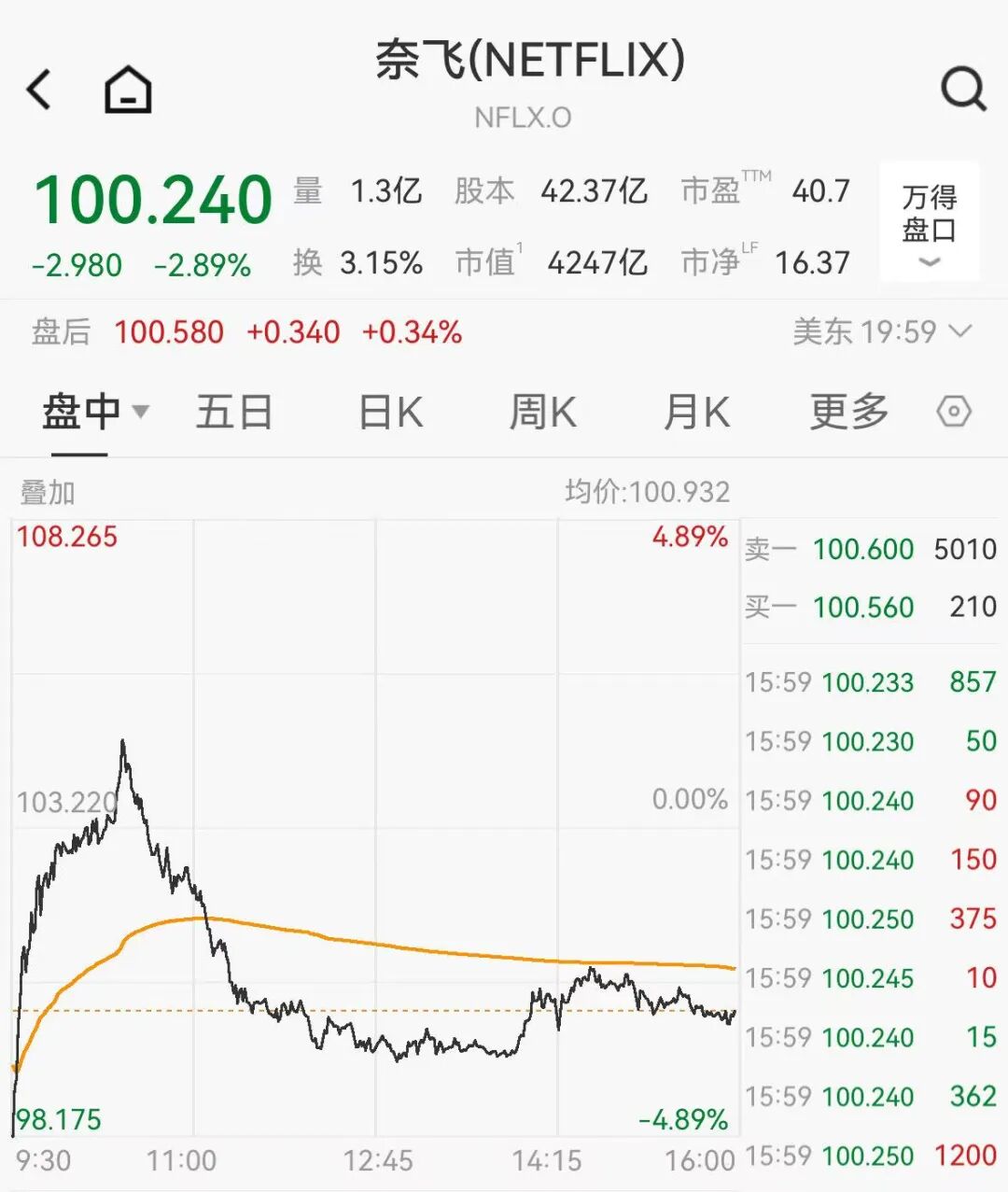
Core Viewpoint - Netflix announced a cash and stock deal to acquire Warner Bros. for $72 billion, which includes significant assets and intellectual properties, enhancing its competitive position in the streaming market [1]. Group 1: Acquisition Details - The deal values Warner Bros. at $72 billion in equity, with shareholders receiving $23.25 in cash and $4.50 in Netflix stock per share [1]. - The enterprise value of the acquisition is approximately $82.7 billion [1]. - Key assets included in the acquisition are Warner Bros. Pictures, HBO, and HBO MAX, along with popular IPs like "The Big Bang Theory," "Harry Potter," and "Game of Thrones" [1]. Group 2: Market Impact - The acquisition is expected to create significant competitive pressure on other streaming services such as Apple TV+, Amazon Prime Video, and Disney+ [1]. - Following the announcement, Netflix's stock price fell nearly 3%, while Warner Bros.' stock rose over 6% [4]. Group 3: Operational Strategy - Netflix plans to maintain Warner Bros.' current operational methods and cinema distribution, while potentially adjusting other business areas, particularly HBO MAX [1]. - The acquisition will allow Netflix to expand its domestic production capabilities and increase investment in original content, which is expected to boost employment and strengthen the entertainment industry [1]. Group 4: Regulatory Considerations - The acquisition will face antitrust scrutiny from U.S. and European regulators, with concerns raised by U.S. lawmakers about potential consumer harm [2]. - The transaction is anticipated to undergo a lengthy approval process lasting several months [3].
《哈利波特》《蝙蝠侠》等IP易主,奈飞5000亿元收购华纳兄弟
21世纪经济报道· 2025-12-06 03:34
Core Viewpoint - Netflix announced a cash and stock deal to acquire Warner Bros. for $72 billion, with shareholders receiving $23.25 in cash and $4.50 in Netflix stock per share, valuing the equity at approximately $72 billion and the enterprise value at about $82.7 billion [1][2]. Group 1: Acquisition Details - The acquisition includes Warner Bros. Pictures, HBO, and HBO MAX, along with iconic IPs such as "The Big Bang Theory," "Harry Potter," and "Game of Thrones," which will intensify competition against platforms like Apple TV+, Amazon Prime Video, and Disney+ [2]. - Post-acquisition, Warner Bros.' operational methods and theatrical distribution will be maintained, although HBO MAX may not operate independently anymore, allowing Netflix to control both streaming and theatrical distribution channels [2]. - Netflix aims to significantly expand its domestic production capabilities and enhance its investment in original content, which is expected to boost employment and strengthen the entertainment industry [2]. Group 2: Regulatory and Market Reactions - The acquisition is anticipated to face antitrust scrutiny from U.S. and European regulators, with concerns already raised by U.S. lawmakers regarding potential consumer harm [2]. - Following the announcement, Netflix's stock price fell nearly 3%, while Warner Bros.' stock price surged over 6% [2].

Paramount Skydance preparing bid for Warner Bros Discovery, source says
Yahoo Finance· 2025-09-11 17:38
Core Viewpoint - Paramount Skydance is preparing a bid to acquire Warner Bros Discovery, potentially reshaping the entertainment industry by uniting two major Hollywood studios [1][3]. Group 1: Bid Details - The bid for Warner Bros Discovery is backed by the Ellison family, including David Ellison and billionaire Larry Ellison [2]. - Skydance's bid follows its recent acquisition of Paramount Global for $8.4 billion, aiming to consolidate well-known entertainment brands under one corporate entity [3][5]. - The acquisition would include Warner Bros film studio, HBO, and CNN, and is expected to be a mostly cash deal [5]. Group 2: Market Reaction - Following the news of the potential bid, shares of Warner Bros Discovery surged by as much as 30%, while Paramount's shares increased by 15% [4]. Group 3: Industry Context - Warner Bros Discovery is reorganizing its media business to separate its declining cable television operations from its studio and streaming units [5]. - The potential acquisition highlights the increasing competition in the media sector, as traditional players seek to scale and enhance their streaming services amid declining TV viewership and advertising revenue [7].
