
LPO技术

Search documents
全球半导体最新展望
智通财经网· 2026-02-18 04:04
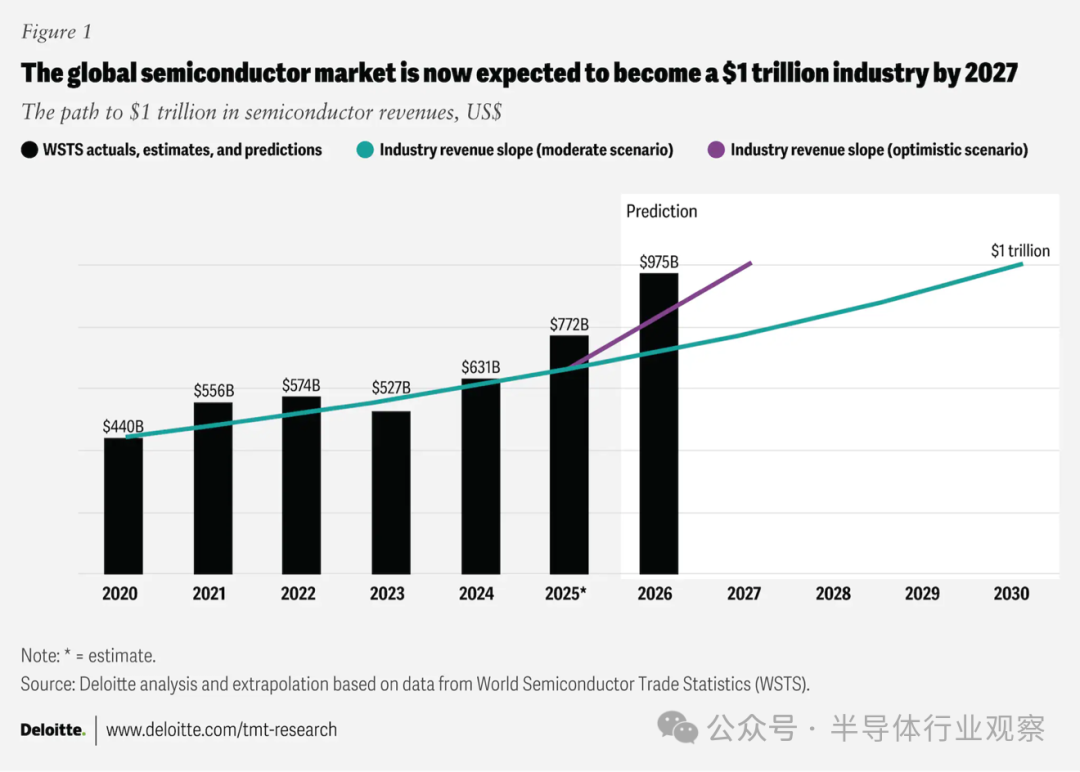
Core Insights - The semiconductor industry is projected to reach a record sales figure of $975 billion by 2026, driven primarily by the growth of artificial intelligence infrastructure [2] - The industry faces a paradox where strong demand from AI is pushing revenues to unprecedented heights, but there are significant risks associated with over-reliance on AI [1][5] - By 2026, AI chips are expected to account for nearly 50% of total industry revenue, yet their production volume remains low, highlighting a structural disparity [5][6] Market Conditions - The semiconductor industry's growth rate is expected to accelerate from 22% in 2025 to 26% in 2026, with long-term projections indicating sales could reach $2 trillion by 2036 [5] - The total market capitalization of the top ten semiconductor companies reached $9.5 trillion by December 2025, a 46% increase from the previous year [5] - The revenue from generative AI chips is forecasted to approach $500 billion by 2026, representing about half of global chip sales [5] Supply Chain Dynamics - The average selling price of chips is projected to be $0.74, with total chip sales expected to reach 1.05 trillion units by 2025 [6] - Memory revenue is anticipated to reach approximately $200 billion in 2026, constituting 25% of total semiconductor revenue [6] - The semiconductor industry is experiencing a supply-demand imbalance, particularly in memory products, leading to significant price increases [7][25] Strategic Considerations - The industry must address potential declines in AI chip demand post-2026 while maintaining high cash levels and low debt [13] - There is a need for strategic partnerships and investments to build ecosystems around semiconductor manufacturing and AI chip platforms [20][22] - The rise of vertical integration among semiconductor and AI infrastructure providers indicates a shift in capital allocation strategies [20][29] Future Outlook - The semiconductor industry is expected to face capacity constraints in 2026, impacting the production of advanced logic processes and memory chips [23][24] - Geopolitical factors and material supply limitations may disrupt procurement and manufacturing processes [19][26] - The transition of AI workloads from training to inference may challenge existing market leaders in AI GPU, CPU, and memory sectors [28]

算力需求驱动 产业链加快技术迭代
Zhong Guo Zheng Quan Bao· 2025-09-15 20:24
Core Insights - The demand for AI computing power is rapidly increasing, driving the evolution of core components and packaging technologies in the optical communication industry [1] - The integration of AI and optical communication technologies is a focal point at the 26th China International Optoelectronic Expo, with companies actively responding to advancements in optical modules and Co-Packaged Optics (CPO) technology [1][2] Industry Trends - Major companies in the optical communication sector showcased their innovations at the expo, including products from Guangxun Technology and Luxshare Technology, focusing on CPO and 1.6T optical modules [2] - The global optical module market is expected to experience a structural explosion, reaching a market size of $12.1 billion by 2025, driven by AI computing clusters and supercomputing centers [3] Company Performance - NewEase achieved a revenue of 10.437 billion yuan in the first half of the year, a year-on-year increase of 282.64%, with net profit rising by 355.68% [4] - Zhongji Xuchuang reported a revenue of 14.789 billion yuan, up 36.95% year-on-year, with a net profit increase of 69.40%, driven by the demand for 800G and 1.6T products [4] - Tianfu Communication's revenue reached 2.456 billion yuan, a 57.84% increase year-on-year, with net profit growing by 37.46% [4] Technological Developments - Nazhen Technology reported a 124% year-on-year revenue growth, reaching 4.216 billion yuan, with optical module revenue accounting for 77.9% of total revenue [5] - The industry is witnessing a shift towards higher integration and miniaturization in optical interconnects, with CPO technology expected to penetrate over 20% of AI data centers by 2026 [3] Capacity Challenges - The industry is transitioning from a demand-focused phase to addressing challenges related to timely delivery and production capacity [6] - Companies are facing tight supply of key raw materials, which is impacting inventory management [7] - Guangxun Technology plans to raise up to 3.5 billion yuan for the production of optical connection and high-speed optical transmission products, indicating ongoing investment in capacity expansion [7]

