MDT智能体

Search documents
从“被动存储”到“主动利用”,数据治理重塑未来医疗
3 6 Ke· 2025-11-29 10:19
Core Insights - The article highlights the increasing importance of high-quality data in the biopharmaceutical industry, especially following the NIH's ban on certain researchers accessing critical biological databases, emphasizing that data is now a core strategic resource [1] - The establishment of the National Data Bureau in China marks a significant step in promoting data governance and the integration of medical data as a valuable resource for innovation and efficiency in healthcare [2] Group 1: Data Governance and Integration - The strategic position of data has been elevated at the national level, with data now recognized as a key production factor alongside traditional elements like land and labor [2] - The Shanghai city has initiated the "Shanghai Urban Trusted Data Space" project, attracting nearly 300 companies and developing over 300 data products, showcasing the active efforts in building a trusted data ecosystem [2] - Medical data is transitioning from being a byproduct of patient treatment to a powerful driver for medical innovation and resource optimization [3] Group 2: Real-World Data and Drug Development - The construction of a big data platform for late-stage pancreatic cancer has gathered data from 100,000 patients across 31 provinces, providing a solid foundation for precision treatment [5] - Real-world evidence (RWE) is becoming crucial in drug development, allowing for faster and more efficient research processes compared to traditional clinical trials [6][7] - The use of historical real-world data can significantly reduce the time required for drug approval, enabling quicker access to new treatments for patients [7] Group 3: Challenges and Innovations - Despite the abundance of real-world data in China, the quality of this data varies, presenting challenges for effective data governance and utilization [7] - The issue of "data silos" and the need for improved communication between data providers and users are highlighted as significant barriers to achieving effective data flow [8][10] - Innovations such as the MDT intelligent system developed by Roche and local hospitals aim to enhance data structuring and extraction efficiency, paving the way for more insightful clinical practices [9]
AI如何重塑医疗生态?跨国力量与本土智慧共筑高分答案
36氪· 2025-11-10 10:23
Core Viewpoint - The integration of AI in healthcare is revolutionizing the industry, making medical exploration faster and more precise [2][3][15] Group 1: AI's Impact on Healthcare - AI is transforming the healthcare sector, with applications in drug development, medical imaging diagnostics, and clinical decision support systems [3] - The rise of AI is driven by both policy support and market demand, positioning healthcare as a promising core area for AI development [3][12] - Roche is emerging as a key player in the transformation of the healthcare ecosystem, actively embracing AI technologies [3][12] Group 2: Addressing Physician Workload - A significant challenge in healthcare is to free up physicians from administrative burdens to enhance system efficiency [5][6] - The introduction of AI tools like "Xiao Luo Zhi Duo Xing" aims to alleviate the workload of physicians by providing comprehensive research solutions [7][8] - This AI tool has already been implemented in 700 top-tier hospitals across 90 cities, saving over 20,000 hours of research time for more than 4,000 doctors [9] Group 3: Data Management Challenges - Fragmented data across different hospitals complicates the implementation of smart healthcare solutions, creating "information islands" [10] - The clinical documentation process is identified as a high-potential area for AI investment, with a market size of $600 million in the U.S. alone [10] - Roche's collaboration with Fudan University and Shanghai AI Lab has led to the development of the MDT (Multidisciplinary Team) AI tool, which significantly reduces the time needed for patient history organization [10][11] Group 4: Building an AI-Driven Ecosystem - The healthcare sector is seen as one of the most underestimated areas for AI applications, with a vision for universal access to precise diagnostic services [13][14] - Roche emphasizes the importance of integrating AI into clinical applications to address real pain points faced by doctors and patients [14] - The company is committed to creating an open and collaborative medical innovation ecosystem through various initiatives, including the "Knowledge Action Institute" and "Smart Medical Incubator 2.0" [14]


进博观察:AI与脑机接口齐飞,“最卷展区”上演未来照进现实
Xin Jing Bao· 2025-11-08 06:55
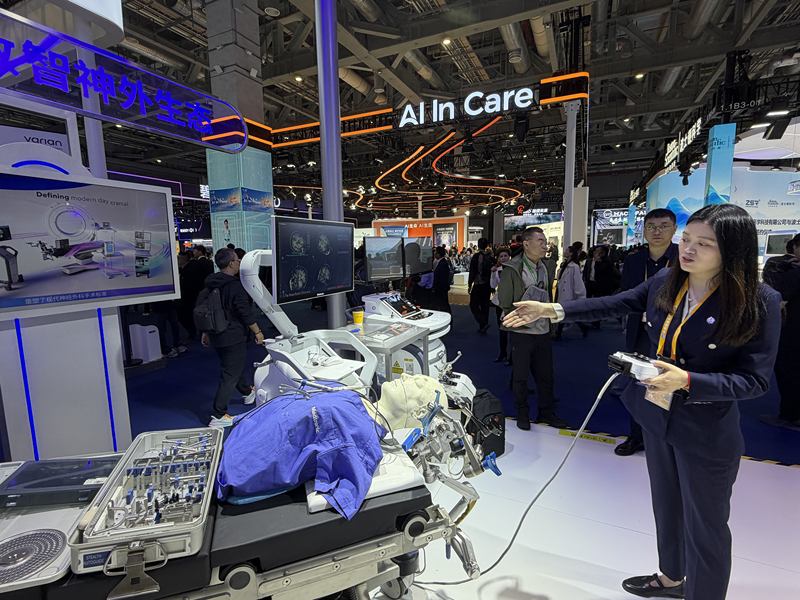
Core Insights - The integration of AI in the medical and pharmaceutical sectors is becoming increasingly prominent, with numerous innovative products showcased at the China International Import Expo, highlighting AI's role in drug development, clinical efficiency, and decision-making [1][2][6]. Group 1: AI Empowerment in Medical Research and Drug Development - The Chinese government has implemented policies to promote AI in the pharmaceutical industry, emphasizing the use of new information technologies in drug research [2]. - Major multinational companies like Roche, AstraZeneca, Johnson & Johnson, and Siemens Healthineers are collaborating with AI firms to advance various projects [2][3]. - Roche's AI-driven solutions, such as the "MDT Intelligent Body" and "Little Roche Smart Star," aim to enhance clinical practice efficiency and support the entire research process, having already assisted over 4,000 doctors in completing more than 600 research projects [3]. Group 2: AI in Medical Devices and Diagnostics - The introduction of AI-powered medical devices is transforming traditional healthcare practices, with companies like Medtronic showcasing their AiBLE smart ecosystem that integrates surgical robots and imaging systems [6]. - Siemens Healthineers presented its AI-driven innovations, including a prostate cancer diagnostic software that enhances detection accuracy and reduces misdiagnosis risks [7]. - Boston Scientific debuted several AI-enabled cardiac health innovations, including the FDA-approved HeartLogic heart failure monitoring system, which can predict heart failure risks [7]. Group 3: Brain-Computer Interface Technology - Brain-computer interface (BCI) technology is emerging as a revolutionary treatment paradigm, enabling patients with severe disabilities to control devices through thought [11][12]. - Siemens Healthineers introduced a comprehensive BCI solution that covers preoperative planning, intraoperative navigation, and postoperative evaluation, facilitating the clinical application of BCI technology [12]. - Medtronic showcased a rechargeable, perceptive closed-loop brain stimulator that offers personalized treatment for conditions like Parkinson's disease, enhancing patient care [12].