MI325X芯片

Search documents
“中国想要,我们抽成,不,加税”
Xin Lang Cai Jing· 2026-01-15 14:26
Core Viewpoint - The U.S. government, under President Trump, has announced a 25% tariff on certain advanced AI chips, including Nvidia's H200 and AMD's MI325X, to encourage domestic production and reduce reliance on foreign manufacturers, particularly in Taiwan [1][2]. Group 1: Tariff Announcement - The tariff will be applied before the targeted chips reach the U.S. and are sent to Chinese customers and other foreign markets [2]. - The tariff is narrowly focused and does not apply to chips imported to support U.S. technology supply chain development and domestic semiconductor manufacturing [2]. - Trump indicated that the U.S. consumes about 25% of the world's semiconductors but only manufactures about 10% of the chips it needs, highlighting a significant reliance on overseas supply chains [2]. Group 2: Impact on Companies - Following the announcement, stock prices of Nvidia, AMD, and Qualcomm saw slight declines in after-hours trading [2]. - Nvidia and AMD have expressed compliance with U.S. export control laws, while Nvidia relies heavily on Taiwanese companies for chip production [2][5]. - There are concerns regarding whether Chinese buyers will purchase the H200 chips, as they are perceived as a "special version" designed for the Chinese market, and there are indications that Chinese companies are seeking to develop domestic alternatives [6][5]. Group 3: Political Context - The announcement follows a series of export restrictions aimed at curbing China's technological development, with Trump previously allowing Nvidia to export H200 chips to China under specific conditions [5]. - The 25% fee on the H200 chips is interpreted by some as a disguised export tax, with implications for Taiwanese manufacturers who may bear the additional costs [5][6].


特朗普过去24小时都忙了什么?(2026-01-15)
Xin Lang Cai Jing· 2026-01-15 11:15
Group 1 - The U.S. government has approved Nvidia's export of H200 chips to China, contingent on a 25% sales tax imposed on imports to the U.S. [1][4] - After months of investigation, the Trump administration has decided not to impose new tariffs on critical mineral imports, seeking to negotiate agreements to ensure supply [2][5] - The U.S. Supreme Court has not yet ruled on the legality of Trump's tariff policies, with the next opinion release potentially scheduled for next week [2][5] Group 2 - The U.S. State Department announced an indefinite freeze on immigrant visa processing for 75 countries, including Russia and Brazil, aimed at blocking low-income groups from obtaining U.S. green cards [3][6] - The Trump administration has finalized its first oil deal with Venezuela, valued at $500 million [3][6]
特朗普:从英伟达对华出口中抽成,不,加税25%
Xin Lang Cai Jing· 2026-01-15 05:23
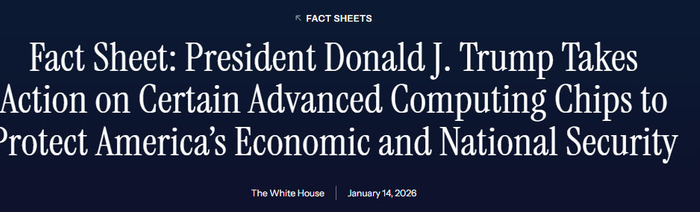
【文/观察者网 齐倩】 据白宫网站消息,当地时间1月14日,美国总统特朗普宣布对某些先进人工智能(AI)芯片征收25%的 关税,其中包括例如英伟达的H200芯片和AMD的MI325X芯片。 彭博社称,这是特朗普此前一天(13日)刚刚批准的协议的关键一步。该协议允许英伟达对华出口在中 国台湾地区制造的H200芯片,但特朗普曾明确表示:美国政府需获得25%的分成。 路透社则提到,此举旨在激励本土生产,减少对台湾等地区芯片制造商的依赖。 宫截图 根据特朗普签署的公告,在进行了为期九个月的232条调查后,美国政府将在目标芯片运抵美国、最终 运往中国客户和其他外国市场之前,对这些芯片征收25%的关税。 白宫在一份事实说明中指出,这项关税将狭窄聚焦,不适用于为支持美国技术供应链建设和加强国内半 导体衍生品制造能力而进口的芯片。但"在不久的将来",特朗普可能对半导体及其衍生产品的进口征收 更广泛的关税,以激励国内制造。 据介绍,美国商务部长卢特尼克拥有广泛酌情权,可进一步豁免。 消息公布后,英伟达、AMD和高通的股价在盘后交易中略有下跌。 据报道,虽然英伟达、AMD和英特尔等美国公司设计了许多最广泛使用的芯片,但大多数芯片 ...
美国将对部分芯片征收25%关税 作为允许英伟达出口协议的一部分
Xin Lang Cai Jing· 2026-01-15 05:01
根据特朗普签署的公告,相反他指示商务部长霍华德·卢特尼克和贸易代表贾米森·格里尔就进口"继续进 行谈判",并在90天后提交报告。白宫发布的事实清单称, 特朗普可能"在不久的将来"宣布新的关税以 及相应的对冲计划,以激励国内制造。 公告称,25%的关税适用于"一类非常狭窄的半导体产品"。据事实清单,这包括H200和AMD公司的 MI325X芯片。对于"为支持美国技术供应链建设而进口的芯片"则不涵盖。编辑/陈佳靖 特朗普1月14日在签字仪式上告诉记者:"这虽然不是最高水平,但也是一个非常好的水平。中国需要这 些芯片,其他人也需要。我们将从这些芯片的销售中拿到25%。" 美国根据《贸易扩展法》第232条进行的调查发现外国制造芯片损害美国国家安全,但特朗普目前暂缓 对更大范围的外国制造芯片征收关税。 美国将对特定半导体进口产品征收25%的关税,这是总统唐纳德·特朗普所批准一项协议中的关键一 步,以此允许英伟达将H200人工智能AI处理器销往中国。 据特朗普1月14日签署的行政命令,美国政府将在芯片最终运往中国客户和其他海外市场之前,在进口 到美国的环节征收关税。英伟达将自己设计的芯片交由台积电生产,包括特朗普在去年1 ...
美国加收25%芯片关税,针对特定产品
半导体芯闻· 2026-01-15 01:41
Core Viewpoint - The article discusses President Trump's announcement of a 25% tariff on certain advanced computing chips, including NVIDIA's H200 and AMD's MI325X, while exempting chips that support the U.S. technology supply chain [1][8]. Group 1: Tariff Announcement - President Trump announced a 25% tariff on specific advanced computing chips, which includes NVIDIA's H200 and AMD's MI325X [1][8]. - Chips imported to support the U.S. technology supply chain will be exempt from these tariffs [1][8]. - The White House indicated that broader tariffs on semiconductors and their derivative products may be imposed in the future [2][8]. Group 2: National Security and Economic Implications - The tariffs are justified under national security concerns, invoking Section 232 of the Trade Expansion Act of 1962 [2][9]. - The U.S. aims to restore domestic semiconductor production capacity to reduce reliance on foreign sources, which is critical for economic and national security [9]. - The current import levels of semiconductors are deemed insufficient to meet domestic demand, posing a threat to the U.S. industrial and military capabilities [9]. Group 3: Industry Reactions - NVIDIA expressed appreciation for the decision, highlighting the balance it strikes for U.S. chip industry competitiveness and high-paying jobs [2]. - AMD stated its compliance with all U.S. export control laws and policies [2]. - Both companies previously agreed to pay 15% of their sales from chips sold in China to the U.S. government, indicating their involvement in the ongoing trade dynamics [3].