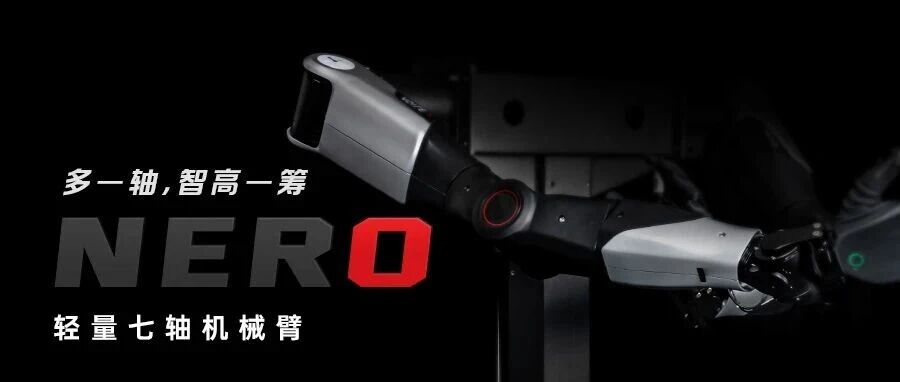
NERO七轴机械臂

Search documents
广东外贸凭产业韧性持续领跑
Xin Lang Cai Jing· 2026-02-07 22:52
Core Insights - Guangdong's goods trade import and export reached 9.49 trillion yuan in 2025, marking a 4.4% year-on-year increase and setting a historical record, accounting for 20.9% of the national foreign trade total, contributing 24.1% to national foreign trade growth [2] Group 1: Export Structure and Growth - The export structure in Guangdong is shifting towards new and superior products, with new productive forces accelerating growth. In 2025, Guangdong exported 4.15 trillion yuan in electromechanical products, a 7.3% increase, making up 68.7% of total exports, up 3.1 percentage points year-on-year [3] - Exports of electronic components, electrical equipment, and computers grew by 20%, 16.8%, and 9.9% respectively, while green and intelligent products like drones, 3D printers, and industrial robots saw export growth rates of 40.9%, 37.1%, and 33.9% [3] Group 2: Company Performance and Market Expansion - Dongguan's Songling Technology Co., Ltd. reported a 52% increase in orders in 2025 compared to 2024, with an expected stable growth rate of 30% to 40% for the current year. The company exported industrial robots worth 460 million yuan, a year-on-year increase of over 30% [4] - The Guangdong Customs has been actively guiding enterprises in technical trade responses and intellectual property protection, facilitating the expansion of Dongguan's smart manufacturing into global markets [4] Group 3: New Trade Dynamics and Support Measures - The Guangdong Customs has focused on cultivating new trade dynamics and creating a "new engine" for foreign trade, with electric vehicle exports increasing 31 times during the 14th Five-Year Plan period, reaching 153 countries and regions [5] - The number of enterprises with import and export performance in Guangdong reached 172,000 in 2025, a 17.6% increase, with private enterprises accounting for 148,000, up 20% [6] Group 4: International Cooperation and Market Diversification - Guangdong's foreign trade market is becoming more diversified, with imports and exports to ASEAN, Hong Kong, and the EU each surpassing 1 trillion yuan in 2025, growing by 5.8%, 12.5%, and 8.4% respectively [8] - The province's exports to emerging markets in Central Asia, Africa, and the Middle East grew by 23.6%, 10.7%, and 8.5%, all exceeding the overall growth rate of Guangdong [8] Group 5: Infrastructure and Regulatory Improvements - Guangdong has implemented 166 measures to promote cross-border trade facilitation, achieving 24/7 appointment customs clearance at key ports and expanding shipping routes to 73 [6] - The provincial government has introduced 108 measures to optimize the business environment, with general trade growing at an average of 9.9% annually, increasing its share from 51.2% to 58.2% [7]

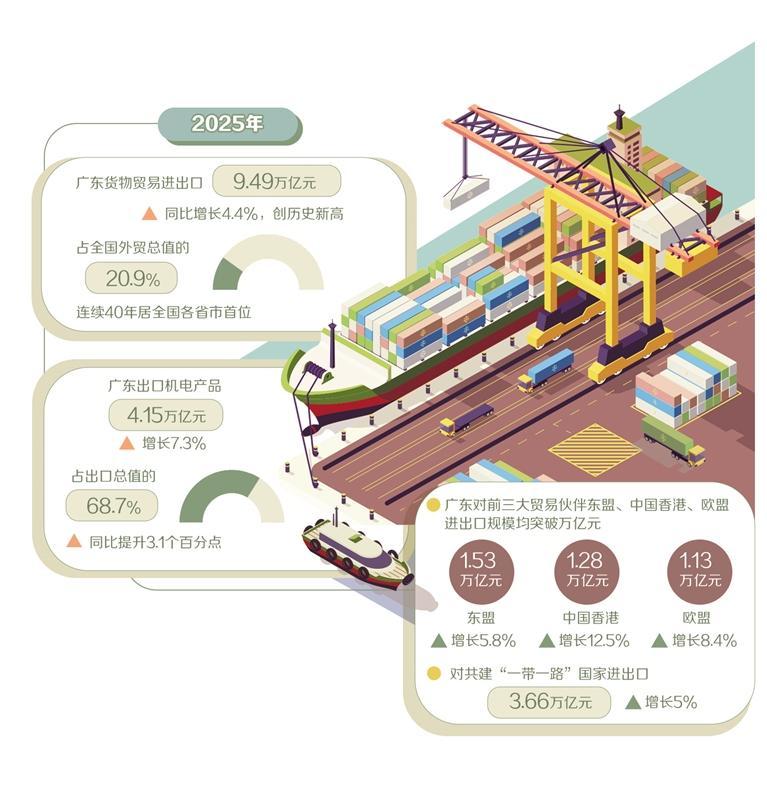
2025年进出口达9.49万亿元,创历史新高—— 广东外贸凭产业韧性持续领跑
Jing Ji Ri Bao· 2026-02-07 22:17
Core Insights - In 2025, Guangdong's goods trade import and export reached 9.49 trillion yuan, a year-on-year increase of 4.4%, marking a historical high and accounting for 20.9% of the national foreign trade total, contributing 24.1% to the national foreign trade growth [1] Group 1: Export Structure and Growth - Guangdong's export structure is shifting towards new and high-quality products, with mechanical and electrical products exported worth 4.15 trillion yuan, growing by 7.3% and accounting for 68.7% of total exports, an increase of 3.1 percentage points year-on-year [2] - Exports of green and intelligent products such as drones, 3D printers, and industrial robots saw significant growth rates of 40.9%, 37.1%, and 33.9% respectively, highlighting the high-end, intelligent, and green characteristics of the export sector [2] - Dongguan exported industrial robots worth 460 million yuan, with a year-on-year growth of over 30%, covering various regions including Asia, Europe, and America [3] Group 2: Enterprise Growth and Support - The number of enterprises with import and export performance in Guangdong reached 172,000, an increase of 17.6%, with private enterprises accounting for 148,000, up by 20%, reinforcing their role as the main force in foreign trade [4] - Guangdong's customs have implemented 166 measures to facilitate cross-border trade, achieving 24/7 appointment customs clearance at key ports, enhancing trade efficiency [4][5] Group 3: Market Diversification - Guangdong's foreign trade market is becoming more diversified, with imports and exports to ASEAN, Hong Kong, and the EU each exceeding 1 trillion yuan, with growth rates of 5.8%, 12.5%, and 8.4% respectively [6] - Trade with emerging markets such as Central Asia, Africa, and the Middle East grew by 23.6%, 10.7%, and 8.5%, all surpassing the overall growth rate of Guangdong [6] Group 4: Future Outlook - Guangdong's foreign direct investment has seen an average annual growth of 7.4% over the past four years, maintaining the top position in the country, indicating a strong willingness among enterprises to expand internationally [7] - The province is expected to leverage its optimized structure and resilient industries to support China's modernization efforts in the face of complex external environments [7]
松灵14999元七轴仿人臂来了!加量不加价,科研最优解
机器人大讲堂· 2025-11-25 00:00
Core Insights - The article highlights the launch of the NERO lightweight 7-axis robot by Songling Robotics, which addresses the specific needs of research scenarios and represents a significant technological advancement in embodied intelligence hardware [1][3][12]. Group 1: Product Features and Innovations - NERO's lightweight design (4.8 kg) and high payload capacity (3 kg) allow for flexible deployment in various laboratory environments, enhancing space utilization and operational efficiency [4][10]. - The 7-axis configuration provides redundancy in degrees of freedom, enabling the robot to perform complex tasks in unstructured environments, such as biological sample handling and micro-device assembly [6][12]. - NERO achieves a balance between lightweight construction and rigidity, utilizing aluminum alloy and resin materials, which allows it to maintain stability while being easy to transport and set up [8][10]. Group 2: Market Positioning and Pricing - Priced at 14,999 yuan, NERO offers a cost-effective solution for research teams, making advanced robotic capabilities accessible to a broader range of users, including graduate students and interdisciplinary teams [12][13]. - The robot's specifications, including ±0.1 mm repeatability and low operational noise (below 60 dB), cater to the stringent requirements of scientific experiments, ensuring high precision and minimal disruption in laboratory settings [13][15]. Group 3: Strategic Implications and Future Directions - The introduction of NERO reflects a broader trend in the embodied intelligence hardware sector, emphasizing the integration of mobility and manipulation capabilities in robotic systems [16][20]. - Songling Robotics aims to create a comprehensive ecosystem that supports the transition from algorithm simulation to real-world deployment, enhancing the research capabilities of academic institutions and innovation centers [22][23]. - The company’s strategy includes developing an open hardware platform that facilitates programming and integration with existing research frameworks, thereby lowering barriers for researchers [18][20].