
共建‘一带一路’

Search documents
春节货运高峰见证中德合作韧性(共建“一带一路”·第一现场)
Xin Lang Cai Jing· 2026-02-14 00:57
Core Insights - The article highlights the increasing trade volume between China and Germany, particularly through the Hamburg port, which serves as a crucial logistics hub for this trade [1][6] - The partnership between China’s COSCO Shipping and Hamburg port is emphasized, showcasing mutual benefits such as stable cargo flow and enhanced operational efficiency [2][6] Trade and Logistics - Hamburg port handles approximately 40% of Germany's trade with China by tonnage, with a reported 7.9% year-on-year increase in container trade between China and Hamburg, reaching 1.8 million TEUs in the first nine months of 2025 [1] - COSCO Shipping's acquisition of a 24.99% stake in the Fuhai terminal in Hamburg is noted as a strategic move to ensure reliable docking resources and improve supply chain resilience [2][6] Shipping Operations - The article describes the operations at the Fuhai terminal, where various goods, including lithium batteries and automotive parts, are transported between China and Europe [3] - The introduction of a direct rail service from Zeebrugge, Belgium, to Mannheim, Germany, is highlighted, aiming to enhance logistics efficiency by reducing delivery times from 5-6 days to 13 hours [4] Service Expansion - COSCO Shipping is expanding its service offerings to include end-to-end logistics solutions, moving beyond traditional shipping to provide comprehensive transportation services [5] - The company is also focusing on developing cold chain logistics for transporting perishable goods, indicating a diversification of its service portfolio [4][5] Strategic Partnerships - The collaboration between COSCO Shipping and Hamburg port is seen as a way to strengthen Hamburg's position as an international shipping hub, enhancing regional competitiveness [6] - The article mentions the cultural exchange and relationship-building aspects of the partnership, which are viewed as valuable in the current global context [7]
广东外贸凭产业韧性持续领跑
Xin Lang Cai Jing· 2026-02-07 22:52
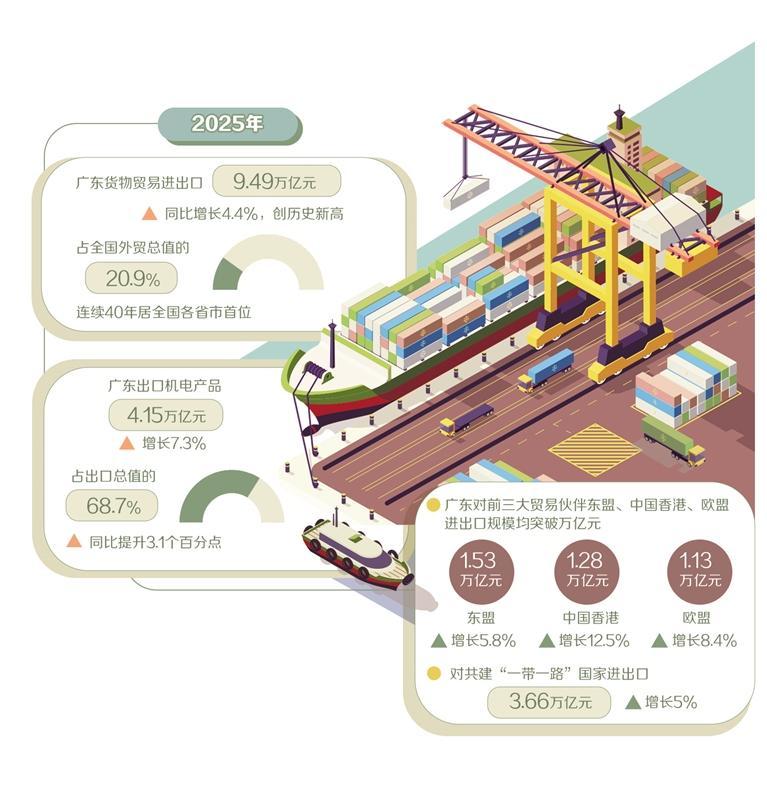
Core Insights - Guangdong's goods trade import and export reached 9.49 trillion yuan in 2025, marking a 4.4% year-on-year increase and setting a historical record, accounting for 20.9% of the national foreign trade total, contributing 24.1% to national foreign trade growth [2] Group 1: Export Structure and Growth - The export structure in Guangdong is shifting towards new and superior products, with new productive forces accelerating growth. In 2025, Guangdong exported 4.15 trillion yuan in electromechanical products, a 7.3% increase, making up 68.7% of total exports, up 3.1 percentage points year-on-year [3] - Exports of electronic components, electrical equipment, and computers grew by 20%, 16.8%, and 9.9% respectively, while green and intelligent products like drones, 3D printers, and industrial robots saw export growth rates of 40.9%, 37.1%, and 33.9% [3] Group 2: Company Performance and Market Expansion - Dongguan's Songling Technology Co., Ltd. reported a 52% increase in orders in 2025 compared to 2024, with an expected stable growth rate of 30% to 40% for the current year. The company exported industrial robots worth 460 million yuan, a year-on-year increase of over 30% [4] - The Guangdong Customs has been actively guiding enterprises in technical trade responses and intellectual property protection, facilitating the expansion of Dongguan's smart manufacturing into global markets [4] Group 3: New Trade Dynamics and Support Measures - The Guangdong Customs has focused on cultivating new trade dynamics and creating a "new engine" for foreign trade, with electric vehicle exports increasing 31 times during the 14th Five-Year Plan period, reaching 153 countries and regions [5] - The number of enterprises with import and export performance in Guangdong reached 172,000 in 2025, a 17.6% increase, with private enterprises accounting for 148,000, up 20% [6] Group 4: International Cooperation and Market Diversification - Guangdong's foreign trade market is becoming more diversified, with imports and exports to ASEAN, Hong Kong, and the EU each surpassing 1 trillion yuan in 2025, growing by 5.8%, 12.5%, and 8.4% respectively [8] - The province's exports to emerging markets in Central Asia, Africa, and the Middle East grew by 23.6%, 10.7%, and 8.5%, all exceeding the overall growth rate of Guangdong [8] Group 5: Infrastructure and Regulatory Improvements - Guangdong has implemented 166 measures to promote cross-border trade facilitation, achieving 24/7 appointment customs clearance at key ports and expanding shipping routes to 73 [6] - The provincial government has introduced 108 measures to optimize the business environment, with general trade growing at an average of 9.9% annually, increasing its share from 51.2% to 58.2% [7]

用好五项政策,做好五件事
Jing Ji Wang· 2026-01-15 08:48
Core Viewpoint - The official launch of the Hainan Free Trade Port on December 18, 2025, marks a significant step in China's commitment to high-level opening-up and the construction of an open world economy, aiming to integrate domestic and international trade [1]. Group 1: Key Policies of Hainan Free Trade Port - The basic policies of the Hainan Free Trade Port include a corporate income tax rate of 15%, personal income tax rate of 15%, zero tariffs, zero barriers to service trade, and tax exemption on repatriated overseas investment profits [1]. - These policies are expected to provide a historical and long-term driving force for Hainan's economy and the construction of China's free trade ports [1]. Group 2: Integration of Domestic and International Trade - Hainan should promote the integration of domestic and international trade, achieving uniform rules, systems, and standards, thereby eliminating the existing discrepancies between domestic and foreign trade [2]. - The goal is to create a seamless trade environment similar to that in the U.S., where trade procedures are consistent regardless of destination [2]. Group 3: Development of Service Trade - Hainan should focus on developing service trade, which currently constitutes only 14.6% of China's total trade volume, compared to over 25% globally [6]. - The emphasis should be on both productive and life service industries, with a particular focus on enhancing the export of productive services [6][7]. Group 4: Positioning as a Trade Hub - Hainan should establish itself as a bridge and hub for trade between Southeast Asia and China, leveraging the RCEP agreement to facilitate trade flows [9]. - The island is positioned to become a central base for trade interactions with Southeast Asian countries [9]. Group 5: Financial Systems for Belt and Road Initiative - Hainan should create a financial system to facilitate the return of RMB investments and trade from Belt and Road Initiative countries, ensuring effective use of RMB [11]. - This system will support the development of the Belt and Road Initiative and generate significant benefits [11]. Group 6: Promoting RMB Internationalization - Hainan is expected to play a crucial role in the internationalization of the RMB by establishing an offshore RMB fund pool [15]. - The aim is to enhance the currency's global standing in line with China's economic position, which currently does not reflect its GDP share [14][15]. Conclusion - By effectively implementing the five key initiatives aligned with the free trade port policies, Hainan is poised to elevate its development significantly over the next 5 to 10 years, becoming a vital gateway for China's new era of opening-up [15].
构建“五区、四廊”总体保护格局
Xin Lang Cai Jing· 2026-01-09 21:49
Core Viewpoint - The Sichuan Provincial Government has issued a planning document for the historical and cultural protection and inheritance system from 2025 to 2035, aiming to establish a multi-level and multi-element system by 2030 and increase the number of national historical and cultural cities to 10 by 2035 [1][2]. Group 1: Overall Protection Framework - The planning proposes a "Five Districts and Four Corridors" protection framework, which includes five cultural districts and four cultural corridors [2]. - The five cultural districts are: Chengdu Plain Shu Culture District, Northeast Sichuan Shu Road Culture District, South Sichuan Salt and Wine Culture District, Northwest Sichuan Ethnic Culture District, and Panxi Ethnic Culture and Third-Line Construction District [2]. - The four cultural corridors are based on the Long March route, the Yangtze and Yellow Rivers, trade routes like the Shu Road and Southern Silk Road, and the Third-Line construction routes [2]. Group 2: Protection Object Catalog - The planning outlines a provincial protection object catalog that includes 21 categories such as historical and cultural cities, towns, villages, traditional villages, historical cultural blocks, historical buildings, and various types of cultural heritage [2]. Group 3: Key Initiatives - The planning identifies 11 key initiatives focusing on integrating cultural heritage into urban construction, enhancing cultural tourism integration, and promoting historical culture [3]. - In urban construction, it emphasizes the integration of national strategies like the Belt and Road Initiative and the Chengdu-Chongqing Economic Circle, while promoting urban features and improving public services [3]. - For cultural tourism, specific experience routes are to be developed in various cultural districts, such as Shu culture, Three Kingdoms culture, and ecological culture [3]. Group 4: Cultural Promotion - The planning aims to strengthen systematic research and inheritance of significant cultural elements like Sanxingdui and the Three Kingdoms, and to create a regional cultural identity system [4]. - It includes initiatives to engage the public in cultural heritage projects and promote cultural activities in schools and communities [4].
“十四五”期间 我国累计提出ISO、IEC国际标准提案1740项
Xin Hua Cai Jing· 2026-01-08 05:30
Core Insights - The market regulatory authority has made significant progress in promoting international standardization in various sectors, including low-carbon energy, biotechnology, artificial intelligence, and industrial networks, with a total of 505 international standard proposals submitted to ISO and IEC in 2025, representing a 15.83% increase from 2024 [1] - During the 14th Five-Year Plan period, China has submitted a total of 1,740 international standard proposals to ISO and IEC, marking a 32.12% increase compared to the 13th Five-Year Plan [1] - In terms of international standard formulation, China led the development and publication of 285 ISO and IEC international standards in 2025, which is a 26.67% increase from 2024 [1] - Cumulatively, during the 14th Five-Year Plan, China has led the formulation and publication of 1,183 ISO and IEC international standards, reflecting an 88.1% increase compared to the 13th Five-Year Plan [1] - The number of foreign language versions of national standards published reached 441 in 2025, with a total of 2,779 foreign language versions during the 14th Five-Year Plan, exceeding a 200% increase from the 13th Five-Year Plan [1] Future Directions - The market regulatory authority plans to continue advancing international standard development in emerging industries such as new materials, aerospace, low-altitude economy, and embodied intelligence, aligning with the suggestions of the 15th Five-Year Plan [2] - The focus will be on accelerating the opening of standard systems to enhance industrial competitiveness and contribute to the high-quality development of global industries [2]
西部陆海新通道“蓉桂琼”铁海联运班列首发
Xin Lang Cai Jing· 2026-01-01 12:36
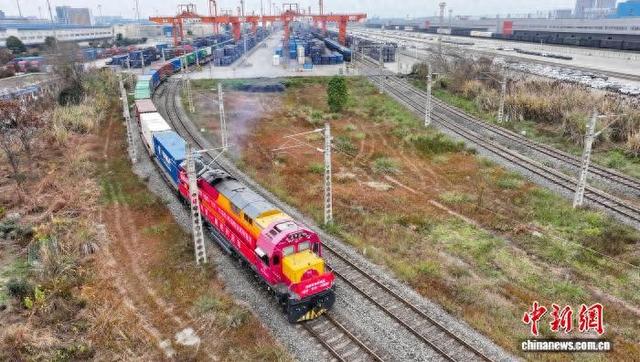
Core Insights - The launch of the "Rongguiqiong" iron-sea intermodal train service from Chengdu to Yangpu Port marks a significant development in the Western Land-Sea New Corridor, enhancing logistics connectivity between Sichuan and Hainan [1][3] - This new intermodal route strengthens the integration of the Belt and Road Initiative and the construction of the Hainan Free Trade Port, promoting regional collaborative development [3][4] - The opening of this route provides Western enterprises with more flexible logistics options, facilitating international business expansion [3] Group 1 - The "Rongguiqiong" intermodal train service is the first of its kind from Chengdu International Railway Port since the Hainan Free Trade Port's operational closure, aimed at improving the efficiency of the logistics system [1][3] - The service connects Sichuan's inland areas with the Beibu Gulf Port and Yangpu Port, enhancing the overall functionality and expansion of the Western Land-Sea New Corridor [1][3] - The increasing openness of Hainan's policy framework is creating multiple development opportunities for Sichuan's foreign trade enterprises [3] Group 2 - Sichuan enterprises are encouraged to leverage Hainan's advantages by establishing assembly workshops and warehousing centers to reduce delivery times and logistics costs [3][4] - The Chengdu International Railway Port plans to collaborate with COSCO Shipping to develop multimodal transport channels linking Southeast Asia, Africa, Europe, and the Americas [4] - A standardized "Iron-Sea Intermodal + Yangpu Transshipment" product system will be established to serve the logistics needs of the southwestern region [4]
中国贸促会推动工商企业深化共建“一带一路”务实合作
Xin Hua Wang· 2026-01-01 07:36
Group 1 - The core viewpoint of the articles emphasizes the ongoing efforts and achievements of the China Council for the Promotion of International Trade (CCPIT) in facilitating trade and investment cooperation with countries involved in the Belt and Road Initiative (BRI) [1][2] Group 2 - In 2025, the CCPIT organized 407 outbound delegations, with 228 of these visiting BRI countries, covering 42 countries and regions [1] - A total of 707 exhibition projects were implemented in 43 BRI countries, with an actual exhibition area of 360,000 square meters and approximately 26,500 participating enterprises [1] - The CCPIT issued 4.9936 million certificates of origin and 559,600 commercial certificates in the first 11 months of 2025, significantly promoting trade facilitation [1] - The CCPIT's legal services have strengthened the protection of enterprises' overseas interests, handling over 400 arbitration cases and managing over 500 patent applications and 700 trademark applications for BRI countries [1] - The Central Economic Work Conference in 2025 emphasized the need to promote high-quality development of the BRI, with plans to continue organizing Chinese business delegations to BRI countries in 2026 [2]
京直播|中国贸促会召开12月例行新闻发布会
Xin Lang Cai Jing· 2025-12-29 06:53
Group 1 - The China Council for the Promotion of International Trade (CCPIT) will hold a regular press conference on December 29 at 14:30 [1] - Wang Wenshuai, the spokesperson for CCPIT, will introduce the progress of the fourth Chain Expo preparation [1] - The conference will cover the achievements of the Chinese entrepreneurs' delegation visiting the United States [1] - It will also discuss the preparations for APEC "China Year" business activities [1] - The event aims to promote the Belt and Road Initiative and report on global intellectual property protection index [1]
前11月江西对东盟进出口同比增长36.6%,锂电池出口大增
Zhong Guo Xin Wen Wang· 2025-12-23 00:44
Group 1 - The core viewpoint is that Jiangxi's trade with ASEAN has significantly increased, with a year-on-year growth of 36.6% in the first 11 months of the year [1] - Jiangxi's total foreign trade import and export value reached 440.61 billion yuan, reflecting a growth of 2.8% [2] - The province's trade with countries involved in the Belt and Road Initiative amounted to 241.53 billion yuan, showing a growth of 13.9% [1] Group 2 - The production-oriented enterprises have played a more significant role in Jiangxi's foreign trade, with a total import and export value of 356.93 billion yuan, an increase of 4.4% [1] - Private enterprises and foreign-funded enterprises saw import and export growth of 2.7% and 8%, respectively [1] - The electronic information industry, a key pillar industry in Jiangxi, recorded an import and export value of 152.91 billion yuan, growing by 4.7% [1] Group 3 - The automotive industry in Jiangxi has experienced accelerated growth, with an import and export value of 24.63 billion yuan, increasing by 24% [1] - Exports of automobiles and auto parts grew by 23.2% and 61.9%, respectively [1] - Major export products in the electronic information sector, such as flat panel display modules, printed circuits, and lithium batteries, saw growth rates of 26.2%, 33.6%, and 54% [1]
药闻 | 2025中国创新药“出海潮”透视
Xin Hua Cai Jing· 2025-11-25 14:46
Core Insights - Since 2025, China's innovative pharmaceuticals have experienced a "simultaneous leap in scale and quality" driven by policy benefits and industry accumulation, with total outbound licensing exceeding $90 billion by the end of October, nearly doubling from $51.9 billion in 2024 [1] - The third quarter saw a significant increase in the "value" of outbound transactions, with notable collaborations such as the global strategic partnership between Hengrui Medicine and GSK, involving 12 innovative drugs and potential milestone payments of up to $12 billion [2][3] - The overall trend indicates three structural changes in China's innovative pharmaceuticals' outbound efforts: an increase in high-value transactions, diversification of technology areas, and enhanced contributions from emerging markets [4] Group 1: Market Performance - The total amount of outbound licensing has surpassed $90 billion, indicating a robust growth trajectory [1] - Hengrui Medicine's collaboration with GSK includes a $500 million upfront payment and potential milestone payments of $12 billion, showcasing the shift from traditional licensing to collaborative development [2] - BeiGene's global sales of its core product, Zebrutinib, reached 7.423 billion yuan, marking a 51% year-on-year increase, with the U.S. market contributing significantly [2][3] Group 2: Structural Changes - High-value transactions are becoming mainstream, with large upfront payments and high-potential milestone clauses [4] - Collaborations are diversifying beyond oncology to include areas like autoimmune diseases and rare diseases [4] - There is a rising trend of local partnerships in countries along the Belt and Road Initiative, which helps reduce costs and expedite market entry [4] Group 3: Challenges and Opportunities - Despite the impressive growth, there are underlying issues such as insufficient internal capabilities and a lack of robust ecological support, which hinder the industry's collective advancement [5][6] - The phenomenon of "selling seedlings" reflects the financial pressures faced by many companies, leading to a reliance on licensing rather than developing their own capabilities [6][7] - The report suggests that targeting Belt and Road countries could provide a strategic opportunity for mid-sized and smaller companies to meet local demand for affordable innovative drugs [8][9] Group 4: Future Directions - The report emphasizes that Chinese pharmaceutical companies should not only focus on drug exports but also on promoting a comprehensive "going out" strategy that includes technology and supply chain integration [9] - The transition from merely "product output" to "technology output" represents a significant evolution in China's pharmaceutical industry, enhancing its global competitiveness [9]


