NOA(领航辅助驾驶)

Search documents
中国智驾“一超多强”新格局,轻舟智航市占率第二
Zhong Guo Jing Ji Wang· 2026-02-06 07:11
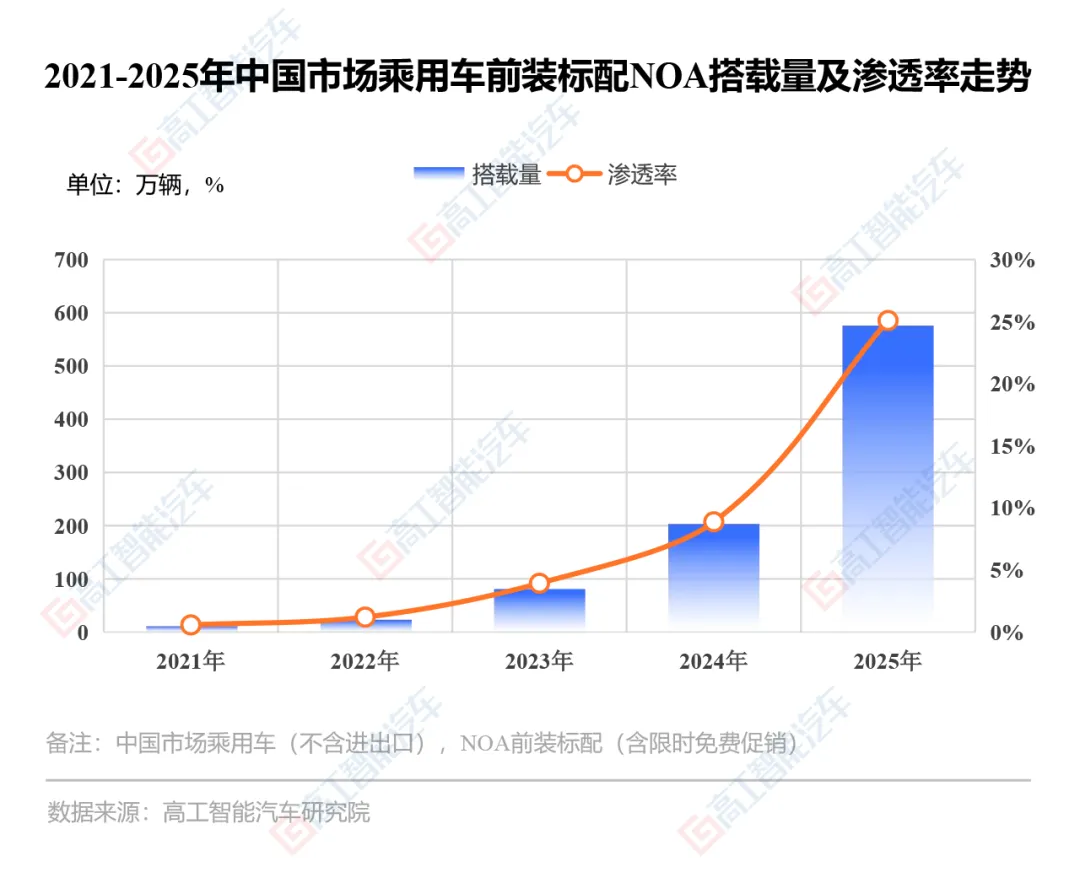
Core Insights - The report by Gaogong Intelligent Automotive Research Institute reveals that Huawei and Qizhou Zhihang together hold over 60% of the market share in the NOA (Navigation Assisted Driving) solutions for passenger cars in China from 2021 to 2025, leading the acceleration of NOA adoption [1] - The market for NOA has seen significant growth, with annual delivery volumes increasing from 118,000 units to 5.767 million units, and penetration rates rising from less than 1% to 25.1%, reflecting a compound annual growth rate of 164.4% [1] Market Share and Competition - Huawei leads the industry with a market share of 41.28%, followed by Qizhou Zhihang at 21.04%, with other competitors like Momenta and Zhuoyutech also making significant strides [1] - Qizhou Zhihang has achieved a milestone of over 1 million units of assisted driving systems delivered, showcasing its strong production and delivery capabilities [1][4] Delivery and Growth - Qizhou Zhihang's delivery volume surged from 500,000 to 1 million units in just 8 months, indicating rapid growth in production partnerships and platform capabilities [4] - The company has established deep collaborations with nearly 10 automotive brands, covering 23 models across a price range of 80,000 to 400,000 yuan [4] User Experience and Safety - The penetration rate of NOA in vehicles priced below 150,000 yuan is projected to reach 17.5% by 2025, with specific rates of 9.3% for vehicles under 100,000 yuan and over 23% for those between 100,000 and 150,000 yuan [4] - Qizhou Zhihang emphasizes safety and reliability, with its users having accumulated over 2.5 billion kilometers using assisted driving, and an average of 146,000 potential accidents avoided annually [5] Technological Innovation - The company has introduced the first end-to-end 6M city NOA solution, achieving performance comparable to higher computational power systems while maintaining safety and user experience [5] - Qizhou Zhihang's approach focuses on "not compromising safety, not stacking computing power, and not sacrificing experience," with ongoing OTA upgrades to enhance system performance [5] Future Outlook - By 2026, the city NOA is expected to enter a phase of large-scale and widespread implementation, with Qizhou Zhihang positioned to lead the market with its substantial share and focus on safety [6]

2秒钟,智驾能做什么?
Bei Jing Shang Bao· 2025-04-02 12:29
Core Viewpoint - The recent vehicle collision incident involving Xiaomi's car has sparked discussions about the boundaries of intelligent driving, particularly focusing on the NOA (Navigation On Autopilot) system's ability to prompt the driver to take control just two seconds before the accident, raising concerns about the adequacy of response time and the established "understanding" between humans and vehicles [1][3]. Group 1: Intelligent Driving Systems - The time interval from the obstacle alert to the collision was only 2 seconds, prompting a reevaluation of intelligent driving vehicles [3]. - Current intelligent driving systems are primarily in the L2 to L2+ stages, meaning they are still considered as driver assistance rather than fully autonomous driving, requiring constant driver supervision [1][6]. - The GB/T 44721-2024 standard states that intervention requests should allow sufficient time for drivers to safely take over the vehicle, ideally with a minimum of 10 seconds for non-planned interventions [3][4]. Group 2: Safety and Technology Challenges - The average human reaction time is approximately 0.6 seconds, leaving insufficient time for drivers to respond adequately after receiving an alert about an obstacle [4]. - Intelligent driving systems face challenges in recognizing complex road conditions, particularly under adverse weather conditions, which can hinder timely obstacle detection [4][5]. - The performance of Automatic Emergency Braking (AEB) systems is improving, but there is still a need for enhanced standards in proactive safety measures compared to passive safety standards in China [5][6]. Group 3: Regulatory and Consumer Awareness - The current legal framework mandates that drivers must keep their hands on the steering wheel, emphasizing that intelligent driving systems do not replace the need for active driver engagement [6][7]. - There is a need for better public understanding of "intelligent driving," which is not synonymous with "autonomous driving," and companies should avoid overstating the capabilities of their systems [7][8]. - Consumers must be made aware of the limitations of current technology, and companies are obligated to provide clear and accurate information regarding the safety and functionality of their products [7][8].