NVIDIA NVLink 6

Search documents
英伟达塑造“Token经济学”
2 1 Shi Ji Jing Ji Bao Dao· 2026-03-17 23:10
Core Insights - NVIDIA's GTC event showcased the launch of the Vera Rubin architecture, marking a significant leap in AI technology with seven new chips entering production, aimed at establishing the largest AI factory globally [1][14] - The introduction of Vera Rubin is expected to double the revenue forecast for AI chips from $500 billion to $1 trillion by the end of 2027 [2][16] - The event emphasized a shift from individual chip competition to a comprehensive system-level competition among tech giants, highlighting the importance of "Token" economics and the AI "five-layer cake" theory [2][16] Chip Architecture and Performance - The Vera Rubin architecture will utilize TSMC's 3nm process and features a tightly integrated design that enhances performance, achieving 50 PFlops for inference and 35 PFlops for training, with a fivefold increase in efficiency compared to the previous Blackwell architecture [4][18] - The architecture includes various chips such as NVIDIA Vera CPU, Rubin GPU, NVLink 6, and Groq 3 LPU, which can be configured into five different racks for data center operations [1][15] Application and Infrastructure - Vera Rubin is designed specifically for "Agentic AI" and long-context reasoning, featuring advanced components like the Transformer Engine 3.0 and Inference Context Memory, enabling AI agents to manage extensive token contexts and perform multi-step reasoning [5][19] - The infrastructure supports high-density liquid cooling and is built on NVIDIA's MGX framework, integrating 256 Vera CPUs to provide scalable and energy-efficient capacity [5][20] Collaborations and Market Impact - Key partners deploying the Vera CPU include Alibaba, ByteDance, Meta, and Oracle Cloud Infrastructure, with full production expected in the second half of the year [6][20] - NVIDIA is positioning itself as a leader in AI infrastructure, with the Vera Rubin DSX AI Factory reference design aimed at maximizing productivity and energy efficiency in AI token generation [6][20] Groq LPU and Real-Time Processing - The Groq LPU architecture, set to be integrated by the end of 2025, is designed for low-latency, real-time interactions, featuring 256 LPU processors with high bandwidth capabilities [21][22] - The LPU's deterministic pipeline architecture eliminates traditional GPU complexities, ensuring consistent execution times critical for applications like autonomous driving and high-frequency trading [22][23] AI Agent and Open Model Ecosystem - NVIDIA introduced the NemoClaw software stack for AI agents, which allows for continuous operation and complex task management, marking a significant development in the open-source AI landscape [11][24] - The company is also expanding its open model ecosystem, launching the Nemotron Coalition to foster collaboration among leading AI labs and model developers [12][24] Real-World Applications - New models for robotics and autonomous driving were unveiled, including the NVIDIA Isaac GR00T for humanoid robots and the NVIDIA Alpamayo for enhanced vehicle reasoning capabilities [13][25] - NVIDIA aims to create a comprehensive AI technology framework that bridges digital and physical worlds, promoting innovation and application across various sectors [13][25]


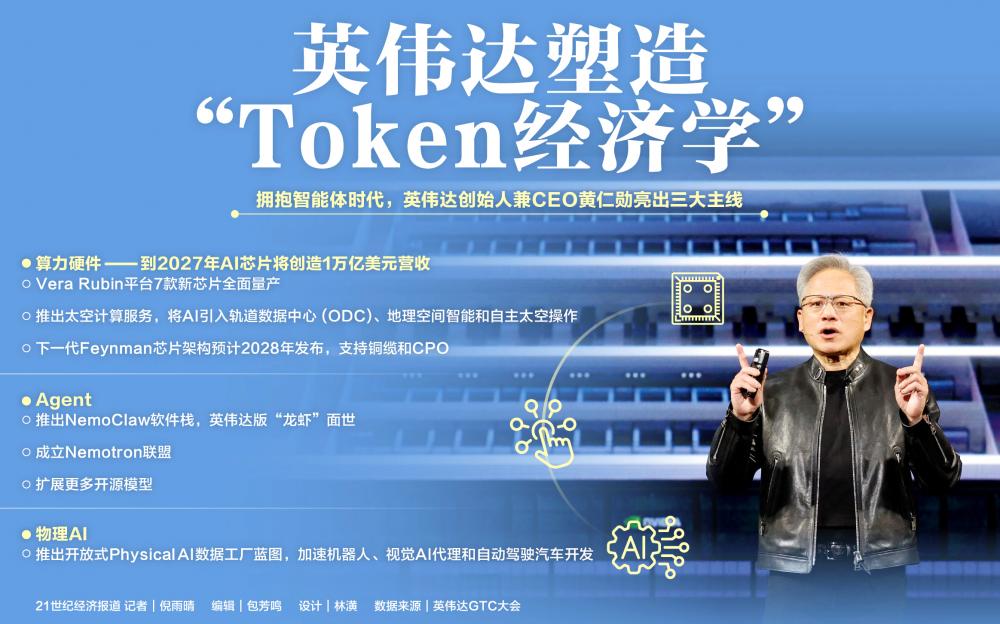
黄仁勋发表重磅演讲!称2027营收至少万亿美元,“龙虾”就是新操作系统!英伟达宣布:七款新芯片全面投产
Mei Ri Jing Ji Xin Wen· 2026-03-17 02:53
Core Insights - Nvidia's CEO Jensen Huang predicts that the new AI chip architectures, Blackwell and Rubin, will generate at least $1 trillion in revenue by the end of 2027, significantly surpassing the previous forecast of $500 billion made in October 2025, highlighting the rapid expansion of AI infrastructure investment [1][10][16] Chip Production and Architecture - Nvidia announced the production of seven new chips under the Vera Rubin architecture, marking the beginning of the Agentic AI era and establishing the largest AI factory globally [2][12] - The new chip lineup includes: - NVIDIA Vera CPU - NVIDIA Rubin GPU - NVIDIA NVLink 6 - NVIDIA ConnectX-9 SuperNIC - NVIDIA BlueField-4 DPU - NVIDIA Spectrum-6 - NVIDIA Groq 3 LPU [2][13][14] AI Supercomputer Capabilities - The Vera Rubin platform integrates these chips to form a powerful AI supercomputer capable of supporting large-scale pre-training, post-training, testing, and real-time intelligent inference [3][14] - Huang describes Vera Rubin as a generational leap, providing the necessary power for every stage of AI development and signaling the onset of the largest infrastructure buildout in history [3][14] Token Factory Concept - Huang introduced the concept of a "Token Factory," suggesting that future data centers will transition from mere storage facilities to factories producing intelligent tokens, which are fundamental units generated by AI [5][11][17] - He emphasized that the performance per watt will determine the economic viability of these factories, with the highest throughput translating to the lowest production costs [20] AI Service Levels - Future AI services will be categorized into different tiers based on token generation rates and costs: - Free tier (high throughput, low speed) - Mid-tier (~$3 per million tokens) - High-tier (~$6 per million tokens) - High-speed tier (~$45 per million tokens) - Ultra-high-speed tier (~$150 per million tokens) [20][21] - Huang noted that as models grow larger and context lengthens, AI will become smarter, but token generation rates may decline [20] OpenClaw and Future Developments - Huang praised the OpenClaw project as a significant advancement, likening it to an operating system for agent-based computing, and predicted that all SaaS companies will evolve into AaaS (Agent-as-a-Service) companies [9][23] - He also hinted at the next-generation computing architecture, Feynman, and the development of a space-based data center, Vera Rubin Space-1, which could extend AI computing capabilities beyond Earth [23]

王炸!英伟达连发7款芯片,黄仁勋演讲刷屏
2 1 Shi Ji Jing Ji Bao Dao· 2026-03-17 01:53
Core Insights - NVIDIA's CEO Jensen Huang announced significant technological breakthroughs and a bold prediction of generating at least $1 trillion in revenue from the new AI chip architecture during the annual GTC conference [1][6][8] - Following Huang's speech, NVIDIA's stock price surged, reaching a peak increase of 4.31% during trading [2] Group 1: Technological Advancements - The newly introduced Vera Rubin architecture includes seven new chips that are now in production, marking a generational leap in AI capabilities [6][11] - The Vera Rubin platform integrates various chip types, including CPUs, GPUs, and storage chips, to create a powerful AI supercomputer capable of supporting large-scale training and real-time intelligent inference [6][12] - Huang emphasized that the introduction of Vera Rubin signifies the onset of a new era in AI infrastructure, with a projected revenue increase from $500 billion to $1 trillion by the end of 2027 [6][8] Group 2: Market Impact - Nearly 60 stocks in the A-share market are linked to NVIDIA, with a combined market capitalization exceeding 2.7 trillion yuan, indicating a strong market interest in AI-related investments [3][4] - The performance of NVIDIA-related stocks has been mixed this year, with around 60% of these stocks recording gains, highlighting the growing influence of NVIDIA's advancements on the broader market [4] Group 3: AI Infrastructure and Ecosystem - NVIDIA is transitioning into an AI infrastructure company, aiming to become a foundational platform for the AI ecosystem, akin to water and electricity in the AI era [8][15] - The company introduced the DSX platform to optimize energy usage in AI infrastructure, addressing energy supply challenges and enhancing grid stability [14][15] - NVIDIA's new AI factory reference design aims to guide the construction and operation of AI infrastructure, promoting efficiency and scalability [15][27] Group 4: AI Agent and Open Model Development - NVIDIA launched the NemoClaw software stack to support AI agents, enabling them to autonomously plan tasks and execute complex workflows [23][24] - The establishment of the Nemotron Coalition aims to advance open model development, with collaborations from leading AI labs to enhance the AI model ecosystem [25][26] - New models targeting robotics and autonomous driving were introduced, showcasing NVIDIA's commitment to integrating AI into real-world applications [26][27]
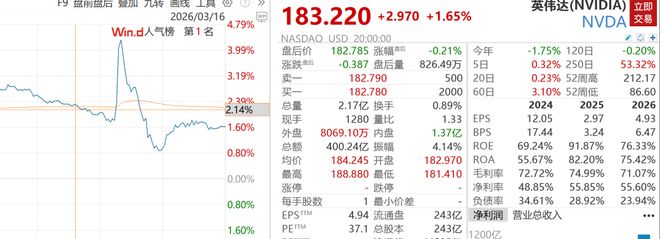
王炸!英伟达连发7款芯片,黄仁勋演讲刷屏
21世纪经济报道· 2026-03-17 01:44
Core Viewpoint - NVIDIA's GTC conference showcased significant advancements in AI technology, with CEO Jensen Huang predicting that the new AI chip architecture could generate at least $1 trillion in revenue, doubling previous forecasts [1][4][6]. Group 1: AI Chip Innovations - The newly announced Vera Rubin architecture includes seven new chips, marking a generational leap in AI capabilities, with products such as NVIDIA Vera CPU and Rubin GPU now in production [4][5]. - The Vera Rubin platform integrates various chips to create a powerful AI supercomputer, capable of supporting large-scale pre-training and real-time intelligent inference [5][10]. - Huang emphasized that the introduction of Vera Rubin signifies the beginning of a new era in AI infrastructure, with a projected revenue of $1 trillion from AI chips by the end of 2027, up from a previous estimate of $500 billion [4][6]. Group 2: System-Level Evolution - The focus has shifted from individual chip performance to the systematic construction of AI infrastructure, indicating a new era of system-level evolution in AI [6][14]. - NVIDIA's new DSX platform aims to optimize energy usage in AI infrastructure, addressing the energy bottleneck in AI development [13][14]. - The introduction of the Vera Rubin DSX AI factory reference design provides a blueprint for building efficient AI infrastructure, enhancing productivity and energy efficiency [14]. Group 3: AI Agent and Open Models - NVIDIA is advancing AI agents capable of autonomous task planning and execution, with the launch of the NemoClaw software stack aimed at enhancing AI agent capabilities [22][23]. - The establishment of the Nemotron Coalition aims to foster collaboration among leading AI labs to develop open frontier models, enhancing the AI ecosystem [25]. - New models introduced, such as NVIDIA Isaac GR00T and Alpamayo, are designed for robotics and autonomous driving, expanding AI applications into the physical world [26].

燃爆!英伟达连发7款芯片,黄仁勋剑指万亿AI芯片收入
2 1 Shi Ji Jing Ji Bao Dao· 2026-03-17 01:17
Core Insights - NVIDIA's GTC event showcased the launch of the Vera Rubin platform, marking a significant advancement in AI infrastructure with seven new chips aimed at creating the world's largest AI factory [1][3] - The introduction of Vera Rubin is expected to double the revenue forecast for AI chips, projecting $1 trillion by the end of 2027, compared to the previous estimate of $500 billion [3] - NVIDIA is transitioning from a GPU-centric company to an AI infrastructure provider, aiming to become a foundational platform for the AI ecosystem [5] Chip Innovations - The new chip family includes NVIDIA Vera CPU, Rubin GPU, NVLink 6, ConnectX-9 SuperNIC, BlueField-4 DPU, Spectrum-6, and Groq 3 LPU, enabling a comprehensive AI computing solution [2] - The Vera Rubin architecture utilizes TSMC's 3nm process, featuring a tightly integrated design that significantly enhances performance metrics, including a 5x improvement in efficiency compared to the previous Blackwell architecture [6][7] System-Level Advancements - The Vera Rubin platform represents a shift from single-chip performance to a system-level evolution in AI infrastructure, emphasizing the need for integrated solutions in AI development [4][10] - The introduction of the DSX platform aims to optimize energy consumption and enhance the scalability of AI infrastructure, allowing for a 30% increase in AI deployment within existing data centers [9] AI Agent and Open Model Ecosystem - NVIDIA is advancing its AI agent capabilities with the launch of the NemoClaw software stack, which supports the development of autonomous AI agents capable of complex task execution [16][18] - The establishment of the Nemotron Coalition aims to foster collaboration among leading AI labs to develop open foundational models, enhancing the AI ecosystem's capabilities [19][21] Application in Real-World Scenarios - The new models introduced by NVIDIA, such as Isaac GR00T and Alpamayo, are designed for robotics and autonomous driving, showcasing the company's commitment to integrating AI into physical applications [20][21] - The focus on real-time interaction and low-latency processing through the Groq LPU architecture positions NVIDIA to lead in the emerging market for agentic AI and real-time decision-making systems [11][15]
Supermicro Announces Support for Upcoming NVIDIA Vera Rubin NVL72, HGX Rubin NVL8 and Expanded Rack-Scale Manufacturing Capacity for Liquid-Cooled AI Solutions
Prnewswire· 2026-01-05 23:00
Core Insights - Supermicro is expanding its manufacturing capacity and liquid-cooling capabilities in collaboration with NVIDIA to deliver data center-scale solutions optimized for the NVIDIA Vera Rubin and Rubin platforms [1][2] - The company’s Data Center Building Block Solutions (DCBBS) approach allows for streamlined production and faster deployment, providing a competitive edge in next-generation AI infrastructure [1][7] Manufacturing and Technology Expansion - Supermicro's partnership with NVIDIA enables rapid deployment of advanced AI platforms, enhancing speed, efficiency, and reliability for hyperscalers and enterprises [2] - The company is investing in expanded manufacturing facilities and a comprehensive liquid-cooling technology stack to streamline production and deployment of fully liquid-cooled NVIDIA platforms [7] Product Features - The NVIDIA Vera Rubin NVL72 SuperCluster integrates 72 NVIDIA Rubin GPUs and 36 NVIDIA Vera CPUs, delivering 3.6 exaflops NVFP4 performance and 1.4 PB/s HBM4 bandwidth [5] - The 2U Liquid-cooled NVIDIA HGX Rubin NVL8 Systems provide 400 petaflops NVFP4 and 176 TB/s HBM4 bandwidth, optimized for AI and HPC workloads [5] - The platform features NVIDIA NVLink 6 for high-speed interconnects, NVIDIA Vera CPU with 2x performance over the previous generation, and advanced reliability features [5][6] Networking and Storage Solutions - The NVIDIA Vera Rubin platform includes NVIDIA Spectrum-X Ethernet Photonics networking, offering 5x power efficiency and 10x reliability compared to traditional optics [6] - Supermicro's storage solutions support the NVIDIA BlueField-4 DPU, enhancing data management capabilities [6] Strategic Positioning - Supermicro's modular DCBBS architecture accelerates deployment and time-to-online, ensuring customers achieve first-to-market advantages [7] - The company is committed to delivering innovative IT solutions across various sectors, including AI, cloud, and 5G infrastructure [8]