AI五层蛋糕理论

Search documents
GTC 2026|黄仁勋五层蛋糕重构AI价值体系,投资逻辑全解析 | 市场观察
私募排排网· 2026-03-25 09:49
Core Viewpoint - The article discusses Jensen Huang's "AI Five-Layer Cake" framework presented at NVIDIA GTC 2026, which outlines how value in the AI era is created and distributed across various industries, emphasizing the interconnectedness of the AI ecosystem and its implications for investment logic and asset allocation [3][5]. Group 1: AI Five-Layer Cake Theory - The "AI Five-Layer Cake" consists of five interconnected layers that collectively drive the AI industry's growth, where progress in each layer directly impacts the value realization of the upper layers [6]. - The five layers are: 1. **Energy Layer**: The foundation of AI, emphasizing the need for efficient energy supply and the projected doubling of global data center electricity consumption to 945 TWh by 2030 [7]. 2. **Chip Layer**: The core of computational power, with advancements in chip technology critical for AI expansion, including NVIDIA's new GPU architecture expected to achieve 50 PFLOPS [8]. 3. **Infrastructure Layer**: The physical embodiment of AI capabilities, with significant investments in AI factories and supercomputers, highlighting the importance of cooling technologies and innovative data center designs [9]. 4. **Model Layer**: The brain of AI, focusing on the transition from language models to physical AI, with open-source models driving demand across the architecture stack [10]. 5. **Application Layer**: The final interface where AI creates measurable economic value, with a shift towards AI agents capable of executing complex tasks across various sectors [11]. Group 2: Investment Logic from the Five-Layer Cake - Huang's framework provides a comprehensive investment strategy that emphasizes prioritizing foundational layers, driven by the exponential growth of token consumption and the need for heavy asset infrastructure [12][13]. - Key investment logic includes: 1. **Bottom-Up Approach**: Prioritizing investments in energy, chips, and infrastructure, which are expected to see more stable performance compared to upper layers [14]. 2. **Token Economy**: The increasing demand for tokens in AI applications, making "cost per token" a critical competitive metric [14]. 3. **Heavy Asset Infrastructure**: The construction of AI factories and data centers represents a new wave of capital expenditure, akin to a modern infrastructure boom [14]. 4. **Positive Feedback Loop**: The interdependence of applications, models, infrastructure, chips, and energy creates a strong positive cycle that enhances value across the entire AI ecosystem [14]. Group 3: Layer-Specific Investment Strategies - **Energy Layer**: Focus on green energy, grid equipment, and storage technologies as core beneficiaries of AI's energy demands [16]. - **Chip Layer**: Investment in GPUs, LPU, and advanced packaging technologies, driven by domestic alternatives and technological advancements [18]. - **Infrastructure Layer**: Capitalizing on the construction of AI factories and data centers, with a focus on liquid cooling and optical interconnects [20]. - **Model Layer**: Targeting investments in general models and open-source ecosystems, while being mindful of competitive pressures [22]. - **Application Layer**: Emphasizing sectors with high barriers to entry and strong profitability potential, such as embodied intelligence and industry-specific AI applications [24]. Group 4: Overall Industry Outlook - The AI industry is in its early stages of industrialization, with significant long-term growth potential as it transitions from training to inference, driving value across the entire supply chain [26].



英伟达塑造“Token经济学”
2 1 Shi Ji Jing Ji Bao Dao· 2026-03-17 23:10
Core Insights - NVIDIA's GTC event showcased the launch of the Vera Rubin architecture, marking a significant leap in AI technology with seven new chips entering production, aimed at establishing the largest AI factory globally [1][14] - The introduction of Vera Rubin is expected to double the revenue forecast for AI chips from $500 billion to $1 trillion by the end of 2027 [2][16] - The event emphasized a shift from individual chip competition to a comprehensive system-level competition among tech giants, highlighting the importance of "Token" economics and the AI "five-layer cake" theory [2][16] Chip Architecture and Performance - The Vera Rubin architecture will utilize TSMC's 3nm process and features a tightly integrated design that enhances performance, achieving 50 PFlops for inference and 35 PFlops for training, with a fivefold increase in efficiency compared to the previous Blackwell architecture [4][18] - The architecture includes various chips such as NVIDIA Vera CPU, Rubin GPU, NVLink 6, and Groq 3 LPU, which can be configured into five different racks for data center operations [1][15] Application and Infrastructure - Vera Rubin is designed specifically for "Agentic AI" and long-context reasoning, featuring advanced components like the Transformer Engine 3.0 and Inference Context Memory, enabling AI agents to manage extensive token contexts and perform multi-step reasoning [5][19] - The infrastructure supports high-density liquid cooling and is built on NVIDIA's MGX framework, integrating 256 Vera CPUs to provide scalable and energy-efficient capacity [5][20] Collaborations and Market Impact - Key partners deploying the Vera CPU include Alibaba, ByteDance, Meta, and Oracle Cloud Infrastructure, with full production expected in the second half of the year [6][20] - NVIDIA is positioning itself as a leader in AI infrastructure, with the Vera Rubin DSX AI Factory reference design aimed at maximizing productivity and energy efficiency in AI token generation [6][20] Groq LPU and Real-Time Processing - The Groq LPU architecture, set to be integrated by the end of 2025, is designed for low-latency, real-time interactions, featuring 256 LPU processors with high bandwidth capabilities [21][22] - The LPU's deterministic pipeline architecture eliminates traditional GPU complexities, ensuring consistent execution times critical for applications like autonomous driving and high-frequency trading [22][23] AI Agent and Open Model Ecosystem - NVIDIA introduced the NemoClaw software stack for AI agents, which allows for continuous operation and complex task management, marking a significant development in the open-source AI landscape [11][24] - The company is also expanding its open model ecosystem, launching the Nemotron Coalition to foster collaboration among leading AI labs and model developers [12][24] Real-World Applications - New models for robotics and autonomous driving were unveiled, including the NVIDIA Isaac GR00T for humanoid robots and the NVIDIA Alpamayo for enhanced vehicle reasoning capabilities [13][25] - NVIDIA aims to create a comprehensive AI technology framework that bridges digital and physical worlds, promoting innovation and application across various sectors [13][25]
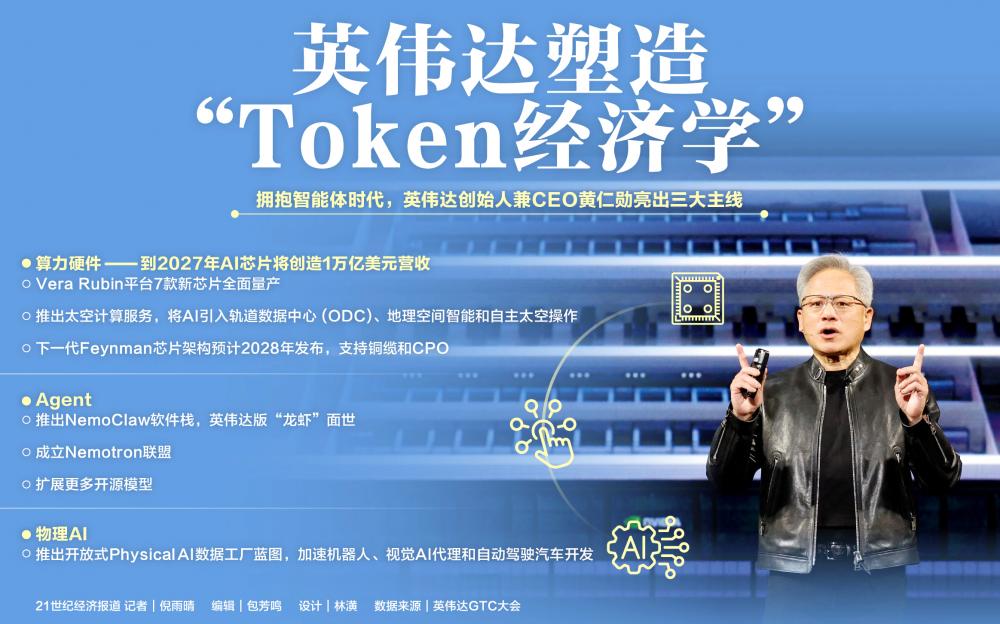
黄仁勋塑造“Token经济学” 英伟达拥抱智能体时代
2 1 Shi Ji Jing Ji Bao Dao· 2026-03-17 22:29
Core Insights - NVIDIA's GTC event showcased the launch of the Vera Rubin architecture, marking a significant leap in AI technology with seven new chips and the establishment of the largest AI factory globally [1][2] - The introduction of Vera Rubin is expected to double the revenue forecast for AI chips, reaching $1 trillion by the end of 2027, compared to the previous estimate of $500 billion [2] - The event emphasized a shift from individual chip competition to a comprehensive system-level competition among tech giants, highlighting the importance of integrated solutions [2] Chip Innovations - The Vera Rubin platform includes a diverse range of chips: NVIDIA Vera CPU, NVIDIA Rubin GPU, NVIDIA NVLink 6, NVIDIA ConnectX-9 SuperNIC, NVIDIA BlueField-4 DPU, and NVIDIA Spectrum-6, which together form a robust data center infrastructure [1] - The architecture utilizes TSMC's 3nm process and features a tightly coupled design that enhances performance, achieving 50 PFlops for inference and 35 PFlops for training [3][4] AI Infrastructure - The Vera CPU rack, built on NVIDIA MGX, integrates 256 Vera CPUs, providing scalable and energy-efficient capacity, with performance improvements over traditional CPUs [4] - The introduction of the Groq LPU architecture aims to enhance real-time interaction capabilities, with the LPX rack containing 256 LPU processors and a bandwidth of 640 TB/s [5][6] AI Agent Development - NVIDIA launched the NemoClaw software stack for AI agents, which allows for continuous operation and complex task execution, positioning it as a foundational tool for the next generation of AI applications [8][10] - The company is also forming the Nemotron Coalition to advance open model development, supporting various applications across industries [10][11] Real-World Applications - New models for robotics and autonomous driving, such as NVIDIA Isaac GR00T and NVIDIA Alpamayo, are designed to enhance decision-making capabilities in real-world environments [11]
霍尼韦尔(HON.US)佐证物理AI加速增长:建筑领域广泛应用,正重塑全球20万场所
智通财经网· 2026-01-27 09:17
Core Viewpoint - Artificial intelligence is significantly impacting real-world efficiency and productivity across various sectors, including airports and hospitals, with a projected widespread application of "physical AI" by 2025 [1] Group 1: AI Implementation - Honeywell's global regional president, Anant Maheshwari, stated that over 200,000 locations worldwide will deploy "physical AI" tools to optimize workflows in automotive factories and energy usage throughout the day by 2025 [1] - Maheshwari emphasized the necessity for every building to enhance energy efficiency, security, and productivity methods [1] Group 2: Supply Chain Adaptation - Honeywell is leveraging lessons learned during the pandemic to ensure its supply chain can withstand the impacts of tariffs imposed by former President Trump [1] - Maheshwari noted a shift in the global trade order from standard global supply chains to more bilateral trade, highlighting the need for local ecosystem operations [1] - The pandemic has prompted companies to build resilient supply chains capable of adapting to uncertainties arising from changes in bilateral relations [1] Group 3: AI Development Insights - NVIDIA's founder and CEO, Jensen Huang, presented the "AI five-layer cake" theory at the World Economic Forum, outlining the foundational elements of AI, including energy, chips, cloud data centers, AI models, and applications [1] - Huang indicated that the "ChatGPT moment" for physical AI has arrived, with machines beginning to understand the real world, reason, and take action [1]

早报 | 浙江一地取消中考选拔功能;贾国龙回归一线,不再打造个人IP;春节AI大战百度腾讯狂“撒钱”;伊武装力量已进入全面戒备状态
虎嗅APP· 2026-01-26 00:15
Group 1 - Iranian armed forces have entered a state of full alert in response to perceived military threats, with a readiness to retaliate against any form of aggression, particularly in the strategic Strait of Hormuz [2] - Baidu and Tencent are launching significant cash giveaway campaigns for the Spring Festival, with Baidu offering 500 million yuan in cash red envelopes and Tencent distributing 1 billion yuan [3] - The Central Radio and Television Station has announced that Galaxy General Robotics will be the designated embodied large model robot for the 2026 Spring Festival Gala, highlighting the company's focus on a multi-domain robot service ecosystem [4] Group 2 - The "Chen Xiaoqun" concept stock has resurfaced in the A-share market, with reports indicating that retail investors are being targeted through algorithmic trading strategies by major financial platforms [5][6] - A Nipah virus outbreak in India has raised health concerns, with a mortality rate ranging from 40% to 75%, prompting increased health monitoring for travelers from India [7] - The founder of Xibei Catering Group, Jia Guolong, has announced a return to frontline operations, focusing on core business rather than personal branding, amid significant financial losses projected for the company [8] Group 3 - Samsung Electronics has raised the price of NAND flash memory by over 100%, reflecting severe supply-demand imbalances in the semiconductor market [11] - The China Information and Communication Research Institute is set to hold a seminar on space computing power, indicating a push towards advancements in this sector [25] - Elon Musk predicts that true artificial general intelligence (AGI) will emerge in 2026, suggesting a transformative period for society and the economy, with energy potentially replacing the dollar as the new currency [27]

黄仁勋最新对话:几千亿只是开胃菜,AI基建还得再砸几万亿
创业邦· 2026-01-22 10:19
Core Viewpoint - The discussion emphasizes that the current investment in AI is not a bubble but rather the beginning of a massive infrastructure build-up, likening it to historical infrastructure projects like railroads and power grids [5][10][34]. Group 1: AI Infrastructure Investment - Nvidia's CEO Jensen Huang stated that the investment in AI infrastructure has only just begun, with estimates suggesting that global spending could reach $3 trillion to $4 trillion by 2030 [13][30]. - The AI infrastructure is conceptualized as a "five-layer cake," with energy at the base, followed by chips, cloud services, AI models, and finally, applications across various industries [13][41]. - Major tech companies have committed to investing over $500 billion in data centers, indicating a significant shift in R&D budgets towards AI [15][31]. Group 2: Job Creation and Economic Impact - Contrary to fears that AI will lead to job losses, Huang argues that AI is creating high-paying blue-collar jobs, with salaries for electricians and plumbers in the U.S. exceeding $100,000 [7][19]. - The healthcare sector has seen an increase in the number of radiologists, as AI takes over repetitive tasks, allowing doctors to focus on patient care [8][21]. - Huang emphasizes the importance of understanding the distinction between the "purpose" and "task" of jobs, suggesting that AI will automate tasks while enhancing the overall purpose of jobs [24][49]. Group 3: AI Sovereignty and Global Development - Huang advocates for every country to develop its own AI capabilities, viewing AI as a fundamental infrastructure akin to electricity and roads [25][28]. - He believes that developing countries can leverage AI to bridge technological gaps, using local languages and cultural data to create tailored AI solutions [28][52]. - For Europe, Huang suggests that the region should capitalize on its strong industrial base and scientific expertise to embrace "physical AI" and robotics [28][54]. Group 4: Current Market Dynamics - Nvidia's GPUs are in high demand, with rental prices increasing, indicating a robust market for AI infrastructure [30][55]. - The shift in R&D budgets towards AI is exemplified by companies like Eli Lilly, which are reallocating funds from traditional labs to AI supercomputing [31][55]. - The current investment climate is characterized by record levels of venture capital flowing into AI-native companies, with over $100 billion expected in 2025 [15][56].