
NVMe SSD

Search documents
Win11 SSD“隐藏加速”通道被堵,这项“神级BUG”没有了
猿大侠· 2026-03-25 04:12
Core Viewpoint - Microsoft has blocked a method in the latest preview version of Windows 11 that allowed users to significantly enhance the theoretical performance of solid-state drives (SSDs) by enabling native NVMe support through a registry modification [1][7]. Group 1: Performance Enhancement - The method allowed the system to bypass the SCSI compatibility layer, enabling direct and efficient communication with SSDs, thereby reducing latency and unlocking their true speed [2]. - In theoretical benchmark tests, particularly in critical scenarios like 4K random read/write, performance improvements were significant, reaching up to 80% or more, which enhanced the fluidity of operations such as game loading and large file extraction [4]. Group 2: User Experience and Risks - Prior to Microsoft's block, this technique was widely shared among users due to its simplicity and noticeable performance boost in daily use [3]. - However, some media outlets have pointed out that this unofficial support method carries risks, with multiple users reporting issues such as inaccessible drives and performance regressions on certain SSD models [6]. - Microsoft has removed the registry path to enable this feature in the latest Windows 11 preview version (Build 26100.8106), suggesting that users should wait for a future official update that safely opens this feature after thorough testing [7].



美光:未来汽车将需要300GB的内存
芯世相· 2026-03-23 06:34
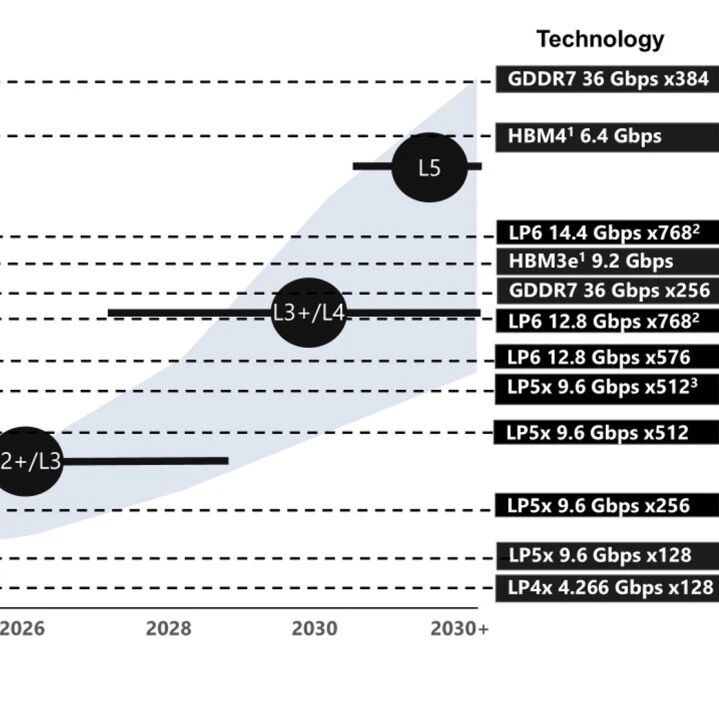
Core Insights - Micron's CEO Sanjay Mehrotra highlighted that with the introduction of L4 autonomous vehicles, the demand for RAM will exceed 300GB, driven by the strong demand for high-end HBM chips from AI cloud providers [3] - Micron reported a significant revenue increase of 200%, reaching $23.86 billion in Q2 2023, primarily due to AI infrastructure and structural supply constraints [3] - The company plans to build multiple fabs in Japan, Singapore, and New York, aiming for a 20% capacity increase by 2026 to alleviate supply-side pressures [3] Group 1: Automotive Memory and Processing Needs - The surge in data from advanced driver-assistance systems (ADAS) and autonomous driving sensors is creating unprecedented demands on automotive memory and storage systems [5] - As vehicles become more electronic and intelligent, the challenges faced in automotive systems are increasingly similar to those in large data centers [6] - The integration of high-priority data functions necessitates faster data transmission speeds between processing units and memory [6] Group 2: System Architecture and Design - The shift towards software-defined vehicles allows for modular design, enabling better bandwidth and memory capacity management [10] - Centralized architectures are being favored over distributed ECUs to handle the large volumes of real-time data from multiple sensors [10] - The design of vehicles is evolving to incorporate various processing units and memory types, focusing on performance where it is most needed [8] Group 3: Memory Technology Trends - LPDDR memory is gaining traction due to its higher bandwidth and lower power consumption, with LPDDR6 achieving 14.4Gb/s [12] - The automotive sector is increasingly utilizing DRAM for computation and NAND for data storage, with a focus on balancing performance and cost [14] - Emerging memory types like MRAM and RRAM are being explored for their low power and high-density storage capabilities [18] Group 4: Future Directions and Challenges - The complexity of future vehicles will require a layered memory and storage architecture to ensure performance and safety [11] - As the industry moves towards L4 and L5 autonomous driving, the need for higher memory capacity and bandwidth will become critical [13] - The automotive memory market is highly concentrated, with a few leading manufacturers dominating, making it essential for OEMs to understand the storage industry dynamics [14]

汽车芯片,新变革
半导体行业观察· 2026-03-07 03:07
Core Viewpoint - The automotive industry is undergoing a significant transformation driven by the exponential growth of data generated by advanced driver-assistance systems (ADAS) and the increasing complexity of vehicle functionalities, necessitating a reevaluation of memory and processing requirements [3][4][5]. Group 1: Data Processing and System Architecture - The data generated by sensors in autonomous and assisted driving is growing explosively, creating unprecedented demands on memory and storage subsystems within vehicles [3]. - The shift towards software-defined vehicles (SDVs) allows for better identification of where advanced processors and memory are needed, optimizing performance and cost [4][5]. - Traditional concerns about data transmission delays are diminishing as high-speed data transfer technologies, such as 10Gbps automotive Ethernet, become more prevalent [4][5]. Group 2: Memory and Storage Technologies - The choice of memory types in electric vehicles (EVs) is critical, with LPDDR6 emerging as a suitable option due to its balance of capacity and bandwidth, essential for ADAS and AI applications [9][11]. - High-bandwidth memory solutions are increasingly important as the demand for real-time processing in vehicles rises, with DRAM and NAND flash being commonly used for various applications [12][16]. - The integration of different memory types, such as DRAM and flash, into hybrid memory architectures is expected to enhance flexibility and performance in future vehicle designs [15][17]. Group 3: Industry Trends and Challenges - The automotive sector is transitioning from distributed electronic control units (ECUs) to more centralized architectures, enabling better data management and real-time decision-making [7][8]. - The increasing complexity of vehicle systems necessitates a focus on optimizing bandwidth, latency, and memory capacity to ensure safety and user experience [8][9]. - The semiconductor industry is experiencing shifts in memory pricing and availability due to rising demand from AI applications, impacting automotive manufacturers' strategies [11][18].
美股异动 | 存储板块盘前走高 希捷科技(STX.US)涨逾8%
Zhi Tong Cai Jing· 2026-01-28 14:00
Core Viewpoint - The storage sector is experiencing a significant pre-market rise, driven by positive earnings forecasts from major companies like Seagate Technology, which expects third-quarter revenue to be substantially higher than Wall Street estimates [1] Group 1: Company Performance - Seagate Technology (STX.US) shares rose over 8% after management projected third-quarter revenue of $2.9 billion, with a fluctuation of $100 million, significantly above the analyst consensus of approximately $2.77 billion [1] - The company also anticipates an adjusted earnings per share (EPS) of about $3.40, with a fluctuation of $0.20, which also exceeds analysts' expectations [1] Group 2: Industry Trends - The construction of AI data centers is driving a surge in demand for High Bandwidth Memory (HBM) storage, leading to a shift in storage chip production from consumer electronics to more complex manufacturing processes for HBM [1] - The three-tier storage stack in AI data centers, consisting of hot layer NVMe SSDs, warm layer/nearline HDDs, and cold layer object and backup storage, is expanding at an exponential rate [1] - Long-standing supply constraints in the HDD industry, combined with a recovery in the NAND cycle and multi-year volume locks from cloud vendors, have increased order visibility for storage product giants [1]

存储板块盘前走高 希捷科技(STX.US)涨逾8%
Zhi Tong Cai Jing· 2026-01-28 14:00
Group 1 - The storage sector saw a pre-market rise, with Seagate Technology (STX.US) up over 8%, Western Digital (WDC.US) up over 6%, SanDisk (SNDK.US) up nearly 5%, and Micron Technology (MU.US) up over 3% [1] - Seagate's management expects Q3 revenue to be $2.9 billion, with a fluctuation of $100 million; this outlook significantly exceeds the Wall Street analysts' average estimate of approximately $2.77 billion [1] - The company anticipates an adjusted earnings per share (EPS) of about $3.40, with a fluctuation of $0.20, which also greatly surpasses analysts' expectations [1] Group 2 - The construction of AI data centers is driving a surge in demand for HBM storage, leading to a shift in storage chip production from consumer electronics to more complex manufacturing and testing processes for HBM [1] - The three-tier storage stack of AI data centers (hot layer NVMe SSD, warm layer/nearline HDD, cold layer object and backup) is experiencing exponential expansion simultaneously [1] - Long-standing supply constraints in the HDD industry, combined with a recovery in the NAND cycle and cloud vendors locking in multi-year contracts, have significantly increased order visibility for storage product giants [1]
AI把闪存链烧断了
投中网· 2025-11-13 06:43
Core Viewpoint - The rising demand for AI is creating significant opportunities and challenges in the NAND flash memory market, particularly for Chinese manufacturers like Yangtze Memory Technologies Co. (YMTC) [4][5]. NAND Price Surge - SanDisk, a leading NAND flash manufacturer, announced a price increase of up to 50% for NAND contracts due to overwhelming market demand, causing a ripple effect throughout the storage supply chain [4][6]. - Other manufacturers, including Micron and Samsung, have also raised prices following SanDisk's lead, indicating a strong demand for NAND products [6]. Impact on AI Server Production - The price hikes have led to module manufacturers like Transcend and Innodisk pausing shipments to reassess pricing, which could disrupt the production of AI servers for major companies like Oracle and Microsoft [4][6]. Market Demand and Projections - TrendForce predicts that AI server shipments will grow by over 20% year-on-year by 2026, with NAND usage in AI servers potentially three times that of traditional servers [6][7]. - The global NAND flash market exceeds $60 billion, dominated by a few major players with approximately 90% market share, leaving limited space for Chinese manufacturers [7]. Opportunities for Chinese Manufacturers - YMTC is positioned to capitalize on the current market dynamics, with plans to increase its monthly production capacity from 100,000 wafers to 150,000 by the end of 2025, aiming for a 15% global market share by 2028 [8]. - The company is also targeting the enterprise SSD market, which offers higher profit margins compared to consumer products [8]. Challenges in Entering the Enterprise Market - YMTC faces significant hurdles in obtaining necessary compatibility certifications from major platform providers and software vendors, which can take 6 to 12 months [10]. - The validation process for large-scale deployment of its products may take up to two years, despite having met technical standards [10]. Industry-Wide Implications - The opportunity for domestic alternatives extends to the entire supply chain, particularly in packaging and testing, with companies like Huatian Technology and Tongfu Microelectronics investing heavily in advanced packaging capabilities [12][13]. - The domestic semiconductor equipment and materials sector is also seeing rapid advancements, with companies like North Huachuang and Zhongwei making significant inroads into the market [14]. Current State of Domestic Production - Despite progress, the overall domestic production rate remains low, with semiconductor equipment localization at about 30% and photolithography equipment at 0-1% [15]. - The NAND market breakthrough could lead to substantial growth in the materials and equipment sectors, as domestic manufacturers seek to reduce reliance on foreign suppliers [16].
