NX8

Search documents
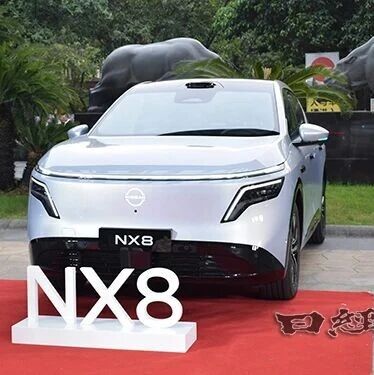
日产将在中国上市“NX8”,最高续航1450公里
日经中文网· 2026-03-23 08:00
Core Viewpoint - Nissan is launching the new SUV "NX8" in China to expand its electric vehicle lineup and address declining sales in the market [2][6]. Group 1: Product Launch - The pre-sale of the NX8 began on March 20, with an official launch scheduled for April [2][4]. - The NX8 will be available in two versions: a pure electric vehicle (EV) and a range-extended electric vehicle (EREV) equipped with a small generator, achieving a total range of 1450 kilometers [4]. Group 2: Market Context - Nissan has fallen behind in the rapidly evolving electric vehicle market [5]. - The company's sales in China have decreased from 1.56 million units in 2018 to an expected 650,000 units by 2025, representing a nearly 60% decline [6].

今年车市价格集体走高
新华网财经· 2026-03-05 15:05
Core Viewpoint - The article highlights the trend of high-end electric vehicles (EVs) emerging in the Chinese automotive market, with a shift in competition towards models priced above 150,000 yuan, indicating a significant change from the previous focus on models priced between 100,000 to 150,000 yuan [2][3]. Group 1: Market Trends - Since March, over 7 new EV models have been launched with guide prices or pre-sale prices above 150,000 yuan, indicating a shift in the competitive price range of the automotive market [2]. - The market share of vehicles priced above 150,000 yuan is expected to increase, with models priced between 200,000 to 300,000 yuan accounting for 18.6% of domestic retail sales, reflecting a clear trend towards high-end development in the EV sector [3]. Group 2: Company Strategies - BYD is focusing on high-end strategies by separating its B-end and C-end markets, targeting the ride-hailing and government vehicle markets with a new brand called Linghui, while also expanding its high-end brands, Tengshi and Yangwang [2]. - GAC Toyota's new model, the Platinum 7, is collaborating with Huawei to feature the Hongmeng cockpit, with a pre-sale price exceeding 150,000 yuan, while Dongfeng Nissan's upcoming NX8 is targeting the 200,000 yuan SUV market [2]. Group 3: Policy Impact - The increase in competition in higher price segments is partly driven by changes in the vehicle trade-in policy, which has made it easier for consumers to upgrade to new vehicles, with 74.1% of consumers opting for new cars priced above 200,000 yuan [4]. - The implementation of the vehicle trade-in policy in 2026 is expected to benefit the 150,000 to 200,000 yuan price segment, promoting growth in the mid-to-high-end market [4].
今年车市价格集体走高
第一财经· 2026-03-05 12:38
Core Viewpoint - The article highlights the shift in the competitive landscape of the Chinese automotive market, particularly in the high-end electric vehicle (EV) segment, with a notable increase in models priced above 150,000 yuan, indicating a trend towards premiumization among domestic brands [3][5]. Group 1: Market Trends - The competition in the automotive market is shifting from the 100,000 to 150,000 yuan price range to the 150,000 to 200,000 yuan range, with over seven new EV models launched since March priced above 150,000 yuan [3]. - The market share of vehicles priced above 150,000 yuan has increased, with 18.6% of domestic retail sales in the 200,000 to 300,000 yuan segment, reflecting a clear trend towards high-end offerings [5]. - The trend of premiumization is further supported by the introduction of new models from both domestic and joint venture brands, such as the Haobo A800 and the GAC Toyota Platinum 7, which are priced above 150,000 yuan [4][5]. Group 2: Company Strategies - BYD is focusing on high-end strategies by separating its B-end and C-end markets, launching a new brand for ride-hailing and government vehicles, and planning to release 12 new high-end models this year [3][5]. - Joint venture brands are also attempting to penetrate the high-end EV market, with GAC Toyota collaborating with Huawei for its Platinum 7 model, which is priced above 150,000 yuan [4]. - The high-end strategy is seen as a core focus for leading companies, including BYD, which aims to achieve higher marginal profits despite intense competition in the domestic market [5]. Group 3: Policy Impact - The increase in vehicle prices is partly driven by changes in the vehicle trade-in policy, which has made it easier for consumers to upgrade to higher-priced models [6]. - The trade-in market is dominated by domestic brands, with 59% of consumers trading in vehicles priced below 150,000 yuan, while 74.1% of new car buyers are opting for vehicles priced above 200,000 yuan [6]. - The implementation of the trade-in policy is expected to benefit the mid-to-high-end market, with specific subsidy thresholds set for both new energy and fuel vehicles [6].

专访东风日产王骞:合资车企转型,要先去“爹味”
第一财经· 2026-01-19 08:30
Core Viewpoint - The article discusses the challenges and strategies of Dongfeng Nissan in the electric vehicle (EV) market, emphasizing the need for joint venture brands to adapt quickly to changing consumer preferences and market dynamics [2][3]. Group 1: Market Positioning and Consumer Engagement - Dongfeng Nissan's strategy focuses on appealing to younger consumers, with 60% of N6 buyers citing aesthetics as their primary reason for purchase [5]. - The concept of "emotional value" is highlighted as essential, where products must resonate with consumers beyond basic functionality, emphasizing co-creation with users [6]. - The N7 and N6 models have seen significant interest, with N7 having a 30% trade-in rate from fuel vehicles, while N6 attracts 60-80% new customers [8]. Group 2: Product Development and Strategy - The choice of a sedan for the N series over an SUV is strategic, as the market for compelling electric sedans is limited compared to SUVs [7]. - Dongfeng Nissan aims to break traditional barriers in product development by gaining local definition rights and speeding up decision-making processes [13][14]. - The company plans to invest 10 billion yuan by the end of 2026 to expand its R&D team to 4,000 people, indicating a long-term commitment to electrification and intelligence [22]. Group 3: Learning from New Forces - Dongfeng Nissan is adopting a project-based operational model inspired by companies like Huawei, aiming to enhance efficiency and responsiveness to market changes [28][29]. - The company acknowledges the need to learn from successful new energy vehicle brands to better meet evolving consumer demands [29]. Group 4: Future Product Plans - By 2027, Dongfeng Nissan plans to launch six new electric models, including two sedans in 2025 and a focus on SUVs with the NX8 model expected to launch in March-April 2026 [30]. - The sales target for new models is set at over 5,000 units per month to be considered successful, with 10,000 units seen as a benchmark for a "hit" product [32].
专访东风日产王骞:合资车企转型,要先去“爹味”丨合资反攻局
Di Yi Cai Jing· 2026-01-19 06:59
Core Viewpoint - The transformation of joint venture brands in the electric vehicle market is ongoing, with a focus on appealing to younger consumers and adapting to market demands [1] Group 1: Company Strategy and Market Position - Dongfeng Nissan's new energy models N7 and N6 have seen significant pre-order success, with over 20,000 orders for N7 in 50 days and over 10,000 for N6 in 10 days, but the brand still faces challenges in establishing a market-defining electric vehicle [1][2] - The company aims to enhance its appeal to younger consumers by emphasizing design, with 60% of N6 buyers citing aesthetics as their primary reason for purchase [3] - Dongfeng Nissan plans to invest 10 billion yuan by the end of 2026 to expand its R&D team to 4,000 people, indicating a long-term commitment to electric and intelligent vehicle development [16] Group 2: Product Development and Consumer Engagement - The company has shifted its product development approach to prioritize local market needs, gaining product definition rights in China starting with the N7 [9] - Dongfeng Nissan is adopting a simplified product configuration strategy, offering only two versions of new models to streamline consumer choices [11][12] - The N6 model is designed to appeal to new customers, with approximately 60-80% of its buyers being first-time Nissan customers [6] Group 3: Competitive Landscape and Future Plans - The company recognizes the competitive nature of the automotive market by 2026 and is focused on meeting customer demands to avoid falling behind [1][15] - Dongfeng Nissan plans to launch six new energy models by the end of 2027, including two sedans in 2025 and an SUV model NX8 targeting the 200,000 yuan market segment [22] - The company is learning from successful competitors like Huawei and Li Auto, adapting project-based operations to enhance efficiency and responsiveness [20][21]