新能源汽车转型

Search documents
亏了近90亿元的广汽集团等待拯救,但启境难成救命稻草
Xin Lang Cai Jing· 2026-03-30 01:17
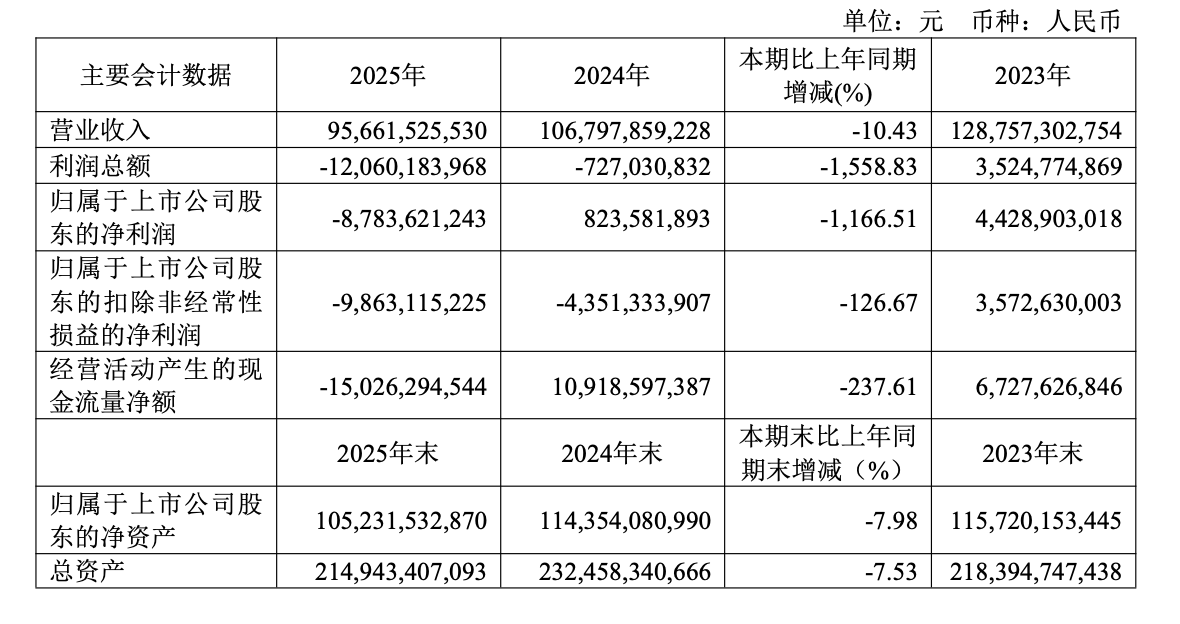
Core Viewpoint - GAC Group reported disappointing annual results for 2025, facing multiple pressures including profit collapse, negative cash flow, and declining sales across its business segments [1] Financial Performance - The company's total revenue for 2025 decreased by 10.43% year-on-year - Net profit attributable to shareholders turned from profit to a loss of 8.784 billion yuan, a staggering decline of 1166.51% - Net cash flow from operating activities was -15.026 billion yuan [1][2] Sales Performance - Sales across GAC Group's main business segments saw significant declines, with GAC Honda's sales down 25.22% to 351,900 units - The self-owned brands, Trumpchi and Aion, also experienced over 20% declines in sales, with annual sales of 319,100 and 290,000 units respectively - Only GAC Toyota managed to maintain stable sales with a slight year-on-year increase [1][2] New Energy Vehicle (NEV) Challenges - Despite the domestic NEV market maintaining over 25% growth, GAC Group's NEV sales fell by 4.64% to 433,600 units, lagging behind competitors like Leap Motor [1] - The reliance on the B-end market for Aion has limited its brand development and market share [4][5] Cost and Efficiency Issues - Weak sales led to underutilization of production capacity, increasing fixed costs per unit by over 40% year-on-year - GAC Honda's production capacity utilization was 59%, while Trumpchi and Aion were at 54% and 46% respectively, with GAC Toyota at 76% [4] Strategic Initiatives - GAC Group is prioritizing the "Qijing" project, a collaboration with Huawei to develop a new high-end NEV brand, with the first model, the GT7, set to launch in June [9] - The company is implementing internal measures like the "Panyu Action" to enhance efficiency and reduce costs through shared resources and platform-based planning [12] Market Positioning and Competition - GAC's high-end brand, Haobo, has struggled to establish a strong market presence compared to competitors like SAIC's Zhiji and Dongfeng's Lantu [6][12] - The competitive landscape in the NEV sector is intensifying, with many brands vying for consumer attention, making it challenging for new entrants like Qijing to gain traction [11]


比亚迪,A股大涨
Zheng Quan Ri Bao· 2026-03-23 06:40
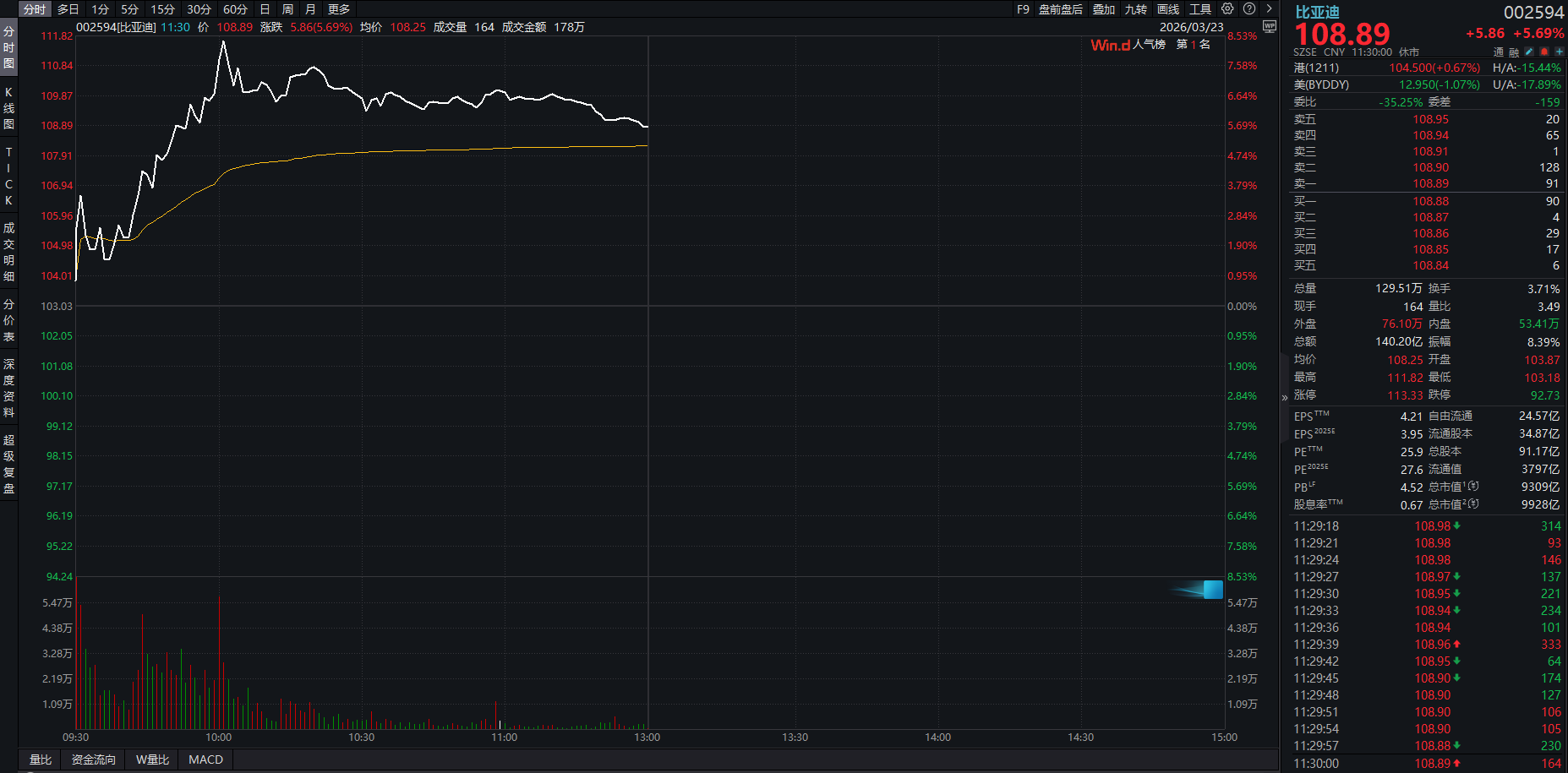
Group 1 - BYD's stock price surged over 8% on March 23, with a midday closing price of 108.89 CNY per share, resulting in a market capitalization exceeding 1 trillion CNY [1] - The China Passenger Car Association noted a significant shift in consumer preferences post-holiday, with the penetration rate of new energy vehicles (NEVs) increasing weekly, driving the recovery of the passenger car market in March [3] - The fuel vehicle market continues to face pressure, with mid-March discounts averaging 24.2%, indicating that consumer expectations for transaction prices have not been met, which has hindered the anticipated recovery in fuel vehicle sales [3] Group 2 - BYD aims to sell 4.6 million NEVs by 2025, maintaining its position as the top-selling automaker in China and leading in brand sales [3] - In the overseas market, BYD is deeply involved in the global transition to electric vehicles, with projected annual overseas sales surpassing 1 million units by 2025, representing a year-on-year growth of over 140% [3] - In February 2026, BYD sold 190,200 NEVs, with exports accounting for 100,600 units, marking a historic milestone where exports exceeded 50% of total sales [3]

机构白皮书:高科技行业对核心技术人才的竞争已进入“刚需”阶段
Xin Hua Cai Jing· 2026-02-27 07:54
Group 1 - The high-tech industry is projected to have the highest salary adjustment rate of 4.9% by 2025, driven by competition for core technical talent in key areas like artificial intelligence and semiconductors [1] - First-tier cities, particularly Shanghai (12,742 CNY/month) and Beijing (12,518 CNY/month), show significant salary advantages, reflecting the strong support of high-tech industries and high-level talent density [1] - New first-tier cities like Hangzhou (10,165 CNY/month) and Nanjing (9,624 CNY/month) are rapidly closing the salary gap with Guangzhou, indicating the growing influence of the Yangtze River Delta economic circle [1] Group 2 - Integrated circuit design engineers in first-tier cities have an average annual salary of 400,591 CNY, while cloud computing architects earn close to 500,000 CNY (491,253 CNY), highlighting the high value of these positions [2] - The manufacturing and automotive industries are expected to have salary adjustment rates of 4.3% and 4.1% respectively by 2025, with traditional "blue-collar" jobs transitioning to "digital craftsmen" [2] - The pharmaceutical and health industry maintains a salary adjustment rate of 4.4% in 2025, driven by aging trends and biotechnological innovations, with key positions like bioinformatics engineers earning 293,820 CNY in first-tier cities [2] Group 3 - The financial industry is projected to have a lower salary adjustment rate of 3.0% in 2025, influenced by stricter regulations and market volatility, with a further decline to 2.9% expected in 2026 [3] - Despite an increase in disposable income for urban residents (4.2% growth in 2025), consumer willingness is becoming more rational, reflected in the consumer goods industry's salary adjustment rate of 3.7%, slightly below the industry average [3] - The salary gap between first-tier and non-first-tier cities remains around 30%, indicating a concentration of high-end consumer resources in first-tier cities [3]
1月头部车企销量表现分化呈现“五增五降”格局
Zhong Guo Zheng Quan Bao· 2026-02-26 20:28
Core Insights - The Chinese automotive market is expected to see record production and sales, with 2026 January sales data serving as a significant indicator for the year's trends [1] - The market is characterized by a high concentration of sales among the top ten companies, which accounted for 83.6% of total sales, indicating a "Matthew Effect" where the strong continue to strengthen [1][2] - The competition among automakers is intensifying, with a clear divide between companies experiencing sales growth and those facing declines [1][3] Market Performance - In January 2026, total domestic car sales reached 2.346 million units, a year-on-year decrease of 3.2%, while production was 2.45 million units, showing a slight increase of 0.01% [1] - The top ten automakers sold a combined 1.962 million units, with five companies showing sales growth and five experiencing declines, highlighting a distinct market segmentation [1][3] Sales Growth Leaders - SAIC Motor led sales with 327,000 units, a significant year-on-year increase of 23.9%, driven by growth in its self-owned brands, new energy vehicles, and overseas sales [2] - Geely and FAW Group followed in the second tier, with sales of 270,100 and 275,000 units respectively, while BYD and Chery ranked in the third tier with sales of 210,100 and 200,300 units [2][3] Factors Influencing Sales - The decline in January sales is attributed to the transition of new energy vehicle purchase tax policies, changes in local subsidies, and the early release of consumer demand at the end of 2025 [4] - Companies that achieved growth typically had advantages in new energy product offerings or overseas market expansion, while those with declining sales struggled to align product adjustments with market demand [4] Strategic Focus of Automakers - Major automakers are setting clear sales targets for 2026, emphasizing product launches and technological advancements to capture market share [5] - Traditional automakers like FAW and Dongfeng are focusing on steady growth and new energy transitions, with specific sales targets set for the year [5][6] Differentiated Strategies - Leading independent brands such as SAIC, Geely, and Great Wall are adopting differentiated strategies to maintain stability and growth, with SAIC's target speculated to be between 4.5 million to 5 million units [5][6] - New energy leaders like BYD are focusing on overseas sales, targeting 1.3 million units, while also expanding their domestic product offerings [6]



突发! 某大型国有汽车集团原董事长被查
Sou Hu Cai Jing· 2026-02-20 15:48
Group 1 - The core viewpoint highlights the rise and fall of Fang Hongwei, who transitioned from a practical technician to the chairman of Shaanxi Automobile Holding, emphasizing the importance of maintaining integrity in the intersection of power and industry [1][3][6] - Fang's leadership in the new energy vehicle sector significantly boosted Xi'an's production to 9.46% of the national total, while Shaanxi's heavy truck market captured over 40% of the Central Asian market [3] - The narrative illustrates the duality of Fang's role, where his initial intent to serve the industry was compromised by corruption, reflecting a broader issue of governance in the intersection of politics and business [3][6] Group 2 - The automotive industry is identified as a core sector of the real economy, with the transition to new energy being a national strategy [6] - Fang's experience serves as a cautionary tale, indicating that power, when unrestrained by institutional frameworks, can hinder sustainable high-quality development despite short-term gains [6] - The conclusion emphasizes the necessity for industry leaders and policymakers to adhere to institutional constraints, ensuring that power serves the industry rather than personal interests [6]
国内汽车市场,突发重大转变!
Xin Lang Cai Jing· 2026-02-14 14:24
Core Insights - The Chinese automotive market experienced a surprising reversal at the beginning of 2026, with companies relying solely on electric vehicles facing significant declines, while traditional manufacturers that balance both fuel and electric vehicles demonstrated resilience [2][29]. Group 1: Market Performance - In January, nationwide retail sales of passenger cars in China reached 1.544 million units, a year-on-year decline of 13.9% and a month-on-month drop of 31.9% [4][31]. - The new energy vehicle (NEV) sector was particularly hard hit, with major companies like BYD reporting a 30.11% year-on-year decline and a staggering 50.04% month-on-month drop in sales [5][10]. - In contrast, traditional fuel vehicle sales showed a smaller decline, with fuel vehicles experiencing a year-on-year drop of 16.9% and a month-on-month decline of only 10.9% [6][33]. Group 2: Company Performance - Geely Holding Group led the sales with approximately 340,000 units sold, showing a year-on-year increase of 2.78% and a month-on-month increase of 14.08% [5][32]. - SAIC Group also performed well, achieving 327,413 units sold, a year-on-year increase of 23.94% despite a month-on-month decline of 18.03% [5][42]. - BYD's sales fell to 210,051 units, marking a significant drop and resulting in it being surpassed by competitors for the first time in four years [10][37]. Group 3: Market Trends - The market share of NEVs dropped from over 50% at the end of the previous year to 38.6% in January, indicating a shift in consumer preference back towards more reliable and fuel-efficient vehicles [11][38]. - The decline in NEV sales was attributed to the reinstatement of a half tax on NEV purchases and demand exhaustion from previous surges in sales [13][40]. - Companies that maintained a dual strategy of fuel and electric vehicles, such as Geely and SAIC, were better positioned to weather the market fluctuations, with fuel vehicles acting as a stabilizing force [15][54]. Group 4: Export Performance - In January, total automotive exports reached 681,000 units, a year-on-year increase of 44.9%, with NEV exports also doubling to 302,000 units [18][47]. - Companies like Chery and Geely reported significant growth in exports, with Chery exporting 119,000 units and Geely 60,500 units, reflecting a strong international demand [45][47]. Group 5: Future Outlook - The automotive industry is transitioning from a policy-driven to a technology-driven market, with traditional manufacturers leveraging their established fuel vehicle bases to adapt to new challenges [20][49]. - Companies that successfully integrate both fuel and electric vehicle strategies, along with international market expansion, are expected to have a competitive advantage moving forward [24][54].

汽车零部件领域“蛇吞象”,天汽模拟收购东实股份60%股权
Jing Ji Guan Cha Wang· 2026-02-12 13:32
Core Viewpoint - Tianjin Automotive Mould Co., Ltd. (Tianqi Mould) is set to acquire a 60% stake in Dongshi Automotive Technology Group Co., Ltd. (Dongshi) through a combination of share issuance and cash payment, aiming for absolute control of 85% post-transaction [2][4]. Group 1: Company Overview - Tianqi Mould, established in 1996 and listed in 2010, specializes in the research, design, production, and sales of automotive body covering moulds and related products, serving major automotive companies like Tesla and BYD [2]. - Dongshi, founded in 2001, is a significant player in the automotive parts sector, providing components for both commercial and passenger vehicles, with a strong market presence due to partnerships with companies like Lear and Cummins [3]. Group 2: Financial Performance - Dongshi's projected revenues for 2024 and 2025 are 3.875 billion and 4.733 billion respectively, with net profits of 369 million and 355 million [3]. - In contrast, Tianqi Mould's revenues for 2024 are expected to be 2.746 billion, with a net profit of 83 million, indicating a significant disparity in financial performance [3]. Group 3: Strategic Importance of the Acquisition - This acquisition marks Tianqi Mould's first major capital operation since a change in control in December 2025, with new management focusing on resource integration to enhance company quality [4]. - The acquisition is viewed as a strategic move to expand Tianqi Mould's business and improve its product chain, customer structure, and regional coverage, leveraging synergies in technology and market [5]. Group 4: Transaction Structure and Market Reaction - The transaction structure has been adjusted to a combination of share issuance and cash payment, which is seen as a pragmatic approach given Tianqi Mould's financial situation, with a cash balance of 1.071 billion and interest-bearing debt of 1.607 billion as of September 2025 [5]. - The market has reacted positively to the acquisition due to the potential for significant operational synergies between the two companies, particularly in enhancing product precision and expanding customer channels [6]. Group 5: Industry Context - The automotive parts industry is undergoing a transformation driven by the shift towards electric vehicles, creating new demands for integrated die-casting and lightweight structural components [5]. - Tianqi Mould's focus on mould development and Dongshi's strength in large-scale component production can create a closed-loop industrial chain, enhancing overall competitiveness in the evolving market [6].

销量未达预期:广汽进入转型关键期
Xin Lang Cai Jing· 2026-02-10 09:47
Core Insights - GAC Group reported a total sales volume of 116,600 vehicles in January 2026, representing an 18.47% year-on-year increase, with self-owned brands achieving over 49,000 units sold, a remarkable 87.58% growth [2][3] - The sales performance in January 2026 serves as a positive signal for GAC Group's operational resilience, countering the negative impact of a projected net loss of 8 to 9 billion yuan for 2025 [2][3] Sales Performance - GAC Toyota's January sales exceeded 62,600 units, marking a 9.82% increase year-on-year, with several high-value models experiencing double-digit growth [2][3] - GAC Honda's January sales reached over 27,600 units, reflecting a significant decline compared to GAC Toyota [4] - AION V achieved record overseas sales in January, contributing to the overall growth of GAC Group's self-owned brands [2][3] Brand Performance - GAC Toyota's cumulative sales for 2025 reached 772,668 units, a slight increase of 0.3%, with new energy vehicles accounting for over 9% of total sales [3][4] - GAC Honda's total sales for 2025 were 351,926 units, down 25.22%, indicating a stark contrast to GAC Toyota's performance [4] - GAC Aion has emerged as a leader in the new energy segment, achieving 480,000 deliveries in 2023, significantly outperforming competitors [11][14] Strategic Adjustments - GAC Group initiated a comprehensive reform called "Panyu Action" aimed at increasing self-owned brand sales to 60% of total sales by 2027 [18][20] - The company has streamlined its new vehicle development cycle from 26 months to 18-21 months, reducing R&D costs by over 10% and improving overall business efficiency by approximately 50% [18][20] - GAC Group's collaboration with Huawei on the "Qijing" project is expected to enhance its technological capabilities and brand strength [21][24] Market Challenges and Opportunities - GAC Group faces challenges in enhancing brand recognition and market competitiveness in the personal consumer segment while continuing to optimize product offerings [18][24] - The overseas market is identified as a crucial growth engine, with GAC's self-owned brands achieving a 47% increase in overseas sales in 2025, nearing 130,000 units [24]
多重困局,启源待解
Zhong Guo Qi Che Bao Wang· 2026-02-09 03:51
Core Viewpoint - The Chinese new energy vehicle market continues to surge in 2025, with Changan Automobile achieving a total sales volume of 2.913 million units, marking a nine-year high, and the new energy vehicle segment experiencing explosive growth of 51% [1] Group 1: Sales Performance - Changan's new energy strategy, particularly through its brand Changan Qiyuan, saw sales surpassing 400,000 units in 2025, despite facing challenges such as high-end positioning setbacks and product quality issues [1][3] - The overall sales figure of 411,000 units for Changan Qiyuan appears impressive but reveals structural issues that could hinder sustainable growth [8][9] Group 2: Product Strategy and Positioning - Changan Qiyuan's product strategy is fundamentally flawed due to unclear brand positioning, leading to internal competition among models with overlapping features and price ranges [3][4] - The flagship model E07, priced between 199,900 to 319,900 yuan, failed to meet market expectations, resulting in sales of less than 1,000 units in 2025 [4][5] - The internal model overlap and lack of differentiation have created confusion among consumers and challenges for dealers [4][5] Group 3: Innovation and Technology - Changan Qiyuan's technological innovation is lagging behind industry leaders, with only one model featuring advanced driving assistance systems, while others remain at a basic level [6][7] - The brand's reliance on external suppliers for battery technology and lack of proprietary advancements have hindered its competitive edge [6][7] - The innovation approach appears reactive rather than proactive, failing to address critical user needs and market trends [7] Group 4: Market Challenges - The sales structure is heavily reliant on a few models, with the Lumin electric vehicle accounting for 39% of total sales, indicating vulnerability to market fluctuations [8][9] - The disconnect between sales targets and actual performance suggests that growth is primarily driven by low-cost models rather than breakthroughs in higher-end markets [9][10] - The challenges faced by Changan Qiyuan reflect broader issues within traditional automakers transitioning to new energy vehicles, emphasizing the need for a return to core user value [9][10]
重大战略失误!全球第四大汽车集团闪崩
汽车商业评论· 2026-02-08 23:06
Core Viewpoint - Stellantis announced a significant impairment charge of approximately $26.5 billion, primarily due to misjudging the pace of the transition to electric vehicles and drastically lowering its electrification targets, leading to a sharp decline in stock prices [4][5][18]. Group 1: Impairment and Financial Impact - The impairment charge is unprecedented in the automotive industry, surpassing the company's current market value, with stock prices plummeting by 30% at one point [4][5]. - Analysts noted that while the market anticipated some impairment, the scale and cash expenditure ratio were critical negative factors affecting the company's performance [4]. - Stellantis's revenue heavily relies on high-margin Jeep and Ram trucks, which are particularly vulnerable in the weak U.S. electric vehicle market [5]. Group 2: Industry Context and Challenges - The automotive industry is facing a crisis, with traditional Western automakers struggling to balance investments between electric and combustion engine vehicles while contending with rising competition from Chinese manufacturers and increasing international trade barriers [5]. - In 2025, electric vehicle sales in Europe are projected to account for 19.5% of total sales, a nearly 30% year-over-year increase, but still below market expectations; in the U.S., the share is only 7.7% [5]. Group 3: Strategic Adjustments and Leadership Changes - Under the leadership of new CEO Antonio Filosa, Stellantis is adjusting its strategy to focus on consumer demand rather than aggressive electrification targets, which were deemed overly optimistic by the previous CEO Carlos Tavares [7][16]. - The company plans to invest in both electric and combustion engine options, reflecting a shift towards a "power choice" strategy that allows consumers to select their preferred powertrain [16]. Group 4: Product Quality and Market Response - Stellantis is addressing product quality issues, with a reported decline in early-month defect complaints by over 50% in North America and over 30% in Europe [12]. - The company is introducing new and updated models, including the Jeep Cherokee and Dodge Challenger, to enhance product appeal and drive sales [12]. Group 5: Future Projections and Financial Outlook - Stellantis expects its revenue for the second half of 2025 to reach between $92.2 billion and $94.6 billion, but anticipates a net loss of $22.4 billion to $24.8 billion during the same period [17]. - The company has decided to suspend its dividend for 2026 and plans to issue up to $5.9 billion in corporate bonds to manage its financial situation [17].