OpenAI Deep Research

Search documents
超越GPT-5、Gemini Deep Research!人大高瓴AI金融分析师,查数据、画图表、写研报样样精通
量子位· 2025-12-26 06:35
Core Viewpoint - The article introduces Yulan-FinSight, a multi-modal report generation system developed by Renmin University of China, designed to meet real financial research and investment needs, showcasing advanced capabilities in data analysis and report writing [1][3]. Group 1: Challenges of General AI in Financial Research - General AI struggles with financial reports due to their highly structured, logical, and visual nature, which involves multiple processes [5]. - Financial research demands higher data integration, analytical depth, and expression forms compared to general AI tasks [6]. - Three main challenges faced by existing general AI systems include: 1. Fragmentation of domain knowledge and data, making it difficult to integrate structured financial data with unstructured information [7]. 2. Lack of professional-level visualization capabilities, as current models can only produce basic visualizations without ensuring data consistency [8]. 3. Absence of iterative research capabilities, where existing systems follow a fixed process that limits dynamic adjustments based on intermediate findings [9]. Group 2: FinSight's Innovations - FinSight aims to emulate human financial analysts by focusing on cognitive processes and introducing three key technological innovations [10]. - The core architecture is based on a Code-Driven Variable-Memory (CAVM) multi-agent framework, allowing for collaborative reasoning through a unified variable space instead of traditional message-based communication [14][16]. - An iterative vision-enhanced mechanism is employed for generating financial charts, combining the strengths of language models for coding and visual models for feedback [20][21]. - The writing framework is restructured into a two-phase process: analysis followed by integration, ensuring clarity and depth in long reports [24][25]. Group 3: Performance and Evaluation - FinSight significantly outperformed existing deep research systems in factual accuracy, analytical depth, and presentation quality, achieving an average score of 8.09 [34]. - The system's visualization capabilities received a score of 9.00, indicating a substantial improvement in generating professional financial charts [35]. - In practical applications, FinSight produced reports averaging over 20,000 words with more than 50 charts, maintaining quality as report length increased [38]. - FinSight ranked first in the AFAC 2025 Financial Intelligence Innovation Competition, demonstrating its robustness and practical utility [39]. Group 4: Broader Implications - FinSight represents a significant advancement in AI capabilities within expert-intensive fields, suggesting that AI can now perform tasks traditionally reserved for human experts, such as problem decomposition and hypothesis validation [40][41]. - This paradigm shift indicates potential applications in various complex domains, including research analysis, legal assessment, and medical decision-making, paving the way for a new generation of productivity centered around expert-level AI agents [43].

Kimi新功能Deep Researcher海外引发热议 还被马斯克直播点名
Sou Hu Cai Jing· 2025-07-10 10:15
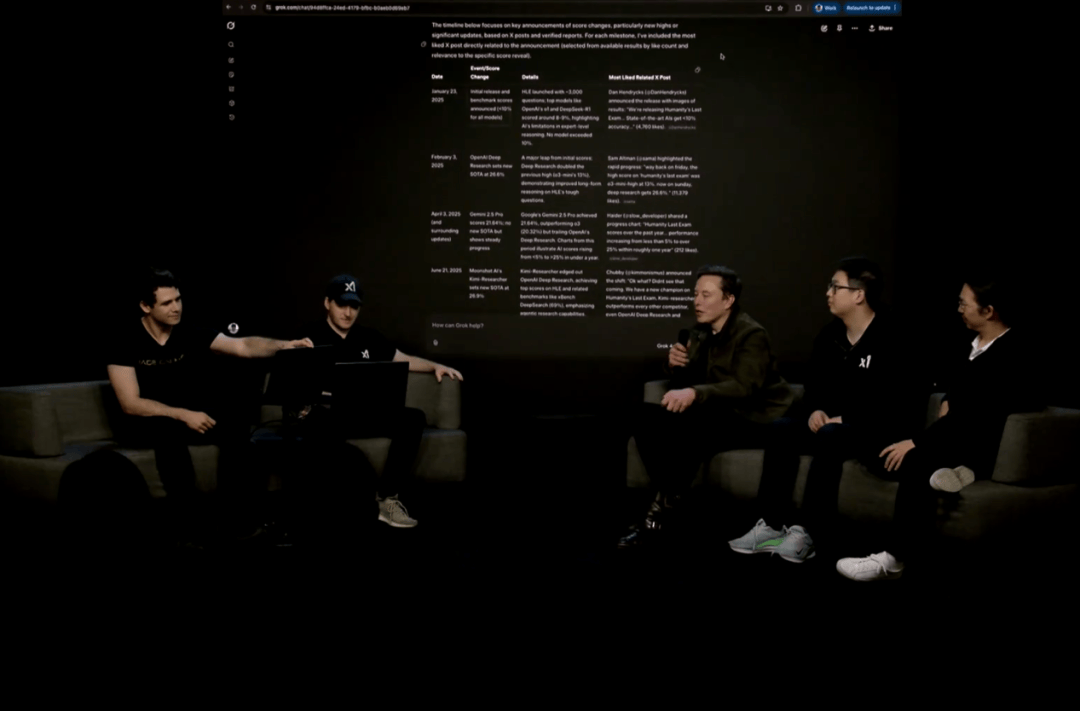
Core Insights - xAI, led by Elon Musk, has launched its latest flagship model, Grok 4, during a live event [1] Group 1: Competitive Landscape - The live event compared the performance of various AI models, including OpenAI, Google's Gemini, and Kimi's Deep Researcher, highlighting that Deep Researcher surpassed Gemini 2.5 Pro and was on par with OpenAI's Deep Research in the Humanities Last Exam (HLE) [3] - Kimi's Deep Researcher achieved a score of 26.9% on HLE, outperforming all competitors, including OpenAI and Google's models, indicating a significant advancement in AI capabilities [4] - AI entrepreneurs and researchers have expressed admiration for Kimi's Researcher product, suggesting it is a top competitor alongside DeepSeek and ByteDance in the Chinese AI market [4][6] Group 2: Performance Metrics - Kimi DeepResearcher performs an average of 23 reasoning tasks for each research assignment, effectively filtering out low-quality information and generating rigorous analytical conclusions [6] - The performance of AI models has shown a remarkable increase, with scores rising from less than 5% to over 25% within a year, demonstrating rapid advancements in AI research capabilities [4]
开启 AI 自主进化时代,普林斯顿Alita颠覆传统通用智能体,GAIA榜单引来终章
机器之心· 2025-06-04 09:22
Core Insights - Alita, developed by Princeton University's AI Lab, embodies the philosophy of "simplicity is the ultimate sophistication," focusing on minimal predefined tools and maximizing self-evolution capabilities [1][11]. Performance Metrics - Alita achieved a remarkable 75.15% pass@1 and 87.27% pass@3 in the GAIA validation benchmark, surpassing notable AI systems like OpenAI Deep Research [3][22]. - In specific tests, Alita scored 74.00% in Mathvista and 52.00% in PathVQA, demonstrating superior performance compared to systems with complex tool libraries [22]. Design Philosophy - The core design principle of Alita is to allow the agent to autonomously create MCP tools without relying on predefined settings, addressing limitations of existing systems that depend heavily on predefined tools [5][6]. - Alita's architecture consists of only essential components, including a Manager Agent and a Web Agent, which facilitate dynamic tool creation and self-evolution [13][16]. Challenges Addressed - Existing generalist agents face limitations such as narrow coverage, restricted creativity, and compatibility issues with various tools, which Alita aims to overcome through its innovative design [6][11]. - Alita's approach emphasizes the importance of simplicity in enhancing creativity and flexibility, leading to improved scalability and generalization capabilities [11][30]. Self-Evolution Mechanism - Alita's self-evolution is facilitated by its ability to dynamically generate and optimize MCP tools based on task requirements, allowing for continuous improvement and adaptation [19][26]. - The system includes three core modules: MCP Brainstorming for task analysis, Script Generating Tool for real-time tool creation, and Code Running Tool for testing and optimizing generated tools [17][19]. Future Implications - Alita's success indicates that a simplified design can drive performance improvements, suggesting a shift in focus for future AI development towards enhancing creativity and evolutionary potential rather than expanding tool complexity [30]. - The paradigm of integrating simplicity with self-evolution is expected to be crucial for the next generation of general AI assistants, enabling them to solve problems without predefined workflows [30].

Deep Research类产品深度测评:下一个大模型产品跃迁点到来了吗?
Founder Park· 2025-04-23 12:37
以下文章来源于海外独角兽 ,作者拾象 Founder Park 正在搭建开发者社群,邀请积极尝试、测试新模型、新技术的开发者、创业者们加入,请扫码详细填写你的产品/项目信息,通过 审核后工作人员会拉你入群~ 海外独角兽 . 研究科技大航海时代的伟大公司。 Deep Research 产品可被理解为 一个以大模型能力为基础、集合了检索与报告生成的端到端系统,对信息进行迭代搜索和分析,并生成详细报告作为输 出。 参考 Han Lee 的 2x2 分析框架,目前 Deep Research 类产品在 输出深度、训练程度 两大维度呈现分异。 输出深度 即产品在先前研究成果的基础上进行了 多少次迭代循环以收集更多信息,可进一步被理解为 Agentic 能力的必要基础。 低训练程度 指代经过人工干预和调整的系统,比如使用人工调整的 prompt,高训练程度则是指利用机器学习对系统进行训练。 和传统 LLM Search 产品相比,Deep Research 是迈向 Agent 产品雏形的一次跃迁,可能也将成为具有阶段代表性的经典产品形态。 Deep Research 产品通过系列推理模型嵌入,已生长出了 Agent 产品 ...


Deep Research 类产品深度测评:下一个大模型产品跃迁点到来了吗?
海外独角兽· 2025-04-21 13:13
作者:Krystal 编辑:penny Deep Research 产品可被理解为 一个以大模型能力为基础、集合了检索与报告生成的端到端系统,对 信息进行迭代搜索和分析,并生成详细报告作为输出。 参考 Han Lee 的 2x2 分析框架,目前 Deep Research 类产品在 输出深度、训练程度 两大维度呈现分 异。 输出深度 即产品在先前研究成果的基础上进行了多少次迭代循环以收集更多信息,可进一步被 理解为 Agentic 能力的必要基础。 低训练程度 指代经过人工干预和调整的系统,比如使用人工调整 的 prompt,高训练程度则是指利用机器学习对系统进行训练。 从 2024 年末问世的 Google Deep Research,到 2024 年 2 月以来密集发布的 OpenAI Deep Research、 Perplexity、xAI Deep Search、Manus,Deep Research 成为各家 Agent 产品角逐的白热化赛道。 和传统 LLM Search 产品相比,Deep Research 是迈向 Agent 产品雏形的一次跃迁,可能也将成为具 有阶段代表性的经典产品形态。 ...
从 R1 到 Sonnet 3.7,Reasoning Model 首轮竞赛中有哪些关键信号?
海外独角兽· 2025-03-03 13:10
Core Insights - The competition among leading AI labs in reasoning models has intensified, with no clear SOTA leader emerging yet [1][3][10] - The release of Claude 3.7 Sonnet's hybrid reasoning model is expected to set a new standard for future AI models [13][16][17] Group 1: Reasoning Models Overview - OpenAI's o3-mini excels in mathematical reasoning but lacks in creative content generation compared to Grok and DeepSeek models [3][4] - Grok 3 Think has rapidly caught up to o3-mini, demonstrating strong reasoning capabilities and faster inference speed [4][5] - Claude 3.7 Sonnet leads in solving real-world coding problems, significantly outperforming others in engineering code tasks [5][19] - Gemini 2.0 Flash is underappreciated, showing strong multimodal understanding but lacking standout features [6][7] - DeepSeek R1 has made innovations despite limited resources, but currently lags behind top labs [7][8] Group 2: Base Model Competition - Grok 3 is perceived to potentially surpass GPT-4.5 in base model capabilities, with user feedback indicating a preference for Grok [10][11] - The importance of high-quality base models for reinforcement learning in reasoning models is emphasized, countering doubts about diminishing returns [12] Group 3: Hybrid Reasoning Model - Claude 3.7 Sonnet's hybrid reasoning model combines LLM and reasoning capabilities, likely influencing future AI model releases [13][16] - Users can toggle between fast and slow thinking modes, enhancing the model's adaptability [14][15] Group 4: AI Coding Developments - Claude 3.7 Sonnet has significantly improved coding capabilities, allowing for longer and more reliable code outputs [20][21] - Claude Code is positioned as a foundational tool for AI coding products, focusing on backend capabilities rather than direct user competition [22][23] Group 5: Action Scaling and Learning - The action scaling capability in Claude 3.7 allows for iterative problem-solving, crucial for effective AI agent deployment [25][26] - Continuous learning and dynamic fine-tuning are identified as key challenges for developing personalized AI agents [28] Group 6: Product Form and User Experience - OpenAI's Deep Research is recognized as the first PMF product in the RL scaling paradigm, offering superior user experience and task completion accuracy [29][30] - The ability to control research depth and breadth through configurable parameters is highlighted as a significant advancement [31][32]