
OpenAI for Healthcare

Search documents
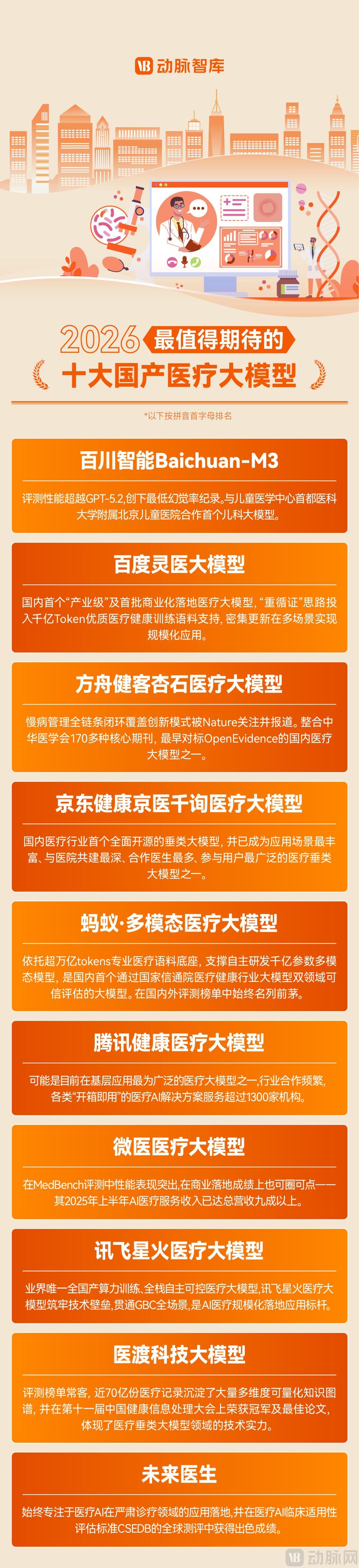
无惧OpenAI,2026年国内最值得期待的十个医疗大模型
3 6 Ke· 2026-02-09 01:31
Core Insights - The medical large model sector is experiencing significant advancements, particularly with the recent launches from OpenAI, Anthropic, and Google, indicating a competitive landscape in healthcare AI [1][3][4] - Domestic companies in China, such as Baichuan Intelligence and Ant Group, are making substantial progress, showcasing their capabilities and innovations in the medical AI field [5][6][10] Group 1: OpenAI's Developments - OpenAI launched ChatGPT Health and OpenAI for Healthcare, which comply with HIPAA regulations and aim to enhance patient care services [2] - ChatGPT Health integrates a new module based on the latest GPT-5 model, allowing users to connect personal health data while ensuring data privacy [2] - OpenAI for Healthcare targets medical institutions, offering enterprise-level solutions for clinical environments, including automated documentation [2] Group 2: Competitors' Responses - Anthropic released Claude for Healthcare, directly competing with OpenAI's offerings, highlighting its commitment to the healthcare sector [3] - Google updated its open-source medical large model, MedGemma 1.5, improving its capabilities in text, medical records, and medical imaging [3] Group 3: Domestic Innovations - Baichuan Intelligence launched Baichuan-M3, surpassing GPT-5.2 in benchmark tests, with a hallucination rate of only 3.5%, which was later improved to 2.6% [4][5] - Ant Group's medical model has gained significant traction, achieving 30 million monthly active users and doubling daily inquiries within a month [5] - JD Health and other domestic firms are also releasing new models and solutions, contributing to a vibrant competitive landscape in China's medical AI sector [5][10] Group 4: Benchmarking and Performance - HealthBench and MedBench are the primary benchmarking systems for evaluating medical large models, assessing safety, clinical applicability, and professional reasoning [7][8] - The performance of medical large models is crucial, with ongoing iterations and resource investments being necessary for advancements [8] Group 5: Industry Trends and Future Outlook - The medical large model sector is expected to grow significantly, with various domestic models emerging as strong contenders in 2026 [6][10] - The integration of local clinical guidelines and data security measures positions domestic models as more suitable for the Chinese market [6] - The increasing support from the government and the focus on localized solutions are likely to enhance the competitiveness of domestic models [6]



巨头竞逐医疗AI赛道 健康160与京东健康等国内龙头打造中国方案
Zheng Quan Ri Bao Wang· 2026-01-21 04:09
Core Insights - Artificial intelligence (AI) is deeply integrated into the healthcare system, driving high-quality development in the industry [1] - The competition in the medical AI sector is intensifying among internet healthcare companies and tech firms [1] - Companies like JD Health and Alibaba Health are advancing from "single-point tools" to "ecosystem competition" [1] Company Developments - JD Health launched the evidence-based medicine AI tool "ZhiYi" aimed at doctors, which is considered a Chinese version of "OpenEvidence" [1] - Alibaba Health's AI product "Hydrogen Ion" has completed internal testing and is designed to be the lowest hallucination rate AI assistant in the medical field [1] - Health 160 has developed a dual-driven model combining public and private WeChat accounts to enhance digital healthcare services [2] Technological Advancements - Health 160 has tested an AI health steward multi-agent system covering pre-diagnosis, diagnosis, and post-diagnosis scenarios [3] - JD Health aims to evolve internet healthcare into a core engine for precise, personalized, and comprehensive health management [3] - OpenAI's ChatGPT for Healthcare has been deployed in various institutions, emphasizing data integration and personalized experiences [2] Industry Trends - The focus of AI healthcare competition has shifted from "usefulness" to "stable, compliant, and sustainable implementation" [3] - Future trends in China's AI healthcare include a complementary relationship between major players' full-chain layouts and precise niche market cultivation [4] - The industry is expected to transition from a "treatment-oriented" approach to "proactive health" as technology matures [4]

巨头竞逐医疗AI,如何重塑行业发展逻辑?
2 1 Shi Ji Jing Ji Bao Dao· 2026-01-19 12:25
Core Insights - Artificial Intelligence (AI) is becoming a core force driving a new wave of technological revolution and industrial transformation in the healthcare sector, injecting strong momentum for high-quality development [1][2] - The medical AI sector is a competitive battleground for internet healthcare companies and tech firms, with significant advancements and product launches from major players like JD Health and Alibaba Health [1][4][5] Company Developments - JD Health launched the "Zhi Yi" evidence-based medicine AI tool for doctors and the 2.0 version of "JD Zhuo Yi," aiming to transform patient service processes and become a new growth engine for hospitals [1][4] - JD Zhuo Yi 2.0 integrates JD Health's "AI + supply chain" capabilities, providing a comprehensive management solution covering clinical nutrition, outpatient medication, and weight metabolism [4] - Alibaba Health introduced its first self-developed medical large model "Hydrogen Ion," focusing on low hallucination rates and high evidence-based capabilities, now in practical application for clinical and research doctors [5][6] Market Trends - The AI healthcare market in China reached 97.3 billion yuan in 2023 and is expected to grow to 159.8 billion yuan by 2028, indicating a shift from conceptual hype to value realization [11] - The integration of AI in healthcare is expected to significantly change the behavior patterns of hospitals, clinicians, and patients, moving towards long-term health management rather than one-time treatments [7][8] Challenges and Considerations - The successful implementation of AI in healthcare faces challenges such as data quality issues, data silos, and the need for improved regulatory frameworks [9][10] - The quality of AI medical products is heavily dependent on the quality and accuracy of training data, necessitating a robust data governance mechanism [9] - Balancing technological functionality with humanistic care is crucial, as AI should enhance the patient experience while ensuring efficient clinical decision-making [10]

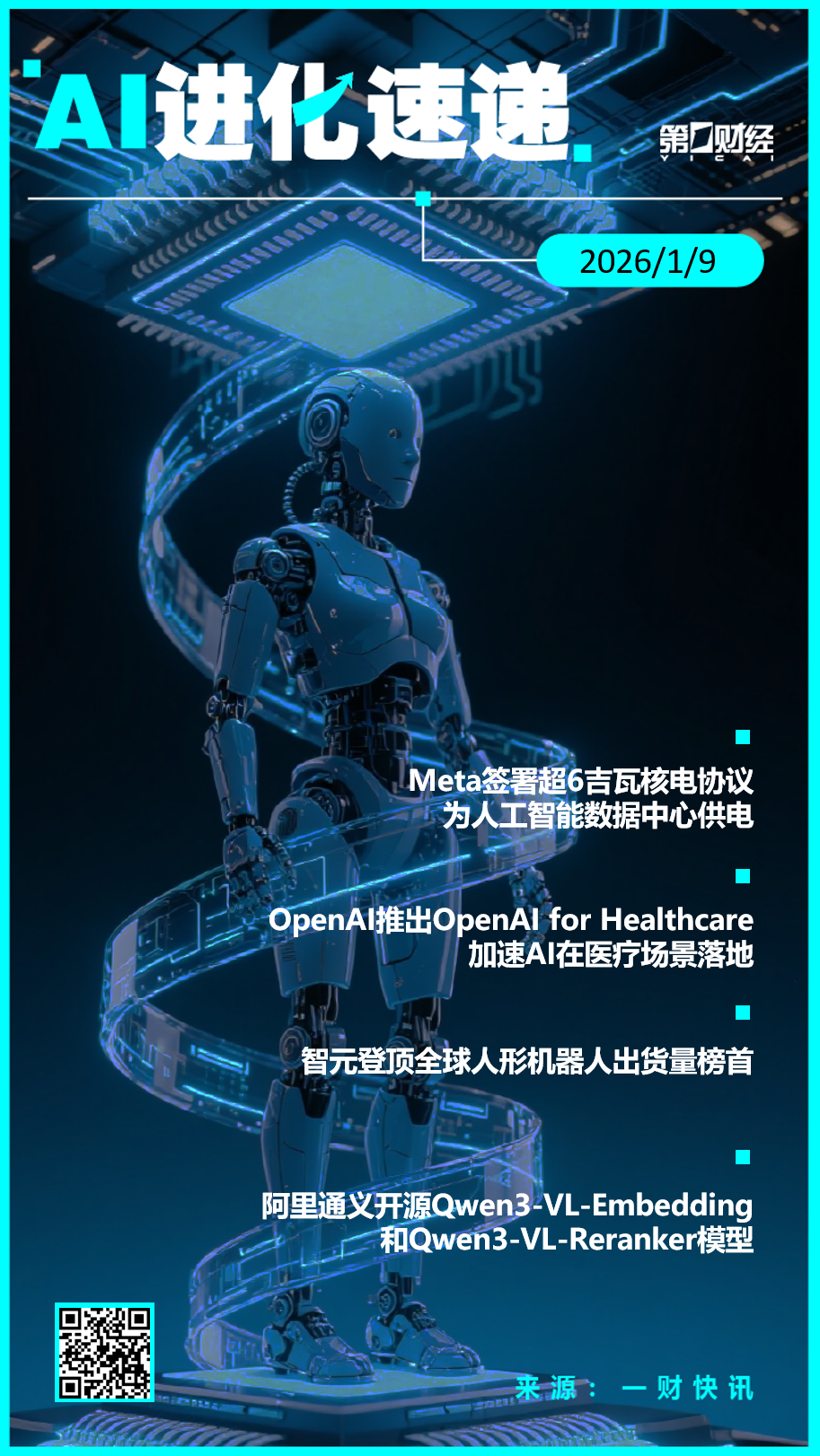
AI进化速递 | Meta签署核电协议为AI数据中心供电
Di Yi Cai Jing· 2026-01-09 13:09
Group 1 - OpenAI launches OpenAI for Healthcare to accelerate the application of AI in medical scenarios [1] - ZhiYuan ranks first in global humanoid robot shipment volume [1][2] - Meta signs agreements with Vistra, TerraPower, and Oklo for over 6 gigawatts of nuclear power to supply AI data centers [1] - Modern Motors begins mass production of AI chips for autonomous robots [1] - Fiserv announces strategic partnership with Microsoft to integrate AI into Fiserv platform [1] Group 2 - Alibaba Tongyi open-sources Qwen3-VL-Embedding and Qwen3-VL-Reranker models [1][2]
OpenAI连续发布两款医疗健康领域AI产品
Zheng Quan Shi Bao Wang· 2026-01-09 00:55
Core Insights - OpenAI has launched two AI products in the healthcare sector: ChatGPT Health for consumers and OpenAI for Healthcare for medical institutions [1] Group 1: Product Overview - ChatGPT Health is integrated into ChatGPT, providing a dedicated space for health-related conversations, capable of connecting to electronic medical records and various health applications [1] - OpenAI for Healthcare is designed to assist medical institutions in delivering more consistent and higher-quality care, enabling the creation of reusable discharge summaries and patient guidance templates [1] Group 2: Functionality - ChatGPT Health generates responses that incorporate user health information and personal context, enhancing the relevance of interactions [1] - OpenAI for Healthcare can analyze medical evidence for application to specific patients, improving the decision-making process in clinical settings [1]