PSRAM

Search documents
灿芯股份(688691.SH):目前主要围绕高速接口IP和高性能模拟IP开展研发
Ge Long Hui· 2026-01-30 09:08
格隆汇1月30日丨灿芯股份(688691.SH)近日接受特定对象调研时表示,公司目前主要围绕高速接口IP和 高性能模拟IP开展研发。在高速接口IP领域,公司目前开展研发的IP主要包括DDR、SerDes、PCIe、 MIPI、PSRAM、TCAM等;在高性能模拟IP领域,公司目前开展研发的IP主要包括ADC、PLL、PMU 等。 ...
东芯股份(688110):砥砺算芯,不负时代
China Post Securities· 2025-08-27 07:38
Investment Rating - The report assigns an "Accumulate" rating to the company [1] Core Views - The company has made significant investments in high-performance GPU technology through its 37.88% stake in Shanghai Lishuan, which is focused on developing scalable graphics rendering GPU chips [5] - The company's revenue for the first half of 2025 reached 343 million yuan, representing a year-on-year increase of 28.81%, with the second quarter showing a revenue of 201 million yuan, up 25.43% year-on-year and 41.11% quarter-on-quarter [4][6] - The semiconductor market is gradually recovering, driven by demand recovery in industrial markets and AI applications, leading to improved sales prices and profitability for the company's main products [6] Company Overview - The latest closing price of the company's stock is 100.02 yuan, with a total market capitalization of 44.2 billion yuan [3] - The company has a debt-to-asset ratio of 4.6% and a current P/E ratio of -263.21 [3] Financial Projections - Revenue projections for 2025-2027 are estimated at 858 million yuan, 1.121 billion yuan, and 1.406 billion yuan respectively, with a gradual recovery in profits expected [9] - The company is expected to achieve a net profit of 86 million yuan by 2027, indicating a significant turnaround from previous losses [9] Product Development - The company has successfully launched its first self-developed GPU chip "7G100" and is currently in the process of customer sampling and mass production [5] - Continuous updates and iterations in storage technology are being pursued, including the mass production of 1xnm flash memory products and ongoing development of SLC NAND Flash and NOR Flash products [7][8]

嵌入式内存有了新选择
3 6 Ke· 2025-07-07 10:13
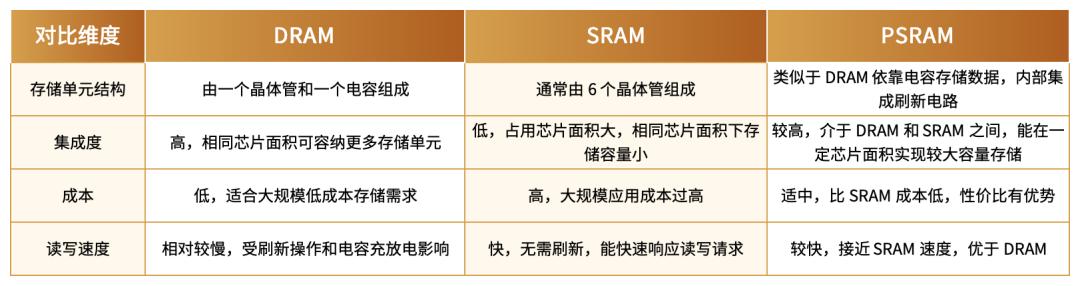
Group 1: Core Concept - The article discusses the emergence of Pseudo Static Random Access Memory (PSRAM) as a new choice in embedded memory, addressing the limitations of traditional storage technologies like SRAM and DRAM [1][2]. Group 2: PSRAM Overview - PSRAM is designed for embedded systems, consumer electronics, IoT, wearable devices, and edge AI products, simulating SRAM characteristics while utilizing DRAM's structure [2]. - PSRAM combines the advantages of SRAM's simple interface and DRAM's storage density, featuring a storage structure of one transistor and one capacitor [3]. Group 3: Technical Comparison - PSRAM's internal structure allows for a storage density that can reach 4-8 times that of SRAM, while maintaining a compatible interface with SRAM [3]. - Compared to DRAM and SRAM, PSRAM offers a balanced cost, speed, and integration level, making it a competitive option in the embedded memory market [3]. Group 4: Market Positioning - PSRAM is positioned as a complementary technology to SRAM, DRAM, and NAND Flash, with various types like OPI PSRAM, QPI PSRAM, and SPI PSRAM catering to different application needs [5][6]. - OPI PSRAM, for instance, achieves a theoretical bandwidth of 2.128Gbps at 133MHz, making it suitable for IoT and wearable devices [5]. Group 5: Application Scenarios - PSRAM is rapidly replacing DDR in mobile communications, real-time control systems, and edge computing, with applications in smartphones and industrial robotics [7]. - Despite not matching the absolute bandwidth of high-end DDR4/DDR5, PSRAM's efficiency in pin usage is redefining embedded storage design paradigms [7]. Group 6: Limitations - PSRAM is volatile and loses data upon power loss, necessitating a combination with non-volatile storage like NAND Flash for data persistence [8]. - The current capacity of PSRAM products ranges from 32-512Mb, which is significantly lower than that of LPDDR5 DRAM products, limiting its use in high-capacity applications [8]. Group 7: Domestic Breakthroughs - China's semiconductor industry is seizing opportunities for PSRAM localization, with companies like Unisoc making significant advancements in this field [9]. - Unisoc's PSRAM products support speeds up to 400MHz and bandwidths of 17.06Gb/s, catering to IoT and wearable applications [9][10]. Group 8: Future Outlook - The demand for MCU storage capacity is expected to grow with the proliferation of IoT and AI applications, positioning PSRAM as a key solution [11]. - The integration of PSRAM into MCUs is seen as a significant trend, enhancing performance, cost-effectiveness, and system design simplicity [11].