PantherLake处理器

Search documents
英特尔2025财年Q4亏损同比扩大 欲提升产能应对服务器芯片供应不足
Zhong Guo Jing Ying Bao· 2026-01-24 00:49
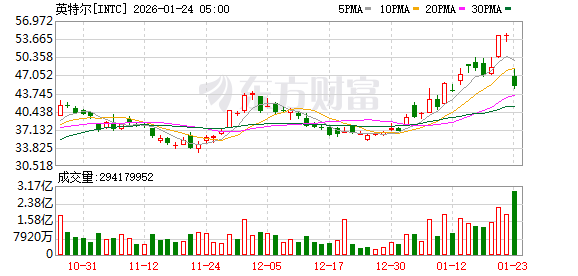
Core Viewpoint - Intel reported a mixed financial performance for Q4 FY2025, with revenue of $13.7 billion, a 4.1% year-over-year decline, but exceeding Wall Street's expectations of $13.43 billion. The company also faced a net loss of $333 million, which was higher than both the previous year and market expectations [2] Financial Performance - Q4 FY2025 revenue was $13.7 billion, down 4.1% year-over-year, but above the expected $13.43 billion [2] - Full-year revenue for FY2025 was $52.9 billion, flat compared to the previous year, with a net loss of $267 million, significantly improved from a loss of $18.76 billion in FY2024 [2] - The stock price fell by 13% in after-hours trading following the earnings report [2] Business Segments - The Data Center and AI (DCAI) segment showed growth, with Q4 revenue reaching $4.74 billion, a 9% year-over-year increase, surpassing the market expectation of $4.42 billion [3] - The Client Computing Group (CCG) segment faced challenges, with annual revenue of $32.2 billion, down 3% due to a sluggish PC market and mismatched production capacity [3] - The advanced 18A process technology is improving but has not yet reached industry-leading levels, impacting overall revenue growth [3][4] Supply Chain and Production Challenges - Intel's CEO acknowledged supply constraints and capacity bottlenecks that prevented the company from fully capturing market demand [4] - The company is currently in a "just-in-time" supply situation, with inventory levels reduced to about 40% of peak levels [4] Market Sentiment and Stock Performance - Despite the post-earnings stock drop, Intel's stock rebounded nearly 180% from a low of $18.965 per share in August 2025 to $54.25 per share by January 21, 2026 [5] - Significant investments from the U.S. government and partnerships with major firms like Nvidia have bolstered market confidence in Intel's capital strength and strategic value [5] - Analysts have upgraded Intel's rating based on strong demand for data center services and improvements in cost control and technology focus [6] Future Outlook - The market anticipates that Intel's advancements in 18A/14A processes and partnerships will enhance its position as a leading manufacturer and key player in the foundry business [6] - However, there are concerns regarding the visibility of potential collaborations with major companies like Apple and Nvidia, which could impact long-term growth [6]


冰与火之歌:英特尔的绝地反击与王者归来
格隆汇APP· 2026-01-22 12:04
Core Viewpoint - Intel, once a dominant player in the CPU market, faced significant challenges leading to a $2.92 billion loss in Q2 2025, but is poised for a turnaround due to strategic investments and internal reforms [5][10][12]. Group 1: Current Challenges - Intel reported a net loss of $2.92 billion in Q2 2025, with a gross margin dropping below 30%, indicating severe distress in its core business [5]. - AMD's EPYC series has captured over 40% market share, leading to a 15% year-over-year decline in Intel's Xeon orders due to its lag in 10nm technology [5][6]. - The company's foundry business has been unprofitable, with a market share of less than 3% and quarterly losses exceeding $1 billion [5][6]. Group 2: Strategic Turnaround - In August 2025, the U.S. government invested $8.9 billion for a 9.9% stake in Intel, becoming its largest shareholder, signaling a commitment to U.S. chip independence [9]. - Nvidia invested $5 billion in Intel, agreeing to collaborate on developing integrated GPU and CPU solutions, marking a significant shift in the competitive landscape [9]. - Intel's cash reserves increased to $30.9 billion following these investments, providing a financial cushion for future operations [9]. Group 3: Internal Reforms - CEO Pat Gelsinger initiated a major restructuring, laying off 35,000 employees to reduce annual operating costs by $23.3 billion, reallocating funds towards advanced process technology and AI development [10][11]. - The company reintroduced a "20% free time" policy for engineers to foster innovation, leading to significant improvements in process technology yields [10]. - Intel is shifting towards a more open business model, securing orders from Apple for low-end M-series chips and exploring further collaborations [11]. Group 4: Market Dynamics and Future Outlook - In 2026, Intel faces a "happy trouble" with a chip shortage driven by unexpected demand for server CPUs, leading to increased analyst ratings [12]. - However, there are concerns about supply chain mismatches and price increases driven by OEMs rather than Intel's pricing strategy [12][14]. - The sustainability of the current demand surge is questioned, as rising storage prices may lead to a market correction [14]. Group 5: Broader Implications - Intel's recovery is seen as a case study in aligning corporate strategy with national interests and industry trends, emphasizing the importance of internal transformation [16]. - The company's future performance will be closely watched, particularly regarding the mass production of its 18A process technology and ongoing competition with AMD [16][17].