Pixso

Search documents
从原型到代码:AI如何重塑产品经理工作流
3 6 Ke· 2026-02-10 01:45
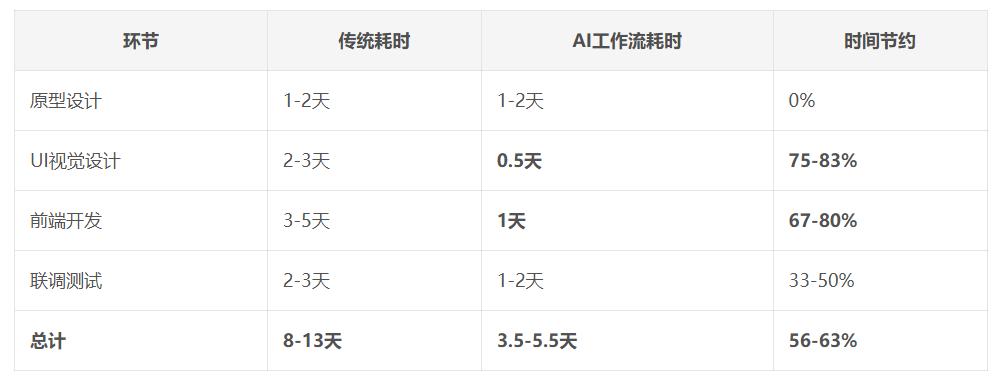
Core Insights - The article discusses how AI workflows can significantly reduce the time required for product development, transforming traditional processes that typically take weeks into streamlined operations that can be completed in hours [1][2]. Traditional Workflow - The traditional product development process involves multiple stages: prototype creation, UI design, front-end development, and back-end integration, which collectively take an average of 2-3 weeks for a medium complexity feature [3]. - Each stage incurs communication costs and time delays, with front-end development alone taking 5-7 working days [3]. AI Workflow Efficiency - The AI workflow can compress the entire development timeline from 8-13 days down to just 3.5-5.5 days, achieving time savings of 56-63% across various stages [4]. - Specific time reductions include: - UI design reduced from 2-3 days to 0.5 days (75-83% savings) - Front-end development reduced from 3-5 days to 1 day (67-80% savings) - Integration testing reduced from 2-3 days to 1-2 days (33-50% savings) [4]. AI Tools and Implementation - The company selected a combination of tools: Pixso for prototyping, Stitch for design generation, and AI Studio for code generation, focusing on usability, low learning curve, compatibility with existing workflows, and reliable output quality [5]. - The process begins with establishing a design baseline in Pixso, followed by applying design language across the prototype using Stitch, and finally generating front-end code in AI Studio [6][12][15]. Impact on Collaboration and Development - The new workflow enhances collaboration between product and development teams, allowing for earlier technical feasibility validation and more precise requirement communication [24]. - The iterative cycle is transformed from "design → review → develop → test" to "prototype → code → fine-tune → launch," facilitating parallel development of front-end and back-end components [24]. Future Outlook - The article predicts that within 18 months, AI will enable even smarter iterative cycles, allowing for reverse engineering of prototypes from code and providing integrated front-end and back-end solutions based on comprehensive functional descriptions [24]. - The role of product managers is evolving to require more structured logical thinking, basic technical understanding, and system-wide design capabilities [24]. Conclusion - The shift towards AI-enhanced workflows is redefining the value of product managers, moving from merely conveying requirements to directly creating products, thus lowering barriers between product thinking and implementation [25][26].

当AI产品开始拼势头,如何做好规模化达人营销这道必答题?
3 6 Ke· 2026-01-21 12:58
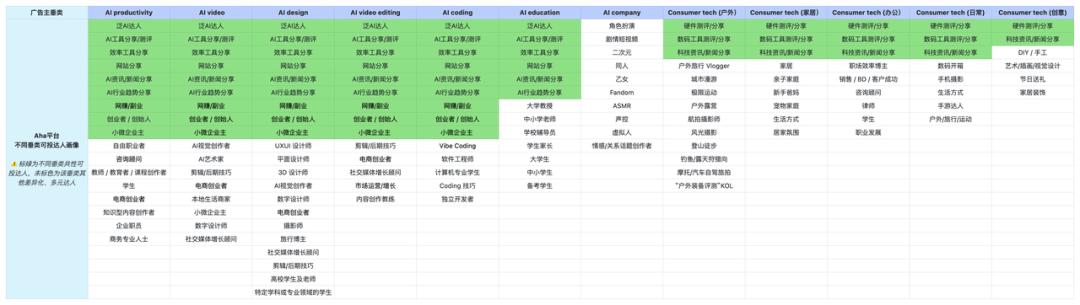
Core Insights - AI applications are facing an unprecedented homogenization crisis, making it increasingly difficult to establish long-term competitive advantages based solely on product features [1][2] - Momentum, defined as the ability of a product to be continuously used and shared, has become the most significant competitive moat in the AI industry [2] - The key to generating momentum lies in scalability and extreme distribution efficiency, as the marginal cost of product development approaches zero [3] Group 1: Challenges in Influencer Marketing - The scalability paradox in influencer marketing presents a natural conflict between scale and execution efficiency, as managing a larger number of influencers increases uncertainty [4][5] - Traditional solutions to scalability issues include either increasing in-house teams or hiring agencies, both of which have their own advantages and disadvantages [6][8] - In-house teams provide high-quality execution but can become unmanageable as project scales increase, leading to inconsistent output quality [7] Group 2: Aha's Innovative Approach - Aha aims to optimize both execution and supply issues in influencer marketing by utilizing AI to handle the execution burdens traditionally managed by human teams [9] - Aha has developed a matching system that leverages a large model to connect brands with over 5 million vetted influencers across various real-world scenarios [11][12] - The platform's approach allows brands to find content expressions that closely align with real decision-making paths in different markets [13] Group 3: Pricing and Efficiency - Aha has implemented a "one-price system" to reduce friction in pricing negotiations, allowing brands to confirm influencer collaborations quickly [17] - The platform provides a visual management system that tracks all stages of influencer collaboration, enhancing transparency and efficiency [18][24] - Aha's system automates data collection and performance tracking, significantly reducing the manual workload for brands [26][28] Group 4: Risk Management and Compliance - Aha offers a platform-level safety mechanism to manage risks associated with influencer collaborations, ensuring that all influencers undergo identity verification and data authorization [29] - The platform includes a multi-stage anti-fraud system to filter out accounts with suspicious activity, ensuring that brands collaborate with genuine creators [31] - Aha's compliance and safety measures are integrated into the platform, providing a clear legal framework for all collaborations [31] Group 5: Case Studies and Impact - Aha has successfully served over a hundred AI tech companies, including major players like Alibaba, demonstrating its effectiveness in scaling influencer marketing [37] - The case of Pixso illustrates how Aha transformed influencer marketing from a labor-intensive process to a systematic operation, significantly improving efficiency [39][42] - Brands using Aha have reported efficiency improvements of over 80%, with faster turnaround times for influencer collaborations [42][43]
万兴科技:深圳市博思云创科技有限公司和北京磨刀刻石科技有限公司为公司投资参股的公司
Zheng Quan Ri Bao Wang· 2025-09-04 11:45
Core Viewpoint - Wanxing Technology (300624) confirmed its investment in Shenzhen Bosiyun Technology Co., Ltd. and Beijing Modao Keshishi Technology Co., Ltd., which include products such as Pixso and Modao respectively [1] Group 1 - Wanxing Technology responded to investor inquiries on September 4 regarding its stake in Bosiyun and Modao Keshishi [1] - The company emphasized that details about the related business should be referenced from public information [1]

Figma上市引爆250%涨幅,中国“设计协作双子星”Pixso、墨刀浮出水面
Sou Hu Cai Jing· 2025-08-02 06:29
Core Insights - Figma's successful IPO on July 31, 2025, reached a market value of $56.3 billion, with stock prices increasing over 250%, setting a record for tech company listings this year [1] - The listing has prompted a reevaluation of the design collaboration sector and raised questions about future leaders in organizational collaboration platforms [1] Group 1: Pixso - Pixso, backed by A-share digital creative software leader Wanjing Technology, has completed multiple rounds of financing, supported by notable institutions such as CICC, Baidu Ventures, and Yonghua Investment [3] - Pixso aims to create an integrated collaboration platform, combining UI design, interaction, version management, component reuse, and front-end delivery into a single browser-based platform, enhancing team collaboration efficiency [3] - The release of Pixso 2.0 introduced a D2C (Design to Code) feature, allowing design components and interaction logic to be converted into front-end code with one click, streamlining communication between design and development [3] Group 2: Mockingbird (墨刀) - Mockingbird focuses on the critical early stages of product design, specifically prototype creation and design validation, becoming a preferred choice for product managers and designers in small teams [5] - The platform has introduced AI-assisted features, such as "AI-generated prototype diagrams," enabling teams to quickly validate ideas by generating initial prototypes based on simple descriptions [5] - Mockingbird's rapid update cycle and flexible tool structure make it well-suited for early-stage projects, particularly in scenarios requiring quick setup and requirement validation [5] Group 3: Market Opportunities - Figma's IPO signals a shift in design collaboration platforms from peripheral tools to core components of enterprise operations, emphasizing the importance of design efficiency and redefining collaboration among people, tools, and processes [7] - Both Pixso and Mockingbird are positioned to address the unique needs of Chinese teams, moving beyond reliance on foreign software and providing localized solutions for design collaboration [7] - Future competition will focus on understanding the specific usage scenarios of Chinese teams and integrating into enterprise processes, with both Pixso and Mockingbird making significant strides in this direction [7]

Figma上市首日股价大涨 万兴科技孵化的Pixso已获中金鑫智、百度风投等投资
Zhong Zheng Wang· 2025-08-01 07:29
Group 1 - Figma, a creative design software company, went public on July 31, with an initial share price of $33 and a first-day closing price of $115.5, representing a 250% increase [1] - Pixso, known as the "Chinese version of Figma," has gained significant market attention due to Figma's successful IPO [1] - Wanxing Technology holds nearly 15% equity in Pixso's parent company, Bosiyun, which was incubated internally by Wanxing Technology [1] Group 2 - Bosiyun, established in 2021, focuses on AI collaborative office solutions and has raised nearly 100 million yuan in Pre-A round financing in 2022, led by CICC [1] - Bosiyun's product lineup includes Pixso, an integrated product design tool, boardmix, an online collaboration whiteboard, and Boshi AI PPT [1] - Wanxing Technology has also launched an online collaboration whiteboard product, Wanxing Huaban, which integrates various creative expression tools for smart office capabilities [2] - Wanxing Technology holds a 22% stake in Beijing Modao Keshishi, which offers the Modao tool, a new generation of prototype design and collaboration tool enhanced by AI [2]
对标Figma 万兴科技孵化Pixso的背后公司已获多家机构投资
Zheng Quan Ri Bao Zhi Sheng· 2025-08-01 07:12
Group 1 - Figma officially listed on the New York Stock Exchange on July 31, 2025, becoming a focal point for tech IPOs and boosting interest in the AI design collaboration sector [1] - Wanxing Technology Group, a leading digital creative software company, is gaining market attention due to its stake in Shenzhen Bosiyun Technology Co., which owns Pixso, known as the "Chinese version of Figma" [1] - Bosiyun was established in 2021 under Wanxing's innovation mechanism and has raised nearly 100 million yuan in Pre-A round financing in 2022, with investments from various firms [1] Group 2 - Pixso is recognized as a leading integrated design collaboration platform in China, capable of replacing Figma, Sketch, Adobe XD, and Axure, and quickly adapted to Figma's service strategy changes in 2022 [2] - Wanxing Technology has also launched an online collaboration whiteboard product, Wanxing Huaban, enhancing online collaborative design capabilities in the AI design collaboration space [2] - The company holds a 22% stake in Beijing Modao Keshishi, with its product Modao being a new generation prototype design and collaboration tool that leverages AI technology for improved efficiency [2]
对标Figma 万兴科技孵化Pixso已获中金鑫智百度风投深高新投复星创富等投资
Zhi Tong Cai Jing· 2025-08-01 02:10
Core Insights - Figma, a creative design software company, went public on July 31, with an initial share price of $33, closing at $115.5 on its first day, marking a 250% increase and a market capitalization exceeding $56.3 billion, highlighting the growing interest in AI design collaboration [1] - Wankang Technology, known for its "Chinese version of Figma," Pixso, holds nearly 15% equity in the company behind Pixso, Bosi Cloud Innovation, indicating a strategic partnership focused on technology empowerment and resource support [1][2] Company Overview - Wankang Technology is recognized as one of the most globalized and comprehensive digital creative software companies in China, with operations in over 200 countries and regions, and a user base exceeding 1.5 billion [3] - The company has developed a range of products, including Wankang Tianmu multimedia model and various AI-enabled tools, positioning itself as the "Chinese version of Adobe" [3] Product Development - Pixso is the first integrated design collaboration platform in China, capable of replacing Figma, Sketch, Adobe XD, and Axure, and gained significant attention after Figma ceased support for Chinese enterprises in 2022 [2] - Wankang Technology also launched the Wankang Whiteboard, enhancing online collaborative design capabilities, and holds a 22% stake in Beijing Modao Keshishi, which offers advanced prototyping and collaboration tools [2]
对标Figma 万兴科技(300624.SZ)孵化Pixso已获中金鑫智百度风投深高新投复星创富等投资
智通财经网· 2025-08-01 02:01
Group 1 - Figma officially listed on the New York Stock Exchange on July 31, with an initial price of $33 per share, closing at $115.5, a 250% increase, and a market capitalization exceeding $56.3 billion, highlighting the focus on AI design collaboration in the tech IPO landscape for 2025 [1] - Wanxing Technology, a leading digital creative software company in China, holds nearly 15% equity in Bosiyun Chuang, the company behind "Chinese version of Figma," Pixso, establishing a deep collaboration through "technology empowerment + resource support" [1][2] - Bosiyun Chuang, founded in 2021, has received nearly 100 million yuan in Pre-A round financing and subsequent A round financing, focusing on the AI collaborative office sector with products like Pixso and boardmix [1][2] Group 2 - Pixso is the first integrated design collaboration platform in China, comparable to Figma, and offers comprehensive product design delivery capabilities, rapidly gaining attention after Figma ceased supply to Chinese enterprises in 2022 [2] - Wanxing Technology also launched the online collaboration whiteboard product, Wanxing Huaban, which integrates various creative expression tools for brainstorming and project planning [2] - Wanxing Technology is one of the most globalized companies in the digital creative software sector in China, with operations in over 200 countries and regions, and a cumulative user base exceeding 1.5 billion [3]
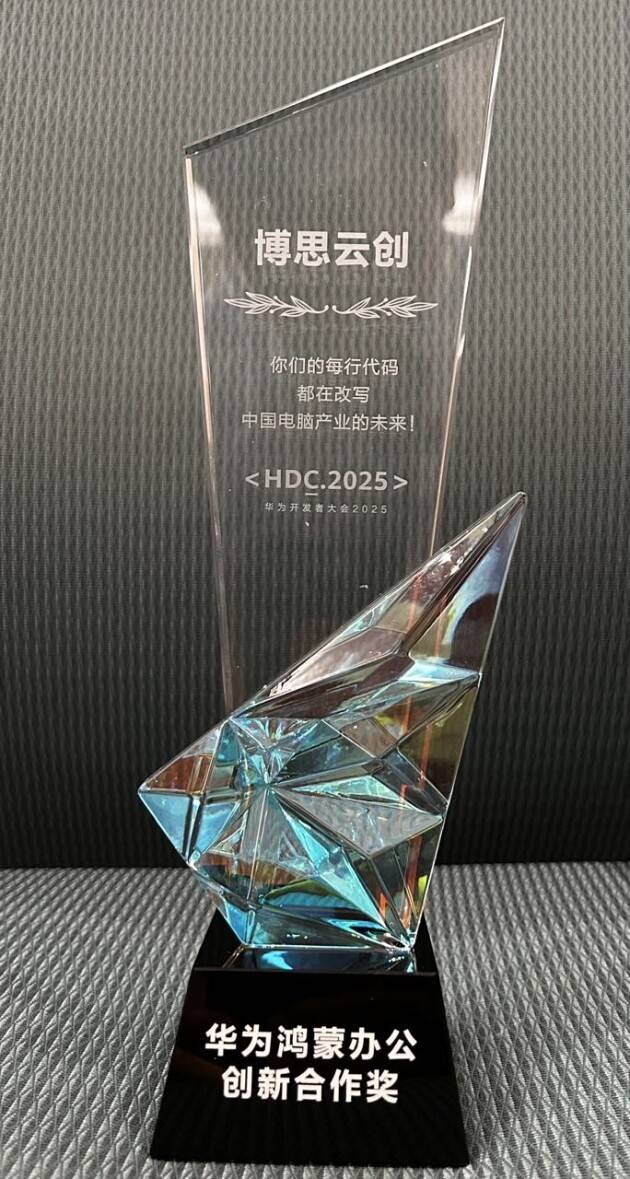
博思云创斩获华为鸿蒙办公创新合作奖,携手共建繁荣鸿蒙生态
Sou Hu Cai Jing· 2025-06-25 01:17
Core Insights - Shenzhen Bosiyun Chuang Technology Co., Ltd. won the "Huawei Harmony Office Innovation Cooperation Award" at the Huawei Developer Conference 2025, recognizing its significant contributions to the Harmony intelligent office ecosystem [1][2] Company Strengths - Bosiyun Chuang focuses on providing digital creative solutions for global enterprises and teams, successfully creating a product matrix that covers multiple scenarios, including Pixso, boardmix, and Bosiyun AIPPT [5] - Pixso is a leading integrated online design tool in China, capable of replacing Figma, Sketch, XD, and Axure, covering the entire workflow from research to asset management [5] - Boardmix is an AI-powered platform that integrates personal knowledge management, team collaboration, and AIGC, serving as an optimal tool for brainstorming, project management, and information visualization [5] - Bosiyun AIPPT is a next-generation AI smart PPT tool that supports conversational creation and file/text conversion to PPT, featuring a vast array of high-quality templates and styles [5] Strategic Integration - Bosiyun Chuang is actively advancing the deep adaptation of its products Pixso, boardmix, and Bosiyun AIPPT with the HarmonyOS, enabling seamless switching across Huawei's Harmony devices for a smart collaborative office experience [6] Financial Backing and Experience - Established in 2021, Bosiyun Chuang has rapidly developed and completed multiple rounds of financing, including nearly 100 million yuan in the Pre-A round in 2022 and A round financing in 2023, attracting investments from notable institutions [7] - The founding team possesses over 10 years of experience in the collaborative office sector and has rich practical experience with enterprise clients, mastering core graphic design algorithms and real-time collaboration technologies [7] Future Outlook - As the Harmony operating system evolves and its ecosystem matures, Bosiyun Chuang aims to deepen its collaboration with Huawei, leveraging its technological advantages in digital collaborative office solutions to enhance the office collaboration experience for Harmony users [8]