Stitch

Search documents
谷歌Stitch「氛围设计」干崩Figma 8.8%股价:十年经验,败给巨头一次更新(附实测)
机器之心· 2026-03-21 08:09
Core Viewpoint - Google’s recent update to its AI design tool, Stitch, has significantly impacted Figma, causing an 8.8% drop in its stock price and an approximate 80% decline since its IPO in August 2025 [2][54]. Group 1: Overview of Stitch - Stitch is an AI-native design platform developed by Google Labs, utilizing the Gemini model, and has been rebranded as a "vibe design platform" [4]. - The platform allows users to generate high-fidelity interfaces and interactive prototypes quickly using natural language descriptions, aiming to streamline traditional UI/UX workflows [4]. - Key features of Stitch include an intelligent design agent, rapid iteration capabilities, and voice collaboration for real-time adjustments [4]. Group 2: User Experience and Functionality - Users can input prompts to generate complete UI designs, such as a seasonal home decor catalog page, which Stitch can create based on the provided specifications [19]. - The platform supports iterative design, allowing users to refine outputs by adding new prompts and adjusting layouts easily [20][27]. - Stitch offers various design modes and systems, enabling users to select or randomly generate design frameworks [16][17]. Group 3: Market Reaction and Industry Impact - The introduction of Stitch has led to a significant market reaction, with Figma's market value dropping nearly $2 billion, reflecting the vulnerability of traditional SaaS companies to AI advancements [54][56]. - The design industry is experiencing anxiety over job security, with many professionals expressing concerns about AI's potential to replace traditional design roles [57]. - Despite the excitement around AI tools like Stitch, experts caution that design involves complex processes that may not be fully addressed by AI-generated outputs [52][56].



AI屠刀下一站“Vibe设计”,谷歌一个产品把合作伙伴Figma干崩了
3 6 Ke· 2026-03-20 07:43
Core Viewpoint - Google's announcement of its AI design tool, Stitch, which supports Vibe Design, has led to a significant drop in Figma's stock price, highlighting the competitive threat posed by major tech companies in the software industry [1][4][12]. Group 1: Stock Market Impact - Figma's stock price fell by approximately 13% within two days following the announcement of Google's new tool, with an 8% drop on the first day and a further 5% on the second day [1]. - Year-to-date, Figma's stock has declined by about 35%, aligning with the overall downturn in the software industry [4]. - Adobe's stock also experienced a decline of around 3% during the same period, indicating a broader trend affecting multiple companies in the sector [4]. Group 2: Google's New Tool Features - Vibe Design allows users to create UI designs using voice commands, eliminating the need for traditional design processes [8]. - Stitch introduces five major capabilities: 1. An AI-native canvas that supports simultaneous handling of images, code, and product requirement documents [8]. 2. Enhanced agent capabilities that understand context and can operate across screens [9]. 3. Real-time voice interaction for immediate feedback and suggestions [9]. 4. Instant prototyping that transforms static screens into interactive prototypes [10]. 5. Consistency in design through a unified design system and the use of DESIGN.md for exporting and importing design rules [10]. Group 3: Competitive Landscape - Figma is positioned as a significant player in the UI/UX design tool market, with a projected revenue of $1.06 billion in 2025, reflecting a 41% year-over-year growth [12]. - The entry of Google into the market with Stitch poses a direct threat to Figma, as both tools offer overlapping functionalities [14]. - Google has advantages over Figma, including the potential for free access to Stitch, extensive distribution through its existing user base, and the ability to bundle services within its enterprise offerings [14][15][16]. Group 4: Industry Commentary - Industry leaders express that while the software sector is facing challenges due to AI advancements, it is not on the verge of extinction, but rather undergoing significant transformation [20].

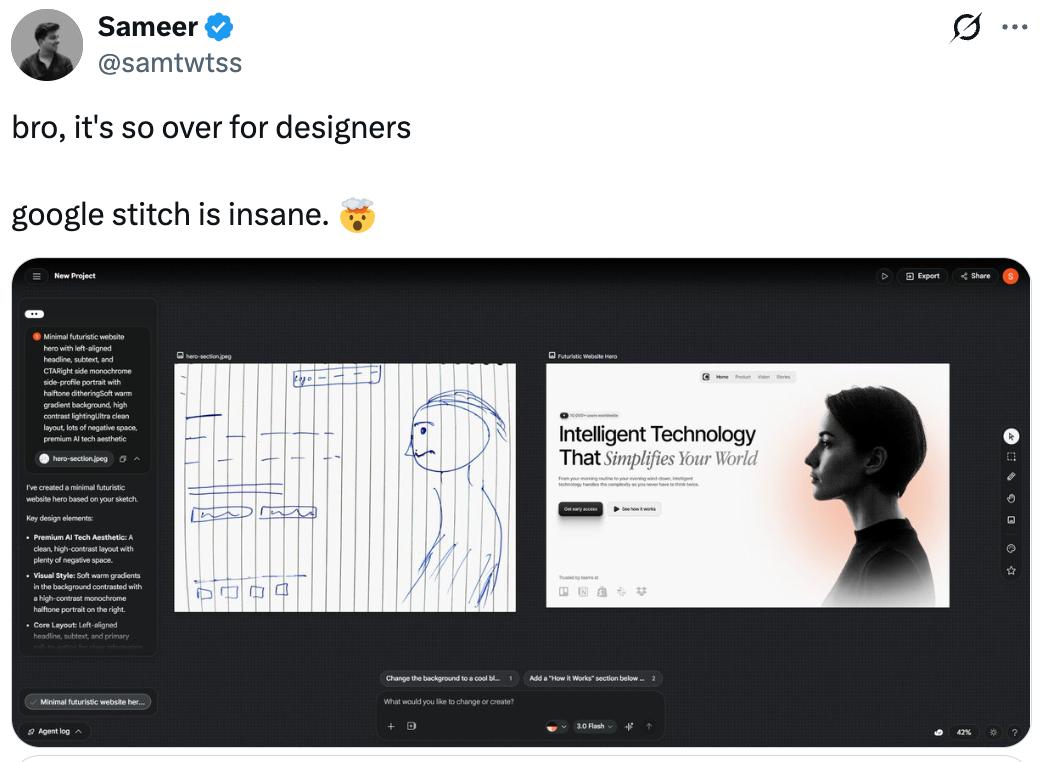
AI屠刀下一站“Vibe设计”!谷歌一个产品把合作伙伴Figma干崩了
量子位· 2026-03-20 05:04
Core Viewpoint - Google's announcement of its AI design tool, Stitch, which supports Vibe Design, has led to a significant drop in Figma's stock price, highlighting the competitive threat posed by major tech companies in the software industry [3][5][40]. Group 1: Impact on Figma - Figma's stock price fell by approximately 13% within two days following Google's product launch, with an 8% drop on the first day and a further 5% on the next [5]. - Year-to-date, Figma's stock has decreased by about 35%, aligning with the overall decline in the software industry [8]. - Adobe's stock also experienced a decline of around 3% during the same period, indicating a broader impact on the sector [9]. Group 2: Features of Google's Stitch - Stitch introduces five major upgrades, including an AI-native canvas that allows for simultaneous handling of images, code, and product requirement documents [19][20]. - The agent capability has been enhanced to understand the context of the canvas, enabling users to describe their needs in natural language [23]. - Real-time voice interaction is now possible, allowing users to communicate their design requirements verbally [25]. - Instant prototyping features enable static screens to transform into interactive prototypes with automatic assessments of screen sequences [28]. - A unified design system ensures consistency across projects, allowing for easy updates and rule exports [32][34]. Group 3: Competitive Landscape - Figma faces competition from Google's Stitch, which offers similar UI/UX design functionalities but with distinct advantages such as being free, easy distribution through Google's ecosystem, and potential bundling with other Google services [40][41][43]. - The entry of major players like Google into the AI design space poses a significant threat to smaller companies like Figma, which may struggle to compete on features and pricing [39][46]. - The rapid evolution of AI technology has outpaced Figma's capabilities, as seen in the comparison of their respective design tools [51].
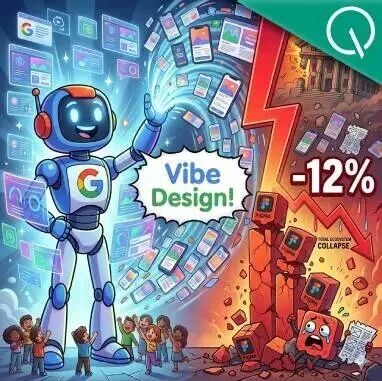
AI正在颠覆设计软件! 谷歌“vibe design”横空出世 Figma(FIG.US)股价两日重挫12%
Zhi Tong Cai Jing· 2026-03-20 02:09
Core Viewpoint - The launch of Google's AI-driven "vibe design" application platform has significantly impacted Figma's stock price, leading to a 12% drop over two days and a year-to-date decline of over 35% due to concerns about AI disrupting the design software industry [1][4]. Group 1: Impact of Google's Launch - Google's new "vibe design" platform, named "Stitch," allows users to create complete design workflows using natural language prompts, similar to an AI design agent [2][3]. - The introduction of "vibe design" emphasizes a conversational approach to design, making it accessible to non-professionals and potentially threatening traditional design software models [3]. Group 2: Market Reactions and Trends - Figma's stock fell by 8% on Wednesday and over 4% on Thursday, reflecting broader market fears about AI's potential to disrupt software companies reliant on subscription revenue models [4][5]. - The iShares Expanded Tech-Software Sector ETF has dropped approximately 30% from its September peak, indicating a significant downturn in the software sector amid fears of AI disruption [5][6]. Group 3: Competitive Landscape - Google's financial strength and distribution channels position it to potentially dominate the design workflow market, especially if it monetizes the new AI features [4]. - Analysts suggest that companies like Adobe and Docusign, which have less robust competitive advantages, may face severe challenges from AI technologies that can replicate their functionalities [7].

Figma Stock Falls Thursday As Google Expands AI Design Push
Benzinga· 2026-03-19 19:21
Core Viewpoint - Figma shares are experiencing a decline due to increased competition from Google's AI Studio and its revamped Stitch platform, which poses a threat to Figma's market position in design and prototyping tools [2][3][4]. Group 1: Competitive Landscape - Google's AI Studio roadmap includes features that integrate Figma, indicating a shift towards deeper design tooling and raising concerns about Figma's ability to maintain its competitive edge as AI-native design tools become more prevalent [2][4]. - The Stitch platform, now positioned as an AI-native design tool, overlaps with Figma's core offerings, such as voice-driven design and agent-style workflows, further intensifying competition [3]. Group 2: Market Performance - Figma's stock (FIG) was down 1.58% at $24.86, nearing its 52-week low of $18.41, reflecting investor concerns amid increasing competition [6]. - The average analyst price target for Figma is $33.40, with recent adjustments from various analysts indicating a cautious outlook, including RBC Capital lowering its target to $31.00 and Stifel to $30.00 [6]. Group 3: Technical Indicators - Figma's Relative Strength Index (RSI) has remained mostly neutral over the past year, with recent movements suggesting a rebound from oversold conditions, indicating potential stabilization in momentum [5].

Figma's stock drops 11% in two days after Google releases 'vibe design' product
CNBC· 2026-03-19 19:01
Core Viewpoint - Figma's stock has experienced a significant decline due to concerns over competition from Google's newly introduced AI-powered design product, Stitch, which has raised fears about the impact of AI on Figma's market position [1][2][3]. Company Performance - Figma's shares dropped 8% on Wednesday and more than 3% on Thursday, resulting in a total decline of approximately 35% for the year [3]. - The company went public in July, initially positioning itself to benefit from the increasing adoption of AI in design [3]. Competitive Landscape - Google's new product, Stitch, allows users to create designs through prompts and provides real-time critiques, posing a potential threat to Figma's market share [2][4]. - Adobe's shares have also seen a decline of about 4% over the past two days, indicating a broader impact on the software industry due to these developments [4]. Strategic Partnerships - In October, Google Cloud and Figma announced an expanded partnership, integrating more of Google's generative AI technology into Figma's platform, which may help Figma leverage AI capabilities despite current challenges [5].

X @BSCN
BSCN· 2026-03-19 08:15
🚨LATEST: FIGMA STOCK DROPS 8% AS GOOGLE AI TOOL STITCH HEATS UP COMPETITIONFigma (NYSE: FIGM) shares dropped 8.8% after Google Labs rolled out major updates to its AI design tool, Stitch.The platform now turns simple text into high-quality UI designs. Users no longer need traditional wireframes to start designing.This directly challenges Figma’s core product offering.Markets reacted quickly as AI reshapes design workflows. ...
谷歌凌晨再放大招!AI网站视觉设计软件sitich登场!figma股价暴跌,okara AI CMO产品上线,小米公布全新大模型【Vic TALK第1601期】
Vic TALK· 2026-03-19 05:16
ai影响不同职业的网站:https://madeye.github.io/jobs/ 推特:https://x.com/victalk6886 Telegram :victalk2021 #clawdbot #aivideo #ai agent #ai 私人助理 #moltbook #人工智能社交平台 #ai雇佣人类 #seedance #simplclaw #agentwars #GLM-5 #elys #perplexityai #moonlake #banban2 #stitch ...

从原型到代码:AI如何重塑产品经理工作流
3 6 Ke· 2026-02-10 01:45
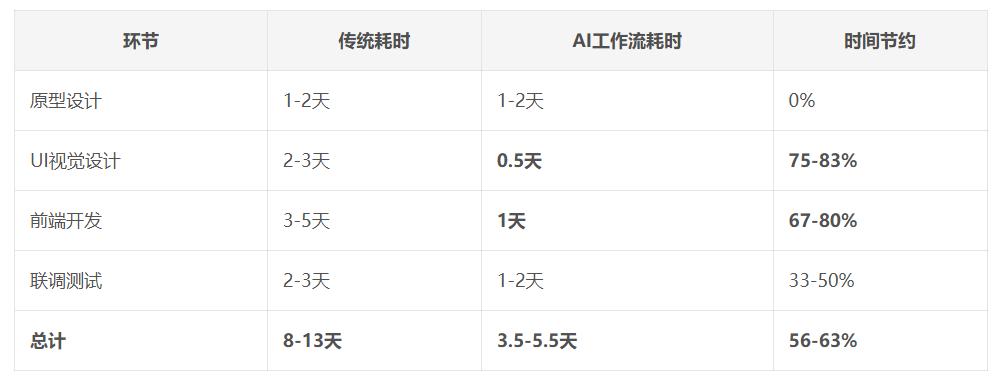
Core Insights - The article discusses how AI workflows can significantly reduce the time required for product development, transforming traditional processes that typically take weeks into streamlined operations that can be completed in hours [1][2]. Traditional Workflow - The traditional product development process involves multiple stages: prototype creation, UI design, front-end development, and back-end integration, which collectively take an average of 2-3 weeks for a medium complexity feature [3]. - Each stage incurs communication costs and time delays, with front-end development alone taking 5-7 working days [3]. AI Workflow Efficiency - The AI workflow can compress the entire development timeline from 8-13 days down to just 3.5-5.5 days, achieving time savings of 56-63% across various stages [4]. - Specific time reductions include: - UI design reduced from 2-3 days to 0.5 days (75-83% savings) - Front-end development reduced from 3-5 days to 1 day (67-80% savings) - Integration testing reduced from 2-3 days to 1-2 days (33-50% savings) [4]. AI Tools and Implementation - The company selected a combination of tools: Pixso for prototyping, Stitch for design generation, and AI Studio for code generation, focusing on usability, low learning curve, compatibility with existing workflows, and reliable output quality [5]. - The process begins with establishing a design baseline in Pixso, followed by applying design language across the prototype using Stitch, and finally generating front-end code in AI Studio [6][12][15]. Impact on Collaboration and Development - The new workflow enhances collaboration between product and development teams, allowing for earlier technical feasibility validation and more precise requirement communication [24]. - The iterative cycle is transformed from "design → review → develop → test" to "prototype → code → fine-tune → launch," facilitating parallel development of front-end and back-end components [24]. Future Outlook - The article predicts that within 18 months, AI will enable even smarter iterative cycles, allowing for reverse engineering of prototypes from code and providing integrated front-end and back-end solutions based on comprehensive functional descriptions [24]. - The role of product managers is evolving to require more structured logical thinking, basic technical understanding, and system-wide design capabilities [24]. Conclusion - The shift towards AI-enhanced workflows is redefining the value of product managers, moving from merely conveying requirements to directly creating products, thus lowering barriers between product thinking and implementation [25][26].
Levi Strauss Taps Microsoft to Build ‘AI Superagent’ for Operations
PYMNTS.com· 2025-11-18 01:21
Core Insights - Levi Strauss & Co. is collaborating with Microsoft to create an enterprise superagent aimed at enhancing employee support, streamlining retail operations, and modernizing data infrastructure [1][2] - The Azure-native orchestrator will function within Microsoft Teams, managing requests across various departments, which is part of Levi's strategy to focus on a "fan-obsessed, direct-to-consumer first business" [2][4] - The superagent is expected to centralize employee inquiries and operational tasks into a single conversational interface, improving support for store associates and corporate teams [2][6] Modernization Strategy - The initiative is part of a broader modernization strategy that includes the use of Surface Copilot+ PCs, GitHub Copilot, and Microsoft Intune, alongside migrating workloads to Microsoft Azure [3] - Levi is utilizing Azure Migrate, Azure AI Foundry, and Semantic Kernel to enhance automation and maintain a zero-trust security posture [3] AI Adoption in Retail - The partnership reflects a trend among retailers to adopt agentic AI for both internal and customer-facing operations, with Levi's consumer tools built on the same data foundations [4][5] - The new Outfitting feature leverages inventory data and customer behavior to provide personalized styling recommendations [4] Competitive Landscape - Levi's AI-powered associate assistant, Stitch, offers store employees immediate access to product information and training resources, aligning with industry competition [5] - The move towards an orchestrator model indicates that traditional apparel brands are adopting advanced architectures to enhance execution and support direct-to-consumer growth [5] Implementation Timeline - The global rollout of the superagent is scheduled to begin in early 2026, with expectations of improved productivity and better alignment across stores, supply chains, and digital channels [6]