Project Genie项目

Search documents
砸崩软件股!Anthropic新工具为什么威力这么大?
凤凰网财经· 2026-02-07 10:57
Core Viewpoint - The introduction of a legal plugin by Anthropic for its Claude Cowork AI has significantly impacted the legal software sector, leading to a sharp decline in stock prices for several companies in this space, indicating increased competition and investor concern about the implications of AI on traditional legal services [4][5][6]. Group 1: Impact on Legal Software Stocks - The release of Anthropic's legal plugin triggered a sell-off in stocks related to legal and data services, with many stocks experiencing declines of over 15% [4][6]. - On the day of the sell-off, the total market value lost in the software, financial services, and asset management sectors was approximately $285 billion [6]. - Companies such as LegalZoom.com saw a nearly 20% drop, while Thomson Reuters and other legal information giants also faced significant declines [6][11]. Group 2: Market Position of Claude AI - Claude has emerged as a preferred tool for legal and financial professionals in conducting analysis, highlighting its competitive position in the AI market [8]. - The legal tools provided by Anthropic claim to automate tasks such as contract review and legal briefs, which are core functions of many legal software products [10]. Group 3: Traditional Legal Information Giants Under Pressure - Companies like LegalZoom, RELX, and Thomson Reuters, which operate in the legal information sector, are facing challenges due to the advancements in AI technology [11][12]. - The introduction of AI tools by startups like Legora and Harvey AI has already begun to disrupt the legal industry, with significant investments flowing into AI products for legal applications [12]. Group 4: Broader Software Industry Concerns - The software sector has been under scrutiny for several months as investors remain cautious about the potential risks posed by AI advancements [13]. - Recent data indicates that only 71% of software companies in the S&P 500 have exceeded revenue expectations this earnings season, compared to 85% for the broader tech industry, suggesting underperformance in the software sector [15].



砸崩软件股!Anthropic新工具为什么威力这么大?
硬AI· 2026-02-04 09:07
Core Viewpoint - The release of a legal plugin by Anthropic for its Claude Cowork AI agent has caused significant turmoil in the legal software sector, leading to a sharp decline in stock prices for several companies in this space [4][5][10]. Group 1: Market Reaction - Following the launch of the legal plugin, stocks related to legal and data service technologies experienced a major sell-off, with many stocks dropping over 15% [5][8]. - On the day of the sell-off, the total market capitalization of software, financial services, and asset management sectors decreased by approximately $285 billion [8]. - Notable declines included Dutch company Wolters Kluwer down 13%, UK-based RELX down 14%, LegalZoom.com down nearly 20%, and Thomson Reuters down 15% [8][9]. Group 2: Impact on Legal Software Sector - The stocks in the legal software sector have cumulatively dropped at least 20% since the beginning of 2026, with the decline accelerating after the release of Anthropic's legal plugin [10]. - The legal tools provided by Anthropic's plugin can automate tasks such as contract review and legal briefs, which are core functions of many legal software products [6][12]. - The market position of Claude as a preferred tool for legal and financial professionals highlights its competitive edge in the AI market [11]. Group 3: Investor Sentiment and Future Outlook - Investor confidence in the legal publishing industry may further deteriorate as AI technology continues to advance [16]. - Prior to the launch of Anthropic's plugin, several startups, including Legora and Harvey AI, had already introduced tools aimed at assisting lawyers with tedious tasks, attracting significant investment [17]. - The performance of software stocks has lagged behind other tech companies, with only 71% of software companies in the S&P 500 exceeding revenue expectations this earnings season, compared to 85% for the entire tech sector [22].


砸崩软件股!Anthropic新工具为什么威力这么大?
华尔街见闻· 2026-02-04 02:56
Core Viewpoint - The launch of Anthropic's legal plugin for its Claude Cowork AI agent has intensified competition in the legal software market, leading to a significant drop in stock prices for several companies in the sector [1][3]. Group 1: Market Reaction - Following the announcement of the legal plugin, stocks related to legal and data services experienced a sharp decline, with many stocks dropping over 15% [1][4]. - On the day of the sell-off, the total market capitalization loss in the software, financial services, and asset management sectors was approximately $285 billion [4]. - Specific companies such as Wolters Kluwer, RELX, LegalZoom.com, and Thomson Reuters saw declines of 13%, 14%, nearly 20%, and 15% respectively [4][12]. Group 2: Competitive Landscape - Anthropic's new tool can perform various legal tasks, including compliance tracking and document review, which are central to many legal software products [2][10]. - The introduction of this plugin is seen as a sign of increased competition in the legal field, potentially leading to negative impacts on existing players [3]. - Claude has emerged as a preferred tool for legal and financial professionals, indicating its strong market position [9]. Group 3: Investor Sentiment - Stocks in the legal software sector have cumulatively dropped at least 20% since the beginning of 2026, with the decline accelerating after the plugin's release [7]. - Investors remain highly cautious about the disruptive potential of AI agents, despite the threat being factored into Wall Street's outlook for 2026 [7]. - The legal publishing industry may see further erosion of investor confidence as AI technology continues to advance [13]. Group 4: Industry Trends - Prior to Anthropic's plugin launch, several startups, including Legora and Harvey AI, had already introduced tools aimed at alleviating tedious tasks for lawyers, attracting significant investment [14]. - Harvey AI reached a valuation of $5 billion in June, while Legora was valued at $1.8 billion in October [14]. - The software sector has been under scrutiny for months, with investors wary of the business risks posed by AI [16].

中际旭创、新易盛均跌超9%
Mei Ri Jing Ji Xin Wen· 2026-02-04 02:11
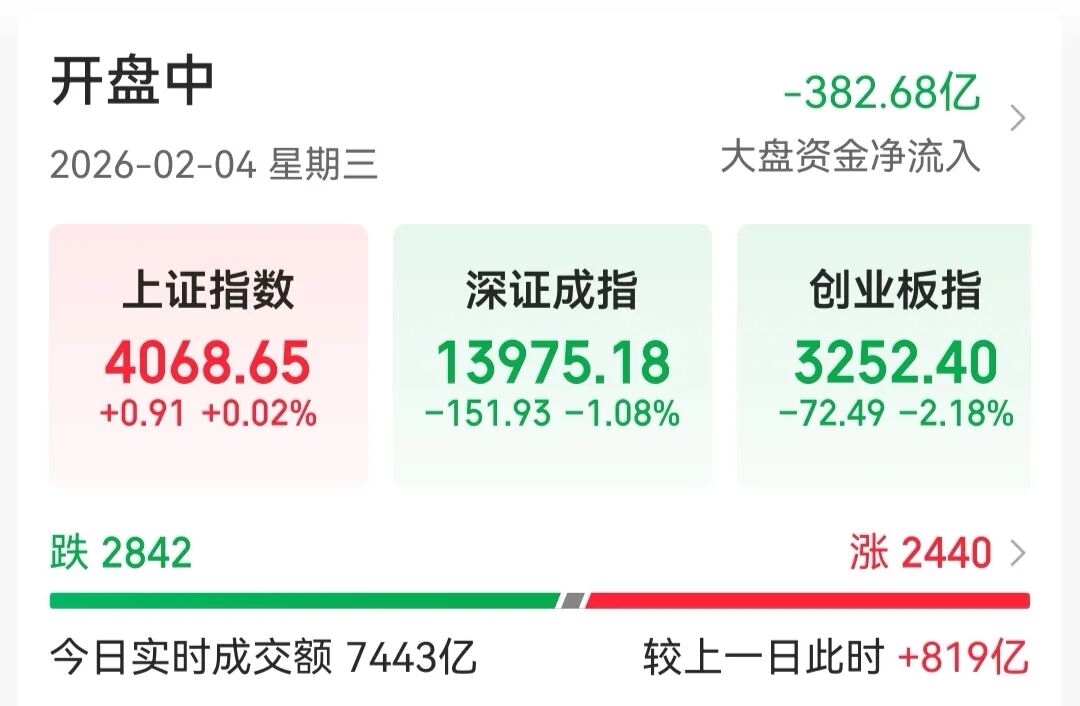
Core Viewpoint - The market showed divergence on February 4, with the ChiNext Index dropping over 2%, while the Shanghai Composite Index rose by 0.02%. The decline was led by sectors such as computing hardware, semiconductor chips, and AI applications, with over 2,800 stocks in the Shanghai and Shenzhen markets experiencing losses [1]. Group 1: Market Performance - The ChiNext Index fell by more than 2%, while the Shanghai Composite Index increased slightly by 0.02% [1]. - The Shenzhen Component Index decreased by 1.08%, indicating a general downturn in the market [1]. - Over 2,800 stocks in the Shanghai and Shenzhen markets reported declines [1]. Group 2: Individual Stock Movements - Zhongji Xuchuang saw a decline of 9.31% with a trading volume exceeding 12.796 billion [2][3]. - Xinyi Sheng dropped by 9.84%, with a trading volume surpassing 10.653 billion [2][3]. - Other notable declines included companies like Kingdee International, which fell by 11.06%, and Meitu, which dropped by 9.74% [3]. Group 3: Sector Analysis - The AI application sector experienced significant volatility, with companies like Ingrity Media hitting the daily limit down [3]. - The Hong Kong Hang Seng Tech Index also saw its decline widen to 2% [3]. - Semiconductor stocks faced early losses, with Fudan University dropping over 6% and Huahong Semiconductor falling more than 4% [3]. Group 4: Industry Concerns - Investors have been closely monitoring the software industry due to potential business risks posed by AI advancements [4]. - The release of Anthropic's Claude Cowork tool has heightened concerns about increased competition in the legal sector [5]. - Data indicates that only 71% of software companies in the S&P 500 exceeded revenue expectations this earnings season, compared to 85% for the entire tech sector [5].