
R6强化学习大模型

Search documents
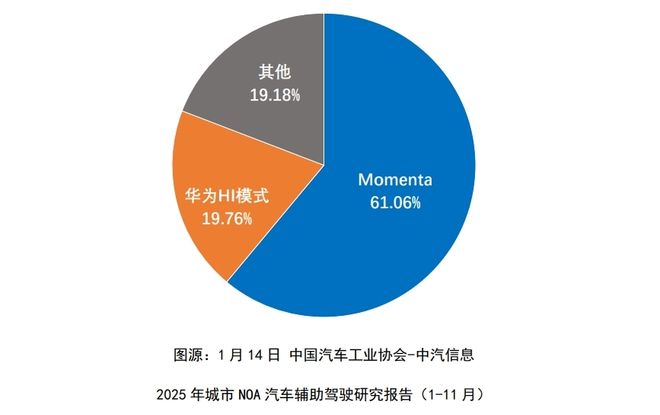
中国智驾双强:Momenta与华为NOA合计占比超80%
Guan Cha Zhe Wang· 2026-01-15 03:44
Core Insights - The report highlights the rapid expansion of the urban NOA (Navigation Assisted Driving) market in China, with a cumulative sales of 3.129 million units from January to November 2025, accounting for 15.1% of passenger car insurance volume, an increase of 5.6 percentage points compared to the entire year of 2024 [1][2] Market Dynamics - The market for third-party urban NOA suppliers is characterized by a "dual strong" pattern, with Momenta and Huawei significantly leading, together holding over 80% of the market share among third-party suppliers [1][2] - Momenta's urban NOA deployment reached 414,400 units, representing 61.06% of the third-party supplier market, with partnerships covering major domestic passenger car manufacturers and 8 out of the top 10 global automakers [2] - Huawei's HI model achieved a deployment of 134,100 units, accounting for 19.76% of the third-party supplier market [2] Competitive Landscape - Domestic brands excelled in the urban NOA segment, with related model sales reaching 2.5373 million units, representing 81.1% of the total, showcasing the innovation and market competitiveness of Chinese automakers [2] - Global brands such as Mercedes-Benz, BMW, Audi, Cadillac, Buick, and Toyota are accelerating their strategies by collaborating with leading Chinese intelligent driving suppliers to implement urban NOA features [2] Technological Advancements - The report indicates that high-level assisted driving is entering a phase of large-scale implementation, where algorithm strength, data loop capabilities, and mass production experience are critical for determining suppliers' market positions and growth rates [3] - The urban NOA is driving systemic changes in the intelligent driving field, with applications extending from highway NOA to urban environments, and a shift towards integrated system architectures [5] - The end-to-end large model has become the core engine for NOA technology iteration, facilitating a transition from modular architectures to integrated perception and planning systems [5] Future Outlook - The report predicts that the integration of multimodal models and end-to-end technologies, along with continuous upgrades to computing platforms, will further enhance the safety experience of urban NOA [5] - The industry competition is shifting from a focus on individual technical metrics to a comprehensive competition based on product experience, technological limits, and mass production capabilities [5]

冲刺5万亿!苏州锚定“AI+制造”强势开局
Xin Hua Ri Bao· 2026-01-05 05:54
Core Viewpoint - Suzhou is accelerating its transformation into a "smart manufacturing city" through the integration of AI and manufacturing, aiming for an industrial output value exceeding 5 trillion yuan by 2026 [1][2][12]. Group 1: Industrial Growth and Economic Foundation - The industrial sector is the foundation of Suzhou's economy, with the industrial output value expected to reach 4.89 trillion yuan by 2025, maintaining its position among the top in the country [2][5]. - Suzhou has established three trillion-level industrial clusters in electronics, equipment manufacturing, and new materials, along with multiple national-level advanced manufacturing clusters [3][5]. - The city has been recognized for its industrial resilience and innovation, with a significant number of national and provincial technology centers and a strong presence in AI and smart manufacturing [3][4]. Group 2: AI Integration in Manufacturing - The "AI + Manufacturing" strategy is positioned as a critical approach to enhance productivity and address challenges such as rising costs and efficiency bottlenecks in the manufacturing sector [6][7]. - AI technologies are being applied across various manufacturing processes, leading to significant improvements in efficiency, such as reducing production planning time from four hours to under one hour [7][8]. - Suzhou has over 2,500 AI-related companies and has established several innovation zones and pilot areas for AI applications, positioning itself as a leader in the integration of AI and manufacturing [8][9]. Group 3: Action Plans and Strategic Initiatives - The "AI + Manufacturing" initiative includes eight major actions aimed at fostering a comprehensive ecosystem for smart manufacturing, focusing on industrial models, data infrastructure, and application scenarios [10][11]. - Key actions include the development of 150 industrial models, the creation of over 200 high-quality industrial datasets, and the promotion of 100 replicable application scenarios to facilitate AI adoption [10][11]. - The initiative also emphasizes the importance of building a robust AI infrastructure, including a target of 40,000 PFLOPS in computing power to support small and medium-sized enterprises [11][12].