城市NOA(导航辅助驾驶)

Search documents
八成市场,两家瓜分:智能驾驶第三方赛道马太效应显现,Momenta、华为占据头部
Di Yi Cai Jing Zi Xun· 2026-01-19 02:34
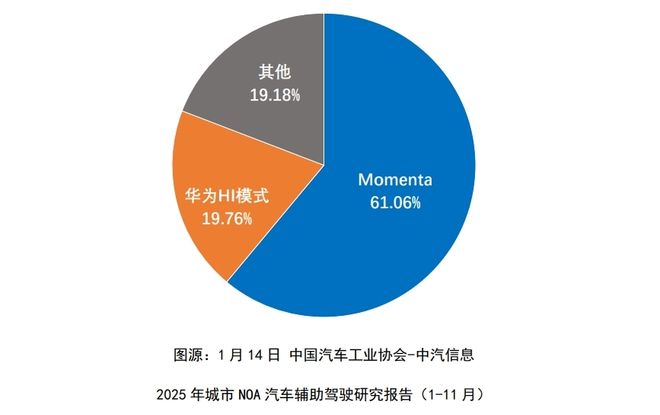
Core Insights - The report indicates that by November 2025, the cumulative sales of passenger cars equipped with urban NOA (Navigation Assisted Driving) in China reached 3.129 million units, marking a shift from high-end differentiation to mainstream adoption [1][3] Group 1: Market Dynamics - Urban NOA has transitioned from niche to mainstream, impacting vehicle delivery schedules, user experience, and brand risks [3] - The market is maturing rapidly, leading to a clear "Matthew Effect," where leading players dominate the market [6][16] - Momenta and Huawei's HI model together hold over 80% of the urban NOA third-party supplier market, with Momenta leading at approximately 61.06% market share [3][12] Group 2: Competitive Landscape - The industry is witnessing a dual-leader scenario, with Momenta and Huawei establishing a strong competitive position [13][16] - Momenta's urban NOA deployment reached 414,400 units from January to November 2025, reinforcing its leadership in the third-party supplier market [12][22] - Collaborations with major automotive brands like BMW and Mercedes-Benz highlight the importance of ongoing technological iteration and reliability in the competitive landscape [15][20] Group 3: Technological Advancements - The evolution of urban NOA is driven by three mechanisms: algorithmic advancement, data feedback loops, and accumulated trust through reliability [9][10][12] - Momenta's R6 reinforcement learning model exemplifies the shift towards advanced algorithms that enhance decision-making capabilities beyond human replication [9] - The data advantage gained through large-scale deployment leads to exponential growth in algorithm training effectiveness, making it difficult for latecomers to catch up [11] Group 4: Global Expansion - Momenta is actively expanding its global footprint, partnering with Southeast Asian platforms and international automotive brands to promote Chinese smart driving technology [18][20] - The adaptability of Chinese smart driving solutions to various global markets is attributed to the complex urban traffic conditions in China, which serve as a robust training environment [19] Group 5: Future Outlook - The Ministry of Industry and Information Technology predicts that by 2030, the integration of advanced driving assistance and connected features will create a trillion-level value increment for the automotive industry [21] - Urban NOA is expected to evolve from a high-end feature to a fundamental capability in new vehicles, influencing user experience and brand trust [21][22] - The competition in urban NOA is likened to a marathon, with Momenta's comprehensive capabilities making it difficult for competitors to replicate [22][23]

智驾“中国方案”双强格局:Momenta与华为NOA合计占比超80%
Guan Cha Zhe Wang· 2026-01-15 03:50
Core Insights - The report highlights the rapid expansion of the urban NOA (Navigation Assisted Driving) market in China, with cumulative sales reaching 3.129 million units from January to November 2025, accounting for 15.1% of passenger car insurance volume, an increase of 5.6 percentage points compared to the entire year of 2024 [1][2] Industry Overview - The urban NOA technology is becoming a core configuration in automotive intelligence, with 2025 identified as a key year for its commercialization [2] - The market is characterized by a "dual strong" pattern among third-party urban NOA suppliers, with Momenta and Huawei leading, together holding over 80% of the market share [1][2] Company Performance - Momenta's urban NOA deployment reached 414,400 units, representing 61.06% of the third-party supplier market, with partnerships covering major domestic passenger car manufacturers and 8 out of the top 10 global automakers [2] - Huawei's HI model achieved a deployment of 134,100 units, accounting for 19.76% of the third-party supplier market [2] - Domestic brands excelled in the urban NOA segment, with related model sales reaching 2.5373 million units, making up 81.1% of the total [2] Competitive Landscape - Global automotive brands such as Mercedes-Benz, BMW, Audi, Cadillac, Buick, and Toyota are accelerating their urban NOA strategies through collaborations with leading Chinese intelligent driving suppliers [2] - The report indicates that the "Chinese solution" for intelligent driving, developed by companies like Huawei and Momenta, is attracting deep cooperation from renowned automotive brands in Germany, the US, Japan, and South Korea, enhancing China's influence in the global automotive value chain [2] Technological Advancements - The report suggests that as high-level assisted driving enters a phase of large-scale implementation, key factors determining supplier market position include algorithm strength, data loop capabilities, and experience in large-scale production [3][5] - The urban NOA is driving systemic changes in the intelligent driving sector, with applications extending from highway NOA to urban environments, and a shift towards integrated system architectures [3][5] Future Outlook - The report predicts that the integration of multimodal models and end-to-end technologies, along with continuous upgrades to computing platforms, will further enhance the safety experience of urban NOA [5] - Competition in the industry is shifting from a focus on individual technical metrics to a comprehensive competition based on product experience, technological limits, and scalability, with leading companies building systematic advantages through algorithms, data loops, and large-scale production [5]


中国智驾双强:Momenta与华为NOA合计占比超80%
Guan Cha Zhe Wang· 2026-01-15 03:44
Core Insights - The report highlights the rapid expansion of the urban NOA (Navigation Assisted Driving) market in China, with a cumulative sales of 3.129 million units from January to November 2025, accounting for 15.1% of passenger car insurance volume, an increase of 5.6 percentage points compared to the entire year of 2024 [1][2] Market Dynamics - The market for third-party urban NOA suppliers is characterized by a "dual strong" pattern, with Momenta and Huawei significantly leading, together holding over 80% of the market share among third-party suppliers [1][2] - Momenta's urban NOA deployment reached 414,400 units, representing 61.06% of the third-party supplier market, with partnerships covering major domestic passenger car manufacturers and 8 out of the top 10 global automakers [2] - Huawei's HI model achieved a deployment of 134,100 units, accounting for 19.76% of the third-party supplier market [2] Competitive Landscape - Domestic brands excelled in the urban NOA segment, with related model sales reaching 2.5373 million units, representing 81.1% of the total, showcasing the innovation and market competitiveness of Chinese automakers [2] - Global brands such as Mercedes-Benz, BMW, Audi, Cadillac, Buick, and Toyota are accelerating their strategies by collaborating with leading Chinese intelligent driving suppliers to implement urban NOA features [2] Technological Advancements - The report indicates that high-level assisted driving is entering a phase of large-scale implementation, where algorithm strength, data loop capabilities, and mass production experience are critical for determining suppliers' market positions and growth rates [3] - The urban NOA is driving systemic changes in the intelligent driving field, with applications extending from highway NOA to urban environments, and a shift towards integrated system architectures [5] - The end-to-end large model has become the core engine for NOA technology iteration, facilitating a transition from modular architectures to integrated perception and planning systems [5] Future Outlook - The report predicts that the integration of multimodal models and end-to-end technologies, along with continuous upgrades to computing platforms, will further enhance the safety experience of urban NOA [5] - The industry competition is shifting from a focus on individual technical metrics to a comprehensive competition based on product experience, technological limits, and mass production capabilities [5]