高温超导材料

Search documents
2025年央媒眼中的中国有色
Xin Lang Cai Jing· 2026-02-04 12:22
Core Viewpoint - The news highlights the achievements of China Nonferrous Metal Group in various areas such as party leadership, operational quality improvement, resource increase, technological empowerment, reform enhancement, ESG practices, international cooperation, and exemplary models, gaining widespread attention from major media outlets in China [1][74]. Group 1: Party Leadership - The company emphasizes the importance of party leadership in ensuring high-quality development through strict accountability [1][76]. - The State-owned Assets Supervision and Administration Commission of the State Council reports that the company is committed to fulfilling its primary responsibilities and promoting effective learning and education [4][79]. Group 2: Operational Quality Improvement - China Nonferrous Metal Group achieved record operational performance in 2024, indicating a strong upward trend [6][81]. - The company reported steady progress in the first half of the year, successfully achieving its mid-year targets [7][82]. Group 3: Resource Increase and Production - The company is accelerating efforts to increase resource reserves and production, focusing on key areas such as new materials and rare metals [10][18]. - In the first ten months of the year, China's total foreign direct investment exceeded 1 trillion yuan, solidifying its status as a major investor [12][87]. Group 4: Technological Empowerment - The company is developing a global leading superconducting niobium material research and manufacturing base [24][99]. - It aims to leverage digital intelligence to build a world-class mining enterprise [20][95]. - The market for high-temperature superconducting materials is expected to grow significantly, from approximately 300 million yuan in 2024 to nearly 5 billion yuan by 2030 [30][105]. Group 5: Reform Enhancement - The company is implementing a "six efficiency" initiative to deepen value creation actions [35][110]. - Equipment upgrades are driving energy savings and carbon reduction, enhancing green productivity [37][112]. Group 6: International Cooperation - The company is actively involved in developing and processing critical minerals in African countries, contributing to local economic development [52][127]. - It has established the first digital copper mine in Africa and is leading in mining intelligence with innovative technologies [55][130]. Group 7: Exemplary Models - A team of young engineers at the company has successfully transformed a high-energy-consuming smelting plant into a low-carbon production line, achieving a copper purity of 99.998% [73][148].


首个高温超导带材发展战略研究报告: REBCO带材发展呼唤协同创新
Zhong Guo Hua Gong Bao· 2026-02-03 07:14
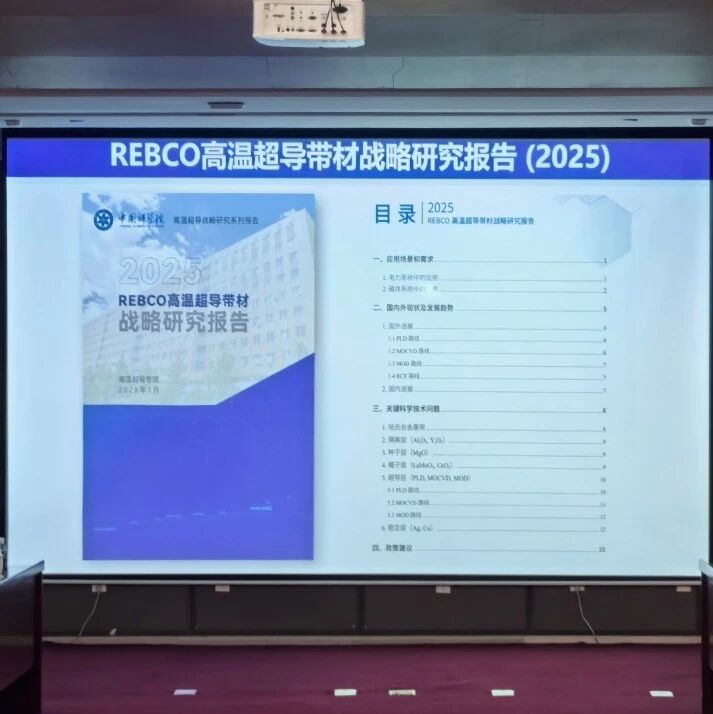
Core Insights - The report released by the Chinese Academy of Sciences focuses on the strategic development of REBCO high-temperature superconducting tapes, marking the first international strategic research report on this topic, which aims to provide a clear roadmap for large-scale applications of high-temperature superconducting materials [1][2] Group 1: REBCO High-Temperature Superconducting Materials - Superconducting materials are recognized for their unique properties of zero electrical resistance and complete magnetic field expulsion, making them highly valuable in various fields such as energy, transportation, medical, and scientific research [1] - Traditional superconductors require extremely low temperatures (-269°C) for operation, leading to high cooling costs and reliance on scarce helium resources, which limits their widespread application [1] - The introduction of REBCO high-temperature superconductors, which operate above the liquid nitrogen temperature (-196°C), significantly reduces cooling costs and maintains excellent current-carrying capacity in high magnetic fields, laying the foundation for broader practical applications [1] Group 2: Challenges and Future Directions - Despite entering the early commercialization phase, the overall performance of REBCO materials has significant room for improvement, necessitating a systematic advancement in materials, processes, and applications [2] - The report identifies ten key scientific and technical issues that hinder the large-scale application of REBCO tapes, derived from comprehensive research on the entire development and application chain [2] - The report emphasizes the need for collaborative innovation to address performance bottlenecks and improve the balance of strength and toughness, structural conduction efficiency, and interlayer bonding in the composite structure of REBCO tapes [2][3]
【新华社】中国科学院报告提出高温超导带材领域十大关键科学技术问题
Xin Hua She· 2026-01-27 02:36
Core Insights - The report titled "2025 REBCO High-Temperature Superconducting Tape Strategic Research Report" was released by the Institute of Physics, Chinese Academy of Sciences, highlighting ten key scientific and technological issues in the field of high-temperature superconductors [1] - High-temperature superconductors, particularly REBCO, are identified as core materials for various applications, including controlled nuclear fusion, magnetic resonance imaging, and superconducting cables due to their low production costs [1] - Despite commercial production being achieved, the complex multi-layer composite structure of REBCO high-temperature superconducting tapes presents challenges in stability and performance enhancement [1] Group 1 - The report identifies critical issues such as improving the yield strength and fatigue resistance of alloy-based tapes to meet high-field application demands [1] - It also addresses the need to overcome inherent limitations in the electrical and thermal properties of buffer layer materials [1] - The ten key issues were derived from in-depth research on the entire industry chain, from R&D to application, analyzing the structure of REBCO high-temperature superconducting tapes [1] Group 2 - The director of the Institute of Physics, Fang Zhong, expressed the hope that revealing these core scientific and technological issues will unite innovation forces from academia, industry, and research to collaboratively drive the large-scale application of high-temperature superconducting materials [1]
【中国新闻网】中国发布国际首个聚焦高温超导带材发展战略研究报告
Zhong Guo Xin Wen Wang· 2026-01-27 02:24
Core Insights - The report titled "2025 REBCO High-Temperature Superconducting Tape Strategic Research Report" was officially released by the Chinese Academy of Sciences, focusing on the development of REBCO (Rare Earth Barium Copper Oxide) high-temperature superconducting tape [1][2] - The report outlines the current state of research, industrialization, and application of REBCO globally, identifying ten key scientific and technological challenges that need to be addressed for large-scale application of high-temperature superconducting materials [1][3] Industry Overview - Superconducting materials are recognized for their zero electrical resistance and complete diamagnetism, making them strategically valuable in various fields such as energy, transportation, medical, and scientific research [3] - Traditional superconductors operate at extremely low temperatures, leading to high cooling costs and reliance on scarce helium resources, which has limited their application to specialized areas like particle accelerators and high-end medical devices [3] - REBCO high-temperature superconductors, with critical temperatures above liquid nitrogen levels, significantly reduce cooling costs and enhance performance in carrying current and resisting magnetic fields, paving the way for broader applications since their commercialization in 2006 [3][4] Applications - In the power system, REBCO tapes can be used to manufacture superconducting cables and fault current limiters, which are essential for urban grid upgrades and ensuring grid safety during short circuits [4] - In magnetic systems, REBCO tapes are applicable in nuclear fusion devices, high-field magnetic resonance imaging, and superconducting motors, which require high mechanical strength and stability [4] Key Scientific and Technological Challenges - The report identifies ten critical scientific and technological issues hindering the large-scale application of REBCO tapes, spanning from the base layer to the superconducting functional layer [5] - These challenges include improving the yield strength and fatigue resistance of alloy substrates, overcoming limitations in buffer layer materials, achieving stability and uniformity in thin-film deposition, and enhancing the bonding strength between layers [5][6] Future Directions - The report emphasizes the need for collaborative innovation in materials, processes, and applications to enhance the performance of REBCO tapes [7] - Key areas for future development include optimizing the internal structure of the superconducting layer, improving the balance of strength and toughness in the substrate and buffer layers, and developing scalable and consistent manufacturing processes to meet growing application demands [7]
【央视新闻】首提稀土钡铜氧高温超导带材“十大关键科学技术问题” 中国科学院发布报告
Yang Shi Xin Wen· 2026-01-27 02:24
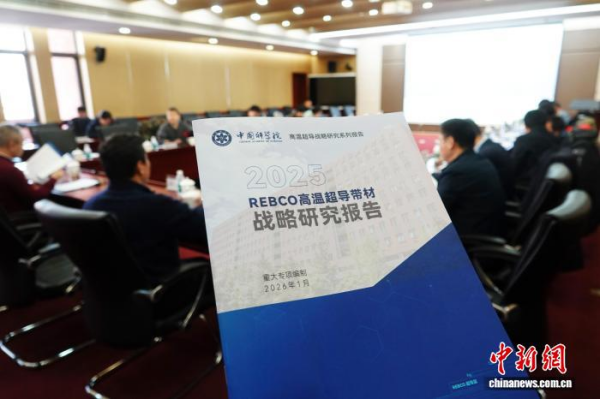
Core Insights - The report released by the Institute of Physics, Chinese Academy of Sciences, is the first strategic research document focusing on the development of REBCO high-temperature superconducting tapes, outlining the current state of research, industrialization, and application globally, and identifying ten key scientific and technological issues in the field [2][4] Group 1: Superconducting Materials Overview - Superconducting materials are considered strategic materials with extraordinary properties such as zero electrical resistance and complete magnetic resistance, having broad application prospects in energy, transportation, medical, and scientific research fields [2] - Traditional superconductors operate at extremely low temperatures (-269°C), leading to high cooling costs and reliance on scarce helium resources, which has limited their application to large scientific devices and high-end medical equipment [2] Group 2: REBCO High-Temperature Superconductors - REBCO high-temperature superconductors have a critical temperature above liquid nitrogen temperature (-196°C), significantly reducing cooling costs and enhancing performance in carrying current and resisting magnetic fields, thus laying the foundation for larger-scale applications [3] - Since commercial production began in 2006, REBCO high-temperature superconducting tapes have shown significant application potential in fields such as magnetic confinement fusion, high-end medical devices, large scientific installations, and superconducting power equipment, primarily focusing on power systems and magnet systems [3] Group 3: Applications in Power and Magnet Systems - In power systems, REBCO tapes can be used to manufacture superconducting cables and fault current limiters, enabling high current, low-loss transmission suitable for urban grid upgrades [3] - In magnet systems, REBCO tapes are applied in critical devices like fusion reactors and high-field magnetic resonance imaging, where high mechanical strength and stability are required [3] Group 4: Future Development and Challenges - Despite entering the early commercialization phase, there is significant room for performance improvement in REBCO high-temperature superconducting tapes, which consist of a multi-layer composite structure [4] - Future development will focus on collaborative innovation across materials, processes, and applications, addressing issues such as enhancing current-carrying capacity, improving strength and toughness balance, and developing scalable, consistent manufacturing processes [4] - The report identifies ten key scientific and technological issues that hinder the large-scale application of REBCO tapes, which require deep collaboration across materials, physics, and engineering disciplines [4][5]
明确稀土钡铜氧从“能用”到“好用”路线图
Ke Ji Ri Bao· 2026-01-27 02:24
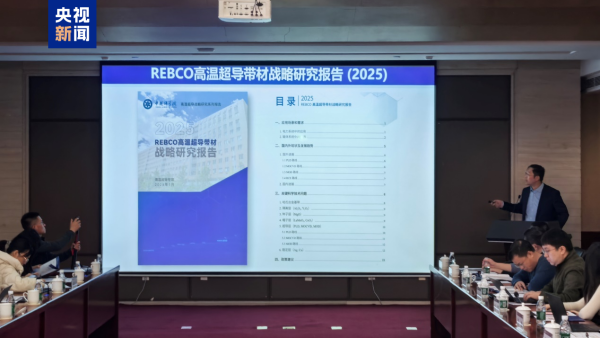
Core Insights - The report released by the Chinese Academy of Sciences focuses on the development of REBCO high-temperature superconducting tapes, outlining the current state of research, industrialization, and application globally, and identifies ten critical scientific and technological issues that need to be addressed for large-scale application [1][2]. Group 1: REBCO High-Temperature Superconducting Tapes - REBCO high-temperature superconducting materials have a critical temperature above the liquid nitrogen range (-196°C), significantly reducing cooling costs and enabling broader practical applications compared to traditional superconductors that require extremely low temperatures (-269°C) [1]. - Since its commercialization in 2006, REBCO tapes have shown great potential in key areas such as magnetic confinement nuclear fusion, advanced medical imaging, large scientific installations, and superconducting power equipment [2]. Group 2: Applications and Systems - In the power system sector, REBCO tapes are primarily used in superconducting cables and fault current limiters, which enhance the safety and stability of power grids by allowing high-capacity, low-loss transmission [2]. - In the magnet system sector, REBCO tapes are applied in high-end equipment such as nuclear fusion devices and high-field magnetic resonance imaging, where high mechanical strength and operational stability are critical [2]. Group 3: Challenges and Future Directions - The report identifies ten key scientific and technological challenges that hinder the large-scale application of REBCO tapes, emphasizing the need for improvements in material performance, processing techniques, and application integration [3]. - Future development should focus on optimizing the internal structure of the superconducting layer, improving the balance of strength and toughness in the composite structure, and developing scalable, consistent manufacturing processes to meet the growing demand for large-scale applications [3].
中科院报告提出高温超导带材领域十大关键科学技术问题
Xin Lang Cai Jing· 2026-01-27 00:11
Core Viewpoint - The report by the Chinese Academy of Sciences outlines ten key scientific and technological issues in the field of REBCO high-temperature superconducting materials, aiming to guide large-scale applications of these materials [1] Group 1: Superconducting Materials - Superconducting materials exhibit zero electrical resistance and can withstand magnetic forces, showing significant potential in applications such as controlled nuclear fusion, magnetic resonance imaging, and superconducting cables [1] - REBCO, a type of high-temperature superconducting material, is highlighted for its relatively low production costs, making it a core material in current superconducting technology research and applications [1] Group 2: Challenges in Production - Despite achieving commercial production, REBCO high-temperature superconducting tapes have a complex multi-layer composite structure, leading to challenges in stable mass production and significant room for performance improvement [1] - The report identifies specific challenges such as enhancing the yield strength and fatigue resistance of alloy-based tapes to meet high-field application requirements and overcoming inherent limitations in the electrical and thermal properties of buffer layer materials [1] Group 3: Collaborative Innovation - The report emphasizes the need for collaboration among industry, academia, and research institutions to address these core scientific and technological issues, aiming to promote the large-scale application of high-temperature superconducting materials [1]
中国科学院报告提出高温超导带材领域十大关键科学技术问题
Xin Hua She· 2026-01-26 10:41
Core Viewpoint - The report by the Chinese Academy of Sciences outlines ten key scientific and technological issues in the field of REBCO high-temperature superconducting materials, aiming to guide large-scale applications of these materials [1] Group 1: Superconducting Materials - Superconducting materials exhibit zero electrical resistance and can withstand magnetic forces, showing significant potential in applications such as controlled nuclear fusion, magnetic resonance imaging, and superconducting cables [1] - REBCO, a type of high-temperature superconductor, is highlighted for its relatively low production costs, making it a core material in current superconducting technology research and applications [1] Group 2: Challenges in Production - Despite achieving commercial production, REBCO high-temperature superconducting tapes have a complex multi-layer composite structure, leading to challenges in production stability and significant room for performance improvement [1] - The report identifies specific challenges such as enhancing the yield strength and fatigue resistance of alloy-based tapes to meet high-field application requirements and overcoming inherent limitations in the electrical and thermal properties of buffer layer materials [1] Group 3: Collaborative Innovation - The report emphasizes the need for collaboration among industry, academia, and research institutions to address these core scientific and technological issues, aiming to drive the large-scale application of high-temperature superconducting materials [1]
中国发布国际首个聚焦高温超导带材发展战略研究报告
Zhong Guo Xin Wen Wang· 2026-01-26 08:44
Core Insights - The report titled "2025 REBCO High-Temperature Superconducting Tape Strategic Research Report" is the first strategic research report focusing on the development of high-temperature superconducting tapes, released by the Chinese Academy of Sciences [1][4]. Group 1: Current Status and Applications - The report systematically reviews the global research, industrialization, and application status of REBCO high-temperature superconducting tapes, identifying ten key scientific and technological issues that need to be addressed for large-scale application [2]. - Superconducting materials, known for their zero resistance and complete diamagnetism, are considered highly strategic materials with broad application prospects in energy, transportation, medical, and scientific research fields [3]. - Traditional superconductors operate at extremely low temperatures (-269°C), leading to high cooling costs and reliance on scarce helium resources, which has limited their application to large scientific devices and high-end medical equipment [3]. Group 2: Advantages of REBCO - REBCO high-temperature superconducting materials have a critical temperature above liquid nitrogen temperature (-196°C), significantly reducing cooling costs and enhancing performance in current carrying and magnetic field resistance, thus laying the foundation for broader applications [5]. - Applications of REBCO are primarily concentrated in two areas: power systems and magnet systems. In power systems, REBCO tapes can be used to manufacture superconducting cables and fault current limiters, which are crucial for urban grid upgrades and ensuring grid safety [5]. - In magnet systems, REBCO tapes are applied in nuclear fusion devices, high-field magnetic resonance imaging, and superconducting motors, which require high mechanical strength and stability [5]. Group 3: Key Scientific and Technological Issues - The report identifies ten critical scientific and technological issues hindering the large-scale application of REBCO tapes, spanning the entire material system from the base layer to the superconducting functional layer [6][7]. - These issues include enhancing the yield strength and fatigue resistance of alloy substrates, overcoming inherent limitations of buffer layer materials, and achieving stability and uniformity in thin-film deposition processes [6][7]. Group 4: Future Directions - The report emphasizes the need for collaborative innovation in materials, processes, and applications to enhance the performance of REBCO tapes, focusing on optimizing internal structures, improving strength and toughness balance, and developing scalable and consistent manufacturing processes [9]. - The release of this report clarifies key directions and implementation paths for China's high-temperature superconducting field, aiming to transition from following to leading in this technology [11].
国际首个!中国科学院发布报告,提供高温超导材料大规模应用路线图
中国能源报· 2026-01-26 08:43
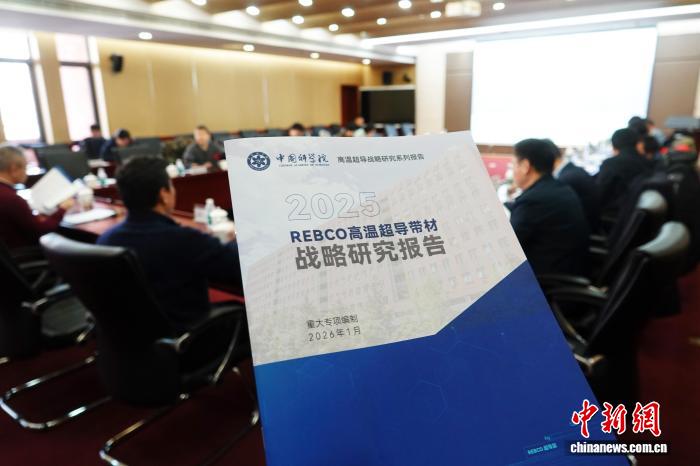
Core Viewpoint - The report released by the Institute of Physics, Chinese Academy of Sciences, outlines the current state and future direction of REBCO high-temperature superconducting tape, identifying ten key scientific and technological challenges that need to be addressed for large-scale application [1][5]. Group 1: Overview of REBCO High-Temperature Superconductors - Superconducting materials, particularly REBCO, are recognized for their extraordinary properties such as zero electrical resistance and complete diamagnetism, making them strategically valuable in various fields including energy, transportation, and healthcare [3]. - Traditional superconductors operate at extremely low temperatures (-269°C), leading to high cooling costs and limited applications primarily in large scientific devices and high-end medical equipment [3]. - REBCO superconductors, with a critical temperature above liquid nitrogen temperature (-196°C), significantly reduce cooling costs and enhance performance in carrying current and resisting magnetic fields, paving the way for broader applications [3][4]. Group 2: Applications and Development Focus - The applications of REBCO superconducting tape are mainly concentrated in two areas: power systems and magnet systems [3]. - In power systems, REBCO tape can be used to manufacture superconducting cables and fault current limiters, which are essential for urban grid upgrades and ensuring grid safety during short circuits [3]. - In magnet systems, REBCO tape's strong current-carrying capacity under high magnetic fields makes it suitable for fusion devices, high-field magnetic resonance imaging, and superconducting motors, which require high mechanical strength and stability [4]. Group 3: Challenges and Future Directions - Despite entering the early commercialization phase, there is significant room for performance improvement in REBCO superconducting tape, which consists of a multi-layer composite structure [4]. - Future development should focus on optimizing the internal structure of the superconducting layer to enhance current-carrying capacity in magnetic fields, improving the balance of strength and toughness in the base, buffer, and protective layers, and developing scalable and consistent manufacturing processes [4]. - The report identifies ten key scientific and technological challenges that hinder the large-scale application of REBCO tape, emphasizing the need for deep collaboration across materials science, physics, and engineering to address these issues [5].