RTX显卡

Search documents
老黄万亿美元梦成真,英伟达版“世界模型”震撼问世
3 6 Ke· 2026-01-23 12:01
Core Insights - Huang Renxun's vision of AI has materialized, transitioning from merely generating images to creating actionable 3D worlds, marking the dawn of a new era in robotics [1][11][30] - The new model from NVIDIA, the 3D Generalist, enables AI to not only visualize but also construct and modify 3D environments, adhering to the laws of physics [10][12][14] Group 1: Technological Advancements - NVIDIA's recent paper on the 3D Generalist model represents a significant leap in AI capabilities, allowing for the generation of detailed 3D environments based on textual descriptions [12][14] - The model utilizes a Vision-Language-Action (VLA) framework, which enables it to create complex 3D layouts, including materials and lighting configurations, from simple prompts [14][24] - The research indicates that the 3D Generalist can achieve performance levels comparable to models trained on significantly larger datasets, demonstrating its efficiency [28][29] Group 2: Implications for Robotics - The ultimate goal of this technology is to facilitate the training of robots in virtual environments that accurately simulate real-world physics, thus overcoming the limitations of traditional training methods [30][34] - By generating diverse virtual scenarios, the model allows robots to undergo extensive training in a fraction of the time it would take in the real world, enhancing their ability to navigate complex physical environments [36][37] - Huang Renxun emphasizes that this advancement is not merely for entertainment or visual effects but is part of a broader ambition to address the challenges of embodied intelligence in robotics [30][32]



美股三大指数,齐创新高!英特尔大涨近23%
Zhong Guo Zheng Quan Bao· 2025-09-18 23:16
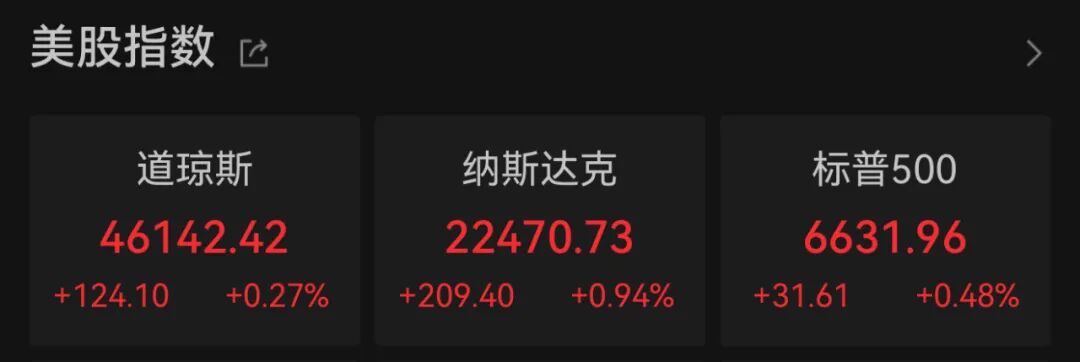
Group 1 - On September 18, US stock indices closed collectively higher, reaching historical highs both intraday and at close, with the Dow Jones Industrial Average up 0.27%, S&P 500 up 0.48%, and Nasdaq Composite up 0.94% [2][4] - The S&P 500 index saw 7 sectors rise and 4 fall, with the technology and industrial sectors leading gains at 1.36% and 1.06% respectively, while consumer staples and discretionary sectors lagged with declines of 1.03% and 0.51% [4] - Nvidia announced a $5 billion investment in Intel, leading to a significant 22.77% increase in Intel's stock price, marking its best single-day performance in nearly 38 years [4] Group 2 - Nvidia's investment will purchase Intel shares at $23.28 each, pending regulatory approval, and aims to develop AI infrastructure and personal computing products [4] - Intel will create Nvidia-customized x86 CPUs for data centers, while also manufacturing x86 system-on-chip solutions integrated with Nvidia's RTX graphics cards for high-performance PCs [4] Group 3 - Gold prices fell by 0.41% to $3643.770 per ounce, while COMEX gold futures dropped 1.07% to $3678.2 per ounce [5] - Crude oil prices also saw a decline, with light crude oil futures down 48 cents to $63.57 per barrel, and Brent crude oil futures down 51 cents to $67.44 per barrel, both reflecting a 0.75% decrease [7]

英伟达将入股!芯片巨头,盘前直线大涨
Zhong Guo Zheng Quan Bao· 2025-09-18 12:54
Core Insights - NVIDIA announced a $5 billion investment in Intel, marking a significant collaboration in AI infrastructure and personal computing products [1] - Following the announcement, Intel's stock surged over 30% in pre-market trading, while NVIDIA's stock rose over 3% [1] Investment Details - NVIDIA will purchase Intel shares at $23.28 each, approximately 6.5% lower than Intel's closing price of $24.90 on September 17 [1] - Post-transaction, NVIDIA is expected to hold over 4% of Intel's shares, becoming a significant shareholder [1] Collaboration Agreement - In the data center sector, Intel will customize x86 CPUs for NVIDIA, which will integrate them into its AI infrastructure platform [1] - In the consumer market, Intel will manufacture x86 system-on-chip solutions that incorporate NVIDIA's RTX graphics cards for high-performance PCs [1] - NVIDIA's CEO referred to the agreement as a "historic collaboration" between the two computing platforms [1] - Intel's CEO stated that this partnership will enhance NVIDIA's leadership in AI and accelerated computing [1] Historical Context - NVIDIA and Intel have a long-standing relationship, having previously collaborated on integrated graphics solutions [2] - The rise of AI has intensified competition, with NVIDIA dominating large model training through its GPUs [2] - Intel's former CEO indicated a drive within the industry to challenge NVIDIA's position, while NVIDIA has gradually entered the CPU market since 2020, directly competing with Intel [2]
英伟达市占,创历史新高
半导体行业观察· 2025-06-09 00:53
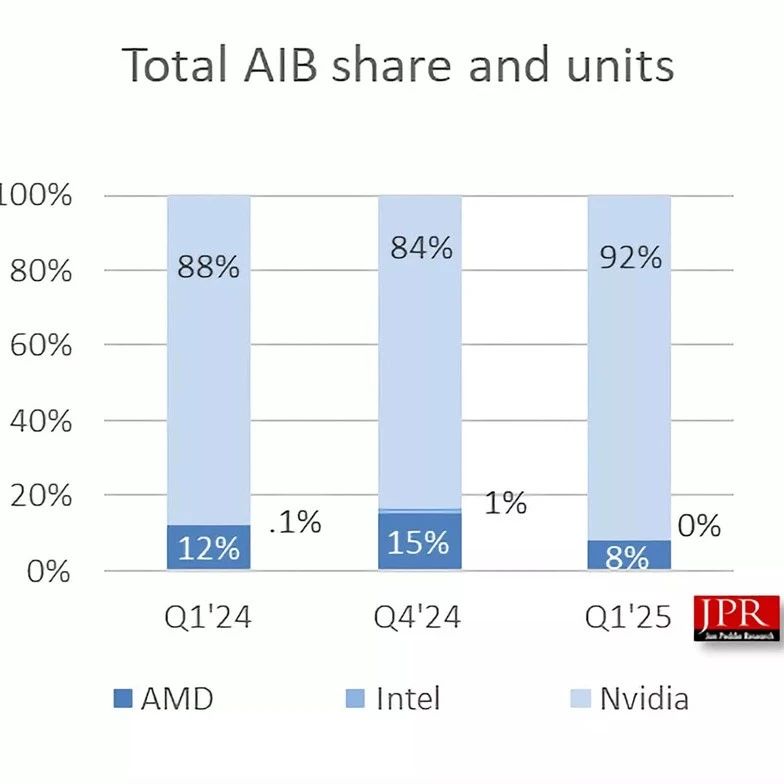
Core Viewpoint - Nvidia's RTX 50 series, despite criticisms, has achieved unprecedented market dominance with a 92% market share, while AMD struggles with supply issues, leading to a significant disparity in sales [1][6]. Group 1: Market Performance - In Q1 2025, total sales of dedicated desktop GPUs reached 9.2 million units, showing over 8% year-on-year and quarter-on-quarter growth [1]. - Nvidia sold millions of RTX 50 series GPUs during January to March, while AMD's Radeon 9000 series shipped less than 750,000 units, resulting in Nvidia's market share soaring to a historic 92% [1]. - AMD's RX 9070 and 9070 XT reported "unprecedented" demand in March, indicating a supply challenge for the company [3]. Group 2: Competitive Landscape - AMD faces challenges in balancing supply between its Radeon GPUs and Ryzen 9000 CPUs, both of which are in high demand [4]. - Recent sales data from Germany indicated that AMD's GPU sales surpassed Nvidia's, suggesting potential growth if production can keep pace [4]. - Nvidia's recent GPU releases have not significantly improved performance compared to its previous RTX 40 Super series, yet its market position remains strong [4]. Group 3: Financial Insights - Nvidia's gaming revenue reached a record $3.8 billion, marking a 42% year-on-year and 48% quarter-on-quarter increase, the fastest growth rate in years for the gaming GPU sector [6]. - High-end consumer GPUs are increasingly being repurposed for small-scale AI computations, contributing to Nvidia's revenue growth [6]. Group 4: Product Developments - AMD's latest Radeon GPUs have finally caught up with Nvidia in ray tracing performance and image quality, with the Radeon 9070 XT outperforming its direct competitors [8]. - Upcoming quarterly reports are expected to reveal competition among mainstream GPUs, including RTX 5060 and RX 9060, as AMD works to increase production [8]. - Nvidia may reduce its consumer GPU output to refocus on its primary revenue driver: AI chips [8].