Omniverse平台

Search documents
SK海力士公布:自建晶圆厂
半导体芯闻· 2026-03-18 10:15
Core Insights - SK Hynix announced plans to build a self-sufficient wafer fab by 2030 to address the growing demand for AI storage while improving production efficiency [1][2] - The company aims to enhance decision-making processes by balancing quality, cost, and speed, moving beyond traditional human experience and rule-based automation [1] - The self-sufficient wafer fab will focus on three core pillars: "Operation AI" for decision automation, "Physical AI" for enhancing existing systems, and "Digital Twin" for safe evolution of all elements [1][2] Group 1 - Operation AI aims to automate engineer judgment, successfully reducing maintenance and defect analysis processing time by half [2] - Physical AI enhances current systems and extends automation into areas still heavily reliant on human input, utilizing NVIDIA's Omniverse platform for simulation before application [2] - The self-sufficient wafer fab is expected to significantly shorten the transition time from design to mass production [1]

巴克莱:2035年AI机器人或成万亿美元赛道 中国占据主导地位
智通财经网· 2026-02-17 23:31
Core Insights - Barclays Bank's latest report indicates that the AI-driven robotics and autonomous machines market is expected to expand to a trillion-dollar scale by 2035, marking a significant leap from its current size and becoming one of the most promising investment themes for the next decade [1] Group 1: Market Growth and Trends - The report titled "The Decade of Robotics" highlights that autonomous vehicles, a relatively mature sector, will lead the growth, followed by drones, and eventually more complex humanoid robots [1] - The report emphasizes a stepwise increase in automation levels and application complexity, driven by advancements in computing power, mechanical systems, and energy systems [1] Group 2: Regional and Sectoral Dynamics - China currently dominates the deployment of humanoid and industrial robots, but Barclays anticipates that nearly 200 listed companies will deeply engage in this theme over the next decade, with about 100 having issued corporate bonds [2] - Traditional automotive manufacturers are expected to become significant players, while the deployment of robotic systems in warehousing, logistics, and retail will continue to accelerate [2] Group 3: Key Players and Supply Chain - Notable companies mentioned include Mercedes-Benz, which is utilizing NVIDIA's Omniverse platform for virtual factory transformations, and Tesla, which has identified robotics as a core focus in its latest earnings call [2] - Key upstream players providing foundational software and hardware for robotics and physical AI include TSMC, Samsung Electronics, and NVIDIA, along with battery manufacturers like EVE Energy and CATL [2] Group 4: Application Trends - The application of physical AI is already evident in large logistics and retail systems, with Amazon deploying over 1 million robots in its fulfillment network, indicating that this scale may only represent a small fraction of long-term potential [3] - Similar trends are emerging in the operations of major retailers like Walmart, further validating the expansive prospects of the robotics and autonomous machines market [3]



英伟达满足客户需求有哪些“高招”?
半导体芯闻· 2026-02-09 10:10
Core Viewpoint - Nvidia is focusing on efficiently meeting customer demands in various verticals such as autonomous driving, robotics, and edge AI by clarifying customer needs and organizing products to avoid redundant development and reduce costs [2]. Group 1: General and Industry Computing Platforms - Nvidia has constructed a "general + industry" computing platform to respond to intelligent computing needs, breaking down demands into "standardized" and "differentiated" categories [3][4]. - The general computing platform integrates core components for training and inference, providing power, operating systems, and model services, categorized into data center, cloud services, edge computing, and embedded computing [4]. - Industry-specific computing platforms are built on the general platform to address unique industry needs, such as the Clara platform for healthcare, DRIVE for automotive, and Isaac for robotics [6][7]. Group 2: Addressing Customer Pain Points - Customers are categorized into three types: "strategic customers" (tech companies), "profitable customers" (industry clients), and "ecosystem customers" (startups and developers) [11]. - Strategic customers require diverse cooperation and Nvidia is introducing NVLink Fusion technology to support multiple architectures, allowing seamless development of intelligent applications [12][13]. - Profitable customers, primarily traditional industries, benefit from customized model training services to create unique competitive advantages [14]. - Ecosystem customers are provided with reference frameworks and pre-trained models to lower entry barriers, enabling faster development and broader adoption of Nvidia's technology [15]. Group 3: Insights and Considerations - Nvidia aims to build a closed-loop, interconnected service network within its industry computing platforms, enhancing value-added services and creating a robust competitive moat [16]. - The company is exploring the establishment of a dedicated manufacturing computing platform to address the entire manufacturing process, indicating a significant market opportunity [17][18]. - By aligning its development needs with broader market demands, Nvidia seeks to maintain a competitive edge through customized solutions and rapid innovation [19].
老黄万亿美元梦成真,英伟达版“世界模型”震撼问世
3 6 Ke· 2026-01-23 12:01
Core Insights - Huang Renxun's vision of AI has materialized, transitioning from merely generating images to creating actionable 3D worlds, marking the dawn of a new era in robotics [1][11][30] - The new model from NVIDIA, the 3D Generalist, enables AI to not only visualize but also construct and modify 3D environments, adhering to the laws of physics [10][12][14] Group 1: Technological Advancements - NVIDIA's recent paper on the 3D Generalist model represents a significant leap in AI capabilities, allowing for the generation of detailed 3D environments based on textual descriptions [12][14] - The model utilizes a Vision-Language-Action (VLA) framework, which enables it to create complex 3D layouts, including materials and lighting configurations, from simple prompts [14][24] - The research indicates that the 3D Generalist can achieve performance levels comparable to models trained on significantly larger datasets, demonstrating its efficiency [28][29] Group 2: Implications for Robotics - The ultimate goal of this technology is to facilitate the training of robots in virtual environments that accurately simulate real-world physics, thus overcoming the limitations of traditional training methods [30][34] - By generating diverse virtual scenarios, the model allows robots to undergo extensive training in a fraction of the time it would take in the real world, enhancing their ability to navigate complex physical environments [36][37] - Huang Renxun emphasizes that this advancement is not merely for entertainment or visual effects but is part of a broader ambition to address the challenges of embodied intelligence in robotics [30][32]

JPM2026|英伟达与礼来宣布共建AI联合创新实验室,加速重塑药物研发范式
GLP1减重宝典· 2026-01-14 15:14
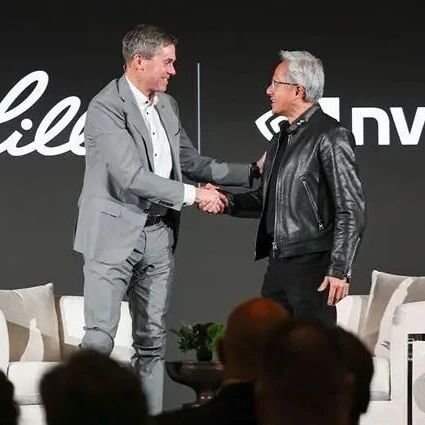
Core Viewpoint - The collaboration between Nvidia and Eli Lilly aims to establish an AI joint innovation lab to address long-standing bottlenecks in drug discovery, development, and manufacturing within the pharmaceutical industry, with a potential investment of up to $1 billion over five years [4][6][7]. Group 1: Collaboration Details - The lab will be located in the San Francisco Bay Area, integrating Eli Lilly's expertise in drug development with Nvidia's strengths in AI and computational infrastructure [6]. - The collaboration will focus on creating a continuous learning system that connects experimental and computational labs, enabling AI-assisted experiments and iterative hypothesis adjustments [8]. - The lab will utilize Nvidia's BioNeMo platform and the next-generation Vera Rubin architecture to build advanced AI infrastructure for life sciences [6][8]. Group 2: Technological Advancements - The partnership aims to develop next-generation foundational and specialized models for life sciences, enhancing efficiency from early discovery to late-stage optimization [8]. - Nvidia's Omniverse platform and RTX PRO servers will be employed to create digital twin models for production lines and supply chains, allowing for simulations and optimizations before real-world implementation [9]. - The collaboration will also explore the application of AI in clinical development, manufacturing, and commercial operations, including the use of multimodal models and robotics [9]. Group 3: Broader Impact - The joint innovation lab is expected to serve as a significant support point for the innovation ecosystem, providing extensive computational resources and professional support to researchers and startups [10]. - Eli Lilly's Lilly TuneLab platform will integrate with Nvidia's Clara open-source models to enhance drug discovery workflows [10]. - The initiative is anticipated to fundamentally change the pace and methods of traditional drug development by combining proprietary data and scientific insights with advanced computational capabilities [7].

豪赌AI医疗,全球第一药企与全球第一科技巨头达成合作
Tai Mei Ti A P P· 2026-01-13 11:20
Core Viewpoint - The strategic partnership between Eli Lilly, a leading pharmaceutical company, and Nvidia, a top technology giant, marks a significant shift in the pharmaceutical industry, focusing on AI-driven drug development and manufacturing processes [1][14]. Group 1: Partnership Details - Eli Lilly and Nvidia will invest $1 billion over five years to establish a joint innovation lab in the San Francisco Bay Area [1]. - The lab will not only serve as a computing center but will also aim to completely restructure the drug development process using AI [2]. - The partnership will utilize Nvidia's latest AI chip architecture, Vera Rubin, which is designed for high-precision scientific calculations essential for drug development [2][3]. Group 2: Technological Integration - The collaboration will integrate hardware and software, with Nvidia's BioNeMo platform and Eli Lilly's TuneLab platform combining to enhance drug discovery [3][4]. - BioNeMo will function as a generative AI platform for biology, capable of generating new protein structures, while Eli Lilly will contribute its extensive historical experimental data [3][4]. - The partnership aims to address the data and model gap in AI healthcare, leveraging federated learning technology [4]. Group 3: Manufacturing Innovations - The collaboration extends to manufacturing, with plans to create a "digital twin" of Eli Lilly's production line using Nvidia's Omniverse platform [5]. - This digital twin will simulate production processes to optimize supply chain efficiency, potentially leading to significant revenue increases for high-demand products [5]. Group 4: Industry Context and Implications - Eli Lilly's decision to partner with Nvidia reflects a strategic move to overcome the challenges of traditional drug development, which is often time-consuming and costly [6][7]. - The partnership signifies a shift from a "Discovery" to a "Design" paradigm in drug development, allowing for targeted molecular design rather than random screening [7][8]. - The collaboration is expected to accelerate industry changes, prompting other major pharmaceutical companies to seek similar technological partnerships [16][18]. Group 5: Future Outlook - The partnership is seen as a potential turning point in AI-driven pharmaceutical development, creating a new model of collaboration between top pharmaceutical and technology companies [15][16]. - The competition in the pharmaceutical industry is likely to intensify as companies race to secure technological alliances, with AI becoming a critical component of drug development [19][20].
CES见证从算力奔向应用 英伟达:AI进入兑现阶段
Xin Lang Cai Jing· 2026-01-06 17:29
Core Insights - The 2026 Consumer Electronics Show (CES) is a significant market sentiment catalyst, especially for the tech sector, with a focus on AI commercialization and sustainable revenue models [1] - NVIDIA's presence at CES is not just about new product launches but emphasizes the pathways for AI business models to materialize [1] Group 1: AI Commercialization - The demand for AI chips remains strong, but investor interest is shifting from concerns about computing power shortages to the timing and methods of AI revenue generation [1] - Companies are increasingly looking for AI systems that are deployable, controllable, and sustainable rather than just the most powerful models [2] - Lenovo and NVIDIA's collaboration on hybrid AI solutions is a key observation point at CES, focusing on providing a complete package for enterprises [2][3] Group 2: NVIDIA's Business Model Transition - NVIDIA's strategy is evolving from merely selling GPUs to offering comprehensive solutions that include hardware, software, and support, which could stabilize revenue streams [3] - The focus for investors is shifting towards the clarity of product forms, real application scenarios, and transparent pricing models [3] - If these aspects are addressed at CES, NVIDIA's data center business may transition from being driven by computing supply to being driven by enterprise AI applications, potentially leading to a revaluation of its business [3] Group 3: RTX Series Evolution - The RTX series, traditionally tied to gaming cycles, is expected to evolve as AI capabilities become standard features in new PCs, shifting demand from gaming to productivity [4][5] - If RTX becomes a default capability in PCs, it could lead to structural changes in sales patterns and valuation for NVIDIA [6] Group 4: Physical AI and Omniverse - NVIDIA's physical AI initiatives, while significant, have been slow to commercialize, with potential applications in robotics, autonomous vehicles, and industrial automation [7] - The launch of the Alpamayo platform at CES aims to enhance the reasoning capabilities of autonomous vehicles, marking a step towards practical applications of physical AI [7][8] - Investors are looking for real-world use cases and clear business models for physical AI, which could signal a shift towards scalable commercial applications [8][9] Group 5: Overall Market Sentiment - The overarching theme at CES 2026 is the transition from discussions about AI capabilities to embedding AI into products, processes, and revenue models [9] - The focus will likely shift from whether demand is overheated to which business lines can deliver sustainable results post-CES [9]
算力到应用的转折点?英伟达:AI进入兑现阶段
Di Yi Cai Jing· 2026-01-06 13:21
Core Viewpoint - The CES 2026 is a pivotal moment for Nvidia, marking the potential real-world application of enterprise AI, shifting focus from computational power to sustainable revenue generation from AI applications [1][12]. Group 1: Enterprise AI and Business Models - The demand for AI chips remains strong, but investor interest is shifting towards how AI can translate into sustainable revenue rather than just computational power availability [1]. - Companies are increasingly looking for AI systems that are deployable, controllable, and sustainable, rather than just the most powerful AI models [4]. - Nvidia's collaboration with Lenovo to showcase enterprise AI solutions at CES is seen as a significant development, focusing on hybrid AI that combines hardware and software for immediate deployment [4][5]. Group 2: Product and Revenue Clarity - Investors are now more interested in tangible product forms, real application scenarios, and clear pricing models rather than conceptual demonstrations [5]. - If Nvidia can provide clear answers regarding product forms and customer applications at CES, it may transition its data center business from being driven by computational supply to being driven by enterprise AI applications [5]. Group 3: RTX Series and Market Dynamics - The RTX series, traditionally tied to gaming cycles, is evolving as AI applications gain traction, potentially becoming a standard feature in new PCs rather than just a gaming upgrade [6][8]. - The shift in RTX's role could lead to structural changes in its sales patterns, supporting Nvidia's revenue and valuation in the long term [8]. Group 4: Physical AI and Commercialization - Nvidia's focus on Physical AI, which aims to enable AI systems to interact with the real world, is seen as a significant but slow-developing business line [9]. - The introduction of the Alpamayo platform for autonomous vehicles at CES indicates a move towards practical applications of Physical AI, with a focus on real-world reasoning capabilities [9][10]. - Investors are looking for concrete use cases and clear business models for Physical AI, which could signal a shift from a technology platform to scalable commercial applications [10][12].
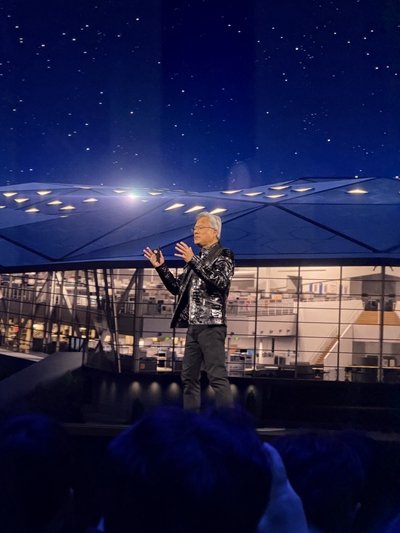
黄仁勋韩国品炸鸡,满足味蕾,激发资本想象
Sou Hu Cai Jing· 2025-11-06 07:21
Core Insights - The dinner attended by Jensen Huang in Seoul has become a significant market event, with stock prices of related companies experiencing notable fluctuations following the news [3][10][12] Group 1: Market Reaction - Following the dinner, stocks related to fried chicken chains, poultry processing, and automation companies saw a surge in trading volume, indicating a strong market reaction to the event [5][10] - Companies like Kkanbu Chicken, Bridge Village Foods, and Cherrybro experienced significant stock price increases and trading volume spikes, as investors speculated on potential consumer growth and technological collaborations [5][12] - The phenomenon has been termed the "Jensen Huang Effect," where his public appearances and comments lead to substantial stock market movements [6][10] Group 2: Corporate Collaborations - NVIDIA's strategic engagements in South Korea were already in progress, with plans to deploy GPUs in Samsung factories for digital twin applications and manufacturing process optimization [8][12] - Collaborations with Hyundai are also advancing, focusing on smart mobility and robotics, with specific hardware technologies being discussed for implementation [8][12] - The announcement of these collaborations coincided with the dinner event, reinforcing market speculation and driving stock prices further [12][14] Group 3: Social Media and Market Dynamics - The dinner transformed from a private event into a public spectacle, with social media amplifying its significance and leading to increased trading activity the following day [10][12] - The event illustrates how personal interactions can quickly translate into market movements, highlighting the role of information dissemination in modern economics [16] - The interplay between social media buzz and corporate announcements created a feedback loop that intensified market interest in related stocks [10][16]
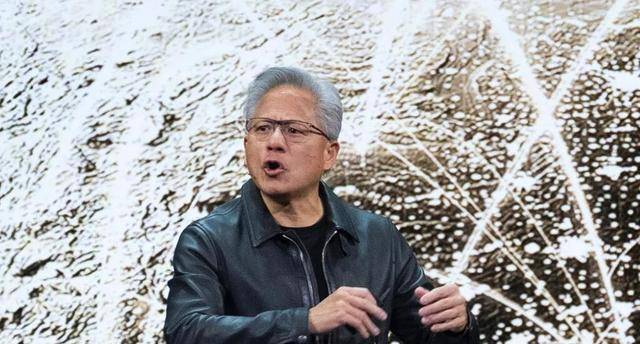
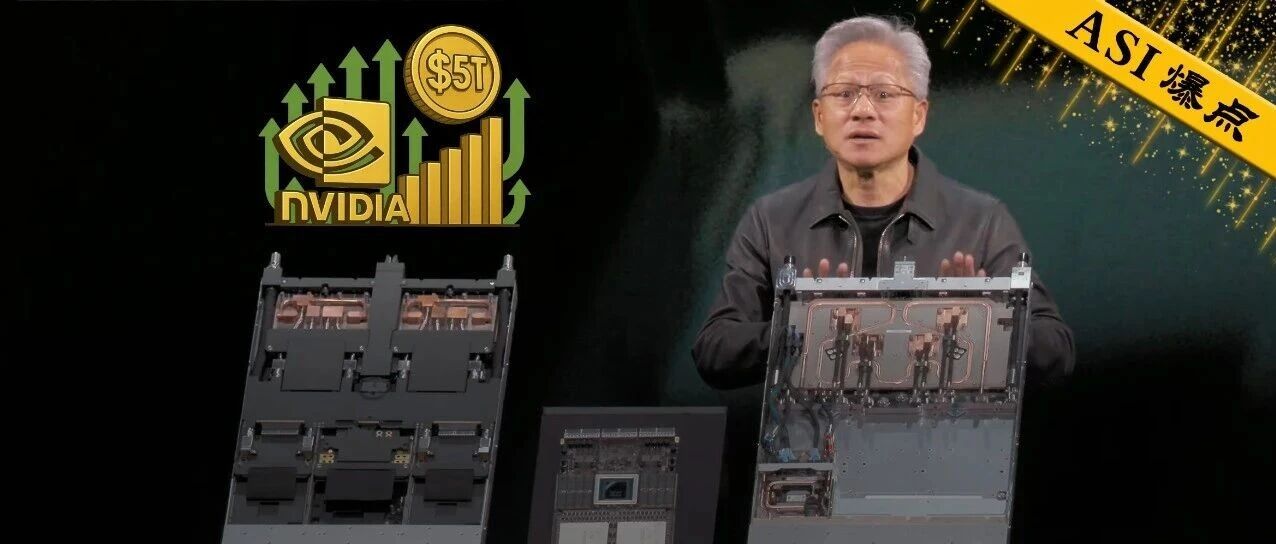
英伟达,全球首个5万亿美元公司诞生!「GPU帝国」超日本德国GDP
猿大侠· 2025-10-31 04:11
Core Insights - NVIDIA has become the first company in the world to surpass a market capitalization of $5 trillion, marking a significant milestone not only for the company but also for the GPU industry and the AI era [2][11][19]. Market Performance - NVIDIA's market capitalization reached $5.062 trillion, with a stock price of $207.94, reflecting a 4.15% increase following the GTC conference [3][10]. - The speed of NVIDIA's market cap growth has accelerated significantly: it took 6138 days to reach $1 trillion, but only 78 days to go from $4 trillion to $5 trillion [3][8]. - Since the launch of ChatGPT in late 2022, NVIDIA's stock has surged by 1087%, indicating a tenfold increase [4]. Financial Performance - For the fiscal year 2024, NVIDIA reported revenues of $60.922 billion, a 126% increase from the previous year's $26.974 billion [9]. - The gross margin improved to 72.7%, up from 56.9%, while operating income surged by 681% to $32.972 billion [9]. - Analysts project NVIDIA's data center revenue to reach $400-500 billion over the next five quarters, with an expected EPS of $9-11 by 2026 [9]. Industry Position - NVIDIA's market cap now exceeds the GDP of Germany and Japan, positioning it as the third-largest economy globally, behind the US and China [19][22]. - The company is seen as a foundational builder and rule-maker in the AI infrastructure space, moving beyond merely selling GPUs [51]. Future Outlook - NVIDIA's CEO Jensen Huang announced a target of $500 billion in GPU sales by 2026, indicating strong future growth potential [6]. - The company is also collaborating with major cloud computing giants, with projected capital expenditures reaching $632 billion by 2027 [17]. Technological Innovations - NVIDIA is pioneering the concept of "AI factories," where data serves as raw material, and data centers act as production lines to generate intelligent outputs [30][32]. - The company is enhancing 6G networks with AI capabilities, allowing for smarter resource allocation and network management [35]. - NVIDIA's Omniverse platform is enabling companies to create digital twins of factories, revolutionizing manufacturing processes [42]. Competitive Advantage - The CUDA programming language is highlighted as NVIDIA's significant competitive advantage, fostering a robust ecosystem for AI developers [48][50].