
SSGJ707

Search documents
BD中国模式:可持续现金流有望重塑估值
HTSC· 2026-03-19 02:55
Investment Rating - The report maintains an "Overweight" rating for the biopharmaceutical and chemical pharmaceutical sectors [6]. Core Insights - The Chinese innovative drug sector is at the beginning of a long cycle, with continuous global output of high-quality assets from Chinese companies. The potential of these assets is not fully reflected in A/H share pricing, leading to a recommendation for the innovative drug sector [1]. - The number and value of business development (BD) deals in the Chinese innovative drug industry have reached record highs in 2023, with 45 BD deals completed (+73% year-on-year) and a total disclosed amount of $57.5 billion (+135% year-on-year) [2]. - The report highlights a significant valuation gap between A/H shares and US stocks for similar innovative drug assets, indicating that A/H shares are systematically undervalued [4]. Summary by Sections Business Development Trends - The report notes that the Chinese innovative drug sector has achieved a global market share of approximately 20% in the number of BD projects and around 75% in the disclosed amount [2]. - There is a high predictability of continued growth in BD activities, driven by increasing interest from multinational corporations (MNCs) and private equity (PE) firms in Chinese assets [2]. Cash Flow Contributions - The report emphasizes that platform companies in China are expected to generate sustainable cash flows through ongoing BD activities, which have not been adequately valued in the market [3]. - It is projected that significant BD deals (with upfront payments exceeding $500 million) will contribute to continuous cash flow growth for companies like Heng Rui Medicine, Shiyao Group, and others [3]. Valuation Comparisons - The report compares the valuations of similar assets in A/H shares and US markets, revealing that Chinese innovative drug companies are undervalued relative to their US counterparts [4][19]. - Specific case studies illustrate the valuation discrepancies, such as between MSD and Kelun Biotech, and Insmed and Haizhi Pharmaceutical, highlighting the potential for significant upside in A/H share valuations [19][22]. Investment Recommendations - The report recommends focusing on large pharmaceutical and biopharmaceutical companies with sustained BD capabilities, including Heng Rui Medicine, Shiyao Group, and others [5]. - Companies that have completed large BD deals are expected to benefit from ongoing milestone cash flows, with specific recommendations for companies like Kelun Biotech and Rongchang Biopharmaceutical [5]. Target Prices and Market Outlook - Target prices for recommended stocks are provided, with specific price targets for companies such as Shiyao Group at HKD 19.25 and Heng Rui Medicine at HKD 98.43, indicating a bullish outlook for these stocks [26].



荣昌生物拿下56亿美元大单 双抗技术缘何频获跨国巨头追捧?
2 1 Shi Ji Jing Ji Bao Dao· 2026-01-13 23:12
Core Insights - The collaboration between AbbVie and Rongchang Biopharma marks a significant shift in the global oncology treatment landscape, highlighting the trend of "Chinese innovation + global market" in drug development [1][2] Group 1: Collaboration Details - AbbVie and Rongchang Biopharma signed an exclusive licensing agreement for the development, production, and commercialization of RC148, a bispecific antibody targeting PD-1 and VEGF [1] - Rongchang Biopharma will receive an upfront payment of $650 million and is eligible for up to $4.95 billion in milestone payments, along with a tiered royalty on net sales outside Greater China [1][2] Group 2: Market Implications - The deal allows Rongchang Biopharma to accelerate clinical trials for RC148 in China and globally, while also supporting the development of other pipelines [2] - AbbVie aims to enhance its product portfolio in immuno-oncology, particularly in the emerging PD-1/VEGF bispecific antibody space, which could improve its competitiveness in solid tumor treatments [2] Group 3: Industry Trends - The PD-1/VEGF bispecific antibody represents a new class of cancer therapies that may overcome tumor resistance mechanisms by simultaneously blocking PD-1 and VEGF [3][5] - Chinese companies are leading in this field, with significant advancements and approvals, such as the launch of Ak112/Ivonescimab by Kangfang Biopharma, which is the first bispecific antibody combining tumor immunity and anti-angiogenesis mechanisms [3] Group 4: Broader Market Dynamics - The global interest in PD-1/VEGF bispecific antibodies is rising, with several Chinese firms successfully engaging in business development (BD) transactions, reflecting the increasing recognition of Chinese innovative drug assets by multinational pharmaceutical companies [6][7] - In 2025, the total value of Chinese innovative drug licensing transactions exceeded $130 billion, accounting for 49% of the global total, indicating a significant shift in the global pharmaceutical landscape [7][8] Group 5: Future Outlook - The increasing number of approved innovative drugs in China, along with the growing bargaining power of Chinese companies in licensing agreements, suggests a transition from a "follow" to a "lead" position in global pharmaceutical innovation [8][10] - The ability of Chinese companies to negotiate favorable terms in BD transactions is becoming crucial, emphasizing the importance of pipeline strength, data quality, and structured deal design [9][10]


荣昌生物频获跨国巨头追捧
2 1 Shi Ji Jing Ji Bao Dao· 2026-01-13 23:08
Core Insights - The collaboration between AbbVie and Rongchang Biopharma marks a significant shift in the global oncology treatment landscape, focusing on the development of the bispecific antibody RC148 targeting PD-1 and VEGF [1][2] Group 1: Collaboration Details - AbbVie and Rongchang Biopharma signed an exclusive licensing agreement for RC148, granting AbbVie rights outside Greater China for development, production, and commercialization [1] - Rongchang Biopharma will receive an upfront payment of $650 million and is eligible for up to $4.95 billion in milestone payments, along with a tiered royalty on net sales outside Greater China [1][2] Group 2: Market Implications - This deal exemplifies the "China innovation + global market" model, providing Rongchang Biopharma with substantial cash flow to accelerate clinical trials for RC148 and support other pipeline developments [2] - The partnership with a top-tier oncology company like AbbVie enhances Rongchang Biopharma's brand and bargaining power in international markets, while AbbVie benefits from expanding its immuno-oncology product portfolio [2] Group 3: Bispecific Antibody Landscape - RC148 represents a new class of cancer therapies aimed at simultaneously blocking PD-1 and VEGF, potentially overcoming tumor resistance mechanisms [5] - The PD-1/VEGF bispecific antibody field is gaining traction, with several Chinese companies, including Kangfang Biopharma and Junshi Biosciences, making significant advancements and entering clinical trials [6][7] Group 4: Industry Trends - The Chinese innovative drug sector is experiencing a surge in licensing deals, with over $130 billion in total transaction value in 2025, surpassing the U.S. for the first time [10] - Factors driving this trend include the impending patent cliff for major drugs and declining R&D efficiency among multinational pharmaceutical companies, leading them to seek external innovations [10][11] Group 5: Future Outlook - The Chinese pharmaceutical industry is transitioning from a follower to a leader in innovation, with a clear direction for future development [14] - Companies are focusing on building a comprehensive value creation logic recognized by international partners, enhancing their negotiation power in licensing agreements [12][13]

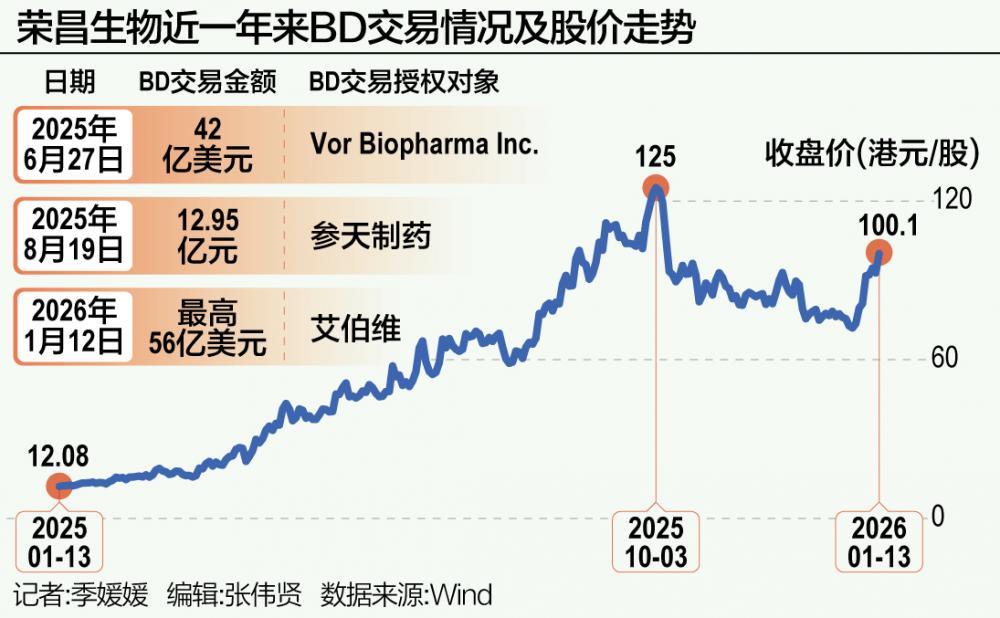
荣昌生物拿下56亿美元大单,双抗技术缘何频获跨国巨头追捧?
2 1 Shi Ji Jing Ji Bao Dao· 2026-01-13 04:08
Core Viewpoint - The collaboration between AbbVie and Rongchang Biologics marks a significant shift in the global oncology treatment landscape, highlighting the trend of Chinese innovative drug companies partnering with multinational giants for drug development and commercialization [1][2]. Group 1: Collaboration Details - AbbVie and Rongchang Biologics signed an exclusive licensing agreement for the development, production, and commercialization of RC148, a bispecific antibody targeting PD-1 and VEGF [1]. - Rongchang Biologics will receive an upfront payment of $650 million and is eligible for up to $4.95 billion in milestone payments, along with a tiered royalty on net sales outside Greater China [1][2]. Group 2: Market Implications - This deal exemplifies the "China innovation + global market" model, allowing Rongchang Biologics to secure cash flow and accelerate clinical trials for RC148 while focusing on the Chinese market [2]. - AbbVie aims to enhance its product portfolio in immuno-oncology, particularly in the emerging PD-1/VEGF bispecific antibody space, which could synergize with existing antibody-drug conjugates (ADCs) and immuno-oncology (IO) drugs [2]. Group 3: Competitive Landscape - The PD-1/VEGF bispecific antibody represents a new class of cancer therapies that may overcome tumor resistance mechanisms by simultaneously blocking PD-1 and VEGF [3][5]. - Chinese companies are leading in this field, with notable products like Ak112/Ivonescimab and SSGJ707 entering clinical trials, indicating a competitive landscape for PD-1/VEGF bispecific antibodies [3][4]. Group 4: Industry Trends - The surge in business development (BD) transactions in the PD-1/VEGF bispecific antibody sector reflects increasing interest from multinational pharmaceutical companies in Chinese innovative drug assets [6]. - In 2025, the total value of Chinese innovative drug licensing transactions exceeded $130 billion, surpassing the U.S. for the first time, indicating a significant shift in the global pharmaceutical landscape [7][8]. Group 5: Future Outlook - The increasing recognition of Chinese innovative drugs is attributed to their rapid development and the ability to meet unmet clinical needs, enhancing their bargaining power in international collaborations [8][9]. - The industry is witnessing a transition from following to leading in drug innovation, with a clear direction for the future of Chinese pharmaceutical development [10].