
Sanchar Saathi

Search documents
因为一个骚操作,印度的反诈APP被全民抵制了
3 6 Ke· 2025-12-12 01:41
Core Viewpoint - The Indian government has mandated that all mobile manufacturers, including Apple and Samsung, must pre-install a network security application called "Sanchar Saathi" within 90 days, which cannot be disabled or uninstalled by users [1][4]. Group 1: Application Overview - "Sanchar Saathi" was initially launched as a web feature by the Indian Ministry of Telecommunications in 2023 to help users report scam calls, locate lost or stolen phones, verify phone authenticity, and check the number of SIM cards registered under their name [4][12]. - The application leverages the Central Equipment Identity Register (CEIR) to lock devices, which is a government database that records all device IMEI numbers, allowing for effective tracking and management of mobile devices [12][16]. Group 2: Public Reaction - The public response has been divided, with supporters arguing that if personal data can be shared with foreign software companies, it should also be shared with the government for security purposes [6]. - Some users have reported positive experiences, such as recovering stolen or lost phones through the application, which has garnered support from those affected by rising phone theft and telecom fraud in India [19][21]. Group 3: Opposition Concerns - Opponents of the mandate focus on issues of "compulsion" and "privacy," arguing that the government should not force users to install the application, citing potential violations of privacy rights [9][22]. - The Indian Ministry of Telecommunications faced backlash for not publicly disclosing the decision to mandate the application, leading to concerns about surveillance and privacy among the public [25][26]. Group 4: Technical and Privacy Issues - Critics, including software advocacy groups, have pointed out that the application requests excessive permissions that are not necessary for its core functions, raising concerns about privacy and security vulnerabilities [30][34]. - The application has been criticized for being poorly designed and for overstepping in terms of permission allocation, which could potentially increase the risk of security breaches [34][38]. Group 5: Industry Response - Major tech companies, including Apple and Google, have expressed opposition to the mandate, as it sets a precedent for pre-installing third-party applications, which could lead to similar demands in other markets [38].

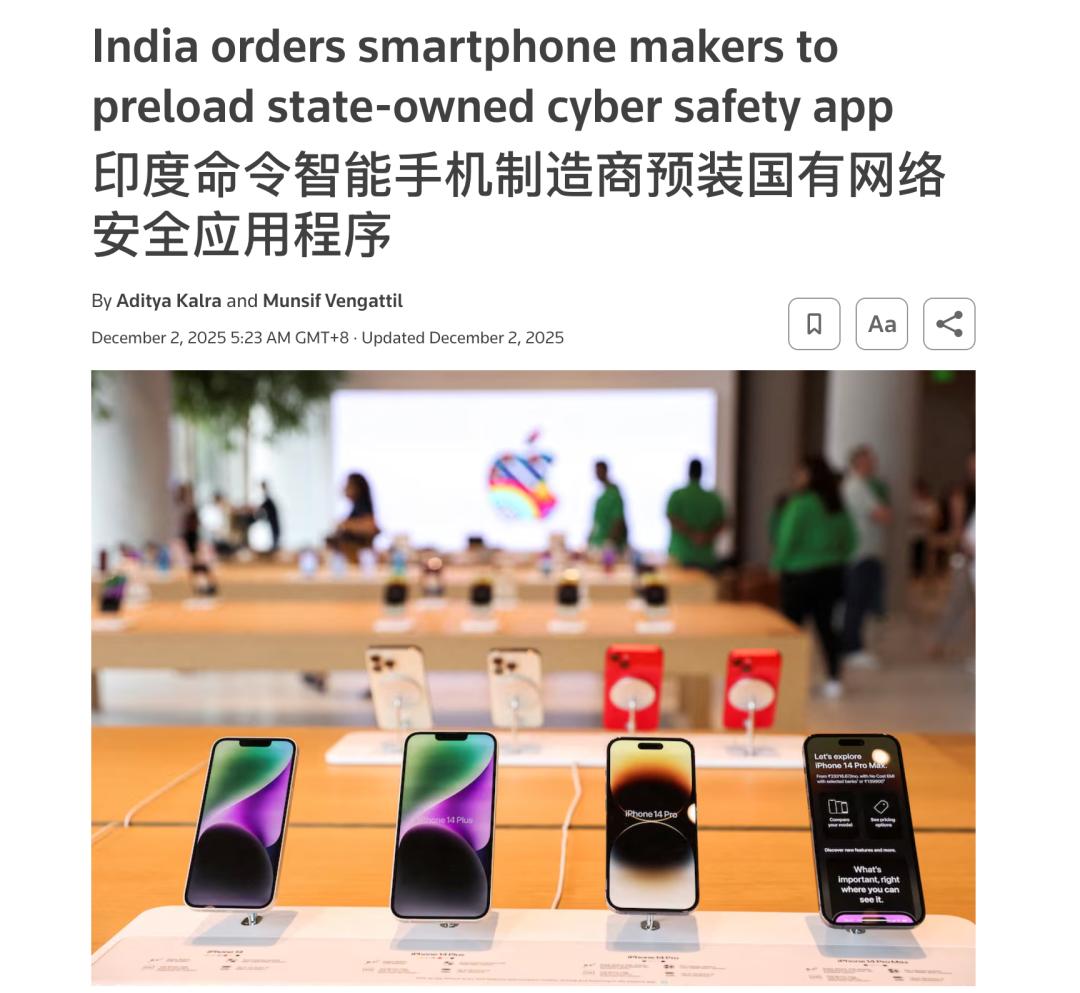
多方抗议下,印度宣布撤销智能手机预装网络安全应用的命令
Xin Lang Cai Jing· 2025-12-04 01:48
Core Viewpoint - The Indian government has revoked a mandate requiring smartphone manufacturers to pre-install a national cybersecurity app, "Sanchar Saathi," on new devices, following strong opposition from privacy advocates and global tech companies [1][6]. Group 1: Government Decision - The Indian government initially notified companies like Apple, Samsung, and Xiaomi on November 28, requiring them to pre-install the app within 90 days, which was intended to combat online fraud [1][6]. - The Ministry of Communications announced on Wednesday that the government decided not to enforce the pre-installation requirement for smartphone manufacturers [3][7]. Group 2: Controversy and Opposition - The mandate faced significant backlash, with opposition leader Mallikarjun Kharge describing it as "near dictatorial," raising concerns about privacy invasion and surveillance [3][7]. - Reports indicated that Apple and Samsung planned to disregard the directive due to the controversy surrounding it [3][7]. Group 3: App Usage and Popularity - The government stated that the app is designed solely to help citizens protect themselves from online threats, and users can uninstall it at any time [5][9]. - As of now, "Sanchar Saathi" has been downloaded by 140 million users, providing information on 2,000 fraud incidents daily, with a rapid increase in user registrations, including 600,000 in just one day [5][9].

X @外汇交易员
外汇交易员· 2025-12-03 03:24
#后续 印度政府试图缓解外界对强制预装网络安全应用Sanchar Saathi可能侵犯隐私或用于监控的担忧,强调用户可自行卸载该软件。印度通信部长表示,“Sanchar Saathi是自愿、透明的,其唯一目的是保护印度移动用户并提升国家网络安全水平。用户可随时自由启用或卸载该应用,在确保安全的同时绝不牺牲隐私。”有印度政府官员称,应用可访问通话记录和短信等手机数据,并会向用户请求使用摄像头及其他功能的权限,但从未获取麦克风、位置信息、蓝牙或操作系统层面的访问权限。外汇交易员 (@myfxtrader):#后续 苹果公司不打算遵守印度政府强制预装国有网络安全应用Sanchar Saathi的命令,并将告知印度政府,苹果在全球任何地方都不会遵循此类指令,因为这些指令会给公司的iOS生态系统带来一系列隐私和安全问题。路透社引述知情人士的话称,苹果不打算诉诸法庭或公开表态。 ...

12月3日美股成交额前20:苹果抵制印度政府安全应用强制安装令
Xin Lang Cai Jing· 2025-12-02 21:49
Group 1: Nvidia - Nvidia's CFO Colette Kress stated that the $100 billion investment in OpenAI is still in the letter of intent stage, involving the deployment of "at least 10 gigawatts" of Nvidia systems, potentially generating $400-500 billion in revenue for Nvidia [1] - Kress emphasized that revenue related to this collaboration has not yet been included in Nvidia's revenue guidance [1] - Nvidia's recent commitment to invest up to $10 billion in competitor Anthropic may further increase demand for its computing chips [1] Group 2: Tesla - Tesla's Shanghai Gigafactory delivered over 86,700 vehicles in November 2025, marking a month-on-month increase of over 40% and a year-on-year increase of nearly 10% [2] - The Model Y has become the best-selling SUV in China over the past year, while Tesla's global electric vehicle deliveries reached a record high in Q3 [2] - Tesla's sales in Norway have broken previous records held by gasoline vehicles, securing the annual sales champion title for 2025 [2] Group 3: Apple - Apple has decided to reject the Indian government's mandate to pre-install a security application on iPhones, citing security and privacy risks [2] Group 4: AMD - AMD announced a price increase for its graphics cards due to rising memory costs, with 8GB and 16GB cards increasing by $20 and $40 respectively starting in December [3] - AMD is investing $1 billion in an AI chip cluster in Ohio [4] Group 5: Broadcom - Bank of America reported that Broadcom is likely to benefit from Google's successful launch of the TPU-based Gemini 3, with expected increases in TPU usage [4] - The average selling price of TPUs is projected to rise from $5,000-$6,000 to $12,000-$15,000 by 2026, with potential shipment increases [4][5] Group 6: Intel - Intel received positive feedback from two potential foundry customers regarding its 14A process node, which is expected to impact data center, PC, and mobile chip markets [5] - Intel's "Alchemist" Arc discrete graphics card has achieved a 1% market share according to Jon Peddie Research [6] Group 7: Boeing - Boeing's stock rose significantly as the company anticipates restoring cash flow generation capabilities by 2026, indicating a major turnaround in its financial situation [6] - Boeing expects to achieve "low single-digit" free cash flow next year, reversing a $2 billion cash burn in 2025 [6] Group 8: MongoDB - MongoDB reported a 19% year-on-year revenue growth to $628 million in Q3, with adjusted earnings per share of $1.32, exceeding expectations [7] - The company raised its revenue and profit guidance for fiscal year 2026, projecting revenues between $2.43 billion and $2.44 billion [7]


苹果抵制印度政府安全应用强制安装令
Xin Lang Cai Jing· 2025-12-02 20:51
Core Viewpoint - Apple Inc. is set to reject the Indian government's mandate to pre-install a security application on iPhones, citing security and privacy risks as the primary reasons for non-compliance [1][2]. Group 1: Government Mandate - The Indian Ministry of Telecommunications issued an administrative order requiring smartphone manufacturers, including Apple, Samsung, and Xiaomi, to pre-install the government’s network security app "Sanchar Saathi" on all new devices within 90 days [1][2]. - The directive also mandates that manufacturers push the app to existing devices through software updates, extending the requirement beyond newly launched phones to those already sold in the market [1][2]. Group 2: Company Response - Apple will inform the Indian government that it will not comply with such mandates in any of its markets due to concerns over security and privacy risks [1][2]. - Following the news, Apple's stock price rose by 1.2% in the U.S. market [1][2].
涉苹果、三星等,印度电信部要求手机制造商预装官方APP引争议
Guan Cha Zhe Wang· 2025-12-02 09:47
Core Viewpoint - The Indian Ministry of Telecommunications has mandated smartphone manufacturers, including Apple, Samsung, Vivo, Xiaomi, and OPPO, to pre-install a government-developed cybersecurity app called "Sanchar Saathi" on all new devices sold in India, which cannot be uninstalled by users [1][3]. Group 1: Government Mandate - The Indian government issued a directive on November 28, requiring smartphone companies to pre-install the "Sanchar Saathi" app within 90 days on all new devices sold in the Indian market [1]. - Existing devices must receive the app through software updates as per the government's instructions [1]. Group 2: App Functionality - "Sanchar Saathi," launched in January 2025, aims to help users block and track lost or stolen smartphones and identify fraudulent mobile connections [3]. - The app has reportedly assisted in recovering over 700,000 lost phones since its launch, with 50,000 recoveries occurring in October alone [3]. Group 3: Industry Response - Concerns have been raised regarding user consent and potential government surveillance, with critics arguing that the mandate infringes on user rights [3]. - Apple’s response to the mandate is uncertain, as the company traditionally resists pre-installing government or third-party apps on its devices [4]. - Counterpoint Research reported a 5% year-over-year increase in smartphone shipments in India for Q3 2025, with sales revenue up 18%, marking a historical high [4].

苹果(AAPL.US)拒装印度监控应用,安全合规引冲突
智通财经网· 2025-12-02 09:13
Core Viewpoint - Apple Inc. plans to reject the Indian government's mandate to pre-install a state-owned cybersecurity app on its smartphones, citing privacy and security concerns related to its iOS ecosystem [1][3] Group 1: Government Mandate - The Indian government has ordered Apple, Samsung, and Xiaomi to pre-install an app called "Sanchar Saathi" within 90 days to track stolen phones and prevent misuse [1] - The app is intended to address serious cybersecurity threats, as confirmed by the Indian Ministry of Telecommunications [1][2] - Critics, including political opponents and privacy advocates, argue that this move is an attempt by the government to gain access to the data of 730 million smartphones in India [1][3] Group 2: Industry Response - Apple is not planning to comply with the directive and will inform the government that such regulations pose privacy and security issues for its iOS ecosystem [1][2] - Other manufacturers, such as Samsung, are evaluating the directive, with concerns that the government did not consult the industry before implementing it [3] Group 3: Legal and Regulatory Context - The directive comes at a time when Apple is involved in a legal battle regarding a $38 billion antitrust fine in India, related to allegations of abusing its market position [4][5] - Apple has indicated that its maximum penalty risk could reach $38 billion based on the average revenue from its global services business over the past three fiscal years [5]