Sapphire Rapids

Search documents
INTC Rides on Strength in Datacenter and AI Group: Is it Sustainable?
ZACKS· 2026-03-24 16:15
Core Insights - Intel Corporation (INTC) is experiencing significant growth in its Datacenter and AI Group, with fourth-quarter 2025 revenues reaching $4.74 billion, a 15% sequential increase, driven by strong demand for Xeon 6 processors [1][9] - The company has rebounded from previous supply chain constraints, achieving a 26.4% operating margin in the fourth quarter [1] Datacenter and AI Group Performance - The server business is a key growth driver, with Granite Rapids processors delivering high-performance workloads that benefit from AI-era server refresh cycles [2] - The ASIC business has seen over 50% growth in 2025, with a 26% sequential increase in the fourth quarter, achieving an annualized revenue run rate exceeding $1 billion [3][9] Market Trends - The AI infrastructure market was valued at $223.45 billion in 2024, with a projected compound annual growth rate of 30.4% by 2030, positioning Intel to benefit from this trend [4] Competitive Landscape - Intel faces competition from Advanced Micro Devices (AMD) and Broadcom, Inc. (AVGO) in the datacenter and AI sectors [5] - AMD is expected to see over 60% annual revenue growth in its Data Center segment over the next three to five years, driven by its EPYC processors and AI accelerators [6] - Broadcom anticipates a 140% year-over-year increase in AI revenues to $10.7 billion for the second quarter of fiscal 2026, supported by strong demand for its networking products and custom AI accelerators [7] Financial Performance - Intel's stock has increased by 81.8% over the past year, outperforming the industry growth of 39.1% [8] - The company's shares currently trade at a price/book ratio of 1.74, below the industry average of 25.76 [10]


英特尔(INTC.O)25Q4跟踪报告:18A良率改善但未达预期,CPU产能限制业绩增长表现
CMS· 2026-01-23 11:32
Investment Rating - The report maintains a positive outlook on the industry, indicating a strong demand driven by AI infrastructure and data center needs, despite some supply constraints [1][16]. Core Insights - Intel's Q4 2025 revenue reached $13.67 billion, slightly below the previous year but at the upper end of guidance, driven by strong growth in AI-related businesses [1][16]. - The company reported a non-GAAP gross margin of 37.9%, exceeding guidance due to revenue growth and reduced inventory reserves [1][16]. - The DCAI segment outperformed expectations with a 15% quarter-over-quarter revenue increase, benefiting from AI infrastructure demand [2][20]. - The company anticipates a revenue decline in Q1 2026, with guidance set between $11.7 billion and $12.7 billion, reflecting seasonal trends and supply prioritization [3][22]. Summary by Sections Financial Performance - Q4 2025 revenue was $13.67 billion, down 4.1% year-over-year but up 0.2% quarter-over-quarter, benefiting from AI infrastructure growth [1][16]. - Non-GAAP gross margin for Q4 was 37.9%, a decrease of 4.2 percentage points year-over-year but higher than the guidance of 36.5% [1][16]. - Full-year revenue for 2025 was $52.9 billion, a slight decline of 0.4% year-over-year, primarily due to supply constraints [1][16]. Segment Performance - Intel Products segment revenue was $12.9 billion in Q4, with a 2% quarter-over-quarter increase, while the DCAI segment saw a 15% increase [2][20]. - The Foundry segment reported $4.5 billion in revenue, up 6.4% quarter-over-quarter, but faced a $2.5 billion operating loss due to early production issues with the 18A process [2][21]. - The Client Computing Group (CCG) revenue was $8.2 billion, down 4% quarter-over-quarter, reflecting supply constraints but strong performance from new Ultra 3 products [2][19]. Future Guidance - For Q1 2026, revenue is expected to be between $11.7 billion and $12.7 billion, with a non-GAAP gross margin forecasted at approximately 34.5% [3][22]. - Capital expenditures for 2026 are projected to be around $16 billion, maintaining a similar level to 2025 [3][22]. - The company aims to improve production efficiency and yield rates to meet market demand, particularly in the data center segment [3][24].
Intel(INTC) - 2025 Q4 - Earnings Call Transcript
2026-01-22 23:00
Financial Data and Key Metrics Changes - Fourth quarter revenue was $13.7 billion, marking strong growth across all businesses, driven by AI infrastructure build-out, with AI PC, traditional server, and networking revenue all up double digits sequentially and year over year [17] - Non-GAAP gross margin for Q4 was 37.9%, approximately 140 basis points ahead of guidance, while full year Non-GAAP gross margin was 36.7%, up 70 basis points year over year [17][18] - Non-GAAP earnings per share for Q4 was $0.15, exceeding guidance of $0.08, driven by higher revenue and stronger gross margins [17] Business Line Data and Key Metrics Changes - Client Computing Group (CCG) revenue was $8.2 billion, down 4% quarter over quarter, despite AI PC units growing 16% [21] - Data Center and AI (DCAI) revenue was $4.7 billion, up 15% sequentially, marking the fastest sequential growth this decade [23] - Intel Foundry revenue was $4.5 billion, up 6.4% sequentially, with an operating loss of $2.5 billion in Q4 due to the early ramp of Intel 18A [24] Market Data and Key Metrics Changes - The client consumption Total Addressable Market (TAM) was estimated to be greater than 290 million units in 2025, marking two consecutive years of growth [22] - The custom ASIC business grew more than 50% in 2025, reaching an annualized revenue run rate greater than $1 billion in Q4 [23] - The demand for traditional servers remains strong, with a focus on ramping available capacity to support the uptick in demand [10] Company Strategy and Development Direction - The company aims to strengthen its client franchise and advance its data center, AI accelerator, and ASIC strategies to capture growth opportunities presented by AI [6] - A centralized approach for the data center and AI group is being implemented to ensure tight coordination across CPUs, GPUs, and platform strategy [10] - The long-term ambition is to rebuild Intel as a compute platform of choice for the next era of AI-driven computing, focusing on world-class engineering and execution [12] Management's Comments on Operating Environment and Future Outlook - Management expressed optimism about the significant growth opportunity AI presents across all businesses, despite acknowledging challenges in meeting demand due to supply constraints [15] - The company is committed to improving yield and efficiency in its manufacturing processes to better support customer needs [16] - Management anticipates a strong year of growth for DCAI in 2026, with improvements in factory network supply expected beginning in Q2 [28] Other Important Information - The company generated $9.7 billion in cash from operations for the full year and ended 2025 with $37.4 billion in cash and short-term investments [19] - The company is planning to retire all $2.5 billion of maturities as they come due this year [30] - The company is focused on building a world-class wafer and advanced packaging foundry, with significant milestones achieved in the development of Intel 18A [13] Q&A Session Summary Question: Short-term supply and yield improvements - Management indicated that improving yields and throughput are key drivers of supply increases, with confidence in a positive trajectory [32] Question: Gross margin expectations - Management explained that gross margin decline in Q1 is due to lower revenue and the impact of new product costs, with expectations for improvement as supply and cost structures stabilize [37] Question: Server prospects and market share - Management emphasized the importance of the 16-channel Diamond Rapids and Coral Rapids in driving market share, with a focus on meeting hyperscaler demand [46] Question: Supply constraints and inventory management - Management acknowledged that both client and data center revenues will be down due to supply constraints, but expects improvements in Q2 [52] Question: External foundry revenue expectations - Management anticipates that significant external foundry revenue will begin to materialize in 2028, with ongoing customer engagements [59]
英特尔的先进封装,太强了
Xin Lang Cai Jing· 2026-01-17 09:33
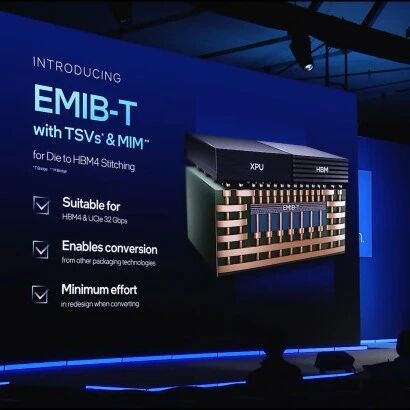
Core Viewpoint - Intel's EMIB interconnect solution demonstrates advantages over traditional 2.5D technology in advanced chip packaging design, showcasing its application in various products and its potential for next-generation chips [1][14]. Group 1: EMIB Technology and Applications - Intel's EMIB technology has been implemented in several of its products, including Ponte Vecchio, Sapphire Rapids, Granite Rapids, Sierra Forest, and the upcoming Clearwater Forest series [1]. - The company emphasizes its advanced packaging capabilities, which include large-scale packaging using EMIB and other proprietary technologies, specifically designed for data center solutions [1][12]. - EMIB technology allows for efficient and cost-effective connections between multiple complex chips, supporting both 2D and 3D expansions, which traditional 2.5D methods cannot achieve [12][14]. Group 2: Comparison with Competitors - Competitors like TSMC utilize 2.5D and 3D packaging technologies that rely on silicon interposers and TSV (Through-Silicon Vias) for interconnections, which can increase design complexity and costs [3][7]. - Intel points out the drawbacks of 2.5D packaging, such as additional costs for silicon used solely for interconnections and limitations in chip size and flexibility [7]. Group 3: Future Prospects and Industry Position - Intel's advancements in EMIB, including the "T" type packaging and Foveros packaging, have attracted attention from industry giants, intensifying competition in the chip manufacturing sector previously dominated by TSMC [14][15]. - The company aims to leverage its advanced packaging solutions to establish a foothold in the foundry business, particularly with the 14A process node designed for third-party customers [28]. - Intel's upcoming products, such as the Jaguar Shores and Crescent Island GPU, are critical for regaining market share, with a focus on securing orders from third parties [30].
英特尔的先进封装,太强了
半导体行业观察· 2026-01-16 01:48
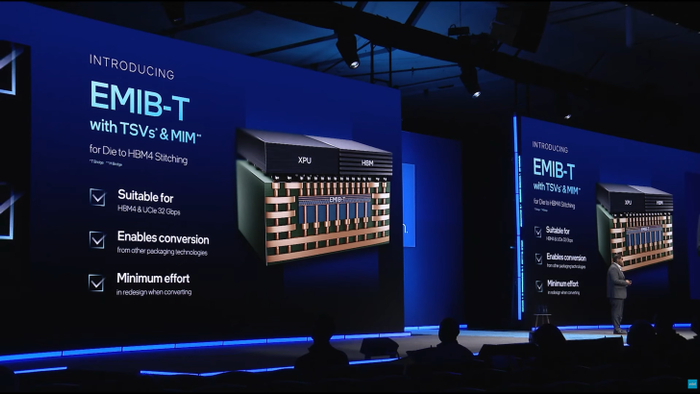
Core Viewpoint - Intel's EMIB interconnect solution demonstrates advantages over traditional 2.5D technology in advanced chip packaging design, showcasing its application in various products and its potential for next-generation chip production [1][17]. Group 1: EMIB Technology and Comparison - Intel's EMIB technology has been applied in several products, including Ponte Vecchio, Sapphire Rapids, Granite Rapids, Sierra Forest, and the upcoming Clearwater Forest series [1]. - Competitors like TSMC utilize 2.5D and 3D packaging technologies, which involve silicon interposers and TSV (Through-Silicon Vias) for interconnections, contrasting with Intel's smaller interconnect bridges [3]. - 2.5D packaging has drawbacks, such as additional costs for silicon interposers and increased complexity and reduced yield with larger chip sizes [8]. Group 2: Advantages of EMIB - EMIB technology eliminates the need for silicon interposers between chips and packages, allowing for flexible chip placement and integration [11]. - The key advantages of EMIB include improved layout flexibility, support for 2D and 3D scaling, cost-saving opportunities, and simplified design processes [14][16]. - Intel's EMIB-T technology enhances bandwidth and chip integration by incorporating TSVs, making it suitable for high-performance applications [13][20]. Group 3: Future Developments and Market Position - Intel is increasing investments in wafer fabrication and aims to establish a new era of advanced chip production in the U.S. with its 14A technology [17][31]. - The company showcased its scalable packaging capabilities with multi-chip products using 18A/14A nodes, Foveros 3D, and EMIB-T technology, setting standards for high-performance computing and AI [18][20]. - Intel's advanced packaging solutions are expected to intensify competition with TSMC's CoWoS solutions, which also integrate multiple HBM chips [18]. Group 4: Industry Collaboration and Customer Focus - Intel is developing a diverse ecosystem participation plan to accelerate product launch and enhance supply chain resilience [29]. - The recent advanced packaging chip demonstration targets external customers, particularly highlighting the advantages of the 14A process node designed for third-party clients [31]. - The success of Intel's advanced packaging technology will depend on securing orders from third parties, which is crucial for the adoption of its 14A technology [33].