Stargate项目

Search documents
AI数据中心的万亿大基建时代:美国GDP增长全靠它
Tai Mei Ti A P P· 2025-11-05 01:31
Group 1 - The core argument of the article highlights the extreme economic divergence in the U.S., with GDP growth in 2025 primarily driven by data centers and information technology, while other sectors show minimal growth [1] - OpenAI plans to invest approximately $1.4 trillion to build over 30 gigawatts of computing infrastructure, aiming to add 1 gigawatt weekly [1][3] - Musk's xAI aims to achieve AI computing power equivalent to 50 million H100 units within five years, indicating a significant push in AI infrastructure [1][3] Group 2 - Major AI companies are aggressively investing in data centers, with OpenAI and Microsoft leading with projects worth hundreds of billions [3][4] - OpenAI's ambition includes a potential 10-gigawatt Stargate project, which could represent a $5 trillion industry over the next 5 to 10 years [3][4] - The investment in data center infrastructure is projected to reach $5 to $7 trillion over the next five years, reflecting the urgency in scaling AI capabilities [5][4] Group 3 - The U.S. electricity system has been growing slowly, with an annual increase of less than 1%, leading to a significant gap between electricity supply and the demand from data centers [25][26] - It is estimated that the U.S. will need to add approximately 80 gigawatts of power annually to meet the growth demands from data centers, electric vehicles, and manufacturing [26][29] - Currently, there is a projected annual shortfall of about 20 gigawatts in electricity supply, which could lead to a cumulative deficit of 100 gigawatts over the next five years [26][27] Group 4 - The competition for energy resources is intensifying, with companies like xAI acquiring a significant portion of available gas turbine generators to power their data centers [37][38] - The supply chain for gas turbines is currently strained, with GE's production capacity being insufficient to meet the rising demand from AI data centers [37][38] - Companies are also facing challenges in sourcing transformers, which have long lead times and are critical for data center operations [41][42] Group 5 - The shift towards high-voltage direct current (HVDC) systems is being explored to improve efficiency in data centers, with NVIDIA advocating for an 800-volt standard [43][44] - The current electricity supply architecture in data centers is primarily based on lower voltage systems, which leads to significant efficiency losses [44][45] - The transition to higher voltage systems is seen as essential for meeting the growing power demands of AI applications and improving overall operational efficiency [48][49]


巴克莱:详解美国数据中心狂潮,45GW,2.5万亿美元投资,谁在建设,谁在掏钱?
美股IPO· 2025-11-03 04:39
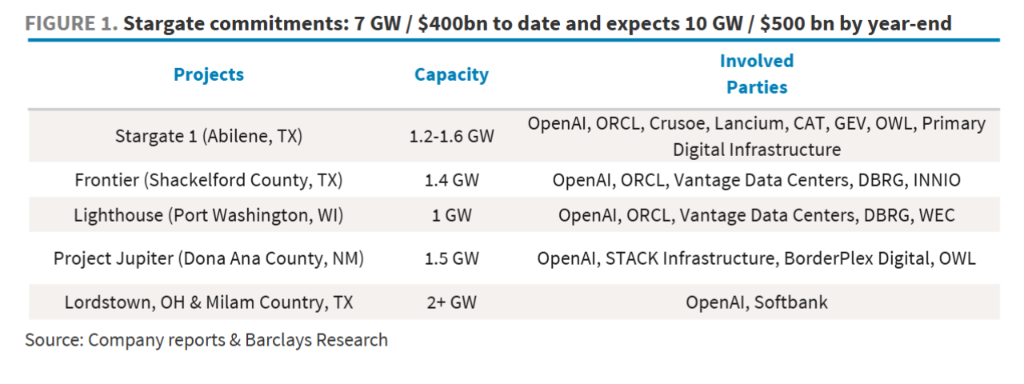
Core Insights - The article highlights a significant surge in data center projects in the U.S., with a total capacity exceeding 45 GW and projected investments surpassing $2.5 trillion, driven by major tech companies like OpenAI, Amazon, Meta, Microsoft, and xAI [4][14]. Group 1: Investment and Capacity - The current wave of data center construction is primarily fueled by the need for advanced AI model training and operation, leading to unprecedented demand for computational power [4][5]. - OpenAI's Stargate project aims for a capacity of 10 GW with an investment of $500 billion by the end of 2025, having already committed approximately 7 GW across various states [8][13]. - Amazon has added 3.8 GW of capacity globally in the past year and is expected to double its capacity by 2027, potentially increasing by about 13 GW in the U.S. alone during 2026-2027 [8][14]. Group 2: Power Infrastructure Challenges - The rapid increase in power demand from data centers is creating significant challenges for the existing U.S. electrical grid, leading to a phenomenon referred to as the "power wall" [4][12]. - Companies are increasingly adopting a "Bring-Your-Own-Power" strategy, opting to build on-site power generation facilities to ensure reliable electricity supply and expedite project timelines [12][14]. - For instance, the Stargate 1 project plans to deploy approximately 350 MW of on-site natural gas generation capacity despite having grid access approval for 1.2 GW [12][13]. Group 3: Financing and Cost Structures - The financing landscape for these massive investments is complex, involving not only the capital expenditures of tech giants but also significant contributions from private equity firms and specialized infrastructure funds [14]. - The construction cost for data centers has escalated, with reports indicating costs exceeding $17 million per MW, and OpenAI's Stargate project reflecting a staggering $5,700 million per MW when including IT equipment [11][14]. - The "Energy as a Service" (EaaS) model is emerging, with energy companies entering long-term power purchase agreements to support data center operations, exemplified by Williams' $2 billion investment in Meta's Prometheus project [14]. Group 4: Supply Chain and Labor Challenges - The explosive demand for power generation equipment is straining supply chains, with heavy gas turbine prices rising by 50% in less than two years and extended delivery times [15]. - Companies are facing challenges in sourcing components and labor, prompting some to acquire second-hand or unused equipment to mitigate long wait times [15].



详解美国数据中心狂潮:45GW,2.5万亿美元投资,谁在建设,谁在掏钱?
Hua Er Jie Jian Wen· 2025-11-02 10:45
Core Insights - A significant infrastructure race driven by artificial intelligence is unfolding in the United States, with planned large data center projects exceeding 45 GW and attracting over $2.5 trillion in investments [1][2] Group 1: Major Players and Projects - The primary drivers of this expansion include OpenAI's Stargate project, Amazon, Meta, Microsoft, and Elon Musk's xAI, all of which are rapidly planning and constructing computing clusters to support increasingly complex AI models [1][2] - Key projects include Stargate 1 (1.2-1.6 GW), Frontier (1.4 GW), Lighthouse (1 GW), Project Jupiter (1.5 GW), and a combined capacity of over 2 GW in Lordstown, OH, and Milam County, TX, with significant involvement from OpenAI and various partners [3][5] Group 2: Financial Aspects - The construction cost for data centers has surpassed $1.7 million per MW, with OpenAI's Stargate project alone representing a commitment of over $400 billion for a 7 GW capacity, translating to approximately $5.7 million per MW [3][5] - Financing structures are complex, with private equity firms and infrastructure funds playing crucial roles, such as Blue Owl Capital's $15 billion joint venture with Crusoe for the Stargate 1 project [7] Group 3: Power Supply Challenges - The existing power grid poses significant challenges, leading companies to adopt "Bring-Your-Own-Power" strategies, including on-site power generation to ensure reliability and expedite energization timelines [1][4] - For instance, the Stargate 1 project plans to deploy approximately 350 MW of on-site natural gas generation despite having grid access approved for 1.2 GW [4] Group 4: Supply Chain Issues - The explosive demand for power generation equipment has strained supply chains, with heavy gas turbine prices increasing by 50% in less than two years and extended delivery times [8] - Companies are resorting to acquiring second-hand or "off-the-shelf" new equipment to mitigate long order queues, exemplified by Fermi America's acquisition of a Siemens gas turbine from an unused LNG project [8]