Tailwind UI

Search documents
Claude一个插件吓哭华尔街,软件公司集体暴跌,2万亿元一日蒸发
猿大侠· 2026-02-09 04:11
Core Viewpoint - The emergence of AI, particularly through Anthropic's new features, is perceived as a significant threat to the Software as a Service (SaaS) industry, leading to a dramatic sell-off in software stocks and a prevailing sentiment of "SaaS is dead" among investors [1][8][30]. Group 1: Market Reaction - The introduction of Anthropic's "plugins" and "silicon-based employees" resulted in a loss of approximately $285 billion in market value for Nasdaq [3]. - Following the initial drop, software stocks continued to decline, with the iShares expanded technology software industry ETF falling an additional 2% [6]. - The overall sentiment on Wall Street shifted to a state of panic, with many investors eager to exit their positions in software companies regardless of current prices [9][30]. Group 2: AI's Impact on SaaS - Anthropic's Claude Cowork can perform tasks traditionally handled by software, such as document drafting and legal compliance, significantly reducing the need for expensive SaaS solutions [12][16]. - The legal plugin introduced by Anthropic threatens the core functionalities of many legal software companies, which previously charged around $50,000 annually for their services [14][16]. - The competitive landscape is intensifying as AI tools like Claude Cowork are expected to disrupt various sectors, including finance, sales, and marketing, leading to widespread concerns about the viability of SaaS companies [25][22]. Group 3: Industry Perspectives - Analysts from Morgan Stanley highlighted that the introduction of AI capabilities in the legal sector would significantly increase competition, exacerbating the challenges faced by existing software companies [22]. - The perception that SaaS companies are merely intermediaries is growing, as AI technologies provide direct access to capabilities that were once reliant on software [40][41]. - Despite the current turmoil, some industry leaders argue that software will remain essential as a backend infrastructure, even if user interfaces evolve due to AI advancements [48].


昔日开源明星被AI逼落斩杀线,收入暴跌80%,75%工程师被裁
3 6 Ke· 2026-01-12 09:21
Core Viewpoint - The company Tailwind CSS, once a prominent player in the open-source community, is facing a severe crisis due to the impact of AI, leading to a significant reduction in its workforce and revenue [1][4][11]. Group 1: Company Situation - Tailwind CSS has laid off 75% of its engineering team, leaving only three founders, one engineer, and one part-time employee [4][10]. - The company, which started in 2017, is known for its utility-first CSS framework that has gained immense popularity among developers [4][11]. - Despite its popularity, the company is struggling financially as its revenue from paid services has plummeted by 80% due to AI-generated code reducing the need for its documentation [4][11]. Group 2: Impact of AI - The introduction of AI has led to a 40% decrease in traffic to Tailwind's CSS documentation compared to early 2023, severely affecting the company's profit margins [11][22]. - The CEO, Adam Wathan, acknowledged that the decline in revenue due to AI has been ongoing for several years, and if the trend continues, the company could run out of cash within six months [11][12]. - The rise of AI has fundamentally changed the dynamics of how developers access information, bypassing traditional documentation and affecting the business model of companies reliant on traffic for revenue [21][22]. Group 3: Community Response and Future Prospects - Following the announcement of layoffs, 90% of the community users calmed down, but some felt deceived by the company's shift towards profitability at the expense of its open-source roots [18][19]. - Google has announced sponsorship for Tailwind, which may help the company maintain its open-source ecosystem and potentially rehire some of the laid-off engineers [22][25]. - The sponsorship from Google is seen as a positive signal for the open-source community, emphasizing the need for a sustainable funding model for open-source projects in the age of AI [25][26].

昔日开源明星被AI逼落斩杀线!收入暴跌80%,75%工程师被裁
量子位· 2026-01-12 04:13
Core Viewpoint - The article discusses the severe impact of AI on Tailwind CSS, a once-thriving startup, leading to significant layoffs and a drastic decline in revenue due to changes in user behavior and reliance on AI-generated content [2][12][50]. Group 1: Company Situation - Tailwind CSS, founded in 2017, is an open-source framework that has gained popularity for its utility-first approach, allowing developers to design UI directly in HTML [9][10][11]. - The company has faced a crisis, with 75% of its engineering team laid off, leaving only three founders, one engineer, and one part-time employee [5][21][22]. - The revenue from Tailwind's paid services, such as Tailwind UI and Catalyst, has plummeted by 80% due to reduced traffic to its documentation as users increasingly rely on AI for code generation [8][24][25]. Group 2: AI's Impact - AI has drastically changed user engagement, causing a 40% drop in traffic to Tailwind's CSS documentation since early 2023, which has directly affected the company's profitability [25][30]. - The CEO, Adam Wathan, acknowledged that the revenue decline had been ongoing for years, but the severity of the situation only became clear after analyzing the data [29][30]. - Wathan expressed that if the trend continues, the company's cash flow could run out within six months, indicating a critical financial situation [30][31]. Group 3: Community Response and Future Outlook - Following the announcement of layoffs, 90% of the community users calmed down, but some long-time users felt betrayed by the company's shift towards profitability at the expense of its open-source roots [42][43]. - Google announced sponsorship for Tailwind shortly after the layoffs, which could help stabilize the company and potentially rehire laid-off engineers [56][59]. - The article emphasizes the need for a sustainable payment mechanism for open-source contributors, as the current reliance on traffic-driven revenue models is becoming increasingly untenable in the AI era [66].

因为AI编程,Tailwind CSS差点死了
3 6 Ke· 2026-01-10 05:04
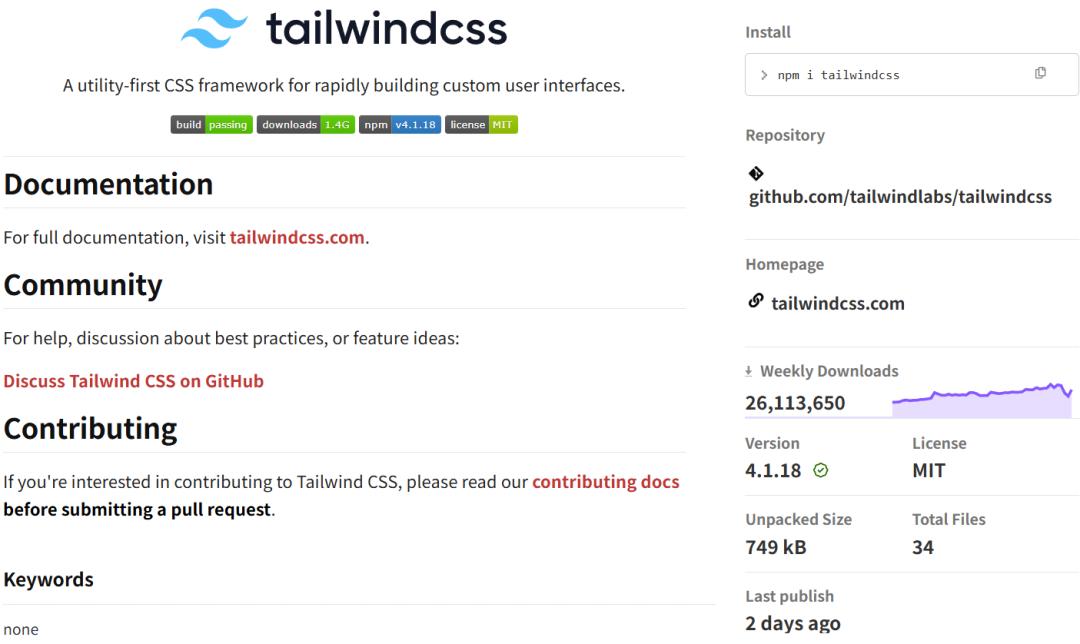
Core Insights - The rise of AI programming agents has significantly impacted the business model of Tailwind CSS, leading to a drastic reduction in team size despite the framework's popularity [2][10][31] Group 1: Business Impact - Tailwind CSS has experienced a 40% decrease in documentation traffic and an 80% drop in revenue compared to early 2023, despite its weekly downloads exceeding 26 million [3][10][22] - The company has laid off 75% of its team members due to financial difficulties caused by AI tools that reduce the need for human developers to access documentation [2][10][22] Group 2: Community Response - The decision to reject a Pull Request aimed at improving AI access to project documentation sparked controversy, with some developers criticizing the leadership for poor financial planning [11][12][13] - Discussions around the sustainability of open-source business models have intensified, highlighting the challenges posed by AI's ability to utilize open-source projects without generating revenue for their maintainers [11][14][31] Group 3: Support and Future Prospects - In response to the crisis, several companies, including Google and Shopify, have offered sponsorships to support Tailwind, with Google committing $5,000 annually [22][25][27] - Tailwind has introduced a new personal subscription service, "Tailwind Insider," priced at $120 per year, which has attracted new customers [26][27] - While the sponsorships provide temporary relief, the company must still explore new business models to ensure long-term sustainability [29][30]
因为AI编程,Tailwind CSS差点死了
机器之心· 2026-01-10 04:06
Core Viewpoint - The rise of AI programming agents has significantly impacted the business model of open-source software, particularly for Tailwind CSS, leading to a drastic reduction in both traffic and revenue despite the framework's popularity [2][10][38]. Group 1: Tailwind CSS's Current Situation - Tailwind CSS has seen a 40% decrease in documentation traffic and an 80% drop in revenue compared to early 2023, despite its growing popularity [10][3]. - The company has laid off 75% of its team members due to financial difficulties caused by the disconnect between AI-driven traffic and commercial conversion [2][10]. - The core issue is that AI tools generate code without requiring developers to consult documentation, which is essential for driving traffic to Tailwind's paid products [10][18]. Group 2: Open Source Business Model Challenges - The traditional open-source business model relies on attracting developers through free tools, guiding them to documentation, and converting them into paying customers [18]. - With AI acting as a user that does not engage with documentation or advertisements, the conversion process is disrupted, leading to a loss of revenue for projects like Tailwind [18][38]. - The situation highlights a broader concern for open-source maintainers: when users become AI, the existing monetization strategies may no longer be viable [38][39]. Group 3: Community Response and Support - Following the announcement of layoffs, several companies, including Google and Shopify, have offered sponsorship to support Tailwind, indicating a vested interest in maintaining the framework [26][30]. - Tailwind has introduced a new subscription service, "Tailwind Insider," which has attracted new customers, potentially alleviating some financial pressure [31][32]. - While these developments provide temporary relief, Tailwind still needs to explore sustainable business models moving forward [33][39].
裁员 75%,收入下降80%,还能活 6 个月,AI 样式底座框架养不起 8 人团队~
菜鸟教程· 2026-01-09 03:30
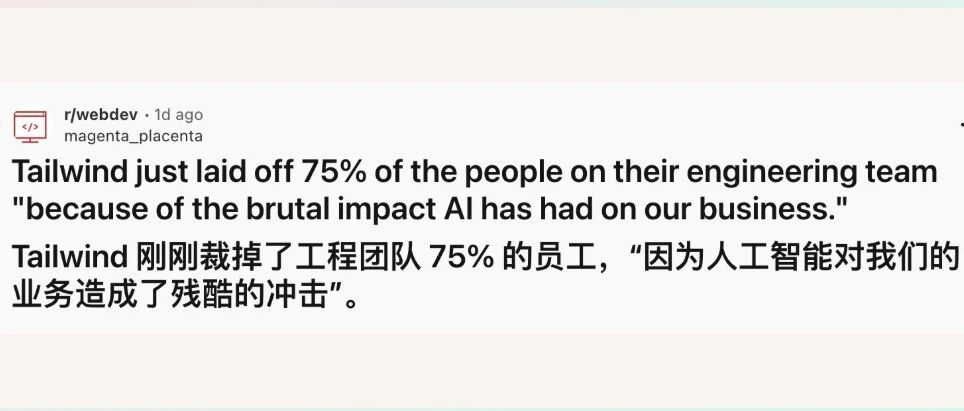
Core Insights - The rise of AI tools has significantly impacted Tailwind's business model, leading to a drastic reduction in revenue and workforce [6][10][11] - Tailwind's founder, Adam Wathan, expressed concerns about the company's survival, stating they have approximately six months before they can no longer meet payroll obligations [8][11] - The popularity of Tailwind as a CSS framework has reached unprecedented heights, but the commercial viability is threatened by AI's ability to generate equivalent code without payment [10][11] Group 1: Business Impact - Tailwind's revenue has decreased by nearly 80%, forcing the company to cut its engineering team by 75%, from four members to one [11] - The introduction of AI tools has disrupted Tailwind's customer acquisition channels, as developers now prefer to ask AI for solutions rather than consulting documentation, resulting in a 40% drop in documentation traffic [10] - The paid component libraries, such as Tailwind UI and Catalyst, which were once revenue pillars, are now at risk as developers can generate similar outputs through AI [10] Group 2: Industry Context - The challenges faced by Tailwind are indicative of a broader trend affecting many open-source and paid model projects, as AI can freely leverage open-source technologies [23][24] - Other platforms, like Stack Overflow, are also experiencing significant declines in traffic, highlighting a widespread issue in the developer community [15] - The financial struggles of creators behind popular frameworks and systems, such as React and Linux, suggest that many in the industry are not financially secure despite their contributions [22]
“AI火了,我们却快完了!”顶级开源框架Tailwind之父含泪裁掉75%兄弟:半年后,这个项目可能就没了
AI前线· 2026-01-08 10:20
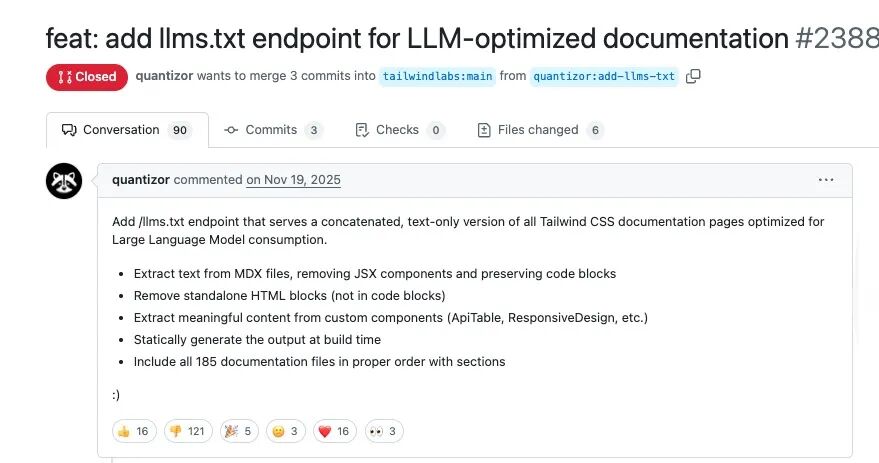
Core Insights - Tailwind CSS, a prominent open-source project, is facing significant survival challenges due to the impact of AI on its business model, leading to a drastic 75% reduction in its engineering team [2][3][18] - The founder, Adam Wathan, expressed that despite the increasing popularity of Tailwind, the commercial success has not followed suit, resulting in a projected inability to pay salaries within six months if the trend continues [2][6][17] Group 1: Company Situation - The engineering team was reduced from 4 to 1 member, highlighting a structural change within the company [18][19] - The remaining team consists of three partners and two employees, indicating a severe limitation in resources [21][19] - The company is experiencing a 40% decline in documentation traffic compared to early 2023, which is critical as documentation is their primary distribution channel [6][19] Group 2: AI Impact - AI programming tools have led to a significant increase in Tailwind's usage, but this has not translated into revenue, with income reportedly down by nearly 80% [6][12][14] - The founder acknowledged that while AI has made Tailwind more popular, it has also contributed to the company's financial struggles, creating a paradox where increased usage correlates with decreased revenue [14][17] - The community's reaction to the layoffs was intense, reflecting a strong contrast between the project's popularity and the company's financial difficulties [7][8] Group 3: Community and Developer Response - A GitHub Pull Request aimed at optimizing Tailwind's documentation for AI usage was stalled, as the founder prioritized immediate revenue generation over community requests [4][5][6] - The community expressed disappointment over the company's focus on monetization rather than enhancing user experience, indicating a potential rift between the company and its user base [5][6][8] - The founder's emotional response to the layoffs and the challenges faced by the company highlights the personal toll of these business decisions [23][3]

“AI火了,我们却快完了”,顶级开源框架Tailwind之父含泪裁掉75%兄弟:半年后,这个项目可能就没了
3 6 Ke· 2026-01-08 09:31
Core Insights - Tailwind CSS, a prominent open-source project, is facing significant survival challenges due to the impact of AI on its business model, leading to a drastic reduction of its engineering team by 75% [1][5][19] - Despite increasing usage and popularity, Tailwind's revenue has plummeted by nearly 80%, creating a disconnect between its open-source success and commercial viability [5][11][13] Group 1: Company Situation - The founder, Adam Wathan, revealed that the company has only about six months left before it can no longer pay salaries, prompting immediate layoffs to avoid a worse situation [1][13] - The engineering team was reduced from four to one, highlighting a structural change within the company [14][17] - The remaining team consists of three partners and two employees, significantly limiting the company's operational capacity [17][19] Group 2: Community Response - The layoffs triggered a strong reaction from the community, with many expressing disappointment over the company's focus on monetization rather than enhancing user experience [4][6] - A proposed feature to optimize documentation for AI usage was rejected by the founder, who emphasized the need to prioritize revenue-generating activities [3][5] Group 3: Market Dynamics - Tailwind is increasingly being used as a default option for AI-generated UI, despite the company's financial struggles [9][10][11] - The founder acknowledged that while AI has made Tailwind more popular, it has also contributed to the decline in direct revenue, creating a paradoxical situation [11][19] - The company is now considering how to leverage AI to address its financial challenges while maintaining its product's relevance [11][19]