Tether Gold(XAUt)

Search documents
黄金背书稳定币市值突破 40 亿美元,XAUt 与 PAXG 占据近九成份额
Xin Lang Cai Jing· 2025-12-16 16:13
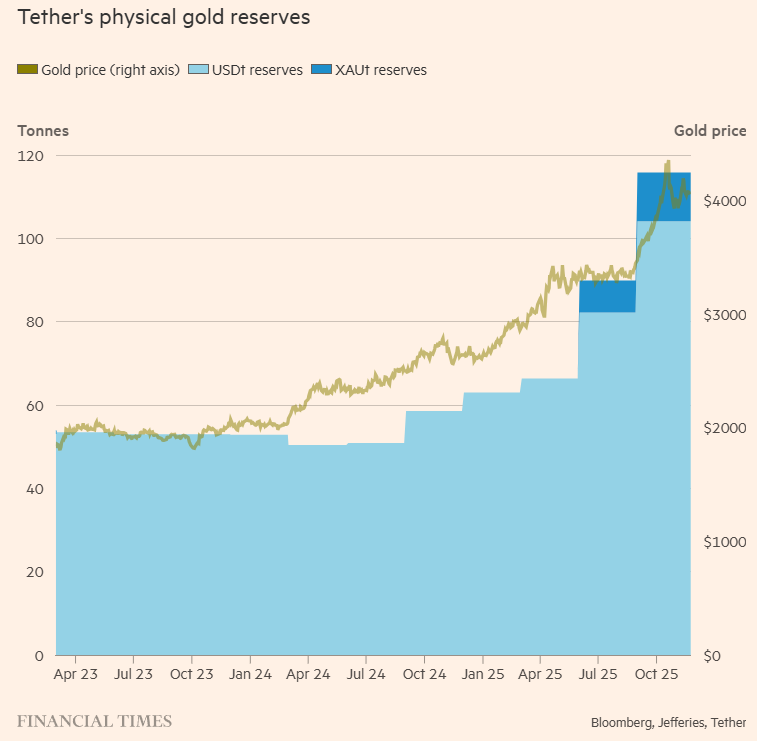
Core Insights - The total market capitalization of gold-backed stablecoins has risen to over $4 billion, nearly tripling from approximately $1.3 billion at the beginning of 2025 [1] - Tether Gold (XAUt) leads the market with a valuation of about $2.2 billion, accounting for around 50% of the market share, while Paxos Gold (PAXG) follows with approximately $1.5 billion, together representing nearly 90% of the tokenized gold market [1] - Gold prices have increased by approximately 66% this year [1] - Tether has been continuously increasing its gold holdings, owning about 116 tons as of the end of September [1]
黄金真正的“大庄家”:“稳定币老大”Tether
华尔街见闻· 2025-11-27 07:54
Core Viewpoint - The article highlights Tether, a controversial stablecoin issuer in the cryptocurrency world, as a significant buyer of gold, reshaping the supply-demand dynamics of traditional safe-haven assets [1][2]. Group 1: Tether's Gold Holdings - As of September 30, Tether holds 116 tons of gold valued at approximately $14 billion, making it the largest single holder of gold outside of major central banks [2]. - In Q3 alone, Tether purchased about 26 tons of gold, accounting for 2% of global gold demand during that period and 12% of known central bank purchases [3][11]. Group 2: Impact on Gold Prices - The article suggests that Tether's gold purchases have contributed to a 56% increase in gold prices by 2025, with gold prices rising by about $2000 this year [5][11]. - Tether's demand has potentially tightened supply and influenced market sentiment, driving speculative funds into the gold market [6]. Group 3: Future Gold Purchases - Tether plans to purchase approximately 100 tons of physical gold by 2025, supported by an expected profit of nearly $15 billion this year [12][11]. - The strategy involves using gold reserves to back two different tokens, USDT and Tether Gold (XAUt), with a total of 116 tons of gold backing these tokens [13]. Group 4: Regulatory Challenges - Tether's gold purchasing strategy conflicts with the recently passed GENIUS Act, which prohibits compliant issuers from using gold as reserve assets [14]. - Despite regulatory challenges, Tether has increased its gold reserves, indicating a long-term strategy focused on tokenized gold [14][17]. Group 5: Market Dynamics and Risks - The intertwining of cryptocurrency and traditional safe-haven assets raises concerns about the potential for speculative bubbles in gold [7][15]. - If demand for stablecoins reverses, the gold reserves supporting them may face selling pressure, impacting the gold market [7][15]. Group 6: Tokenized Gold Market - Tether's ambition in the tokenized gold market reflects a desire to provide a more accessible way for retail investors to hold gold without the high costs associated with physical ownership [17][18]. - However, demand for tokenized gold remains low, with Tether being one of the few issuers with significant holdings [19].


黄金真正的“大庄家”:“稳定币老大”Tether
美股IPO· 2025-11-27 03:38
Core Insights - Tether has emerged as a significant player in the gold market, holding 116 tons of gold as of September 30, making it the largest single holder of gold outside of major central banks [2][3][5] - The surge in gold prices this year, which increased by approximately $2000, coincided with Tether's accelerated gold purchases, indicating a potential influence on market dynamics [5][7] - Tether's strategy involves supporting two different tokens with gold reserves, reflecting a complex motivation behind its gold acquisition [10][13] Group 1: Tether's Gold Holdings and Market Impact - Tether's gold holdings are valued at around $14 billion, comparable to the official reserves of countries like South Korea and Hungary [3][5] - In Q3, Tether purchased about 26 tons of gold, accounting for 2% of global gold demand during that period and 12% of known central bank purchases [3][8] - The demand from Tether is believed to have tightened supply in the short term and influenced market sentiment, potentially driving speculative investments into gold [5][11] Group 2: Future Projections and Regulatory Challenges - Tether plans to purchase approximately 100 tons of physical gold by 2025, supported by an expected profit of nearly $15 billion this year [8][9] - The recent passage of the GENIUS Act, which prohibits stablecoin issuers from using gold as reserve assets, raises questions about Tether's increasing gold reserves despite regulatory constraints [10][14] - Tether's ambition to promote tokenized gold as a viable alternative to fiat-backed cryptocurrencies reflects a long-term vision, despite current market challenges [13][14] Group 3: Risks and Speculative Nature of Gold - The intertwining of cryptocurrency and traditional safe-haven assets like gold introduces risks, particularly if stablecoin demand reverses, leading to potential sell-off pressures on gold reserves [11][12] - The volatility of cryptocurrencies contrasts with the perceived stability of gold, raising concerns about the speculative nature of gold as an investment in the current market environment [11][12] - Tether's approach to tokenized gold aims to address the challenges faced by retail investors in holding physical gold, but demand for such products remains limited [13]

黄金真正的“大庄家”:“稳定币老大”Tether
Hua Er Jie Jian Wen· 2025-11-27 01:46
Core Insights - Tether, a major stablecoin issuer, has emerged as a significant buyer of gold, holding 116 tons valued at approximately $14 billion, making it the largest single holder of gold outside of central banks [1][3][5] - Tether's gold purchases have influenced gold prices, contributing to a 56% increase in gold prices in 2025, with its buying activity aligning closely with price surges [3][5] - The intertwining of cryptocurrency and traditional safe-haven assets like gold raises concerns about potential market volatility and the risk of speculative bubbles in gold [3][7] Group 1: Tether's Gold Holdings and Market Impact - As of September 30, Tether's gold holdings are comparable to the official reserves of countries like South Korea and Hungary, with its purchases accounting for 2% of global gold demand in Q3 [1][5] - Tether's gold buying activity has increased significantly, with its purchases representing 14% of central bank gold purchases in Q2 and 12% in Q3 [5][6] - The demand from Tether is expected to continue, with plans to purchase an additional 100 tons of gold by 2025, supported by its projected profits of nearly $15 billion this year [5][6] Group 2: Regulatory and Strategic Considerations - Tether's strategy involves using gold to back two different tokens, USDT and Tether Gold (XAUt), with a total of 116 tons of gold in reserves [6][10] - The recent GENIUS Act prohibits stablecoin issuers from using gold as reserve assets, yet Tether has increased its gold reserves, raising questions about its long-term strategy [6][10] - Tether's ambition to create a gold-backed cryptocurrency aims to provide a more accessible way for retail investors to hold gold, despite current regulatory challenges [10][11] Group 3: Speculative Risks and Market Dynamics - The relationship between gold and cryptocurrencies reflects concerns over currency devaluation, but the volatility of cryptocurrencies poses risks to the stability of gold as a safe-haven asset [7][11] - Jefferies predicts increased demand for gold from the stablecoin sector, but the unpredictable nature of the crypto market could lead to significant pressure on gold prices if demand shifts [7][11] - Tether's efforts to promote a gold-backed value exchange system face skepticism, particularly regarding the transparency and security of its gold reserves [11]
黄金稳定币梳理:从主流稳定币到PGI-20251105
Guo Tai Jun An Qi Huo· 2025-11-05 10:17
Report Industry Investment Rating No information provided in the content. Core Viewpoints of the Report - Amid tariff policies and geopolitical events causing global financial market volatility, the value of gold as a traditional safe - haven asset is increasingly prominent. Blockchain technology has spurred the rise of cryptocurrencies and given birth to gold - backed stablecoins, which combine gold's safe - haven nature with the high liquidity and decentralization of cryptocurrencies, offering new investment and risk - management tools for the traditional gold market and creating new buyers for gold [1][7]. - The report analyzes tokenized gold models represented by Pax Gold and Tether Gold, as well as the PGI scheme proposed by the World Gold Council in September 2025, and explores the differences and complementarities among the traditional gold market, tokenized gold models, and the PGI model [1][7]. - Gold - backed stablecoins, represented by XAUt and PAXG, have advantages such as low investment thresholds and low fees, with relatively low margin occupancy, but also face regulatory compliance issues due to decentralization and currently have a small scale. The PGI scheme shows the ambition to combine compliance and flexibility, with unique advantages in pledge and lease convenience, but its specific performance and market impact need further observation after implementation [3][45]. Summary According to the Directory 1. Blockchain and Cryptocurrency Basics: The Technological Foundation for Understanding Gold - Backed Stablecoins 1.1 Core Features of Blockchain - Blockchain has two core features: non - tamperability and decentralization. Non - tamperability means that each transaction record on the blockchain is stored in a chained manner through encryption algorithms. To modify a historical transaction record in a block, one must modify a series of blockchain records and their cryptographic proofs, making the transaction records on the blockchain non - tamperable and non - forgeable [8]. - Decentralization means that the entire blockchain network has no single centralized server but consists of numerous nodes with equal rights, connected peer - to - peer. Transaction records are broadcast to the whole network, and all nodes can verify and store the complete transaction ledger, which helps build a trust mechanism and makes the network more secure and stable [11]. 1.2 Classification of Cryptocurrencies and the Positioning of Gold - Backed Stablecoins - Cryptocurrencies can be classified into three categories based on value anchoring: native cryptocurrencies (e.g., Bitcoin and Ether), stablecoins (e.g., USDT), and real - world assets (RWA). Gold - backed stablecoins are positioned between stablecoins and RWA, mainly as "convenient on - chain gold investment products" rather than "on - chain currencies" [15][17][18]. 2. Overview of Mainstream Gold - Backed Stablecoins: Pax Gold and Tether Gold 2.1 Pax Gold (PAXG): A Compliance Benchmark with Priority on Regulation - PAXG is an ERC - 20 standard gold token issued by Paxos in September 2019 on the Ethereum blockchain, with excellent compatibility. Paxos actively seeks higher - level financial regulation. Each PAXG token corresponds to 1 ounce of LBMA - certified physical gold stored in London vaults, and token holders can trace the corresponding gold. PAXG can be redeemed for legal tender, other cryptocurrencies, or physical gold. As of late October 2025, its market value has increased by 153.16% in the past year to about $1.35 billion, and the number of investment gold ounces has grown from 196,700 ounces to 332,000 ounces [22][24][25]. 2.2 Tether Gold (XAUt): A Late - Comer Dominator Backed by Tether - XAUt is issued by Tether, the issuer of the largest US dollar stablecoin USDT. It has become the leader in the gold - backed stablecoin market. Technically and in terms of reserves, it is similar to PAXG, but its compliance process is relatively slow. Tether is not a licensed financial institution, and its financial compliance risk is more uncertain. As of late October 2025, its market value has increased by 215.61% in the past year to about $2.14 billion, and the number of investment gold ounces has grown from 246,300 ounces to 521,800 ounces [27][28][29]. 2.3 Price Difference between Gold - Backed Stablecoins and Spot Gold - The quotes of mainstream gold - backed stablecoins represented by XAUt and PAXG are basically the same as the London gold spot price, but there are still price differences, with the premium or discount fluctuating within ±$100 per ounce [30]. 3. The World Gold Council's PGI Scheme: A Revolutionary Framework Combining Law, Technology, and Regulation 3.1 Background of the PGI Proposal - The traditional physical gold investment market has two trading models: allocated and unallocated gold models, both of which have pain points. The allocated gold model has a high investment threshold, poor liquidity, and holding costs, while the unallocated gold model has prominent counter - party risks. The PGI scheme is designed to address these issues [37]. 3.2 Core Design of PGI - The core design of PGI includes legal, technological, and regulatory aspects. Legally, it solves the legal difficulty of "divisible ownership" of physical gold, defining PGI as an "intangible movable property" with an account - isolation - like risk - control mechanism. Technologically, it is "technology - neutral", does not require physical delivery, and supports a minimum trading unit of one - thousandth of an ounce, with high liquidity. In terms of regulation, it meets the requirements of mainstream financial regulatory regulations in the US and Europe and can be used as a compliant collateral [38]. 4. Comparison of Gold Investment Tools - In terms of investment thresholds, gold - backed stablecoins and PGI have significantly lower thresholds. Gold - backed stablecoins have an advantage in holding costs. In terms of regulation, gold - backed stablecoins are weakly regulated due to decentralization, while PGI tries to balance blockchain technology and regulation. In terms of market scale, gold - backed stablecoins currently have a small scale, and the performance of PGI remains to be seen [43][44][45].
币圈要囤黄金?“稳定币老大”筹资建“黄金稳定币财库”
Hua Er Jie Jian Wen· 2025-10-04 07:34
Group 1 - Tether is expanding into traditional safe-haven assets, specifically gold, by collaborating with Antalpha to raise at least $200 million for a publicly traded investment tool backed by physical gold [1] - The partnership between Tether and Antalpha is deepening, having previously collaborated on the Tether Gold (XAUt) project, which has a current market value of $1.5 billion [2] - Tether's XAUt market value has doubled this year, driven by a 46% increase in gold demand due to geopolitical uncertainties and inflation concerns [3] Group 2 - The collaboration aims to create a complete ecosystem around "digital gold," with Antalpha providing collateralized lending services and establishing physical vaults for gold bar exchanges [2] - The trend of "digital asset treasury" (DATs) is emerging, with over 80 such companies formed this year, as firms seek to emulate MicroStrategy's strategy of holding significant amounts of Bitcoin [3] - Despite the potential, the DAT model has faced challenges, with many companies experiencing significant stock price declines due to weakening institutional investor demand [3]
USDT发行商Tether收购加拿大黄金特许权公司32%股份
Sou Hu Cai Jing· 2025-06-13 08:30
Core Insights - Tether continues its acquisition strategy by purchasing a 31.9% stake in Elemental Altus Royalties, a publicly listed gold royalty company in Canada, for approximately $89.4 million [2][4] - This investment is part of Tether's strategy to integrate stable assets like gold and Bitcoin into its ecosystem, aiming to enhance the transparency and stability of digital financial products [2][4] - Tether's CEO emphasizes the importance of gold as a time-tested store of value and its role in building resilient financial infrastructure for the future [4] Acquisition Details - Tether acquired 78,421,780 shares of Elemental at a price of 1.55 CAD (approximately 1.14 USD) per share, completing the transaction on Tuesday [2] - The acquisition allows Tether to gain diversified exposure to global gold production without the operational risks associated with mining [2] Impact on Tether Gold - The acquisition strengthens Tether's ecosystem and supports its gold-backed stablecoin, Tether Gold (XAUt), which has become the largest gold-backed cryptocurrency since its launch in 2020 [4][5] - Tether plans to leverage its new exposure to launch more commodity-backed digital assets in the future [4] Market Context - The price of gold has seen a significant increase, rising approximately 30% within the year, with spot gold reaching a peak of $3,500 in April before slightly retreating to $3,388 [6] - Tether's XAUt stablecoin market cap reached $854 million in April, reflecting its growth alongside rising gold prices [5][6] Recent Investment Activities - Tether's acquisition of Elemental follows a record profit of $13 billion last year and a series of strategic investments, including a $458.7 million Bitcoin purchase and a $3.9 billion transfer to Twenty One Capital [7] - The company has also invested in various sectors, including media and sports, indicating a broadening of its investment portfolio [7]