WAI

Search documents
微盟集团(02013):经调利润回正,AI贡献提速
NORTHEAST SECURITIES· 2026-03-18 06:03
Investment Rating - The report maintains a "Buy" rating for the company, indicating a positive outlook for the stock's performance in the coming months [4][6]. Core Insights - The company has achieved its first positive adjusted profit since 2021, with total revenue reaching 1.592 billion yuan in 2025, a year-on-year increase of 18.9%. The adjusted net profit was 42 million yuan, marking a significant improvement [1]. - The company's strategic focus on AI is showing results, with AI-related revenue expected to accelerate in 2026. The introduction of various AI products has contributed to this growth [3][4]. - The company is optimizing its SaaS offerings, particularly in retail, which has led to improved operational efficiency and customer quality, despite a short-term decline in the number of paying users [2]. Financial Performance Summary - In 2025, the company reported total revenue of 1.592 billion yuan, with a gross profit of 1.195 billion yuan and a gross margin of 75.1% [1]. - The adjusted net profit for 2025 was 42 million yuan, a notable recovery from previous losses, while the net profit attributable to shareholders was a loss of 221 million yuan, significantly narrowed compared to prior periods [1][5]. - The company expects to achieve revenues of 1.763 billion yuan in 2026, with a projected net profit of 5 million yuan, indicating a continued recovery trajectory [5][10]. AI Strategy and Product Development - The company has launched several AI products, including WAI and WIME, which have seen significant user engagement and growth in GMV [3]. - The AI-related revenue reached 116 million yuan in 2025, with a substantial quarter-on-quarter growth of 137.5% in the second half of 2025 [3]. - The company is also exploring new business units and partnerships in the AI sector, indicating a robust commitment to expanding its AI capabilities [3]. Market Position and Future Outlook - The company is expected to see revenue growth of 17.63 billion yuan in 2026, with a corresponding price-to-sales ratio of 3.55 [4]. - The report anticipates a continued increase in profitability, with net profit projections of 67 million yuan in 2027 and 138 million yuan in 2028, reflecting a strong recovery and growth potential [4][5].
微盟 AI 产品负责人孙茜:不做 Agent 的 SaaS 厂商,恐将被「革命」丨SaaS + Agent 十人谈
雷峰网· 2025-10-01 03:33
Core Viewpoint - The article emphasizes that the integration of Agent technology into SaaS systems is not just an option but a necessity for survival in the evolving tech landscape, particularly as AI becomes a fundamental requirement for customer acquisition [4][5][6]. Group 1: Challenges of Integrating Agent into SaaS - Integrating Agent technology into existing SaaS systems presents significant technical challenges, including the rapid iteration of Agent architectures and the need for substantial modifications to mature SaaS systems [6][7][21]. - The integration process is likened to a race between the rapid evolution of Agent technology and the necessary upgrades to SaaS systems, requiring a dual-team approach to manage both existing frameworks and explore new technologies [7][26]. Group 2: The Role of Agent in SaaS - Agents are seen as suitable for SaaS systems due to their ability to handle tasks related to business processes and professional expertise, aligning well with the functional nature of many SaaS applications [12][14]. - The relationship between SaaS and Agent is expected to evolve, potentially leading to a scenario where traditional SaaS models become less visible, with Agents taking a more prominent role [8][13]. Group 3: Business Model Transformation - The traditional subscription-based business model of SaaS is anticipated to change as Agent technology becomes more integrated, with potential new billing methods based on performance metrics such as interaction counts and content generation [8][18][17]. - The focus will shift from the tools used to achieve results to the outcomes themselves, reflecting a broader trend in how SaaS companies may charge for their services in the future [18][17]. Group 4: Market Dynamics and Competition - The introduction of Agent technology is expected to create differentiation opportunities in the highly competitive SaaS market, which has been characterized by significant homogeneity [30][31]. - Companies that can effectively leverage AI and Agent technology will likely gain a competitive edge, particularly those with established customer bases and industry influence [32]. Group 5: Future Outlook - The article suggests that as the integration of Agent technology matures, it may redefine the roles of SaaS providers, with a potential shift towards becoming specialized experts in their respective fields rather than just platform providers [33][34]. - The ongoing development of Agent capabilities will be crucial for SaaS companies to maintain relevance and meet evolving customer needs in a rapidly changing technological landscape [22][20].


X @Bitget
Bitget· 2025-08-12 09:00
Listing Information - $WAI (WORLD3_AI) is now listed on Bitget Spot [1] - Trading pair is WAI/USDT [1] - Trading started on August 12, 9:00 AM (UTC) [1] Promotional Activities - 5,180,000 WAI are available through Candybomb and community giveaways [1] Platform - Bitget is the platform for trading $WAI [1]
X @BitMart
BitMart· 2025-08-12 09:00
Listing Announcement - BitMart listed WORLD3 (WAI) [1] - WAI trading is now live on BitMart [1] Project Overview - WORLD3 is a decentralized platform for creating and deploying AI agents [1] - The platform facilitates task automation and strategic operations across Web2 and Web3 [1] - WORLD3 is powered by cutting-edge technology (https://t.co/I9UVDE6se5) [1]
X @BitMart
BitMart· 2025-08-12 08:40
Listing Announcement - BitMart announces the primary listing of WORLD3 (WAI), ticker symbol WAI [1] - Trading pair for WORLD3 is WAI/USDT [2] - Trading will commence on August 12, 2025, at 9:00 AM UTC [2] Project Overview - WORLD3 is a decentralized platform focused on AI agents [1] - The platform enables users to create and deploy AI agents for task automation across Web2 and Web3 [1] - WORLD3 utilizes Agent VM technology and the WORLD3 AI Protocol [1] - The platform supports hierarchical planning, continuous execution, multi-chain connectivity, and cross-platform automation for AI agents [1]
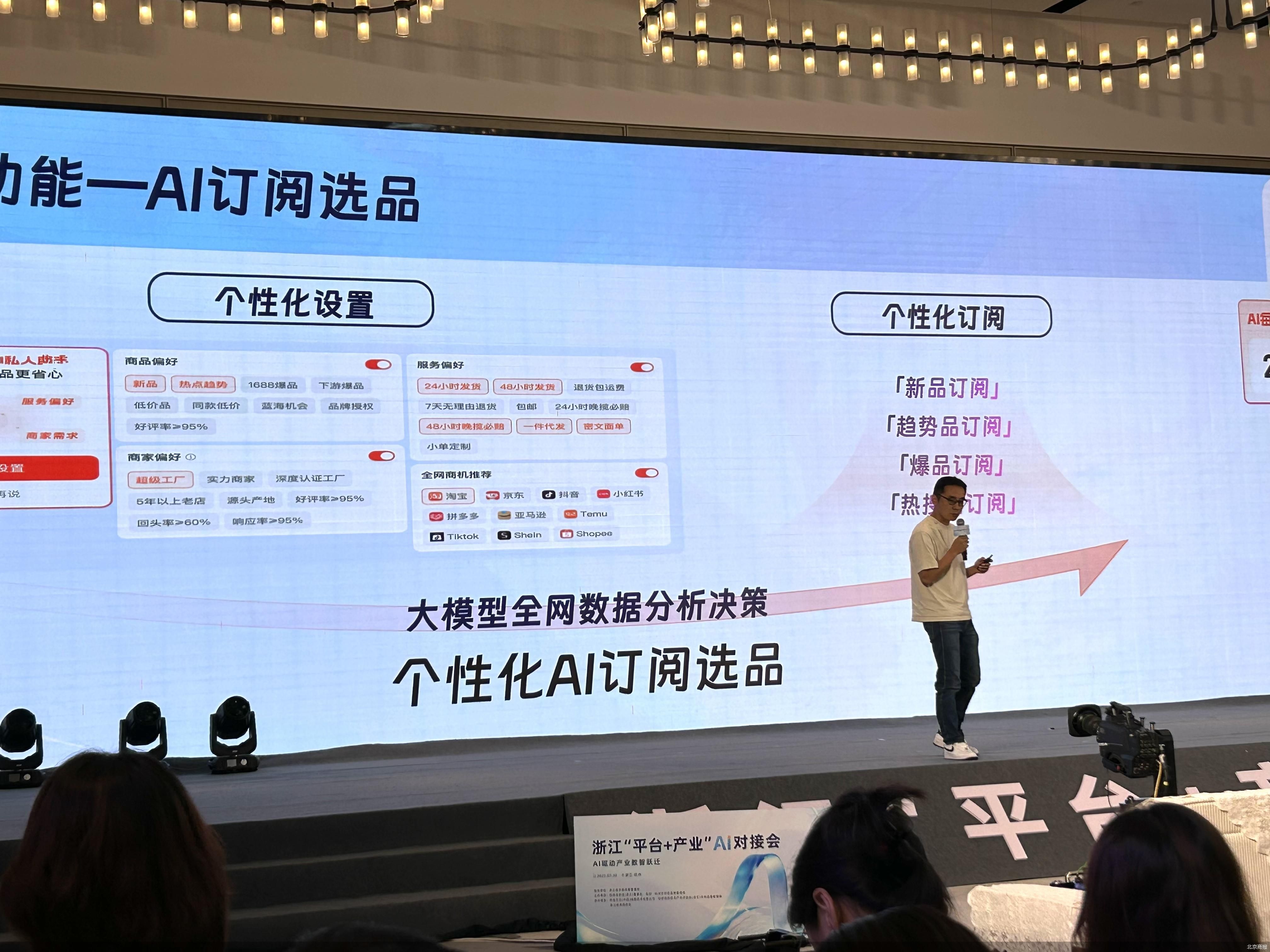
电商猛推AI工具 商家观望算账
Bei Jing Shang Bao· 2025-08-03 15:43
Core Insights - E-commerce platforms are increasingly investing in AI tools to enhance product selection, design, and customer service, with companies like 1688 and ZhiDeMai Tech updating their AI offerings [1][6] - Small and medium-sized enterprises (SMEs) are experiencing significant productivity improvements, with some achieving an efficiency of 5 million yuan per employee and creating products with a gross margin of 92% [3][4] - Despite the potential benefits, SMEs face challenges in AI adoption, including high understanding costs, time for widespread implementation, and insufficient cost-effectiveness [1][5] Group 1: AI Tools and Their Impact - AI tools are primarily used for basic functions such as image generation and data insights, with more complex applications requiring additional time for adaptation [1][5] - Companies like Tiwan Tans Trading have successfully leveraged AI for product selection and operational efficiency, increasing annual revenue from 10 million yuan to 40 million yuan [3][4] - The introduction of AI tools has led to significant reductions in product development cycles, with some companies able to produce hundreds of new products in a single day [3][4] Group 2: Challenges and Limitations - Many SMEs prioritize cost reduction and efficiency gains when using AI tools, indicating a need for platforms to enhance the practical output of these technologies [5][6] - The current application of AI in e-commerce remains at a basic level, with many businesses still relying on simple tools for product image creation and marketing material generation [5][6] - There is a need for traditional manufacturing companies to adapt their mindset and possess technical capabilities to fully utilize AI tools [5][6] Group 3: Market Competition and Future Directions - E-commerce platforms are focusing on customer acquisition rather than immediate commercialization of AI products, indicating a competitive landscape [7][8] - Recent upgrades in AI capabilities, such as improved product search accuracy from 88% to 94.5%, demonstrate ongoing efforts to enhance user experience [7][8] - The future of AI tools in e-commerce will depend on their ability to adapt to different scenarios and user needs, emphasizing the importance of personalization [8]

电商猛推AI工具:平台不着急商业化,商家观望算账
Bei Jing Shang Bao· 2025-08-03 09:30
Core Insights - E-commerce platforms are increasingly investing in AI tools to enhance product selection, design, and customer service, with companies like 1688 and ZhiDeMai Technology updating their AI offerings [1][4] - Small and medium-sized enterprises (SMEs) utilizing AI have reported significant productivity improvements, with some achieving a revenue increase to 5 million yuan per employee and creating products with a gross margin of 92% [1][4] - Despite the potential benefits, SMEs face challenges in AI adoption, including high understanding costs, time for widespread implementation, and insufficient cost-effectiveness [1][6] Group 1: AI Implementation in E-commerce - Current AI applications by merchants are primarily basic, focusing on tasks like image generation and data insights, with more complex integrations requiring additional time [1][6] - Platforms like 1688 have iterated their products to lower barriers for SMEs, but the primary need remains cost reduction and efficiency improvement [1][7] - The consensus in the industry is that AI tools must be further tailored to specific scenarios and personalized to achieve true scalability [1][9] Group 2: Case Study of Successful AI Utilization - Liu Shiqi, general manager of Tiwantans Trading Co., leveraged AI to grow his slipper business to an annual revenue of 40 million yuan, successfully selling a "ugly slipper" for $145 with a profit margin of $50 [4][5] - His strategy involved using AI for product selection based on market trends, significantly reducing the product development cycle from 1-1.5 months to less than a week [4][5] - Liu emphasized the importance of innovation over imitation, focusing on creating unique products that meet new market demands [5] Group 3: E-commerce Platforms' AI Tools - Major e-commerce platforms are developing AI products to enhance merchant efficiency in areas like product selection, marketing, and customer service [6][8] - For instance, Taobao's "Image to Video" tool automates the creation of promotional videos, while JD's Yanxi model analyzes product features and user preferences [6][8] - 1688's digital human product has evolved to assist merchants in optimizing product images and participating in marketing activities, resulting in a 150% improvement in business outcomes for SMEs using the tool [7][8] Group 4: Future of AI in E-commerce - The current focus for e-commerce platforms is on acquiring customers rather than immediate commercialization of AI products [9] - There is a recognition that AI tools need to adapt to various industry scenarios and user needs to achieve widespread application [9] - The integration of AI into the e-commerce search process is being prioritized to enhance user experience, with improvements in search accuracy from 88% to 94.5% [8][9]