
X(原Twitter)

Search documents
把推特改成X之后,马斯克成功把用户赶到了Threads
3 6 Ke· 2026-02-05 00:57
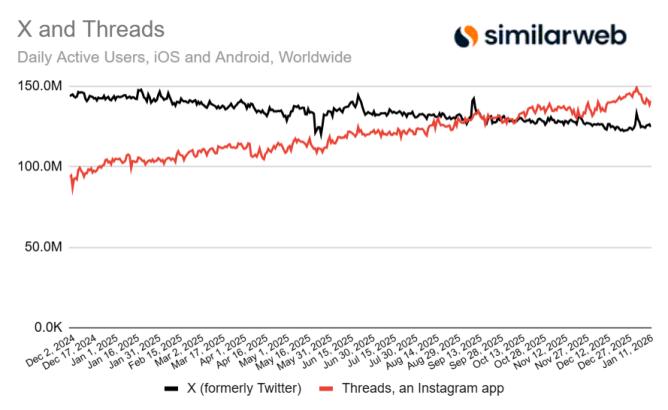
Core Insights - Meta's Threads has surpassed X (formerly Twitter) in daily active users (DAU) on mobile, reaching 141.5 million compared to X's 125 million as of January 7, 2026 [1][3] - Threads achieved significant user growth, reaching 130 million DAU as early as September 2023, and has continued to grow rapidly [3][6] - The integration of Threads with Instagram has been a key factor in its success, allowing it to leverage Instagram's existing user base [10][13] Group 1: Threads Performance - Threads reached 100 million users within just five days of its launch, a record growth rate for any app [7] - By August 2025, Threads' global monthly active users exceeded 400 million, doubling its user base within a year [7] - Approximately 96% of Threads users also have Instagram accounts, indicating strong user overlap and integration [13] Group 2: X's Decline - X has experienced a 23% decline in daily active users in the U.S. since Elon Musk's acquisition, marking one of the steepest drops among social media platforms [23] - Major advertisers, including Disney and Warner Bros, have paused ad spending on X due to concerns over its content environment [25] - The platform has been criticized for becoming a "toxic" environment, leading to significant media withdrawals and user dissatisfaction [26][29] Group 3: Content and User Experience - Threads aims to create a less contentious environment, focusing on personal sharing rather than political discourse, which has attracted users seeking a different experience [20] - X's content ecosystem has deteriorated, with the introduction of a paid verification system leading to an increase in misinformation and fake accounts [29][30] - The chaotic user experience on X has contributed to the rise of alternative platforms like Bluesky, which saw a surge in users following the 2024 U.S. elections [36] Group 4: Market Dynamics - The social media landscape is becoming increasingly fragmented, with users gravitating towards platforms that meet their specific needs, whether for news or social interaction [40] - X remains relevant for real-time news updates, while Threads caters to users looking for a more casual and engaging social experience [40]


Threads日活超越X:2026 出海平台怎么选?
Xin Lang Cai Jing· 2026-02-04 12:20
Core Insights - Meta's Threads has surpassed X (formerly Twitter) in daily active users, reaching approximately 141.5 million compared to X's 125 million as of January 7, 2026, indicating a steady growth trend for Threads and a slowdown for X [1][16]. Group 1: Brand Value Comparison - The competition between Threads and X has become a significant consideration for brands in social media marketing, prompting a reevaluation of investment in these platforms [3][19]. - The true impact on brand decisions stems from the different content contexts and interaction logics formed by each platform, which influence how brands are perceived and responded to [4][20]. Group 2: Platform Characteristics - X maintains a "public information space" characteristic, focusing on news events and public discourse, making it suitable for brand tasks centered on visibility and engagement with current events [5][21]. - Threads offers a more casual and light interaction environment, where users seek low-interference social experiences, which fosters a gradual relationship-building process between brands and users [8][24]. Group 3: User Perception and Interaction - The structural differences between platforms affect how users interpret brand messaging; on X, brands are seen as collections of opinions, while on Threads, brand identity is built through ongoing interactions [8][24]. - Threads emphasizes continuous dialogue over fragmented, event-driven communication, allowing for a more immersive user experience with brands [8][24]. Group 4: Strategic Recommendations for Brands - Brands should treat Threads as a "content adaptation testing ground," focusing on natural expressions and light content rather than direct confrontational discussions [10][26]. - It is crucial for brands to differentiate their roles on each platform rather than simply transferring resources; Threads should be approached as a friendly participant while X serves as a platform for information dissemination and industry engagement [10][26]. Group 5: Data-Driven Decision Making - Brands should rely on real interaction data rather than subjective perceptions to determine which platform to invest in, utilizing comprehensive monitoring tools to analyze engagement metrics [11][27]. - By focusing on average interaction rates, depth of user responses, and interaction decay rates, brands can better assess which platform is more suitable for building relationships and fostering engagement [15][31].
英国上议院通过16岁以下青少年使用社交媒体禁令
Guo Ji Jin Rong Bao· 2026-01-22 13:29
Core Viewpoint - The UK House of Lords has passed an amendment to ban social media use for individuals under 16, increasing pressure on the government to implement similar regulations as Australia [1][3]. Group 1: Legislative Action - The amendment was initiated by a coalition of Conservative, Labour, and Liberal Democrat members, passing with a vote of 261 in favor and 150 against, and will now be reviewed by the Labour-led House of Commons [1]. - Over 60 Labour MPs have urged Prime Minister Starmer to support the ban, indicating significant political backing for the initiative [4]. Group 2: Concerns and Support - The proposal is driven by concerns over the negative impact of social media on the mental health of teenagers, particularly those under 16, who are seen as vulnerable to psychological issues due to their developmental stage [2][3]. - High-profile cases, such as the suicide of 14-year-old Molly Russell, have highlighted the dangers of social media exposure to harmful content, prompting calls for regulatory measures [2]. - Supporters argue that social media can exacerbate issues like anxiety, depression, and self-harm among youth, necessitating restrictions until they are more mature [3]. Group 3: Opposition and Considerations - Opponents of the ban express concerns that a complete prohibition may drive youth to less regulated platforms, potentially leading to greater risks and negative outcomes [3]. - The government is currently conducting a three-month public consultation to evaluate various options, including the ban, age thresholds, and enhanced age verification measures [3].
Facebook超越TikTok成为肯尼亚最受欢迎的社交网站
Shang Wu Bu Wang Zhan· 2025-12-23 16:46
Group 1 - Cloudflare data indicates that Facebook has risen to become the second most visited internet platform in Kenya by 2025, surpassing TikTok to become the most popular social website in the country [1] - Google remains the most popular internet platform in Kenya, maintaining its first-place ranking [1] - X (formerly Twitter) has seen a decline in popularity in Kenya, falling out of the top ten by 2025 [1] Group 2 - TikTok's ranking has dropped from fourth place last year to eighth place in 2025 [1] - OpenAI's ChatGPT is identified as the most widely used generative AI platform in Kenya [1]
澳大利亚能否打赢“青少年保卫战”
Xin Lang Cai Jing· 2025-12-20 22:07
Group 1 - Australia has implemented a social media ban for users under 16, marking the first legislative action of its kind globally, with platforms facing fines up to 49.5 million AUD for non-compliance [1][2] - The ban was supported by a significant majority of parents, with 77% approval in domestic polls, highlighting a strong public sentiment for protecting children online [2] - Major platforms like Facebook and YouTube are included in the initial list of ten platforms subject to the ban, with over 1 million accounts of minors expected to be affected [2][3] Group 2 - Tech companies, including Meta and Google, have expressed concerns about the ban's implementation, arguing it is difficult to enforce and may infringe on user privacy [3] - Critics of the ban suggest that it does not effectively address the root causes of harmful content and advocate for educating children on safe social media use instead of outright bans [3][4] - The Australian government remains committed to the ban, with Prime Minister Albanese encouraging youth to engage in offline activities during school holidays [3][4]