
YSL

Search documents
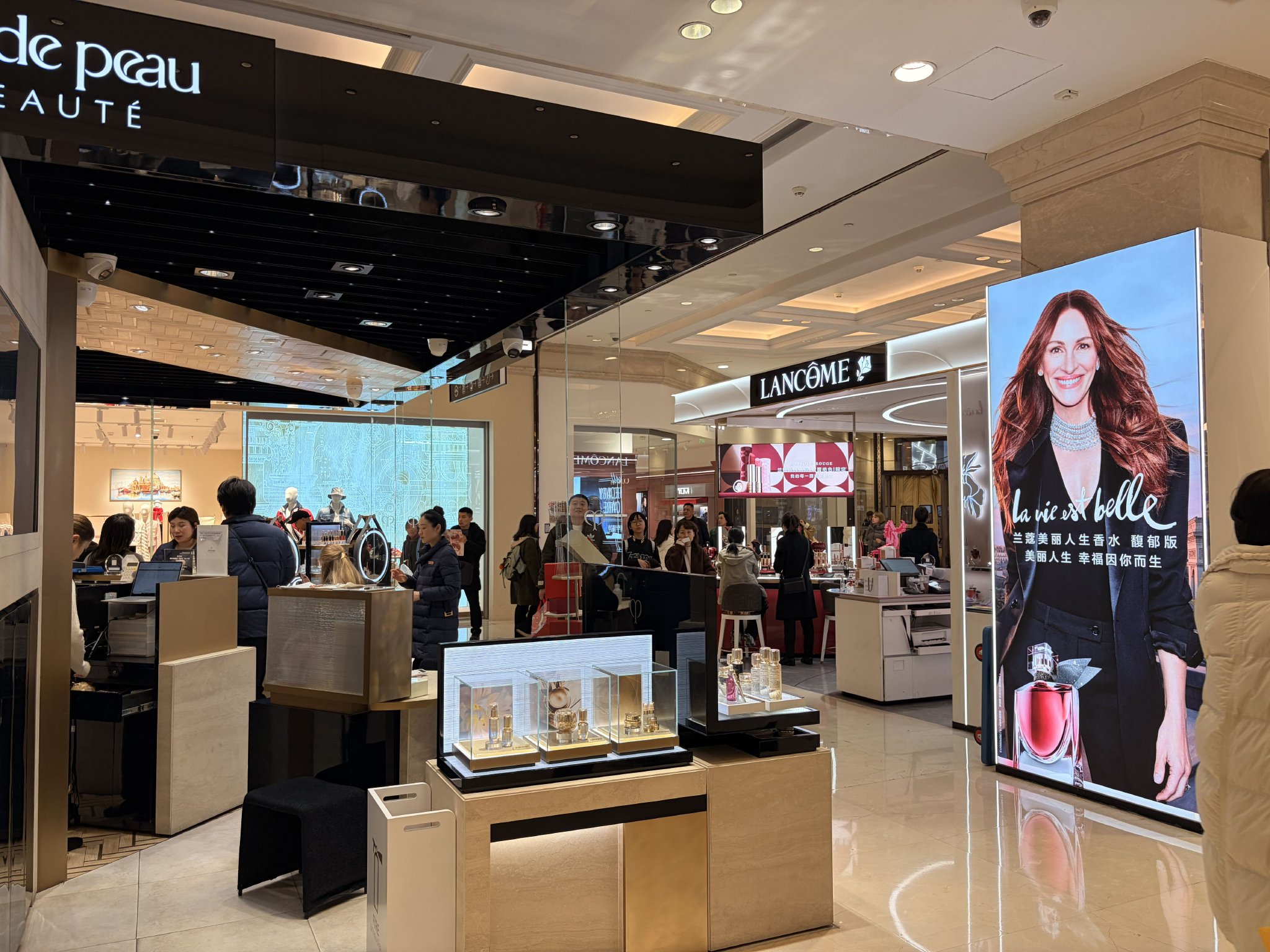
高端美妆又行了,上海柜姐:每天“一车车”发货|新春走基层
Xin Lang Cai Jing· 2026-02-15 02:08
Core Viewpoint - The financial reports from major beauty groups indicate a recovery trend in China's high-end beauty market in the second half of 2025 [1] Group 1: Financial Performance and Market Trends - L'Oréal's sales growth in mainland China is projected to be 1% in the first half and 5% in the second half of 2025, contributing to growth in the North Asia region [2] - Estée Lauder and Shiseido have adjusted their financial reporting, with Estée Lauder separating mainland China from the Asia-Pacific market starting in Q2 2025, and Shiseido merging its China and travel retail businesses [2] - Estée Lauder's revenue growth in mainland China for Q2 to Q4 of 2025 is expected to be -2%, 9%, and 13% respectively, while Shiseido's comparable sales growth is projected at -14%, -7%, 8%, and 2% for the same quarters [2] - Bain & Company's report indicates that the beauty and personal care category will be the first to recover positive growth in 2025, while other luxury categories are still in a phase of decline [2] Group 2: Consumer Behavior and Market Dynamics - Increased consumer traffic in beauty sections of malls, particularly during the pre-Spring Festival period, indicates a rise in purchasing activity [3][4] - The beauty market is expected to rebound in 2025 after a slight decline in 2024, with a projected growth rate of 5.1% [7] - High-end brands are adjusting prices and inventory to facilitate recovery, with a notable shift of consumers from high-end to mass brands due to improved offerings and competitive pricing [11][17] Group 3: Product Innovation and Market Strategy - Major beauty brands are focusing on localized research and innovation in China, with L'Oréal, Estée Lauder, and Shiseido establishing R&D centers in Shanghai [19] - New product launches and collaborations, such as L'Oréal's partnership with Huashan Hospital and Shiseido's introduction of a new medical beauty brand, reflect a trend towards localized product development [20] - The market is shifting towards more specialized segments, such as scalp care and lip care, indicating a move from basic skincare to more refined personal care [12][13] Group 4: Long-term Market Outlook - The sustainability of current growth drivers, such as price reductions and niche market expansions, remains uncertain [14] - The beauty market is entering a phase of stock competition, with brands needing to enhance core competitiveness and adapt to changing consumer preferences [18] - The demand for high-end beauty products persists, but consumers are increasingly discerning, leading to a need for brands to align pricing with product value [17]


欧莱雅在中国市场遭遇“滑铁卢”,反应慢了?
Xi Niu Cai Jing· 2025-12-16 01:24
Core Insights - 2024 is expected to be a challenging year for L'Oréal, particularly in the Chinese market, which has become a significant concern for the company [2] Group 1: Financial Performance - L'Oréal achieved a record sales figure of €43.48 billion in 2024, representing a year-on-year growth of 5.1% [2] - The operating profit reached €8.688 billion, with a year-on-year increase of 6.7%, resulting in an operating margin of 20% [2] - The North Asia market, which includes China, reported a sales decline of €10.3 billion, down 3.2% year-on-year, making it the only region with negative growth among L'Oréal's five major markets [2] Group 2: Market Dynamics - The growth rate of L'Oréal in the Chinese market has been declining, with previous growth rates exceeding 20% from 2019 to 2021, but dropping to low single-digit growth from 2022 onwards [2] - The first quarter of 2024 showed decent performance, but the second quarter experienced negative growth, which continued into the third and fourth quarters [2] - Factors contributing to the negative growth in the North Asia market include weak selective channels and pressure on travel retail sales [2] Group 3: Competitive Landscape - L'Oréal's revenue in China is primarily driven by mass-market and premium cosmetics, with brands like L'Oréal Paris and Lancôme being significant contributors [3] - The mass-market segment faces intense competition from local skincare brands that are gaining popularity due to the "national trend" and high cost-performance ratios [3] - In the premium segment, consumers are becoming more discerning, often opting for "alternative" products instead of high-end offerings, which diminishes L'Oréal's previous pricing advantages [3][4] Group 4: Adaptability Challenges - Local brands are quicker to respond to market changes and consumer demands due to their advantages in channels and supply chains, putting L'Oréal at a disadvantage [4] - The beauty market's dynamics have shifted, requiring brands to adopt more agile and flexible strategies to keep pace with rapid changes [4] Group 5: Future Outlook - In the first three quarters of 2025, the North Asia market reported sales of €7.35 billion, with a slight year-on-year growth of 0.5%, indicating a low growth state [5] - The Chinese market remains a crucial revenue source for L'Oréal, necessitating a focus on market trends and consumer demand changes to potentially restore high growth in the future [5]
L'Oréal (OTCPK:LRLC.F) 2025 Earnings Call Presentation
2025-12-03 12:00
L'Oréal USA Overview - L'Oréal USA is the 1 beauty manufacturer in the U S [8, 23] - L'Oréal USA represents 27% of subsidiary sales in the North America zone [9] - Over 75% of L'Oréal USA's units are produced in North America [10] - L'Oréal USA has experienced 7X growth since 1995 [15] Market Position and Growth - L'Oréal has a 16% share of market (SOM) in the total beauty market, which is more than 2X larger than the 2 competitor [24] - The U S is the 1 beauty market in size and growth worldwide, accounting for 27% of the global market with a +5% change [38, 39] - L'Oréal is accelerating faster than the market, gaining major momentum with a +5% increase in Q3 [50, 52] Category Performance - L'Oréal's haircare is growing 3X the market rate [56] - In makeup, all of L'Oréal's CPD brands are outperforming the market year-to-date [64] - L'Oréal has a 34% share of market in mass makeup [73] Channel Strategy - E-commerce accounts for 26% of L'Oréal's business and is accelerating at +2X the market rate year-to-date [92] - B&M (Brick and Mortar) remains a priority, representing 65% of the total market [98]
欧莱雅重押“放缓明显”的香水市场
36氪未来消费· 2025-10-24 08:05
Core Viewpoint - L'Oréal's third-quarter revenue increased by 3.4% year-on-year, with North Asia, including China, growing by 4.7%, surpassing analyst expectations of 3.2% [3] Revenue Performance - The mass cosmetics segment showed the lowest growth at 0.4%, while luxury beauty and professional hair care grew by 1.5% and 1.1%, respectively. The skin science beauty segment led with a growth rate of 6.1%, although this growth has noticeably slowed [4] - In China, all segments except mass cosmetics achieved growth exceeding market levels, with notable performances from brands like Lancôme, Helena Rubinstein, and YSL [4] Strategic Acquisition - L'Oréal announced a €4 billion acquisition of Kering's beauty business, which includes the luxury perfume brand Creed and the fragrance rights for Balenciaga and Bottega Veneta [4][5] - This acquisition is seen as a significant move for L'Oréal in the high-end fragrance market, which is expected to enhance its market share in this segment from 13.7% to potentially 19.7% [5] Market Dynamics - The luxury beauty sector remains competitive, with L'Oréal's luxury division still showing growth despite overall high-end consumption slowing down [4][5] - The global fragrance market's annual sales growth has slowed from 13% last year to 11% this year, with high-end fragrances experiencing a more pronounced slowdown [6] Challenges Ahead - The Gucci fragrance business, currently licensed to Coty until 2028, poses a challenge as L'Oréal will need to invest significantly to reshape the brand's image upon acquisition [6][7] - Creed, while a promising asset, currently generates approximately $400 million in annual sales, indicating that L'Oréal will need to invest heavily to expand the sales network for Creed and the other brands acquired [7]
L’Oréal Stock Takes a Hit After Q3 Results Release
Yahoo Finance· 2025-10-22 09:58
Core Insights - L'Oréal's stock declined by 6.4% to 372.45 euros following disappointing third-quarter results [1] - The company's like-for-like sales growth for Q3 was 4.2%, falling short of analysts' expectations by 50 basis points [2] - Analysts expressed concerns over the lack of visibility in future growth, particularly regarding the Chinese market and fragrance destocking [5] Financial Performance - Reported sales for the third quarter increased by 0.5% to 10.33 billion euros, which was 1% below the consensus estimate of 10.44 billion euros [5] - Adjusted for IT transformation, L'Oréal's sales rose by 4.9% during the same period [6] Strategic Moves - L'Oréal announced the acquisition of Kering Beauty for 4 billion euros, marking the company's largest deal to date [6] - The CEO expressed cautious optimism for upcoming sales events in China and the holiday season in the U.S. and Europe [4]
中国线上美妆:市场龙头相对整体市场保持强劲增长-China Online Beauty_ Market leaders sustained strong growth vs. broader market
2025-10-19 15:58
Summary of Key Points from the Conference Call Industry Overview - The Chinese beauty e-commerce market experienced a slight contraction in September with a Gross Merchandise Value (GMV) decline of -1.0% and a -2.6% decline in Q3, following a -2.2% decline in August [2][21] - Despite the overall market decline, tracked cosmetics leaders outperformed with +8.1% growth in September, up from +6.5% in August, and a solid +12% two-year CAGR [2][21] - The tracked beauty companies gained market share by +125 basis points (bps) in September, with Q3 growth improving to +6.5% compared to +3.5% in Q2 [2][21] Company Performance Highlights L'Oréal - Achieved +11% GMV growth in September, expanding market share by +177bps [4] - Q3 GMV growth accelerated to +10%, a significant improvement from flat growth in Q2 [4] Estée Lauder - Delivered impressive GMV growth of +16% in September and maintained strong momentum with a +14% increase in Q3 [5] - Market share gains of +299bps were driven by flagship brands La Mer and Estée Lauder [5] LVMH - GMV grew +7% YoY in September, gaining +122bps in market share [6] - The brand Dior was a key driver, with pricing increases offsetting volume declines [6] Proya - Experienced a -9% YoY decrease in September, with its flagship brand declining -11% [8] - Despite frequent new product launches, the company struggled to rejuvenate core brand growth [8] Giant Biogene - Declined -7% YoY in September, with flagship brand Kefumei falling -10% [9] - Consumer confidence was impacted by resurfaced product quality concerns [9] Shiseido - Overall online sales increased by +2% YoY in September, with flagship brand Shiseido seeing a +28% growth [10] - The premium line Clé de Peau declined -15% YoY [10] Beiersdorf - GMV performance rebounded with a +7% increase in September, following a -21% decline in August [11] - Eucerin achieved a +107% GMV increase in September [11] P&G Beauty Brands - Posted robust GMV growth of +21% in September, rebounding from +5% growth in August [12] - Significant market share gain of +148bps was noted [12] Unilever - Continued to face challenges with a -4% decline in September, following a -21% drop in August [13] - Market share gains were robust, increasing by +133bps [13] Henkel - Beauty Care division faced pressure with a -16% decline in September and -24% in Q3 [14] Investment Implications - Outperform ratings on Beiersdorf and Unilever, with Market-Perform ratings on Henkel and L'Oréal [16] - In the Chinese cosmetics market, Shiseido is rated Underperform, Proya is rated Market-Perform, and Giant Biogene is rated Outperform [18] Additional Insights - The upcoming 11.11 Singles Day festival is seen as a critical checkpoint for assessing brand market positions amid ongoing controversies [9] - The Douyin platform has been a significant contributor to market growth, while T+T continues to observe declines [21] This summary encapsulates the key points from the conference call, highlighting the performance of major companies within the beauty industry and the overall market dynamics.