eMMC/UFS

Search documents
美光:未来汽车将需要300GB的内存
芯世相· 2026-03-23 06:34
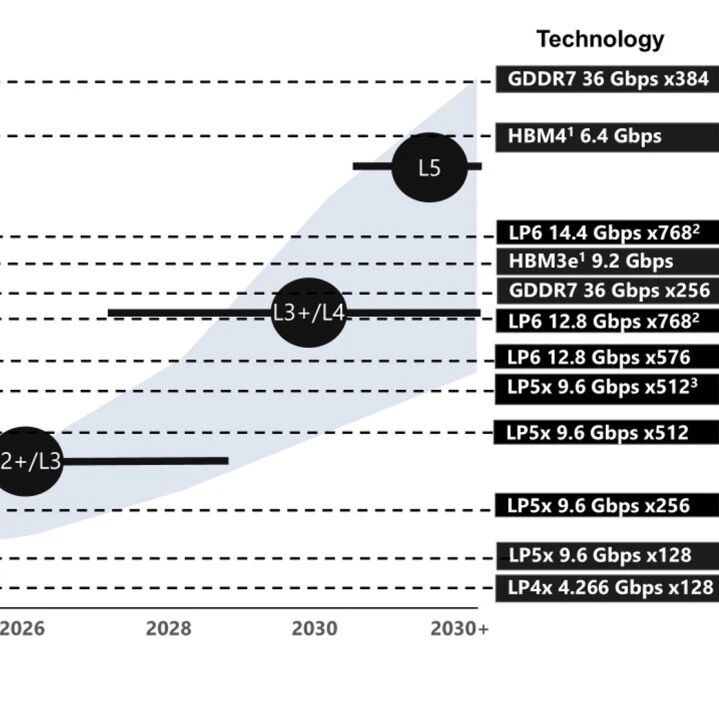
我是芯片超人花姐,入行20年,有50W+芯片行业粉丝。 有很多不方便公开发公众号的, 关于芯片买卖、关于资 源链接等, 我会分享在朋友圈 。 扫码加我本人微信 美光 CEO Sanjay Mehrotra 表示 , 随着车企推出具备 L4 级自动驾驶能力的车型,汽车最终 将需要超过300GB的RAM 。 据 The Register 报道,梅赫罗特拉是在美光发布季度财报后作出 上述表态的。 与此同时,这些车辆还包含一系列关键性不同的功能。比如,信息娱乐系统中的某些 功能 对提醒 驾驶员至关重要,而另一些则不是。这里的挑战在于,既要把整车作为一个单一系统来管理,又要 把它看作一个"系统中的系统",其中某些功能比其他功能拥有更高优先级。而解决这一问题的最 佳方式,就是提高带宽、降低延迟,并且更细致地划分:哪些部件需要部署在哪些位置、采用哪种 制造工艺,以及对应的成本是多少。 西门子 EDA 汽车与军工航天领域混合物理与虚拟系统副总裁 David Fritz 表示:"当我们谈到像 具备服务质量保障的 10Gb 车载以太网这类东西时,传统汽车工程师会说,'我怎么保证这个信号 真的能在 100 毫秒内到达制动系统?' ...


汽车芯片,新变革
半导体行业观察· 2026-03-07 03:07
Core Viewpoint - The automotive industry is undergoing a significant transformation driven by the exponential growth of data generated by advanced driver-assistance systems (ADAS) and the increasing complexity of vehicle functionalities, necessitating a reevaluation of memory and processing requirements [3][4][5]. Group 1: Data Processing and System Architecture - The data generated by sensors in autonomous and assisted driving is growing explosively, creating unprecedented demands on memory and storage subsystems within vehicles [3]. - The shift towards software-defined vehicles (SDVs) allows for better identification of where advanced processors and memory are needed, optimizing performance and cost [4][5]. - Traditional concerns about data transmission delays are diminishing as high-speed data transfer technologies, such as 10Gbps automotive Ethernet, become more prevalent [4][5]. Group 2: Memory and Storage Technologies - The choice of memory types in electric vehicles (EVs) is critical, with LPDDR6 emerging as a suitable option due to its balance of capacity and bandwidth, essential for ADAS and AI applications [9][11]. - High-bandwidth memory solutions are increasingly important as the demand for real-time processing in vehicles rises, with DRAM and NAND flash being commonly used for various applications [12][16]. - The integration of different memory types, such as DRAM and flash, into hybrid memory architectures is expected to enhance flexibility and performance in future vehicle designs [15][17]. Group 3: Industry Trends and Challenges - The automotive sector is transitioning from distributed electronic control units (ECUs) to more centralized architectures, enabling better data management and real-time decision-making [7][8]. - The increasing complexity of vehicle systems necessitates a focus on optimizing bandwidth, latency, and memory capacity to ensure safety and user experience [8][9]. - The semiconductor industry is experiencing shifts in memory pricing and availability due to rising demand from AI applications, impacting automotive manufacturers' strategies [11][18].
存储追踪(2 月):尽管受春节假期影响,价格依然保持坚挺-MEMORY TRACKER (Feb) Price stayed robust despite CNY
2026-03-06 02:02
Summary of Global Memory Industry Conference Call Industry Overview - The conference call focused on the global memory market, specifically DRAM and NAND sectors, highlighting price trends and market dynamics for February 2026. Key Points on DRAM Prices - **Spot Prices**: - PC DRAM spot prices increased by 6-7% month-over-month (MoM) in February, although the pace of growth slowed due to the Chinese New Year (CNY) holiday [2][18]. - Server DDR5 prices rose by 16% MoM, while DDR4 prices remained unchanged [2][18]. - **Contract Prices**: - DRAM contract prices in February were up 92% compared to 4QCY25, with specific increases of 107% for PC, 97% for Server, 89% for Mobile, and approximately 80% for Consumer segments [3][6]. - The overall contract price increase for DRAM is expected to continue into 2QCY26, driven by sustained server demand despite anticipated contractions in PC and Mobile demand [3][6]. Key Points on NAND Prices - **Spot Prices**: - NAND wafer spot prices saw a robust increase of 17-25% MoM in February [4][22]. - **Contract Prices**: - NAND wafer contract prices rose by 15-25% MoM, with increases of 97-133% compared to 4QCY25 [5][25]. - The contract price for eMMC/UFS used in Mobile is expected to increase by 95% quarter-over-quarter (QoQ) in 1QCY26 due to supply shortages [5][25]. Market Dynamics - **Demand Trends**: - While PC and Mobile segments are expected to experience demand contraction due to price elasticity, server demand is likely to remain under fulfilled, supporting continued price increases [3][6][14]. - The overall memory market is anticipated to see a moderation in price increases towards the end of CY26 as demand from consumer segments declines significantly [6][20]. - **Investment Implications**: - Companies such as Samsung Electronics, SK hynix, Micron, and SanDisk are rated as outperformers with respective price targets of KRW 140,000, KRW 750,000, USD 330.00, and USD 1,000.00 [8][9][10][12]. Additional Insights - **Resistance from Module Makers**: - There is increasing hesitation among module makers regarding price hikes, which may impact future price trends [6][20]. - **Long-term Outlook**: - Despite short-term price increases, the long-term outlook for memory prices may be cautious due to rising competition, particularly from Chinese manufacturers [25][20]. Conclusion - The global memory market is currently experiencing significant price increases in both DRAM and NAND sectors, driven by strong server demand and supply constraints. However, potential demand contractions in consumer segments may lead to moderated price growth in the latter part of the year.
存储器追踪 -1 月价格 parabolic 式上涨延续-MEMORY TRACKER (Jan) Parabolic price hike continues
2026-02-10 03:24
Summary of Global Memory Market Analysis Industry Overview - The analysis focuses on the **memory market**, specifically **DRAM** and **NAND** segments, highlighting significant price increases in January 2026 compared to previous quarters [1][2][3][4][5][6]. Key Insights on DRAM Prices - **DRAM Contract Prices**: - January 2026 contract prices surged by **86%** compared to 4QCY25, with a **50%+** month-over-month increase [2][3][6]. - Specific increases included **98%** for PC DRAM, **90%** for Server DRAM, **89%** for Mobile DRAM, and **60%** for Consumer DRAM [3]. - The demand from Cloud Service Providers (CSP) is a primary driver, while PC and smartphone demand is expected to weaken later in 2026 [3][6]. - **Spot Prices**: - PC DRAM spot prices increased by **27%** month-over-month in January for both DDR4 and DDR5, with Server DDR5 experiencing a **110%** spike [2][3][6]. - The overall trend indicates a robust demand despite potential future contractions in PC and smartphone markets [3][6]. Key Insights on NAND Prices - **NAND Contract Prices**: - January 2026 contracts indicated a **74%** quarter-over-quarter increase for 1QCY26 [4][20]. - The average NAND wafer contract price rose by approximately **30%** month-over-month and **75%** compared to 4QCY25 [5][20]. - Mobile NAND prices are expected to rise by **60%** quarter-over-quarter in 1QCY26 due to supply shortages [5][20]. - **Spot Prices**: - NAND wafer spot prices increased by **17-25%** month-over-month, indicating strong demand despite some hesitance from module customers [4][22]. Investment Ratings and Price Targets - **Samsung Electronics**: Rated **Outperform** with a price target of **KRW 140,000** [8]. - **SK hynix**: Rated **Outperform** with a price target of **KRW 750,000** [9]. - **Micron**: Rated **Outperform** with a price target of **US$ 330.00** [10]. - **KIOXIA**: Rated **Underperform** with a price target of **JPY 7,000.00** [11]. - **SanDisk**: Rated **Outperform** with a price target of **US$ 1,000.00** [12]. Additional Considerations - The analysis suggests that while prices are expected to remain elevated due to CSP demand, a moderation in price increases is anticipated as PC and smartphone demand contracts significantly [6][14]. - The overall memory price trajectory is projected to level off towards the end of 2026, with potential declines starting in 2027 [6][20]. Conclusion - The memory market is experiencing unprecedented price hikes driven by strong demand from CSPs and lean inventories in the PC and mobile sectors. However, caution is advised as demand may weaken later in the year, impacting future pricing trends [6][20].
These Analysts Increase Their Forecasts On Silicon Motion Technology Following Q4 Earnings - Silicon Motion Technology (NASDAQ:SIMO)
Benzinga· 2026-02-05 13:29
Core Viewpoint - Silicon Motion Technology Corp. reported better-than-expected fourth-quarter sales results and provided first-quarter sales guidance above market estimates, despite missing earnings per share expectations [1][2]. Group 1: Financial Performance - The company reported quarterly earnings of $1.26 per share, which was below the analyst consensus estimate of $1.30 per share [1]. - Quarterly sales reached $278.461 million, exceeding the analyst consensus estimate of $260.987 million [1]. Group 2: Future Guidance - For the first quarter, Silicon Motion expects sales between $292.000 million and $306.000 million, significantly higher than market estimates of $230.755 million [2]. Group 3: Market Reaction - Following the earnings announcement, Silicon Motion shares fell by 5.6% to $121.20 in pre-market trading [2]. Group 4: Analyst Ratings - Needham analyst Neil Young maintained a Buy rating on Silicon Motion and raised the price target from $125 to $155 [4]. - Wedbush analyst Matt Bryson also maintained an Outperform rating and increased the price target from $130 to $150 [4].


These Analysts Increase Their Forecasts On Silicon Motion Technology Following Q4 Earnings
Benzinga· 2026-02-05 13:29
Silicon Motion Technology Corp. (NASDAQ:SIMO) reported better-than-expected fourth-quarter sales results and issued first-quarter sales guidance above estimates, after the closing bell on Tuesday.Silicon Motion Technology reported quarterly earnings of $1.26 per share which missed the analyst consensus estimate of $1.30 per share. The company reported quarterly sales of $278.461 million which beat the analyst consensus estimate of $260.987 million.Silicon Motion Technology said it sees first-quarter sales o ...

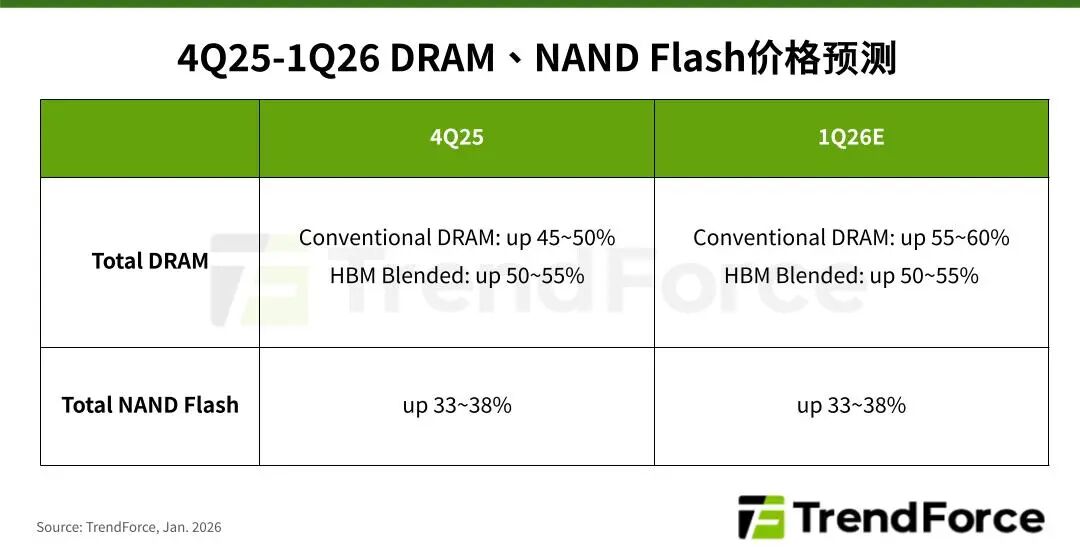
TrendForce集邦咨询:预计2026年第一季度各类存储器产品价格全面持续上涨
Zhi Tong Cai Jing· 2026-01-05 09:23
Group 1: DRAM Market Insights - The first quarter of 2026 is expected to see a significant increase in PC DRAM prices due to tightened supply from manufacturers, despite a slowdown in overall demand for PC units [2] - Server DRAM demand is projected to grow substantially as cloud service providers (CSPs) increase their purchases, with a forecasted price increase of over 60% in the first quarter [3] - Mobile DRAM supply remains tight, leading to strong purchasing power from brands, with expectations of rising contract prices for LPDDR4X and LPDDR5X [3] - Graphics DRAM prices are expected to rise due to supply constraints, despite a conservative demand outlook influenced by NVIDIA's sales target adjustments [3] - Consumer DRAM customers are willing to pay higher prices for prioritized supply in the first quarter, as supply continues to lag behind demand [3] Group 2: NAND Flash Market Insights - The NAND Flash market is anticipated to grow significantly, driven by AI applications, with Enterprise SSD demand expected to surpass mobile applications for the first time by 2026 [4] - Client SSD demand is projected to decline in the first quarter due to reduced laptop shipments and capacity downgrades in lower-end models, yet contract prices are expected to increase by at least 40% [4] - The supply of NAND Flash products is tightening as manufacturers prioritize high-margin products, leading to increased prices for Enterprise SSDs [4] - eMMC/UFS demand is showing signs of weakness due to inventory adjustments, although Chromebook shipments are benefiting from government projects [5] - NAND Flash wafer supply is constrained as manufacturers focus on high-margin product lines, resulting in continued price increases despite weak demand in consumer markets [5]
Silicon Motion: Gen5, Mobile, And Early Enterprise Traction Strengthen The Buy Case (SIMO)
Seeking Alpha· 2025-11-22 13:40
Core Insights - Silicon Motion Technology Corporation (SIMO) has shown positive performance in its Q3 2025 earnings report, with increases in revenue and margins, and a faster-than-expected ramp-up in the Gen5 product mix [1] - The demand for eMMC/UFS remains strong, indicating a solid market position for the company [1] Company Performance - Revenue and margins have increased, reflecting strong operational performance [1] - The Gen5 product mix has stepped up more rapidly than anticipated, suggesting effective product development and market strategy [1] Market Demand - There is robust demand for eMMC/UFS products, which bodes well for the company's future growth prospects [1]
Silicon Motion: Gen5, Mobile, And Early Enterprise Traction Strengthen The Buy Case
Seeking Alpha· 2025-11-22 13:40
Core Insights - Silicon Motion Technology Corporation (SIMO) has shown positive performance in Q3 2025, with increased revenue and margins, and a faster-than-expected ramp-up in the Gen5 product mix [1] - The demand for eMMC/UFS remains strong, indicating a solid market position for the company [1] Financial Performance - Revenue and margins have improved, reflecting the company's operational efficiency and market demand [1] - The Gen5 product mix has stepped up more rapidly than anticipated, suggesting effective product development and market strategy [1] Market Demand - There is a robust demand for eMMC/UFS products, which is a positive indicator for the company's future growth prospects [1]

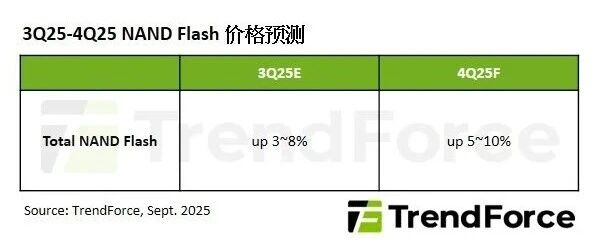
集邦咨询:受QLC产品热度的外溢效应驱动 预计NAND Flash第四季价格将上涨5-10%
智通财经网· 2025-09-25 05:57
Core Insights - The demand in the consumer market was overdrawn in the first half of the year, leading to a weaker-than-expected peak season in the second half, with forecasts for Q4 2025 indicating price stabilization. However, HDD supply shortages and long lead times have shifted CSPs' storage demand towards QLC Enterprise SSDs, resulting in a surge of urgent orders and significant market volatility [1] - SanDisk announced a 10% price increase, while Micron paused pricing due to capacity considerations, shifting the supply-side sentiment from conservative to positive. Consequently, NAND Flash contract prices are expected to rise across all product categories in Q4, with an average increase of 5-10% [1][2] Supply Side Analysis - NAND Flash supply has improved due to production cuts and inventory reduction in the first half of the year, alleviating price pressures. Most manufacturers are focusing capital expenditures on advanced process upgrades to optimize cost structures and concentrate on high-margin products, reducing price competition and supporting prices [4] - QLC products are widely used in SSDs due to their cost advantages, particularly driven by the demand for massive data storage from generative AI, prompting manufacturers to focus on QLC capacity [4] Demand Side Analysis - In the second half of the year, NAND Flash demand is affected by weakened consumer purchasing power and a slowdown in OEM procurement, with significant machine inventory in the channel awaiting clearance. However, the demand for Enterprise SSDs has surged due to server OEMs and CSPs actively clearing inventory and the upcoming release of NVIDIA's new Blackwell chips in the second half of 2025, maintaining positive overall demand for NAND Flash [4] Client SSD Market - Client SSD manufacturers have significantly reduced inventory levels through production cuts and supply strategy adjustments, leading to a more balanced market. The high demand for cost-effective large-capacity QLC products further supports this demand [5] Enterprise SSD Market - SSD suppliers are reassessing order volumes for products exceeding 120TB due to a surge in customer demand and are strategically increasing the production ratio of QLC Flash to meet market changes. Current market conditions indicate that supplier inventory levels have fallen below healthy standards, with a tightening supply expected to drive up prices in Q4 [6] eMMC/UFS Market - In the context of a profit-oriented NAND Flash supply chain, eMMC/UFS products face weak demand and intense competition from local manufacturers in the Chinese market, giving domestic smartphone brands greater bargaining power. With module manufacturers holding high inventory levels, price competition may further compress price increases, although manufacturers are expected to raise prices in Q4 to recover losses [7] NAND Flash Wafer Supply - NAND Flash wafer manufacturers are experiencing a temporary decline in output due to production line adjustments during process transitions. To compensate for previous losses, manufacturers are prioritizing high-margin product lines, further tightening wafer supply to module manufacturers. With ongoing enterprise AI investment momentum, supply is expected to remain tight, contributing to price increases in Q4 [9]