iShares罗素2000 ETF

Search documents
不相信“假曙光”?美股小盘股创新高,投资者忙于落袋为安
智通财经网· 2025-09-30 10:56
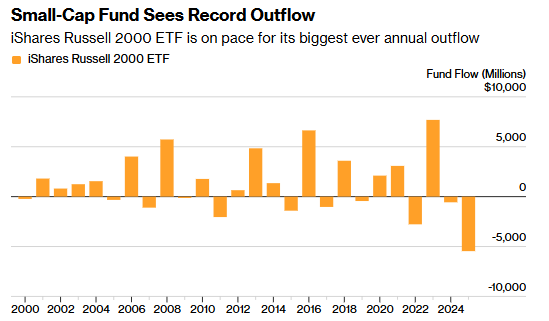
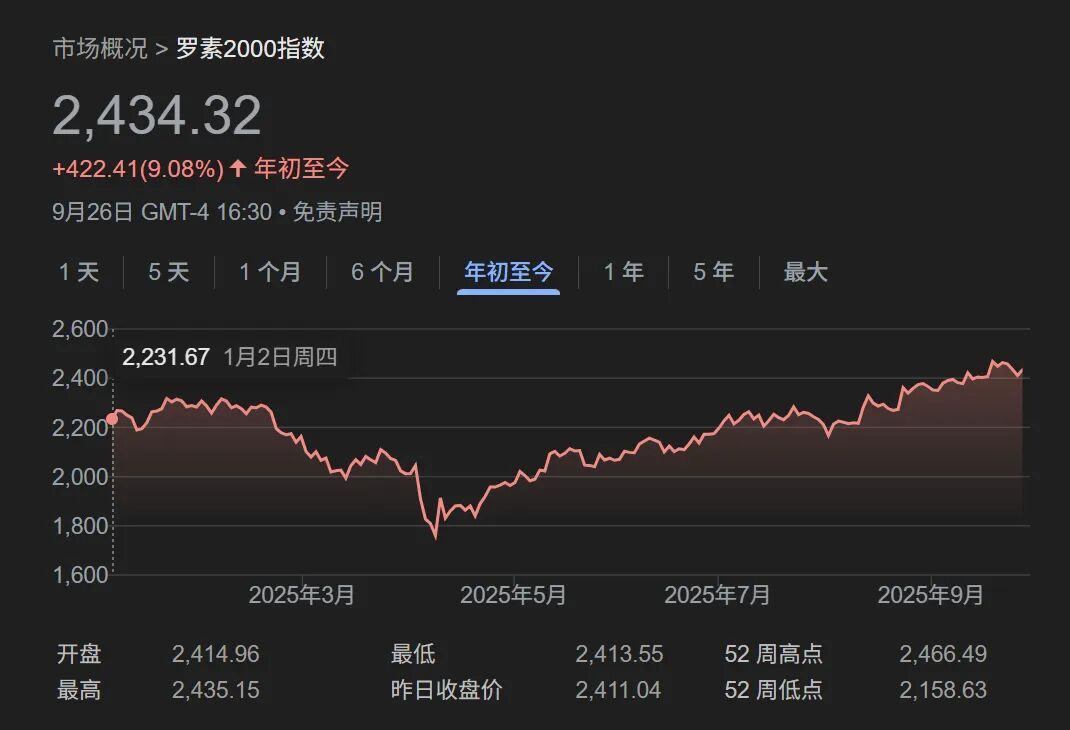
Core Insights - The small-cap sector in the U.S. stock market has shown strong performance recently, with investors cashing in on profits after years of losses, particularly in the Russell 2000 index [1][4] - Despite the recent gains, investor confidence remains fragile due to past experiences of false dawns in the small-cap sector [2][4] - The Russell 2000 index is the last major U.S. stock index to reach a historical high after the recent bear market, taking four years to recover [4] Fund Flows and Market Sentiment - Approximately $5.4 billion has been withdrawn from the iShares Russell 2000 ETF this year, even as the index reaches new highs [1] - The small-cap sector has experienced its longest consecutive weekly gains in five years, driven by expectations of further interest rate cuts [4] - However, there is a general unease in the market, with high-risk assets, including small-cap stocks and cryptocurrencies, appearing overvalued [4][5] Analyst Perspectives - Analysts suggest that the recent small-cap trading related to interest rate cuts may have ended, recommending a shift back to AI-related stocks [5] - There is a notable discrepancy between the Russell 2000 index's gains and the outflows from its associated ETF, indicating a potential rotation of funds towards large-cap stocks [7] - Investors may need to wait several months or even longer for small-cap stocks to perform on par with large-cap stocks before reallocating funds back into the small-cap sector [7] Future Outlook - For small-cap stocks to attract sustained inflows, a more favorable business environment is necessary, which would allow them to outperform large-cap stocks [7]

现在小盘股也不便宜了
Guo Ji Jin Rong Bao· 2025-09-29 12:01
Group 1 - The small-cap stock bubble is raising alarms as they have outperformed large-cap stocks in Q3 2025, driven by a rally in technology stocks [1][2] - The Russell 2000 index has seen a gain of over 10% as of September 29, 2025, surpassing the S&P 500's approximately 7% increase [2][4] - Small-cap stocks have historically performed best during periods of Federal Reserve easing and economic recovery, but their recent performance contrasts sharply with earlier in the year [4] Group 2 - The technology sector, particularly semiconductors, has led the recent surge in small-cap stocks, with notable performers like Astera and Credo seeing gains of over 100% and 60% respectively in Q3 [5][10] - Despite the strong performance, concerns arise as the rebound is driven by a limited number of growth and tech stocks, leading to questions about overall value [11] - The forward P/E ratio for the iShares Russell 2000 ETF has reached 24.64, indicating that small-cap stocks may no longer offer the value they once did [11][12] Group 3 - The iShares Russell 2000 Growth ETF has an alarming forward P/E ratio of 36.38, suggesting a bubble similar to large-cap tech stocks [12] - Some small-cap stocks, like Oklo, have seen significant price increases without generating any revenue, raising further concerns about valuation sustainability [12] - Defensive sectors such as consumer staples and healthcare are recommended for small-cap investments, as cyclical sectors may struggle without substantial interest rate cuts [14]
鲍威尔鸽声助力,美小盘股强势反弹!美银、瑞银加入看多阵营
贝塔投资智库· 2025-08-26 04:02
Group 1 - The core viewpoint of the articles is that small-cap stocks are experiencing a rotation of funds from large-cap technology stocks, supported by dovish signals from the Federal Reserve Chairman Jerome Powell, indicating potential interest rate cuts in the near future [1][2]. - The Russell 2000 index, which represents small-cap stocks, has outperformed the Nasdaq 100 index, with a cumulative increase of 9% over the past three weeks compared to a 3.2% increase for the Nasdaq 100 [1]. - Analysts from Bank of America and UBS believe that small-cap stocks may continue to outperform large-cap stocks in the short term, especially if there are no significant macroeconomic surprises [1][2]. Group 2 - Following Powell's dovish comments, the Russell 2000 index saw a single-day increase of 3.9%, marking its best performance since early April, and the inflow of funds into the iShares Russell 2000 ETF reached the highest level since November of the previous year [2]. - RBC Capital Markets noted that small-cap stocks have finally broken out of their consolidation phase, driven by investor repositioning and outflows from large-cap tech stocks [2]. - Despite the recent positive trends, there are concerns about the sustainability of small-cap stock performance, particularly if economic worries materialize, which could lead to a rapid end to the current rally [3]. Group 3 - Bank of America is closely monitoring the upcoming non-farm payroll report, which could provide further support for a potential rate cut in September, while the performance of small-cap stocks will depend on earnings, sales trends, and tariff risks [3]. - Truist Financial recently upgraded its rating on U.S. small-cap stocks from "attractive" to "neutral," citing valuation advantages and improving earnings trends [3]. - Despite recent gains, the S&P 600 small-cap index has underperformed large-cap stocks by approximately 13 percentage points over the past year, indicating a potential "catch-up opportunity" for investors [3].