
小盘股

Search documents
Big Tech stocks are quietly gaining momentum, but don't expect the bounce to last
MarketWatch· 2026-03-09 20:34
Core Viewpoint - The escalating conflict in Iran has caused a shift in investor behavior, leading to a return to megacap technology stocks as a safe haven amidst rising oil prices and market volatility [1] Group 1: Market Dynamics - Investors have recently rotated into value stocks and small caps, but the current geopolitical tensions have prompted a flight back to familiar investments [1] - Oil prices have briefly exceeded $100 per barrel, contributing to the market's instability and influencing investor sentiment [1] Group 2: Sector Performance - Megacap technology companies are regaining attention, not as leaders in growth but as a stable option during turbulent market conditions [1]


永太科技跌2.02%,成交额8.17亿元,主力资金净流出1.29亿元
Xin Lang Zheng Quan· 2026-02-26 02:23
Group 1 - The core point of the news is that Yongtai Technology's stock has experienced fluctuations, with a recent decline of 2.02% and a total market value of 23.369 billion yuan [1] - As of February 26, the stock price is reported at 25.26 yuan per share, with a trading volume of 8.17 billion yuan and a turnover rate of 3.94% [1] - Year-to-date, Yongtai Technology's stock has increased by 1.36%, but it has seen a decline of 4.64% over the last five trading days and an 18.59% drop over the last 60 days [1] Group 2 - Yongtai Technology, established on October 11, 1999, specializes in the research, production, and sales of fluorine fine chemicals, with a revenue composition of 33.38% from lithium and other materials, 30.87% from trade, 19.50% from plant protection, and 16.04% from pharmaceuticals [2] - As of September 30, the company reported a revenue of 4.028 billion yuan for the first nine months of 2025, reflecting a year-on-year growth of 20.65%, and a net profit attributable to shareholders of 32.5539 million yuan, up 136.23% year-on-year [2] - The company has distributed a total of 5.21 billion yuan in dividends since its A-share listing, with 87.656 million yuan distributed in the last three years [3]

大盘股长期收益率远高于小盘股
Bei Jing Shang Bao· 2026-02-25 16:13
Core Viewpoint - The shift in investor preference from small-cap stocks to large-cap stocks in the A-share market reflects a fundamental change in investment logic, driven by the increasing emphasis on value investing and the stability of large-cap stocks [1][2]. Group 1: Market Performance - Large-cap stocks have significantly outperformed small-cap stocks, becoming the new favorites among investors due to their higher risk resistance and better earnings stability [1]. - The transition from small-cap to large-cap stocks is not merely a style rotation but indicates a deeper change in investor behavior, with a growing focus on cash dividends and long-term returns [1][2]. Group 2: Risk and Stability - Large-cap stocks possess strong governance structures and diversified business models, allowing them to maintain relatively stable performance even during economic downturns, making them attractive to institutional investors seeking steady returns [2]. - Small-cap stocks, while capable of explosive growth in certain phases, are more vulnerable to external shocks and policy changes, leading to significant performance volatility [2]. Group 3: Market Dynamics - The ongoing improvement of market regulations is diminishing the speculative appeal of small-cap stocks, as stricter compliance and transparency requirements favor large-cap stocks with clearer earnings prospects [2]. - The concentration of resources towards leading companies enhances the investment attractiveness of large-cap blue-chip stocks, optimizing market resource allocation [2]. Group 4: Long-term Outlook - The preference for large-cap stocks is expected to persist in the medium to long term, as industry concentration increases and leading firms solidify their positions [3]. - As asset pricing shifts from speculative expectations to intrinsic value and actual performance, the investment returns of large-cap stocks are likely to become a primary target for investors [3].
侃股:大盘股长期收益率远高于小盘股
Bei Jing Shang Bao· 2026-02-25 11:37
Core Viewpoint - The shift in investor preference from small-cap stocks to large-cap stocks in the A-share market reflects a fundamental change in investment logic, driven by the increasing importance of value investing principles [1][2]. Group 1: Market Performance - Large-cap stocks have significantly outperformed small-cap stocks, becoming the new favorites among investors due to their higher risk resistance and better earnings stability [1]. - The transition from small-cap to large-cap stocks is not merely a style rotation but indicates a deeper change in investor behavior, with a growing focus on cash dividends and long-term returns [1][2]. Group 2: Risk and Stability - Large-cap stocks possess strong governance structures and diversified business models, allowing them to maintain relatively stable performance even during economic downturns [2]. - Small-cap stocks, while capable of explosive growth in certain phases, are more vulnerable to external shocks and policy changes, leading to significant earnings volatility [2]. Group 3: Market Dynamics - The ongoing improvement in market regulations is diminishing the speculative appeal of small-cap stocks, as stricter compliance and transparency requirements favor large-cap stocks with clearer earnings prospects [2]. - The concentration of capital towards leading companies is creating a "stronger getting stronger" phenomenon, optimizing market resource allocation and enhancing the investment attractiveness of large-cap blue-chip stocks [2]. Group 4: Long-term Outlook - The logic favoring large-cap stocks is unlikely to reverse easily, as industry concentration continues to rise, and leading companies enhance their positions [3]. - Investors' preference for large-cap stocks fundamentally reflects a desire for certainty, as asset pricing increasingly relies on intrinsic value and actual performance rather than speculative expectations [3].
美银:如何理解开年全球市场?“可负担性”才是 2026 的总叙事:“主街”要赢一次,AI叙事巨变,日元是“关键”
美股IPO· 2026-02-15 00:08
Core Viewpoint - The report by Bank of America’s Michael Hartnett team indicates a significant shift in investment focus from "Wall Street elites" to "Main Street" ordinary citizens, driven by "affordability" politics under the Trump administration, leading to a rise in small-cap value stocks and pressure on tech giants [1][3]. Group 1: Market Dynamics - The current market is experiencing a historic rotation from large-cap growth stocks to small-cap value stocks, marking a significant change in asset allocation [3][5]. - The AI narrative is shifting from "AI awe" to "AI poverty," putting pressure on technology stocks as the costs associated with AI development rise [3][11]. - The correlation between the Japanese yen and the Nikkei index has turned positive for the first time since 2005, indicating a potential long-term bull market, although a rapid appreciation of the yen could trigger global deleveraging [3][17][20]. Group 2: Winners and Losers - "Main Street" assets are benefiting from inflationary pressures, with notable performances from silver (+56%), the KOSPI index (+34%), and Brazilian stocks (+30%) since October [5][8]. - Conversely, "Wall Street" wealth bubble assets are facing sell-offs, with the "Magnificent Seven" stocks down by 8% and Bitcoin plummeting by 41% [8][9]. Group 3: Future Outlook - The report suggests that the current market paradigm shift is just the beginning of a new era, with emerging markets and small-cap stocks expected to lead the next phase of growth [25][33]. - The potential for a significant policy or earnings event, such as a major tech company cutting capital expenditures, could reverse current market trends [10][14]. - The report emphasizes that the U.S. government is unlikely to allow 30-year Treasury yields to exceed 5%, which would be a critical turning point for small-cap value stocks relative to large-cap growth stocks [29][21].

爱克股份股价上涨受业绩改善预期及业务转型推动
Jing Ji Guan Cha Wang· 2026-02-14 01:11
Core Viewpoint - The recent stock price increase of Aike Co., Ltd. (300889.SZ) is driven by expectations of improved performance, progress in business transformation, and market capital flow [1] Financial Performance - The company forecasts a significant reduction in losses for 2025, with expected net profit losses ranging from -62.72 million to -90.15 million yuan, narrowing by 16.10% to 41.63% compared to 2024's loss of -107 million yuan [2] - For the first three quarters of 2025, the company reported a revenue of 822 million yuan, representing a year-on-year growth of 29.56%, with an increasing revenue contribution from the new energy sector [2] Business Development - The company is strategically transforming towards the new energy sector through acquisitions, focusing on supporting the electric vehicle industry and energy storage, aiming for a "new energy-focused, lighting as a supplement" business model [3] - Although the traditional municipal landscape lighting business is contracting, the high-margin cultural tourism lighting segment is recovering, partially offsetting the decline in the main business [3] Capital and Technical Analysis - There has been significant fluctuation in net inflow of main funds over the past five trading days, indicating active short-term capital speculation [4] - The stock price broke through a key resistance level on February 13, reaching 25.68 yuan, with the MACD indicator showing a continuous upward trend, suggesting a strong short-term technical outlook [4] Market Environment - The company is part of the small-cap balanced, LED, and lithium battery sectors, which have gained attention in the current market environment favoring small-cap stocks, alongside favorable policies for new energy [5] - Despite still being in a loss position, the company's price-to-sales ratio (TTM) is approximately 4.7 times, lower than some peers, indicating potential market anticipation of successful transformation [5] Future Development - There remains uncertainty in the expansion of the company's new energy business, particularly regarding the expected growth in the charging pile market [6] - The high pledge ratio of the controlling shareholder (54.33%) raises concerns about liquidity risk [6] - The recent significant increase in stock price may lead to short-term correction pressure [6]

美银Hartnett:小盘股比科技股更值得押注 科技巨头不再是赢家
Xin Lang Cai Jing· 2026-02-08 09:18
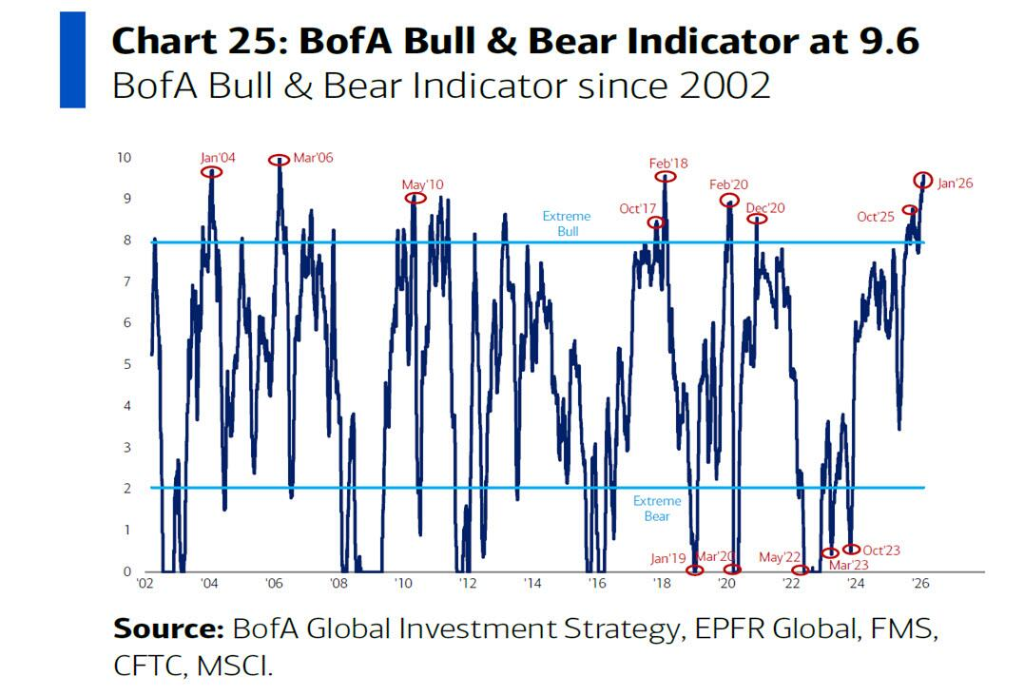
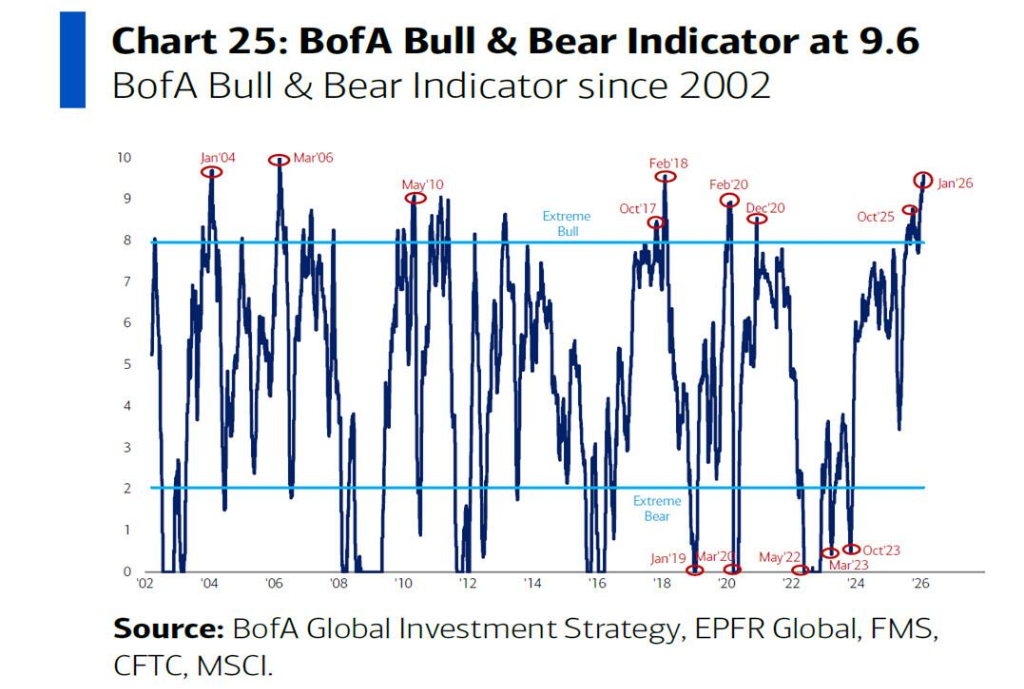
Core Insights - The Bull & Bear Indicator has reached its highest level since 2006, signaling a "sell" recommendation from Bank of America strategist Michael Hartnett, with a current reading of 9.6, indicating extreme market conditions [1] - Hartnett suggests a shift in asset allocation for 2026, advocating for a strategy of "long Main St, short Wall St," which involves moving funds from crowded tech giants and cryptocurrencies to small-cap stocks and international markets [3] Market Dynamics - The recent market downturn aligns with Hartnett's warnings, marked by a sudden crash in software stocks and significant declines in silver and Bitcoin prices, exacerbated by political factors [4] - The cryptocurrency market has lost $2 trillion in value since October 2025, equivalent to 10% of U.S. consumer spending, which Hartnett warns will have a substantial economic impact [4] Technology Sector Analysis - Tech giants are facing a "capital expenditure trap," with projected AI-related capital expenditures for 2026 reaching $670 billion, which is 96% of their combined cash reserves, compared to 40% in 2023 [5] - This shift from a "light asset" to a "heavy asset" model threatens the market leadership of tech stocks in the 2020s [5] Economic Policy Implications - Hartnett believes that the Trump administration will intervene in various sectors to lower inflation, which, combined with AI's impact on the labor market, could lead to unexpected declines in inflation by 2026, benefiting small and mid-cap stocks [6] - Since the new government took office, small-cap stocks have outperformed billionaire concept stocks, with small caps rising 13% compared to a mere 6% increase for the latter [7] Capital Flow Trends - Recent EPFR data indicates a significant style shift in the market, with outflows from safe-haven assets like gold and cryptocurrencies, while undervalued markets are seeing substantial inflows [10] - Investment-grade bonds have experienced 41 consecutive weeks of net inflows, indicating a preference for safer assets amid market volatility [11] Future Outlook - Hartnett posits that the years 2025-2026 will mark the end of "American exceptionalism" and the beginning of "global rebalancing," with emerging markets and commodities becoming the new winners [15] - The current market decline is viewed as a "healthy and overdue bubble deflation," unless a systemic event occurs [13]
美银Hartnett:小盘股比科技股更值得押注,科技巨头不再是赢家
Hua Er Jie Jian Wen· 2026-02-08 07:59
Group 1 - The Bull & Bear Indicator has reached its highest level since 2006, currently at 9.6, signaling a "sell" recommendation from Bank of America's chief investment strategist Michael Hartnett [1] - Hartnett attributes this extreme reading to a combination of "position peak, liquidity peak, and inequality peak" [1] - The recent market downturn aligns with Hartnett's warnings, including significant drops in software stocks and cryptocurrencies, leading to a broader panic in the market [4] Group 2 - Hartnett suggests a strategic shift for 2026: "long Main St, short Wall St," indicating a move away from crowded tech giants and cryptocurrencies towards small-cap stocks and international markets [3] - The anticipated capital expenditures for tech giants in AI for 2026 are projected to reach $670 billion, which is 96% of their combined cash reserves, compared to only 40% in 2023 [5] - This shift from a "light asset" to a "heavy asset" model poses a significant threat to the market leadership of tech stocks in the 2020s [5] Group 3 - Hartnett believes that the Trump administration will intervene in various sectors to lower inflation, which, combined with AI's cooling effect on the labor market, will benefit small and mid-cap stocks in 2026 [7] - Since the new government took office, small-cap stocks have risen by 13%, while billionaire concept stocks like NVDA and META have only increased by 6% [7] - There is a significant style shift in the market, with key "bubble support levels" identified for tech ETFs, Bitcoin, and gold [10] Group 4 - Recent data shows a net outflow from safe-haven assets, with gold funds experiencing their first weekly net outflow since November 2025, and cryptocurrency funds seeing a $1.5 billion outflow [14] - Conversely, there has been a massive inflow into undervalued markets, with the Korean stock market recording a historic $5.2 billion weekly inflow [14] - Hartnett views the current period as a historical turning point, marking the end of "American exceptionalism" and the beginning of "global rebalancing," with a focus on international stocks and emerging market commodities [15]


海亮股份跌2.65%,成交额4614.41万元,主力资金净流入277.52万元
Xin Lang Cai Jing· 2026-02-06 01:58
Core Viewpoint - Hailiang Co., Ltd. has experienced a decline in stock price recently, with a notable drop of 11.84% over the past five trading days, despite a year-to-date increase of 1.74% [2]. Group 1: Stock Performance - As of February 6, Hailiang's stock price was 12.88 CNY per share, with a market capitalization of 29.518 billion CNY [1]. - The stock has seen a 15.21% increase over the past 60 days, contrasting with an 8.33% decrease over the last 20 days [2]. Group 2: Financial Performance - For the period from January to September 2025, Hailiang reported a revenue of 64.933 billion CNY, a year-on-year decrease of 4.52%, while the net profit attributable to shareholders was 0.925 billion CNY, reflecting a year-on-year increase of 5.21% [2]. - Cumulative cash dividends since the A-share listing amount to 2.486 billion CNY, with 1.065 billion CNY distributed over the past three years [3]. Group 3: Shareholder Information - As of September 30, 2025, the number of shareholders increased to 30,600, up by 83.72%, while the average number of circulating shares per person decreased by 37.65% to 72,273 shares [2]. - The fifth largest circulating shareholder is Hong Kong Central Clearing Limited, holding 57.3828 million shares, an increase of 33.5988 million shares from the previous period [3].

震荡市资金抢筹大宽基,中证A500ETF(159338)今日盘中净流入近2亿份
Mei Ri Jing Ji Xin Wen· 2026-02-05 13:47
Group 1 - The core viewpoint of the article highlights the increasing inflow of funds into the CSI A500 ETF (159338), with a net inflow of 198 million shares, indicating a strong interest in dividend sectors as risk appetite decreases [1] - The market is shifting towards dividend sectors due to lower risk tolerance, with expectations of stable performance before the Spring Festival and a rebound afterward, particularly with the upcoming Two Sessions [1] - The CSI A500 index has shown superior historical performance, with a growth of 464.28% since its inception compared to the 361.15% growth of the CSI 300 index, outperforming it by 103.13 percentage points [1] Group 2 - The CSI A500 ETF has the highest number of holders among similar products, with its total number of accounts being more than three times that of the second-ranked product, indicating strong investor preference [1]