
o1推理模型

Search documents
观察| 100万亿Tokens的:AI正在发生你看不见的巨变
未可知人工智能研究院· 2025-12-07 03:02
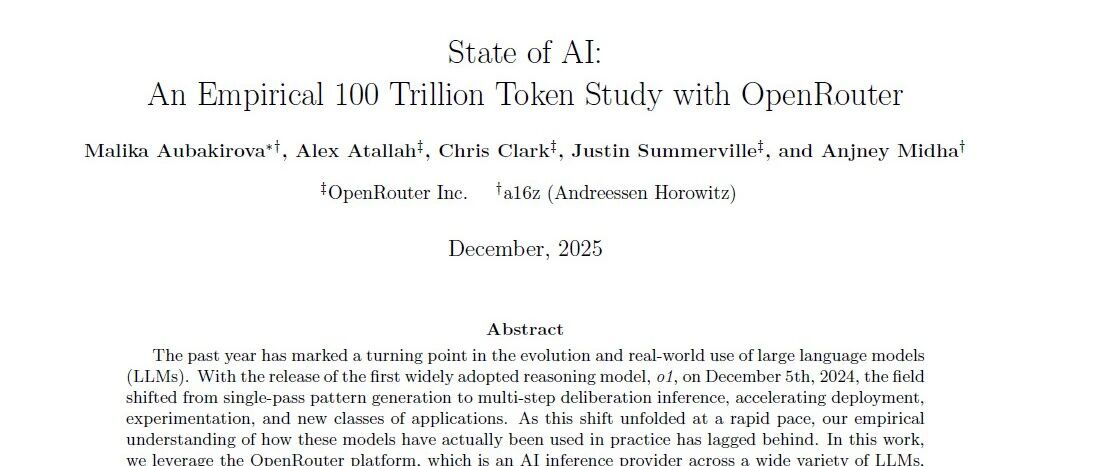
Core Insights - The report reveals that AI is undergoing a significant revolution, characterized by a shift from traditional models to reasoning models that can think and plan in multiple steps [3][11][12]. Group 1: OpenRouter and Its Importance - OpenRouter is likened to "Meituan" in the AI world, connecting over 500 million developers to more than 300 AI models, making its data highly credible [5][6]. - OpenRouter's daily token processing volume has surpassed 1 trillion, indicating a rapid growth from approximately 100 trillion tokens annually from early 2024 to mid-2025, marking a tenfold increase [8][6]. Group 2: Reasoning Revolution - The report identifies a "reasoning revolution," where AI models evolve from simple response machines to complex reasoning machines capable of multi-step thinking [11][12]. - The launch of OpenAI's o1 reasoning model (codename Strawberry) is a pivotal event, as it incorporates internal reasoning processes that enhance its problem-solving capabilities [18][19]. - Users are increasingly engaging in complex tasks, leading to longer prompts and more dialogue rounds, indicating a shift towards training AI for intricate tasks [20][21][23]. Group 3: Agentic AI - Agentic AI represents a transformation where AI can autonomously plan, execute, and verify tasks, moving from passive response to active engagement [27][30]. - The report highlights that agentic reasoning is the fastest-growing behavior on OpenRouter, indicating a shift in user expectations from simple answers to task completion [34][35]. Group 4: Rise of Open Source Models - Open source models, particularly from Chinese teams like DeepSeek R1 and Kimi K2, are rapidly gaining market share, challenging the dominance of closed-source models [44][47]. - DeepSeek R1 offers significant cost advantages, with a cost of $0.003 per 1K tokens compared to $0.03 for GPT-4, making it attractive for developers [52]. Group 5: Real-World AI Usage - The primary applications driving token usage are creative writing and programming, with AI becoming indispensable for developers [71][72]. - Users are not merely relying on AI for content generation but are engaging in co-creation, indicating a shift in the role of AI from a tool to a creative partner [77][78]. Group 6: Model Personality - Users' choices of AI models are influenced by the "personality" of the models, which affects user retention and engagement [88][95]. - The report suggests that models with unique personalities can outperform those with higher benchmark scores in terms of user loyalty [96][100]. Group 7: Implications for the Chinese AI Industry - The success of Chinese models like DeepSeek R1 and Kimi K2 in the global market indicates that they have competitive capabilities [109]. - The report emphasizes the importance of focusing on reasoning and agentic capabilities as key technological directions for the Chinese AI industry [115].

揭秘:OpenAI是如何发展出推理模型的?
硬AI· 2025-08-04 09:46
硬·AI 作者 | 龙 玥 编辑 | 硬 AI 当全世界都在为ChatGPT的横空出世而狂欢时,你可能不知道,这只是OpenAI一次"无心插柳"的惊喜。科 技媒体Techcrunch一篇最新的深度文章揭示了, OpenAI从数学竞赛走向"通用AI智能体"(AI Agents) 的宏大愿景 。这背后,是一个长达数年的深思熟虑的布局,以及其对AI"推理"能力的终极探索。 01 意外的起点:数学 很多人以为OpenAI的成功故事是从ChatGPT开始的,但真正的颠覆性力量,却源于一个看似与大众应用 相去较远的地方——数学。 2022年,当研究员亨特·莱特曼(Hunter Lightman)加入OpenAI时,他的同事们正在为ChatGPT的发布 而忙碌。这款产品后来火遍全球,成为现象级的消费应用。但与此同时,莱特曼却在一个不起眼的团 队"MathGen"里,默默地教AI模型如何解答高中数学竞赛题。 让OpenAI名声大噪的ChatGPT,可能只是一次"美丽的意外"。在其内部,一个始于数学、代号"草莓"的宏大计划,已悄 然掀起一场"推理"革命。其终极目标是创造出能自主处理复杂任务的通用AI智能体。"最终,你只需告诉计 ...

揭秘:OpenAI是如何发展出推理模型的?
Hua Er Jie Jian Wen· 2025-08-04 07:02
Core Insights - OpenAI's journey towards developing general AI agents began unexpectedly with a focus on mathematics, which laid the groundwork for their reasoning capabilities [2][3] - The success of ChatGPT was seen as a surprising outcome of this foundational work, which was initially low-profile but ultimately led to significant consumer interest [2][3] - OpenAI's CEO Sam Altman envisions a future where users can simply state their needs, and AI will autonomously complete tasks, highlighting the potential benefits of AI agents [3] Group 1: Mathematical Foundations - The initial focus on mathematics was crucial as it serves as a testbed for logical reasoning, indicating that a model capable of solving complex math problems possesses foundational reasoning abilities [2][3] - OpenAI's model recently won a gold medal at the International Mathematical Olympiad, showcasing the effectiveness of their reasoning capabilities developed through mathematical challenges [3] Group 2: Breakthrough Innovations - In 2023, OpenAI achieved a significant leap in reasoning capabilities through an innovative approach known as "Strawberry," which combined large language models, reinforcement learning, and test-time computation [4][5] - This combination led to the development of a new method called "Chain-of-Thought," allowing models to demonstrate their reasoning processes rather than just providing answers [6] Group 3: Nature of AI Reasoning - OpenAI researchers are pragmatic about the nature of AI reasoning, focusing on the effectiveness of models in completing complex tasks rather than strictly adhering to human-like reasoning processes [7] - The company's culture emphasizes a bottom-up approach to research, prioritizing breakthrough ideas over short-term product gains, which has enabled significant investments in reasoning models [7] Group 4: Future Directions - Current AI agents show promise in well-defined tasks but struggle with more subjective tasks, indicating a need for advancements in training models for these areas [8] - OpenAI is exploring new universal reinforcement learning techniques to enable models to learn skills that are difficult to verify, as demonstrated by their IMO gold medal model [8] Group 5: Competitive Landscape - OpenAI, once the leader in the AI industry, now faces strong competition from companies like Google, Anthropic, xAI, and Meta, raising questions about its ability to maintain its lead in the race towards advanced AI agents [9]